Maths Standard — Sample Question Bank

A free sample: two questions for every marks band from 1 to 5, each from a different chapter, with marking-scheme solutions.
1 Mark Questions

11 Mark · March 2024 · Standard · 13. StatisticsFull page
If the mean of the first $n$ natural numbers is $\frac{5n}{9}$, then the value of $n$ is :
  • (a)$5$
  • (b)$4$
  • (c)$9$
  • (d)$10$
Show SolutionHide Solution
(C) $9$
21 Mark · March 2025 & March 2026 · Standard · 14. ProbabilityFull page
If for any event E, $P(E) + P(\bar{E}) = q$, then the value of $q^2-3$ is:
  • (a)$0$
  • (b)$- 2$
  • (c)$2$
  • (d)$1$
Show SolutionHide Solution
(B) $- 2$

2 Mark Questions

32 Marks · March 2025 · Standard · 2. PolynomialsFull page
Find the zeroes of the polynomial $p(x) = x^2 + \frac{4}{3}x - \frac{4}{3}$.
Show SolutionHide Solution
$p(x) = x^2 + \frac{4}{3}x - \frac{4}{3}$
$= \frac{1}{3}(3x^2 + 4x - 4)$ (1/2 Mark)
$= \frac{1}{3}(3x^2 + 6x - 2x - 4)$
$= \frac{1}{3}(3x - 2)(x + 2)$ (1 Mark)
For zeroes, $p(x) = 0$
$\Rightarrow (3x - 2)(x + 2) = 0$
$\Rightarrow 3x - 2 = 0$ or $x + 2 = 0$
$x = \frac{2}{3}$ or $x = -2$ (1 Mark)
$\therefore$ Zeroes of $p(x)$ are $\frac{2}{3}$ and $-2$.
42 Marks · March 2024 · Standard · 3. Linear EquationsFull page
If $2x + y = 13$ and $4x - y = 17$, find the value of $(x - y)$.
Show SolutionHide Solution
$2x + y = 13$ -------- (i)
$4x - y = 17$ -------- (ii)
Adding (i) and (ii):
$6x = 30$ (1 Mark)
$\Rightarrow x = 5$
Substituting $x = 5$ in (i):
$2(5) + y = 13 \Rightarrow 10 + y = 13$
$\Rightarrow y = 3$ (1 Mark)
$\therefore x = 5 \text{ and } y = 3$
$\Rightarrow x - y = 5 - 3 = 2$

3 Mark Questions

53 Marks · March 2023 & March 2024 & July 2024 & March 2025 & March 2026 · Standard · 1. Real NumbersFull page
Prove that $\sqrt{3}$ is an irrational number.
Show SolutionHide Solution
Let $\sqrt{3}$ be a rational number.
$\therefore \sqrt{3} = \frac{p}{q}$, let $p \& q$ be co-primes and $q \neq 0$
$3q^2 = p^2 \Rightarrow p^2$ is divisible by $3 \Rightarrow p$ is divisible by $3$
$\Rightarrow p = 3a$, where 'a' is some integer
quad ----- (i)
$9a^2 = 3q^2 \Rightarrow q^2 = 3a^2 \Rightarrow q^2$ is divisible by $3 \Rightarrow q$ is divisible by $3$
$\Rightarrow q = 3b$, where 'b' is some integer
quad ----- (ii)
(i) and (ii) leads to contradiction as 'p' and 'q' are co-primes.
$\therefore \sqrt{3}$ is an irrational number.
63 Marks · March 2026 · Standard · 12. Surface Areas & VolumesFull page
A right circular cylinder and a right circular cone have equal bases and equal heights. If their curved surface areas are in the ratio $8: 5$, then find the ratio between the radius of their bases to their height.
Show SolutionHide Solution
Let $r$ and $h$ be the radius and height of cylinder as well as cone respectively
$\frac{2\pi rh}{\pi r l} = \frac{8}{5}$ (I) (1 Mark)
$\Rightarrow \frac{2h}{\sqrt{r^2+h^2}} = \frac{8}{5}$
$\Rightarrow 100 h^2 = 64 r^2 + 64 h^2$
$\Rightarrow 36 h^2 = 64 r^2$ (II) (1 Mark)
$\therefore \frac{r}{h} = \frac{3}{4}$ (III) (1 Mark)
Hence the required ratio is $3: 4$

4 Mark Questions

74 Marks · March 2024 · Standard · 4. Quadratic EquationsFull page
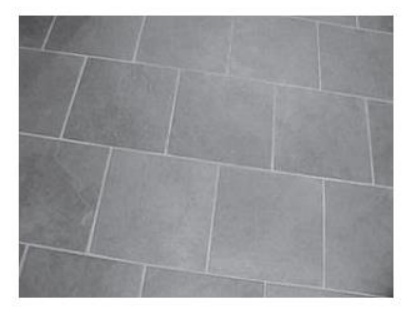
A rectangular floor area can be completely tiled with $200$ square tiles. If the side length of each tile is increased by $1$ unit, it would take only $128$ tiles to cover the floor.
(i) Assuming the original length of each side of a tile be $x$ units, make a quadratic equation from the above information.
(ii) Write the corresponding quadratic equation in standard form.
(iii) (a) Find the value of $x$, the length of side of a tile by factorisation.
OR
(b) Solve the quadratic equation for $x$, using quadratic formula.
figure for this question
Show SolutionHide Solution
(i) $200 x^2 = 128 (x + 1)^2$
(ii) $25x^2 = 16x^2 + 32x + 16$
$\Rightarrow 9x^2 - 32x - 16 = 0$
(iii) (a) $9x^2 - 32x - 16 = 0$
$\Rightarrow (9x + 4) (x - 4) = 0$
$x \neq -\frac{4}{9}$ so, $x = 4$
OR
(iii) (b) $x = \frac{32\pm\sqrt{1024+576}}{18} = \frac{32\pm 40}{18}$
$x \neq -\frac{4}{9}$ so, $x = 4$

Why $x = 4$ is correct:
With $x = 4$, each tile covers $4^2 = 16$ sq units, so $200$ tiles cover $200 \times 16 = 3200$ sq units.
With a side of $4 + 1 = 5$ units, each tile covers $25$ sq units, so $128$ tiles cover $128 \times 25 = 3200$ sq units.
Both give the same floor area of $3200$ sq units, so $x = 4$ is the required side length.
84 Marks · March 2025 · Standard · 5. Arithmetic ProgressionsFull page
The minimum age of children eligible to participate in a painting competition is $8$ years. It is observed that the age of the youngest boy was $8$ years and the ages of the participants, when seated in order of age, have a common difference of $4$ months. If the sum of the ages of all the participants is $168$ years, find the age of the eldest participant in the painting competition.
Show SolutionHide Solution
The ages of the participants form the following AP
$8, 8\frac{1}{3}, 8\frac{2}{3}, 9, ...$
where first term $= 8$ and common difference $= \frac{1}{3}$
Let the number of participants be $n$
$S_n = \frac{n}{2}[2 \times 8 + (n-1)\frac{1}{3}] = 168$
$n^2 + 47n - 1008 = 0$
$\Rightarrow n = 16$
$\therefore$ the age of the eldest participant $= 8 + 15 \times \frac{1}{3} = 13$ years

5 Mark Questions

95 Marks · March 2023 & March 2024 & July 2024 & March 2025 & March 2026 · Standard · 10. CirclesFull page
Prove that a parallelogram circumscribing a circle is a rhombus.
Show SolutionHide Solution
figure for this question

ABCD is a parallelogram touching the circle at P, Q, R, S by sides AB, BC, CD, DA respectively.
We know that tangents drawn from the external point to a circle are equal.
$\therefore AP = AS$
quad --------(i)
$PB = BQ$
quad --------(ii)
$CR = CQ$
quad --------(iii)
$DR = DS$
quad ---------(iv)
Adding (i), (ii), (iii), (iv)
$(AP + PB) + (CR + DR) = (AS + DS) + (BQ + CQ)$
$AB + CD = AD + BC$
ABCD is a parallelogram
$\Rightarrow AB = CD, AD = BC$
$\Rightarrow 2AB = 2AD \Rightarrow AB = AD$
$\Rightarrow \text{ABCD is a rhombus.}$
105 Marks · March 2024 · Standard · 11. Areas Related to CirclesFull page
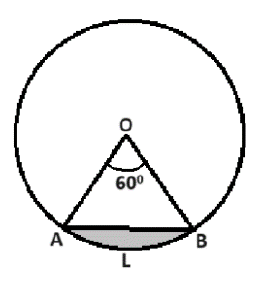
An arc of a circle of radius $21$ cm subtends an angle of $60^\circ$ at the centre. Find :
(i) the length of the arc.
(ii) the area of the minor segment of the circle made by the corresponding chord.
Show SolutionHide Solution
figure for this question

(i) Length of the arc AB = $2 \times \frac{22}{7} \times 21 \times \frac{60}{360}$
$= 22$ cm
(ii) Area of sector OALB = $\frac{22}{7} \times 21 \times 21 \times \frac{60}{360} = 231$ cm$^2$
Area of $\triangle OAB = \frac{\sqrt{3}}{4} \times 21 \times 21 = \frac{441\sqrt{3}}{4}$ cm$^2$
Area of minor segment = $\left(231 - \frac{441\sqrt{3}}{4}\right)$ cm$^2$
or $(231 - 190.95) = 40.05$ cm$^2$