From a point on the ground, which is $30 \text{ m}$ away from the foot of a vertical tower, the angle of elevation of the top of the tower is found to be $60^\circ$. The height (in metres) of the tower is:
A ladder $14$ m long just reaches the top of a vertical wall. If the ladder makes an angle of $60^\circ$ with the wall, then the height of the wall is :
A kite is flying at a height of $150$ m from the ground. It is attached to a string inclined at an angle of $30^\circ$ to the horizontal. The length of the string is:
Assertion (A): A ladder leaning against a wall, stands at a horizontal distance of $6 \operatorname{m}$ from the wall. If the height of the wall up to which the ladder reaches is $8 \operatorname{m}$, then the length of the ladder is $10 \operatorname{m}$. Reason (R): The ladder makes an angle of $60^{\circ}$ with the ground.
(a)Both Assertion (A) and Reason (R) are true and Reason (R) is the correct explanation of the Assertion (A).
(b)Both Assertion (A) and Reason (R) are true, but Reason (R) is
(c)Assertion (A) is true, but Reason (R) is false.
(d)Assertion (A) is false, but Reason (R) is true.
Show SolutionHide Solution↓
(C) Assertion (A) is true, but Reason (R) is false.
A $30$ m long rope is tightly stretched and tied from the top of pole to the ground. If the rope makes an angle of $60^\circ$ with the ground, the height of the pole is :
An observer 1.8 m tall stands away from a chimney at a distance of 38.2 m along the ground. The angle of elevation of top of chimney from the eyes of observer is $45^\circ$. The height of chimney above the ground is
A peacock sitting on the top of a tree of height 10 m observes a snake moving on the ground. If the snake is $10\sqrt{3}$ m away from the base of the tree, then angle of depression of the snake from the eye of the peacock is
A car is moving away from the base of a $30$ m high tower. The angle of elevation of the top of the tower from the car at an instant, when the car is $10\sqrt{3}$ m away from the base of the tower, is :
From a point on the ground, which is $60$ m away from the foot of a vertical tower, the angle of elevation of the top of the tower is found to be $45^\circ$. The height (in metres) of the tower is :
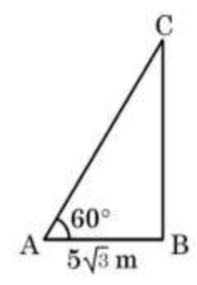
A wire is attached from a point A on the ground to the top of a pole BC, making an angle of elevation as $60^\circ$. If AB = $5\sqrt{3}$ m, then length of the wire is
If the length of the shadow of a tower is $\sqrt{3}$ times its height, then the angle of elevation of the sun is
(a)$45^\circ$
(b)$30^\circ$
(c)$60^\circ$
(d)$0^\circ$
Show SolutionHide Solution↓
(B) $30^\circ$
2 Marks Questions
162 Marks · 🔁 March 2023 & March 2024 · Standardopen ↗
The length of the shadow of a tower on the plane ground is $\sqrt{3}$ times the height of the tower. Find the angle of elevation of the sun.
Show SolutionHide Solution↓
Let AB be the tower of height 'h'. $\therefore$ AC = $\sqrt{3}$ h In $\triangle ABC$, $\tan \theta = \frac{AB}{AC} = \frac{h}{\sqrt{3} h}$ $\Rightarrow \tan \theta = \frac{1}{\sqrt{3}}$ $\Rightarrow \theta = 30^\circ$
The angle of elevation of the top of a tower from a point on the ground which is $30$ m away from the foot of the tower, is $30^\circ$. Find the height of the tower.
Show SolutionHide Solution↓
Height of tower = AB In $\triangle ABC$, $\tan 30^\circ = \frac{AB}{30}$ AB = $\frac{30}{\sqrt{3}} = 10\sqrt{3}$ $\therefore$ Height of Tower is $10 \sqrt{3}$ m
It is found that on walking $20$ m towards a chimney in a horizontal line through its base, the elevation of its top changes from $30^\circ$ to $60^\circ$. The height of the chimney is :
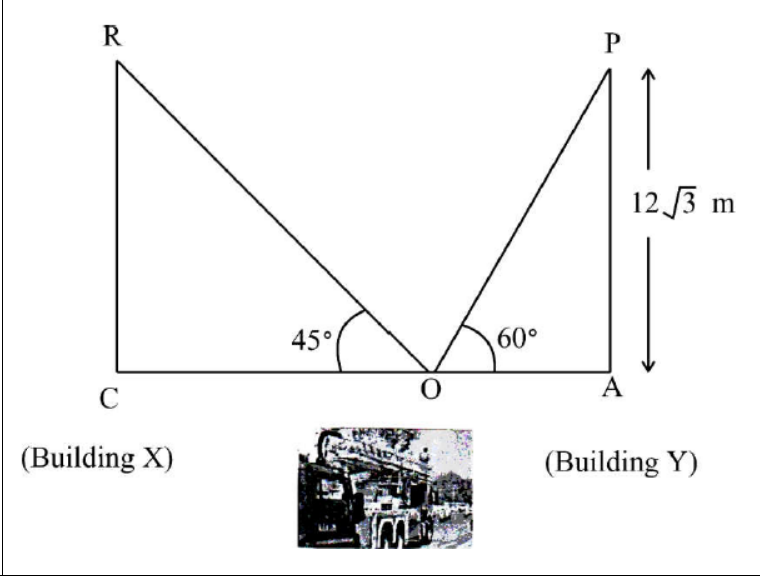
Due to short circuit, a fire has broken out in New Home Complex. Two buildings, namely X and Y have mainly been affected. The fire engine has arrived and it has been stationed at a point which is in between the two buildings. A ladder at point O is fixed in front of the fire engine. The ladder inclined at an angle $60^\circ$ to the horizontal is leaning against the wall of the terrace (top) of the building Y. The foot of the ladder is kept fixed and after some time it is made to lean against the terrace (top) of the opposite building X at an angle of $45^\circ$ with the ground. Both the buildings along with the foot of the ladder, fixed at 'O' are in a straight line. Based on the above given information, answer the following questions : (i) Find the length of the ladder. (ii) Find the distance of the building Y from point 'O', i.e. OA. (iii) (a) Find the horizontal distance between the two buildings. OR (b) Find the height of the building X.
Show SolutionHide Solution↓
(i) In $\triangle OAP$, $\frac{OP}{12\sqrt{3}} = \cosec 60^\circ = \frac{2}{\sqrt{3}}$ $\Rightarrow OP = 24$ m $\therefore$ Length of ladder is $24$ m (ii) In $\triangle OAP$, $\frac{OA}{12\sqrt{3}} = \cot 60^\circ = \frac{1}{\sqrt{3}}$ $\Rightarrow OA = 12$ m $\therefore$ the distance of the building Y from point O ie.,OA is $12$ m (iii) (a) OP = OR = $24$ m $\therefore$ In $\triangle OCR$, $\frac{OC}{24} = \cos 45^\circ = \frac{1}{\sqrt{2}}$ $\Rightarrow OC = 12\sqrt{2}$ m $\therefore$ distance between two buildings $=$ OA + OC $= (12 + 12\sqrt{2})$ m or $12(1 + \sqrt{2})$ m OR (iii) (b) OP = OR = $24$ m $\therefore$ In $\triangle OCR$, $\frac{RC}{24} = \sin 45^\circ = \frac{1}{\sqrt{2}}$ $\Rightarrow RC = 12\sqrt{2}$ m $\therefore$ height of building X is $12\sqrt{2}$ m
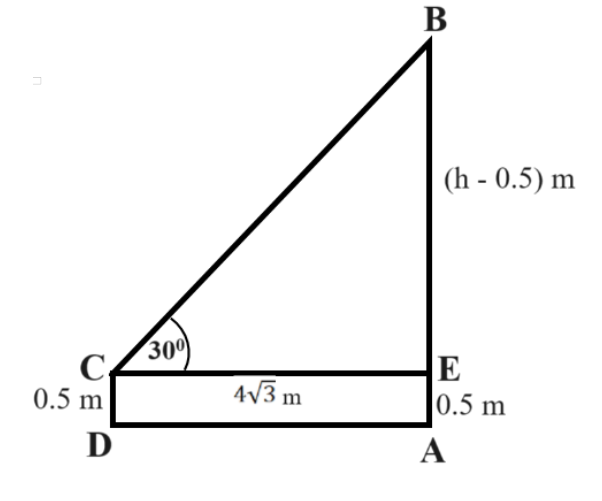
Case Study – 2 A class VI student went to a park and went up the slide to play. The angle of elevation of the slide is $30^{\circ}$, but the base from which the angle of elevation is measured is $50$ cm above the ground level and the distance of this point from the bottom of the staircase (which is vertical) is $4\sqrt{3}$ m. Based on the above information, answer the following questions: (i) Write the angle of depression from the top of the slide to its base. (ii) (a) Find the height of the staircase. OR (b) Find the length of the slide. (iii) Will the angle of elevation increase or decrease if the staircase was made taller?
Show SolutionHide Solution↓
Let AB be the staircase. (i) $30^{\circ}$ (ii) (a) $\text{tan } 30^{\circ} = \frac{h-0.5}{4\sqrt{3}}$ $\Rightarrow h = 4.5$ So, height of the staircase is $4.5$ m OR (b) $\text{cos } 30^{\circ} = \frac{4\sqrt{3}}{l} = \frac{\sqrt{3}}{2}$ $\Rightarrow l = 8$ So, length of the slide is $8$ m. (iii) Angle of elevation will increase.
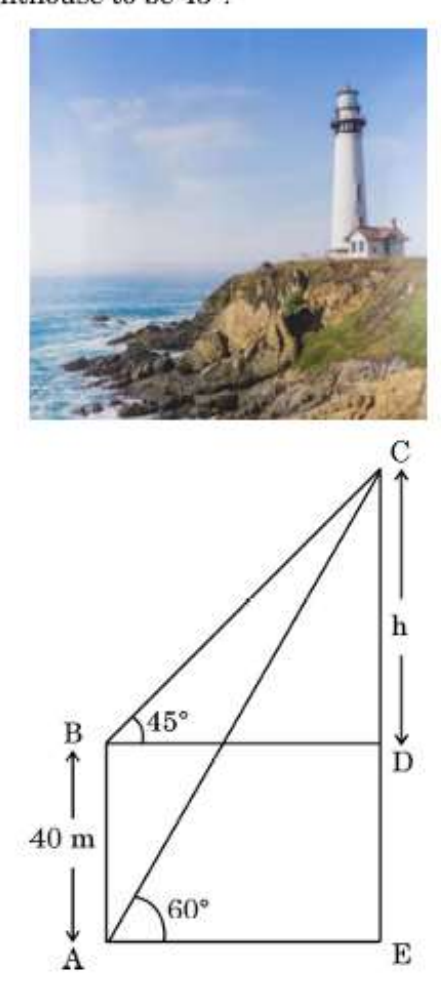
Case Study - 3: Amrita stood near the base of a lighthouse, gazing up at its towering height. She measured the angle of elevation to the top and found it to be $60^\circ$. Then, she climbed a nearby observation deck, $40$ metres higher than her original position and noticed the angle of elevation to the top of lighthouse to be $45^\circ$. (i) If $CD$ is $h$ metres, find the distance $BD$ in terms of '$h$'. (ii) Find distance $BC$ in terms of '$h$'. (iii) (a) Find the height $CE$ of the lighthouse [Use $\sqrt{3} = 1.73$]. OR (iii) (b) Find distance $AE$, if $AC = 100$ m.
Show SolutionHide Solution↓
(i) $\frac{h}{BD} = \tan 45^\circ = 1 \implies BD = h$ m. (ii) $\frac{h}{BC} = \sin 45^\circ = \frac{1}{\sqrt{2}} \implies BC = \sqrt{2}h$ m. (iii)(a) $\tan 60^\circ = \frac{EC}{AE} \implies \sqrt{3} = \frac{h + 40}{h} \implies h = 54.6$ m. $CE = 94.6$ m. (iii)(b) $\cos 60^\circ = \frac{AE}{AC} \implies \frac{1}{2} = \frac{AE}{100} \implies AE = 50$ m.
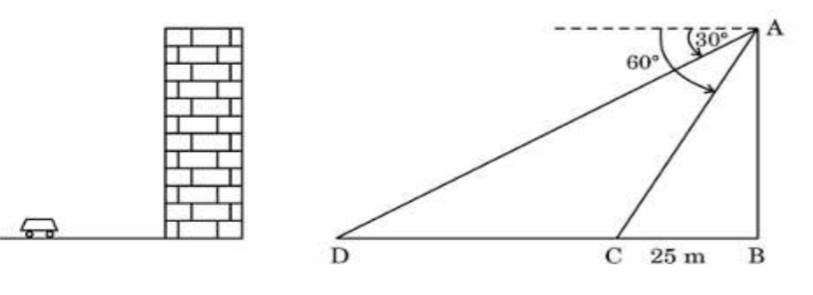
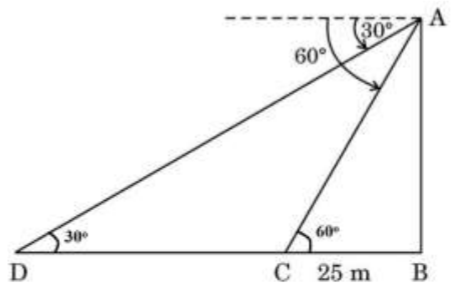
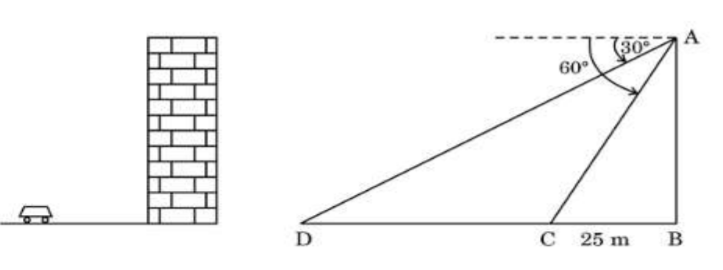
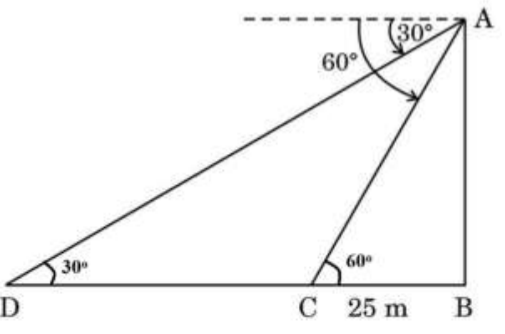
Tejas is standing at the top of a building and observes a car at an angle of depression of $30^\circ$ as it approaches the base of the building at a uniform speed. $6$ seconds later, the angle of depression increases to $60^\circ$, and at that moment, the car is $25$ m away from the building. Based on the information given above, answer the following questions : (i) What is the height of the building? (ii) What is the distance between the two positions of the car? (iii) (a) What would be the total time taken by the car to reach the foot of the building from the starting point? OR (iii) (b) What is the distance of the observer from the car when it makes an angle of $60^\circ$?
Show SolutionHide Solution↓
(i) In $\triangle ABC$, $\tan 60^\circ = \sqrt{3} = \frac{AB}{25}$ (1/2 Mark) $\Rightarrow AB = 25\sqrt{3}$ (1/2 Mark) $\therefore$ Height of building = $25\sqrt{3}$ m (ii) In $\triangle ABD$, $\tan 30^\circ = \frac{1}{\sqrt{3}} = \frac{25\sqrt{3}}{BD}$ (1/2 Mark) $\Rightarrow BD = 75$ $\therefore$ Distance between two positions of car = $75 - 25 = 50$ m (1/2 Mark) (iii) (a) Time taken to cover the distance of $50$ m = $6$ sec (1 Mark) $\therefore$ Time taken to cover the distance of $75$ m = $\frac{6}{50} \times 75$ (1 Mark) $= 9$ sec OR (iii) (b) In $\triangle ABC$, $\cos 60^\circ = \frac{BC}{AC}$ (1 Mark) $\Rightarrow \frac{1}{2} = \frac{25}{AC}$ $\Rightarrow AC = 50$ (1 Mark) $\therefore$ Distance of the observer from car when it makes the angle of $60^\circ = 50$ m
Tejas is standing at the top of a building and observes a car at an angle of depression of $30^\circ$ as it approaches the base of the building at a uniform speed. 6 seconds later, the angle of depression increases to $60^\circ$, and at that moment, the car is 25 m away from the building. Based on the information given above, answer the following questions : (i) What is the height of the building? (ii) What is the distance between the two positions of the car ? (iii) (a) What would be the total time taken by the car to reach the foot of the building from the starting point ? OR (iii) (b) What is the distance of the observer from the car when it makes an angle of $60^\circ$?
Show SolutionHide Solution↓
(i) In $\triangle ABC$, $\tan 60^\circ = \sqrt{3} = \frac{AB}{25}$ (1/2 Mark) $\Rightarrow AB = 25\sqrt{3}$ (1/2 Mark) $\therefore$ Height of building = $25\sqrt{3}$ m (1 Mark) (ii) In $\triangle ABD$, $\tan 30^\circ = \frac{1}{\sqrt{3}} = \frac{25\sqrt{3}}{BD}$ (1/2 Mark) $\Rightarrow BD = 75$ (1/2 Mark) $\therefore$ Distance between two positions of car = $75 - 25 = 50$ m (1 Mark) (iii) (a) Time taken to cover the distance of 50 m = 6 sec (1 Mark) Time taken to cover the distance of 75 m = $\frac{6}{50} \times 75$ $= 9 \text{ sec}$ (1 Mark) OR (iii) (b) In $\triangle ABC$, $\cos 60^\circ = \frac{BC}{AC}$ (1 Mark) $\Rightarrow \frac{1}{2} = \frac{25}{AC}$ AC = 50 (1 Mark) $\therefore$ Distance of the observer from car when it makes the angle of $60^\circ = 50 \text{ m}$
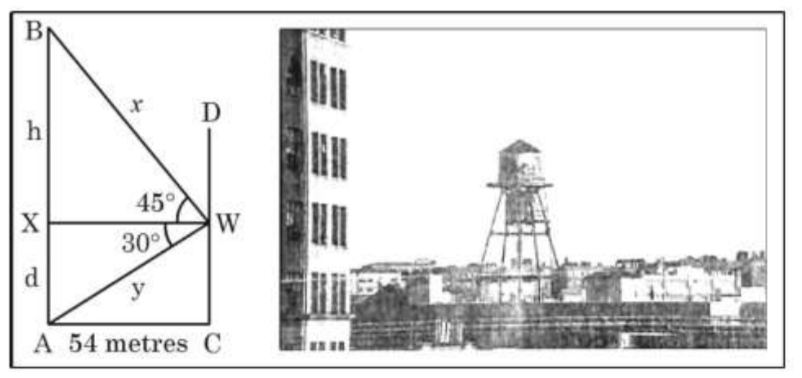
Elevated water storage tanks are built to store and supply water to nearby colonies. In the diagram given above, AB is an elevated water tank and CD is a nearby multistorey building. The building is 54 metres away from the water tank. From a window (W) of the building, the angle of elevation of top of the tank is $45^\circ$ and angle of depression of its foot is $30^\circ$. (i) Write a relation between $d$ (the height of window) and $y$. (ii) Determine the value of $h$. (iii) (a) Determine height of the water tank. OR (iii) (b) Find the value of $x$ and height of the window above ground level.
Show SolutionHide Solution↓
(i) $\sin 30^\circ = \frac{1}{2} = \frac{d}{y} \Rightarrow 2d = y$ (I) (1) (ii) $\tan 45^\circ = 1 = \frac{h}{WX} = \frac{h}{54} \Rightarrow h = 54$ m (I) (1) (iii) (a) $\tan 30^\circ = \frac{1}{\sqrt{3}} = \frac{d}{54} \Rightarrow d = 18\sqrt{3}$ m (I) (1) Height of the tank = $h + d = (54 + 18\sqrt{3})$ m (II) (1) OR (iii) (b) $\angle WAC = 30^\circ$, $\tan 30^\circ = \frac{WC}{54} = \frac{1}{\sqrt{3}} \Rightarrow WC = 18\sqrt{3}$ m (I) (1) $\sin 45^\circ = \frac{h}{x} = \frac{1}{\sqrt{2}} \Rightarrow x = h\sqrt{2} \Rightarrow x = 54\sqrt{2}$ m (II) (1)
Elevated water storage tanks are built to store and supply water to nearby colonies. In the diagram given above, AB is an elevated water tank and CD is a nearby multistorey building. The building is $54$ metres away from the water tank. From a window (W) of the building, the angle of elevation of top of the tank is $45^\circ$ and angle of depression of its foot is $30^\circ$. (i) Write a relation between $d$ (the height of window) and $y$. (ii) Determine the value of $h$. (iii) (a) Determine height of the water tank. OR (iii) (b) Find the value of $x$ and height of the window above ground level.
Show SolutionHide Solution↓
(i) $\sin 30^\circ = \frac{d}{y} \Rightarrow 2d = y$ (I Mark) (ii) $\tan 45^\circ = 1 = \frac{h}{WX} = \frac{h}{54} \Rightarrow h = 54$ m (I Mark) (iii) (a) $\tan 30^\circ = \frac{1}{\sqrt{3}} = \frac{d}{54} \Rightarrow d = 18\sqrt{3}$ m (I Mark) Height of the tank = $h + d = (54 + 18\sqrt{3})$ m (II Mark) OR (iii) (b) $\angle WAC = 30^\circ, \tan 30^\circ = \frac{1}{\sqrt{3}} = \frac{WC}{54} \Rightarrow WC = 18\sqrt{3}$ m (I Mark) $\sin 45^\circ = \frac{1}{\sqrt{2}} = \frac{h}{x} \Rightarrow x = h\sqrt{2} \Rightarrow x = 54\sqrt{2}$ m (II Mark)
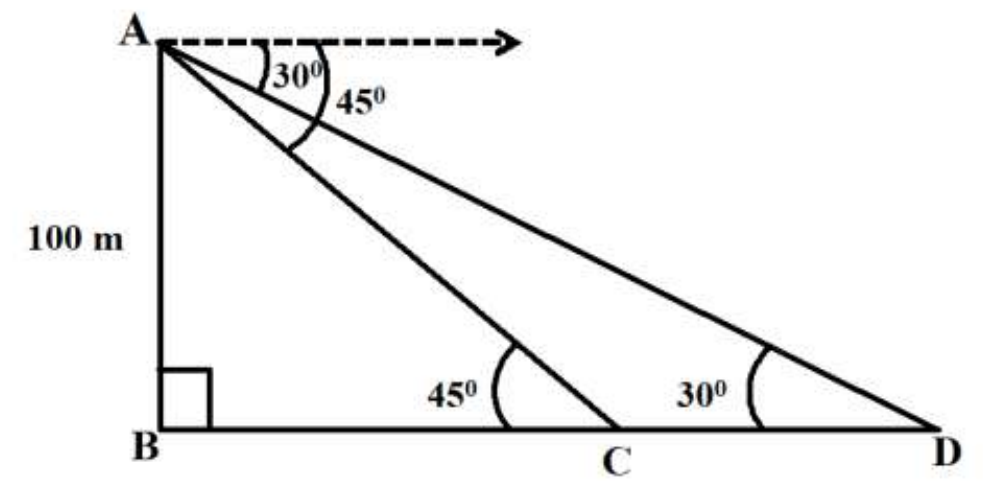
As observed from the top of a lighthouse, $100$ m above sea level, the angle of depression of a ship, sailing directly towards it, changes from $30^\circ$ to $45^\circ$. Determine the distance travelled by the ship during the period of observation. (Use $\sqrt{3}= 1.732$)
Show SolutionHide Solution↓
Correct figure. In $\triangle ABC$ $\frac{100}{BC} = \tan 45^\circ = 1$ $\Rightarrow BC = 100$ In $\triangle ABD$ $\frac{100}{BD} = \tan 30^\circ = \frac{1}{\sqrt{3}}$ $\Rightarrow BD = 100 \sqrt{3}$ $\Rightarrow 100 + CD = 100 \sqrt{3}$ $\Rightarrow CD = 100 \sqrt{3} - 100 = 100 (1.732 - 1) = 73.2$ Hence, distance travelled by the ship during the period of observation is $73.2$ m
As observed from the top of a $75$ m high lighthouse from the sea-level, the angles of depression of two ships are $30^\circ$ and $60^\circ$. If one ship is exactly behind the other on the same side of the lighthouse, find the distance between the two ships. (Use $\sqrt{3}= 1.73$)
Show SolutionHide Solution↓
1 for correct figure PQ = Height of Light house = $75$ m $\angle XQS = \angle QSP = 30^\circ$ $\angle XQR = \angle QRP = 60^\circ$ R and S are position of ships. In $\triangle PQR$, $\frac{75}{PR} = \tan 60^\circ = \sqrt{3} \Rightarrow PR = \frac{75}{\sqrt{3}} = 25\sqrt{3}$ In $\triangle PQS$, $\frac{75}{PS} = \tan 30^\circ$ PS = $75\sqrt{3}$ $\therefore$ Distance between the ships, RS = PS – PR $= 75 \sqrt{3}-25 \sqrt{3} = 50\sqrt{3}$ $= 50 \times 1.73 = 86.5$ $\therefore$ Distance between the ships is $86.5$ m
From a point on the ground, the angle of elevation of the bottom and top of a transmission tower fixed at the top of $30$ m high building are $30^\circ$ and $60^\circ$, respectively. Find the height of the transmission tower. (Use $\sqrt{3} = 1.73$)
Show SolutionHide Solution↓
1 for correct figure Height of building AB = $30$ m BP = transmission tower = h(say) $\angle ACB = 30^\circ$, $\angle ACP = 60^\circ$ In $\triangle ABC$, $\tan 30^\circ = \frac{AB}{AC}$ $\Rightarrow \frac{1}{\sqrt{3}} = \frac{30}{AC} \Rightarrow AC = 30\sqrt{3}$ In $\triangle APC$, $\tan 60^\circ = \frac{AP}{AC}$ $\sqrt{3}= \frac{30+ h}{30\sqrt{3}}$ $\Rightarrow 30\sqrt{3} \times \sqrt{3}= 30 + h$ $\Rightarrow h = 30 (3 - 1)$ $\Rightarrow h = 60$ $\therefore$ Height of transmission tower = $60$ m
From the top of a tower $100 \text{ m}$ high, a man observes two cars on the opposite sides of the tower with angles of depression $30^\circ$ and $45^\circ$ respectively. Find the distance between the two cars. (Use $\sqrt{3} = 1.73$)
Show SolutionHide Solution↓
1 for correct figure $AB = \text{Height of tower} = 100 \text{ m}$ $P$ and $Q$ are position of cars $\angle XBP = \angle APB = 30^\circ$ $\angle YBQ = \angle AQB = 45^\circ$ In $\triangle ABQ$, $\tan 45^\circ = \frac{AB}{AQ} \Rightarrow 1 = \frac{100}{x}$ $\Rightarrow x = 100$ In $\triangle ABP$, $\tan 30^\circ = \frac{AB}{AP} = \frac{100}{y}$ $\frac{1}{\sqrt{3}} = \frac{100}{y} \Rightarrow y = 100\sqrt{3}$ $= 100(1.73) = 173$ Distance between cars = $x + y = 100 + 173 = 273$ $\therefore \text{Distance between cars is } 273 \text{ m}$.
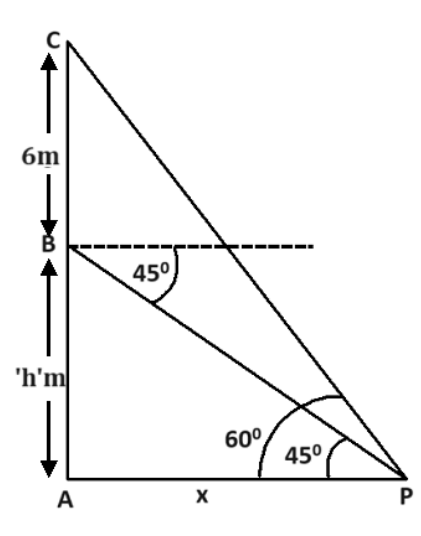
A pole $6$m high is fixed on the top of a tower. The angle of elevation of the top of the pole observed from a point P on the ground is $60^\circ$ and the angle of depression of the point P from the top of the tower is $45^\circ$. Find the height of the tower and the distance of point P from the foot of the tower. (Use $\sqrt{3} = 1.73$)
Show SolutionHide Solution↓
Correct figure Let BC be the pole and AB be the tower of height '$h$' m. $\tan 45^\circ = 1 = \frac{h}{x}$ $\Rightarrow h = x$ ----- (i) $\tan 60^\circ = \sqrt{3} = \frac{h+6}{x}$ $\Rightarrow h + 6 = x\sqrt{3}$ ----- (ii) Solving (i) & (ii) to get $h = 3 (\sqrt{3} + 1) = 8.19$ and $x = 8.19$ Therefore, the height of tower is $8.19$ m and the distance of point P from the foot of the tower is $8.19$ m
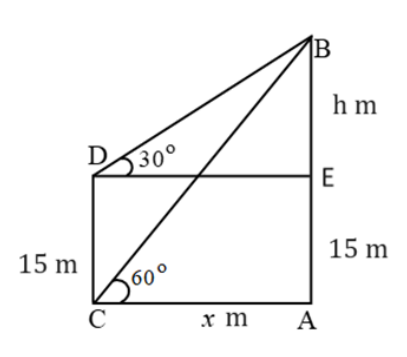
From the top of a $15$ m high building, the angle of elevation of the top of a tower is found to be $30^\circ$. From the bottom of the same building, the angle of elevation of the top of the tower is found to be $60^\circ$. Find the height of the tower and the distance between tower and the building.
Show SolutionHide Solution↓
Correct figure Let CD be the building and AB be the tower. $\tan 30^\circ = \frac{h}{DE} = \frac{h}{x} = \frac{1}{\sqrt{3}}$ ----- (i) $\Rightarrow x = h\sqrt{3}$ $\tan 60^\circ = \frac{h+15}{x} = \sqrt{3}$ ----- (ii) $\Rightarrow h + 15 = x\sqrt{3}$ Solving (i) and (ii) to get $x = 7.5\sqrt{3}$ m or $\frac{15\sqrt{3}}{2}$ m and $h = \frac{15}{2} = 7.5$ m Hence height of the tower is $7.5 + 15 = 22.5$ m
335 Marks · 🔁 March 2024 & March 2025 · Standardopen ↗
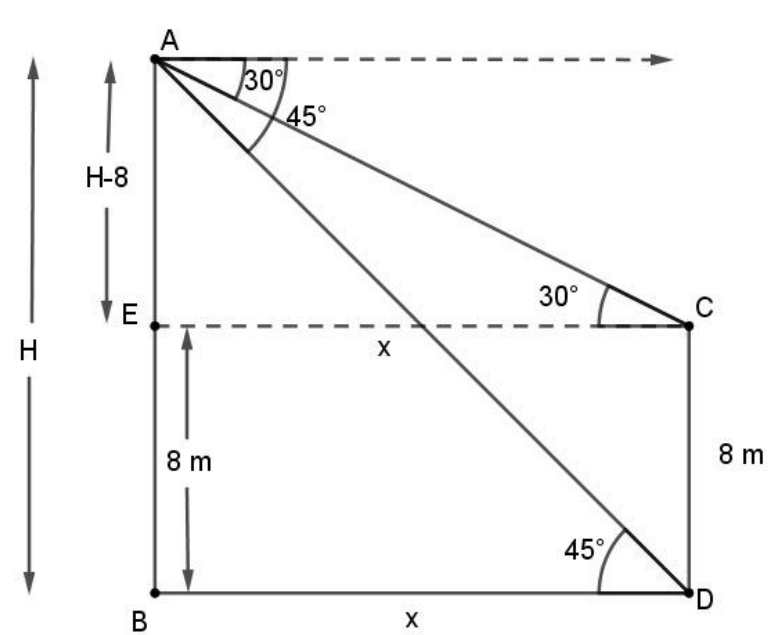
The angles of depression of the top and the bottom of a $8$ m tall building from the top of a multi-storeyed building are $30^\circ$ and $45^\circ$ respectively. Find the height of the multi-storeyed building and the distance between the two buildings.
Show SolutionHide Solution↓
Correct figure Let height of multi storeyed building AB be H m and CD is a tall building. Let the distance between the two buildings be X m. In $\Delta ABD$ $$\begin{aligned}& \tan 45^\circ = 1 = \frac{H}{X} \\ & \Rightarrow H = X \text{---------(i)} \\ & \text{In } \Delta AEC\end{aligned}$$ tan 30^° = frac{1}{√3} = $\frac{H-8}{X}$ $$\begin{aligned}& X = \sqrt{3} (H-8) \text{---------(ii)} \\ & \text{Solving equations (i) \& (ii)}\end{aligned}$$X = 4 (3 + √3)$ \\ and $H = 4 (3 + √3) The height of the multi storeyed building is $4 (3 + \sqrt{3})$ m and the distance between the two buildings is $4 (3 + \sqrt{3})$ m.
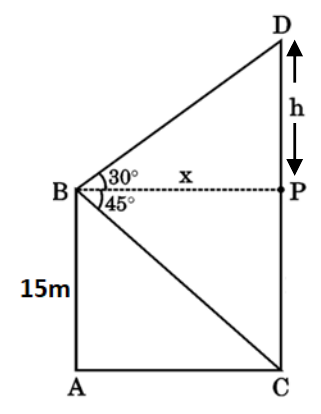
From a window $15$ metres high above the ground in a street, the angles of elevation and depression of the top and the foot of another house on the opposite side of the street are $30^{\circ}$ and $45^{\circ}$ respectively. Find the height of the opposite house. (Use $\sqrt{3} = 1.732$)
Show SolutionHide Solution↓
For correct figure In right $\triangle BPC$, $\tan 45^{\circ} = 1 = \frac{15}{x}$ $\Rightarrow x = 15$ In right $\triangle BPD$, $\tan 30^{\circ} = \frac{h}{x}$ $h = \frac{15}{\sqrt{3}}$ or $5\sqrt{3}$ $\therefore$ Height of opposite house $(CD) = 5\sqrt{3} + 15$ $= 5 (1.732) + 15 = 23.66$ m
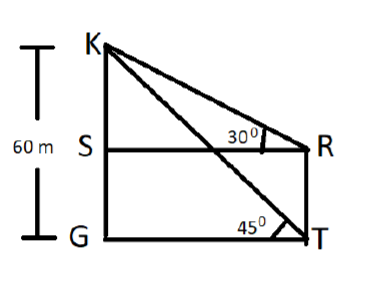
A kite is flying at a height of $60$ m above the ground level. Ravi, standing at the roof of the house is holding the string straight and observes the angle of elevation of kite as $30^\circ$. From the bottom of the same building, the angle of elevation of kite is $45^\circ$. Find the length of the string and height of roof from the ground. (Use $\sqrt{3} = 1.73$)
Show SolutionHide Solution↓
Let $K$ be the position of kite and $TR$ is the height of building. Correct figure (I) (1 Mark) $\therefore \tan 45^\circ = 1 = \frac{60}{GT}$ (II) (1 Mark) $\Rightarrow GT = 60$ m (III) (1 Mark) Also, $\tan 30^\circ = \frac{1}{\sqrt{3}} = \frac{KS}{SR}$ (IV) ($\frac{1}{2}$ Mark) $\Rightarrow KS = 20\sqrt{3}$ m or $34.6$ m (V) ($\frac{1}{2}$ Mark) Hence, $TR = (60 - 20\sqrt{3})$ m $= 60 - 34.6 = 25.4$ m (VI) ($\frac{1}{2}$ Mark) Also, $\sin 30^\circ = \frac{1}{2} = \frac{KS}{KR}$ (VII) ($\frac{1}{2}$ Mark) $\Rightarrow KR = 40\sqrt{3} = 69.2$ m $\therefore$ The length of the string $= 69.2$ m and height of roof from the ground $= 25.4$ m
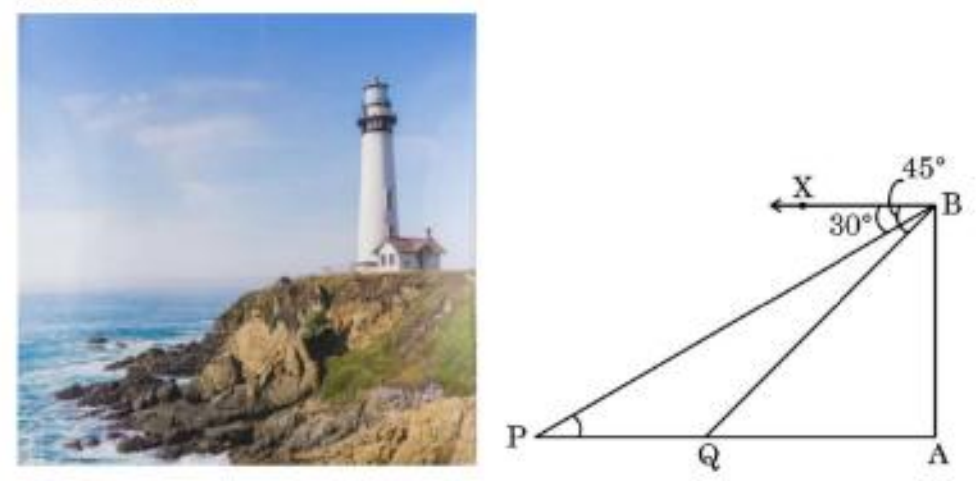
A lighthouse stands tall on a cliff by the sea, watching over ships that pass by. One day a ship is seen approaching the shore and from the top of the lighthouse, the angles of depression of the ship are observed to be $30^{\circ}$ and $45^{\circ}$ as it moves from point P to point Q. The height of the lighthouse is $50$ metres. Based on the information given above, answer the following questions: (i) Find the distance of the ship from the base of the lighthouse when it is at point Q, where the angle of depression is $45^{\circ}$. (ii) Find the measures of $\angle PBA$ and $\angle QBA$. (iii) (a) Find the distance travelled by the ship between points P and Q. OR (b) If the ship continues moving towards the shore and takes $10$ minutes to travel from Q to A, calculate the speed of the ship in $\operatorname{km/h}$, from Q to A.
Show SolutionHide Solution↓
(i) $\angle AQB = \angle QBX = 45^{\circ}$ and $\angle APB = \angle PBX = 30^{\circ}$ In $\triangle AQB$, $\tan 45^{\circ} = \frac{50}{AQ}$ $AQ = 50 \operatorname{m}$ (ii) $\angle PBA = 60^{\circ}$ $\angle QBA = 45^{\circ}$ (iii)(a) In $\triangle APB$, $\tan 30^{\circ} = \frac{50}{AP}$ $AP = 50\sqrt{3} \operatorname{m}$ Distance travelled by the ship $= PQ = 50\sqrt{3} - 50 = 50(\sqrt{3} - 1) \operatorname{m}$ or $36.5 \operatorname{m}$ OR (iii)(b) Speed of the ship $= \frac{50 \operatorname{metres}}{10 \operatorname{minutes}}$ $= 0.3 \operatorname{km/h}$
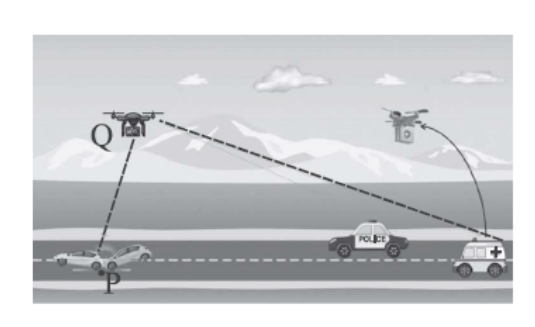
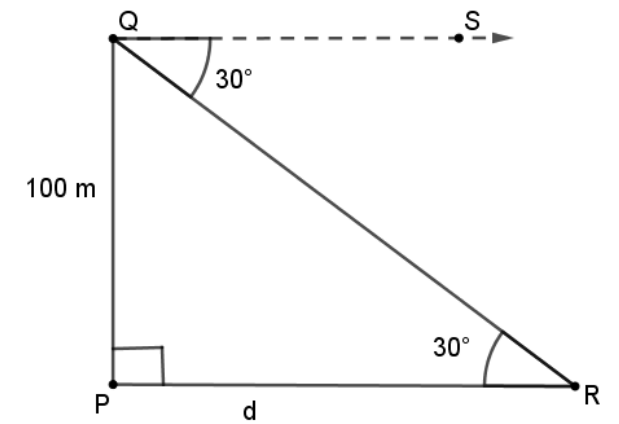
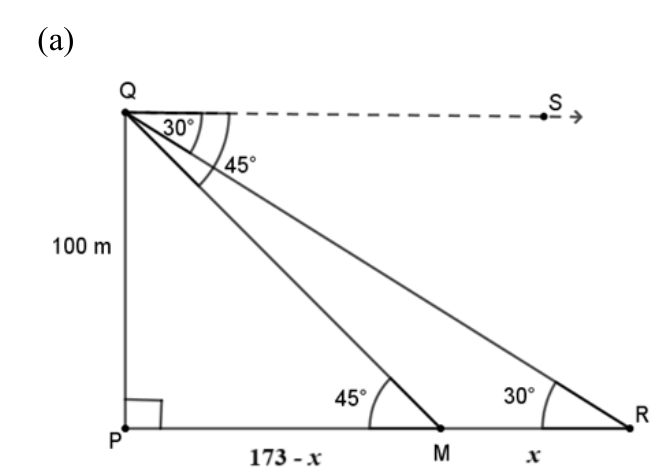
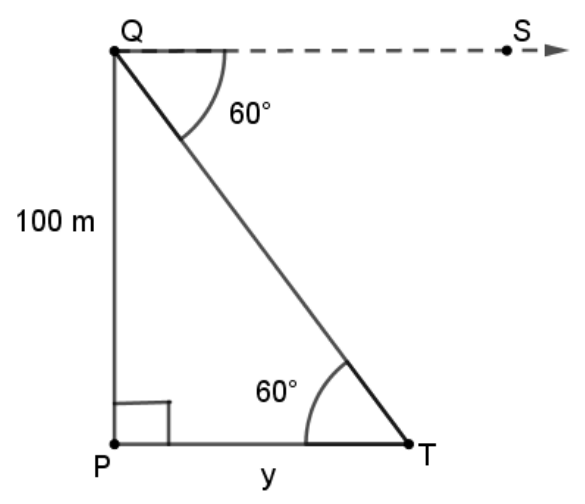
A drone was used to facilitate movement of an ambulance on the straight highway to a point P on the ground where there was an accident. The ambulance was travelling at the speed of $60$ km/h. The drone stopped at a point Q, $100$ m vertically above the point P. The angle of depression of the ambulance was found to be $30^\circ$ at a particular instant. Based on above information, answer the following questions : (i) Represent the above situation with the help of a diagram. (ii) Find the distance between the ambulance and the site of accident (P) at the particular instant. (Use $\sqrt{3}= 1.73$) (iii) (a) Find the time (in seconds) in which the angle of depression changes from $30^\circ$ to $45^\circ$. OR (iii) (b) How long (in seconds) will the ambulance take to reach point P from a point T on the highway such that angle of depression of the ambulance at T is $60^\circ$ from the drone ?
Show SolutionHide Solution↓
(i) For correct figure (ii) In $\triangle PQR$, $\frac{100}{d} = \tan 30^\circ = \frac{1}{\sqrt{3}}$ $\Rightarrow d = 100\sqrt{3} = 173$ m (iii) (a) For correct figure In $\triangle PQM$, $\frac{100}{173-x} = \tan 45^\circ = 1$ $\Rightarrow x = 73$ m Time taken = $\frac{73\times 18}{60\times5} = \frac{219}{50}$ or $4.4$ seconds (approx.) OR (iii) (b) For correct figure In $\triangle PQT$, $\frac{100}{y} = \tan 60^\circ = \sqrt{3}$ $\Rightarrow y = \frac{100}{\sqrt{3}} = \frac{100\sqrt{3}}{3}$ or $173/3$ m Time taken = $\frac{100\sqrt{3} \times 18}{3 \times 60 \times5} = 2\sqrt{3}$ or $3.5$ seconds (approx.)
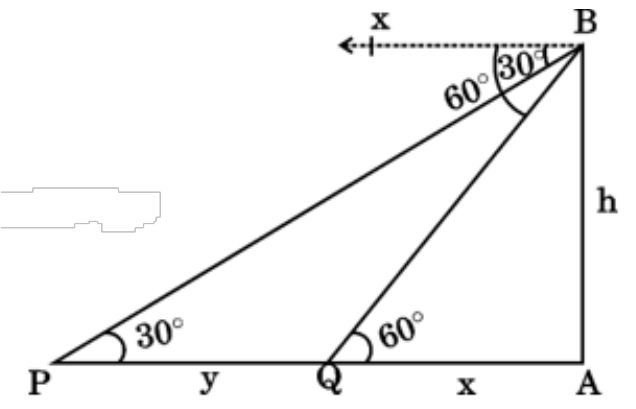
A man on a cliff observes a boat at an angle of depression of $30^{\circ}$ which is approaching the shore to the point immediately beneath the observer with a uniform speed. Six minutes later, the angle of depression of the boat is found to be $60^{\circ}$. Find the time taken by the boat from here to reach the shore.
Show SolutionHide Solution↓
Correct fig. In $\triangle$QAB $\tan60^{\circ} = \sqrt{3} = \frac{h}{x}$ $h=\sqrt{3}x$.........(i) In $\triangle$PAB $\tan30^{\circ} = \frac{h}{y+x} = \frac{1}{\sqrt{3}}$ $y + x=\sqrt{3}h$.........(ii) solving (i) and (ii) $y=2x$ Time taken by the boat from Q to A = $\frac{1}{2} \times 6 =3$ min.
If a vertical pole of length $7.5 \text{ m}$ casts a shadow $5 \text{ m}$ long on the ground and at the same time, a tower casts a shadow $24 \text{ m}$ long, then the height of the tower is :
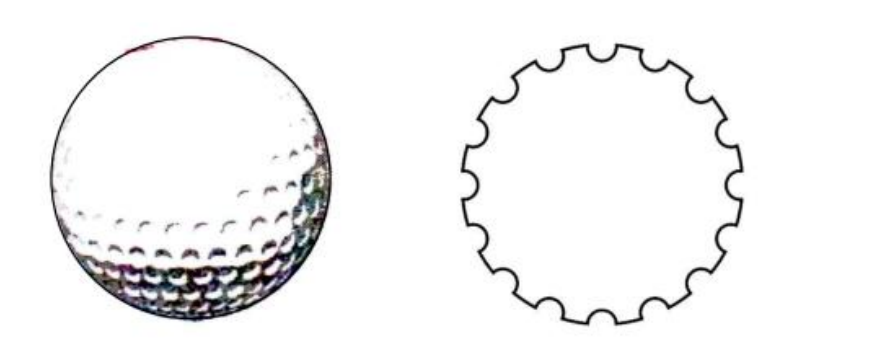
A golf ball is spherical with about $300 - 500$ dimples that help increase its velocity while in play. Golf balls are traditionally white but available in colours also. In the given figure, a golf ball has diameter $4.2$ cm and the surface has $315$ dimples (hemi-spherical) of radius $2$ mm. Based on the above, answer the following questions : (i) Find the surface area of one such dimple. (ii) Find the volume of the material dug out to make one dimple. (iii) (a) Find the total surface area exposed to the surroundings. OR (iii) (b) Find the volume of the golf ball.
Show SolutionHide Solution↓
(i) $SA = 2\pi r^2 = 2 \times \frac{22}{7} \times 4 = \frac{176}{7} \text{ mm}^2$ or $25.1 \text{ mm}^2$ (ii) Volume of material dug out to make one dimple $= \frac{2}{3} \times \frac{22}{7} \times 8 = \frac{352}{21} \text{ mm}^3$ or $16.76 \text{ mm}^3$ (iii)(a) radius of ball $= 21$ mm Total surface area exposed to surroundings $= 4\pi(21)^2 - 315 \times \pi(2)^2 + 315 \times 2\pi(2)^2$ $= 4 \times \frac{22}{7} \times 21 \times 21 + \frac{22}{7} \times 315 \times 4$ $= 9504 \text{ mm}^2$ OR (iii) (b) Volume of the golf ball $= \frac{4}{3}\pi(21)^3 - 315 \times \frac{2}{3}\pi(2)^3$ $= 33528 \text{ mm}^3$
_a_1.png)
_a_1.png)
_a_1.png)
_a_1.png)
_a_1.png)