Coordinate Geometry — Class 10 Maths PYQs

Previous-year board questions (2023–2026) with marking-scheme solutions, grouped by topic and marks.

Try each question first, then press (or tap Show Solution) to reveal the answer. Press again for the next question.

Year:Marks:Level:

Distance Formula

1 Mark Questions
11 Mark · July 2023 · Standardopen ↗
The distance of the point $(4, 7)$ from the $x$-axis is :
  • (a)$7$ units
  • (b)$5$ units
  • (c)$4$ units
  • (d)$10$ units
Show SolutionHide Solution
(a) $7$ units
21 Mark · March 2023 · Standardopen ↗
The distance between the points $(0,2\sqrt{5})$ and $(-2\sqrt{5},0)$ is
  • (a)$2\sqrt{10}$ units
  • (b)$4\sqrt{10}$units
  • (c)$2\sqrt{20}$ units
  • (d)0
Show SolutionHide Solution
(A) $2\sqrt{10}$ units
31 Mark · March 2023 · Standardopen ↗
Assertion (A): Point $P (0, 2)$ is the point of intersection of $y$-axis with the line $3x + 2y = 4$.
Reason (R): The distance of point $P (0, 2)$ from $x$-axis is 2 units.
(a) Both Assertion (A) and Reason (R) are true, and Reason (R) is the correct explanation of Assertion (A).
(b) Both Assertion (A) and Reason (R) are true, but Reason (R) is not the correct explanation of Assertion (A).
(c) Assertion (A) is true, but Reason (R) is false.
(d) Assertion (A) is false, but Reason (R) is true.
Show SolutionHide Solution
(b) Both Assertion (A) and Reason (R) are correct but Reason (R) is not the correct explanation of Assertion (A)
41 Mark · March 2023 · Standardopen ↗
The distance of the point $(-1, 7)$ from $x$-axis is :
  • (a)$-1$
  • (b)$7$
  • (c)$6$
  • (d)$\sqrt{50}$
Show SolutionHide Solution
(b) $7$
51 Mark · March 2023 · Standardopen ↗
The distance of the point $(– 6, 8)$ from origin is :
  • (a)$6$
  • (b)$-6$
  • (c)$8$
  • (d)$10$
Show SolutionHide Solution
(d) $10$
61 Mark · March 2023 · Standardopen ↗
The distance between the points $P\left(-\frac{11}{3}, 5\right)$ and $Q\left(-\frac{2}{3}, 5\right)$ is:
  • (a)$6$ units
  • (b)$4$ units
  • (c)$2$ units
  • (d)$3$ units
Show SolutionHide Solution
(d) $3$ units
71 Mark · March 2023 · Standardopen ↗
The distance of the point $(-6, 8)$ from $x$-axis is
  • (a)6 units
  • (b)-6 units
  • (c)8 units
  • (d)10 units
Show SolutionHide Solution
(C)8 units
81 Mark · 🔁 March 2023 & March 2026 · Standardopen ↗
The distance of the point $(-4, 3)$ from y-axis is
  • (a)$-4$
  • (b)$4$
  • (c)$3$
  • (d)$5$
Show SolutionHide Solution
(B) $4$
91 Mark · March 2023 · Standardopen ↗
The distance between the points $(0, 5)$ and $(-3, 1)$ is :
  • (a)$8$ units
  • (b)$5$ units
  • (c)$3$ units
  • (d)$25$ units
Show SolutionHide Solution
(B) $5$ units
101 Mark · March 2024 · Standardopen ↗
The point on x-axis which is equidistant from the points $(5, -3)$ and $(4, 2)$ is :
  • (a)$(4.5, 0)$
  • (b)$(7,0)$
  • (c)$(0.5, 0)$
  • (d)$(-7,0)$
Show SolutionHide Solution
(B) $(7, 0)$
111 Mark · March 2024 · Standardopen ↗
If the distance between the points $(3, - 5)$ and $(x, - 5)$ is $15$ units, then the values of $x$ are :
  • (a)$12,-18$
  • (b)$- 12, 18$
  • (c)$18,5$
  • (d)$-9,-12$
Show SolutionHide Solution
(b) $-12, 18$
121 Mark · July 2025 · Standardopen ↗
M is a point on y-axis at a distance of $4$ units from x-axis and it lies below the x-axis. The distance of point M from point Q $(5, 1)$ is :
  • (a)$\sqrt{2}$ units
  • (b)$\sqrt{34}$ units
  • (c)$\sqrt{50}$ units
  • (d)$\sqrt{90}$ units
Show SolutionHide Solution
(C) $\sqrt{50}$ units
131 Mark · July 2025 · Standardopen ↗
A$(-4, 5)$ and C$(8, 2)$ are the two opposite vertices of a parallelogram ABCD. Its diagonals intersect each other at P$(a, b)$. The relation between 'a' and 'b' is:
  • (a)$b = a - 1.5$
  • (b)$b = a + 1.5$
  • (c)$b = a - 4.5$
  • (d)$b = a + 4.5$
Show SolutionHide Solution
(B) $b = a + 1.5$
141 Mark · March 2025 · Standardopen ↗
The equation of a line parallel to the x-axis and at a distance of $3$ units below x-axis is :
  • (a)$x = 3$
  • (b)$x=-3$
  • (c)$y = -3$
  • (d)$y = 3$
Show SolutionHide Solution
(C) $y = - 3$
151 Mark · March 2025 · Standardopen ↗
The distance of the point $(4, 0)$ from x-axis is :
  • (a)$4$ units
  • (b)$16$ units
  • (c)$0$ units
  • (d)$4\sqrt{2}$ units
Show SolutionHide Solution
(C) $0$ units
161 Mark · March 2025 · Standardopen ↗
The distance of a point A from x-axis is $3$ units. Which of the following cannot be coordinates of the point A ?
  • (a)$(1,3)$
  • (b)$(-3,-3)$
  • (c)$(-3,3)$
  • (d)$(3, 1)$
Show SolutionHide Solution
(d) $(3, 1)$
171 Mark · March 2025 · Standardopen ↗
The distance of which of the following points from origin is less than $5$ units ?
  • (a)$(3, 4)$
  • (b)$(2, 6)$
  • (c)$(-3, -4)$
  • (d)$(1, 4)$
Show SolutionHide Solution
(d) $(1, 4)$
181 Mark · March 2025 · Standardopen ↗
The distance of point $P(1, -1)$ from $x$-axis is :
  • (a)$1$
  • (b)$-1$
  • (c)$0$
  • (d)$\sqrt{2}$
Show SolutionHide Solution
(a) $1$
191 Mark · March 2025 · Standardopen ↗
The distance of the point $A(-3, -4)$ from $x$-axis is
  • (a)3
  • (b)4
  • (c)5
  • (d)7
Show SolutionHide Solution
(B) 4
201 Mark · March 2025 · Standardopen ↗
The distance of point $(a, -b)$ from $x$-axis is
  • (a)$a$
  • (b)$-a$
  • (c)$b$
  • (d)$-b$
Show SolutionHide Solution
(C) $b$
211 Mark · March 2025 · Standardopen ↗
The distance of point $P(3a, 4a)$ from y-axis is
  • (a)$3a$
  • (b)$-3a$
  • (c)$4a$
  • (d)$-4a$
Show SolutionHide Solution
(A) $3a$
221 Mark · March 2025 · Standardopen ↗
The point on y-axis equidistant from the points $A(1, 3)$ and $B(4, 4)$ is
  • (a)$(0, 11)$
  • (b)$(11, 0)$
  • (c)$(0, 13)$
  • (d)$(0, 12)$
Show SolutionHide Solution
(A) $(0, 11)$
231 Mark · March 2026 · Standardopen ↗
If the distance between the points $(4, p)$ and $(1, 0)$ is $5$, then $p$ is equal to:
  • (a)$\pm4$
  • (b)$4$
  • (c)$-4$
  • (d)$0$
Show SolutionHide Solution
(A) $\pm 4$ (1 Mark)
241 Mark · March 2026 · Standardopen ↗
In the given figure, a circle is centred at $(1, 2)$. The diameter of the circle is
figure for this question
  • (a)$4$
  • (b)$2\sqrt{2}$
  • (c)$\sqrt{5}$
  • (d)$2\sqrt{5}$
Show SolutionHide Solution
(D) $2\sqrt{5}$
251 Mark · March 2026 · Standardopen ↗
The distance between the points $(a \cos \theta + b \sin \theta, 0)$ and $(0, a \sin \theta - b \cos \theta)$ is
  • (a)$\sqrt{a^2 + b^2}$
  • (b)$a^2-b^2$
  • (c)$\sqrt{a^2 - b^2}$
  • (d)$a^2 + b^2$
Show SolutionHide Solution
(A) $\sqrt{a^2 + b^2}$
261 Mark · March 2026 · Standardopen ↗
A circle centred at $(-1, 2)$ passes through the point $(0, 3)$. Radius of the circle is
  • (a)$2\sqrt{2}$
  • (b)$\sqrt{2}$
  • (c)$\sqrt{26}$
  • (d)$1$
Show SolutionHide Solution
(B) $\sqrt{2}$
271 Mark · March 2026 · Standardopen ↗
The distance between the points (a cos $\theta$ + b sin $\theta$, 0) and (0, a sin $\theta$-b cos $\theta$) is
  • (a)$\sqrt{a^2+b^2}$
  • (b)$a^2-b^2$
  • (c)$\sqrt{a^2-b^2}$
  • (d)$a^2 + b^2$
Show SolutionHide Solution
(A) $\sqrt{a^2+b^2}$
281 Mark · March 2025 · Basicopen ↗
The distance of a point $P(3, - 7)$ from y-axis is :
  • (a)3
  • (b)7
  • (c)$- 7$
  • (d)$\sqrt{58}$
Show SolutionHide Solution
(A) 3
291 Mark · March 2025 · Basicopen ↗
For a point $X(a, b)$ where ($b > a > 0$), the value of its [distance from x-axis - distance from y-axis] is :
  • (a)$a - b$
  • (b)$b - a$
  • (c)$a^2 - b^2$
  • (d)$b^2 - a^2$
Show SolutionHide Solution
(B) $b - a$
301 Mark · March 2025 · Basicopen ↗
The distance of the point $(2, 3)$ from the origin is :
  • (a)$2$
  • (b)$3$
  • (c)$5$
  • (d)$\sqrt{13}$
Show SolutionHide Solution
(D) $\sqrt{13}$
311 Mark · March 2025 · Basicopen ↗
The distance of point $P(3, 4)$ from the $x$-axis is
  • (a)$3$ units
  • (b)$4$ units
  • (c)$5$ units
  • (d)$7$ units
Show SolutionHide Solution
(B) $4$ units
321 Mark · March 2025 · Basicopen ↗
The distance between the points $(-6, 9)$ and $(2, 7)$ is :
  • (a)$2\sqrt{17}$
  • (b)$4\sqrt{17}$
  • (c)$2\sqrt{5}$
  • (d)$2\sqrt{15}$
Show SolutionHide Solution
(a) $2\sqrt{17}$
331 Mark · March 2025 · Basicopen ↗
The distance between the points $(2, -7)$ and $(-2, -1)$ is :
  • (a)$10$
  • (b)$2\sqrt{13}$
  • (c)$8$
  • (d)$4\sqrt{13}$
Show SolutionHide Solution
(b) $2\sqrt{13}$
341 Mark · March 2025 · Basicopen ↗
The distance between the points $(2, 3)$ and $(-2, -3)$ is
  • (a)$4\sqrt{13}$
  • (b)$\sqrt{40}$
  • (c)$2\sqrt{13}$
  • (d)$5$
Show SolutionHide Solution
(C) $2\sqrt{13}$
351 Mark · March 2025 · Basicopen ↗
If the distance between the points $(3, 0)$ and $(2, y)$ is $\sqrt{5}$, then the value(s) of y is :
  • (a)2, -2
  • (b)2, 0
  • (c)2, 1
  • (d)-2, 0
Show SolutionHide Solution
(A) 2, -2
361 Mark · March 2025 · Basicopen ↗
ABCD is a rectangle with its vertices at $(2, -2), (8, 4), (4, 8)$ and $(-2, 2)$ taken in order. Length of its diagonal is
  • (a)$4\sqrt{2}$
  • (b)$6\sqrt{2}$
  • (c)$4\sqrt{26}$
  • (d)$2\sqrt{26}$
Show SolutionHide Solution
(D) $2\sqrt{26}$
371 Mark · March 2026 · Basicopen ↗
The distance between points $(3, 0)$ and $(0, -3)$ is:
  • (a)$3$ units
  • (b)$6$ units
  • (c)$\sqrt{6}$ units
  • (d)$\sqrt{18}$ units
Show SolutionHide Solution
(d) $\sqrt{18}$ units
381 Mark · March 2026 · Basicopen ↗
The end points of the diameter AB of a circle are A(4, 0) and B (0, - 4).
The length of the diameter is :
  • (a)3 units
  • (b)8 units
  • (c)$\sqrt{8}$ units
  • (d)$\sqrt{32}$ units
Show SolutionHide Solution
(d) $\sqrt{32}$ units
391 Mark · March 2026 · Basicopen ↗
The coordinates of opposite vertices of the square ABCD are A $(-5, 0)$ and C$(0, 5)$. The length of a diagonal of the square ABCD is :
  • (a)$5$ units
  • (b)$10$ units
  • (c)$\sqrt{10}$ units
  • (d)$\sqrt{50}$ units
Show SolutionHide Solution
(d) $\sqrt{50}$ units
401 Mark · March 2026 · Basicopen ↗
The distance between the points $(-4, 2)$ and $(1, 0)$ is :
  • (a)$\sqrt{13}$ units
  • (b)$3$ units
  • (c)$9$ units
  • (d)$\sqrt{29}$ units
Show SolutionHide Solution
(D) $\sqrt{29}$ units
411 Mark · March 2026 · Basicopen ↗
The distance between the points $(-5, 1)$ and $(2, 2)$ is:
  • (a)$2\sqrt{5}$ units
  • (b)$\sqrt{10}$ units
  • (c)$5\sqrt{2}$ units
  • (d)$3\sqrt{2}$ units
Show SolutionHide Solution
(C) $5\sqrt{2}$ units
421 Mark · March 2026 · Basicopen ↗
The distance between the points $(-1, 2\sqrt{2})$ and $(2, \sqrt{2})$ is :
  • (a)$\sqrt{5}$ units
  • (b)$\sqrt{11}$ units
  • (c)$\sqrt{13}$ units
  • (d)$\sqrt{7}$ units
Show SolutionHide Solution
(B) $\sqrt{11}$ units
431 Mark · March 2026 · Basicopen ↗
The distance between the points $(-2, 5)$ and $(5, -2)$ is
  • (a)$7\sqrt{2}$
  • (b)$14$
  • (c)$2\sqrt{7}$
  • (d)$7$
Show SolutionHide Solution
(A) $7\sqrt{2}$
441 Mark · March 2026 · Basicopen ↗
The distance between the points $(-4, 5)$ and $(-1, 2)$ is
  • (a)$5$
  • (b)$3\sqrt{2}$
  • (c)$6$
  • (d)$2\sqrt{3}$
Show SolutionHide Solution
(B) $3\sqrt{2}$
2 Marks Questions
452 Marks · July 2023 · Standardopen ↗
If the point P $(3, - 3)$ is equidistant from the points A $(4, 9)$ and B $(- 9, k)$, find the value(s) of $k$.
Show SolutionHide Solution
$(3-4)^2 + (-3 - 9)^2 = (-9 - 3)^2 + (k - (-3))^2$
$(-1)^2 + (-12)^2 = (-12)^2 + (k+3)^2$
$1 + 144 = 144 + (k+3)^2$
$1 = (k+3)^2$
$k+3 = \pm 1$
$k = -2, -4$
462 Marks · March 2023 · Standardopen ↗
Point $P(x, y)$ is equidistant from points $A(5, 1)$ and $B(1, 5)$. Prove that $x = y$.
Show SolutionHide Solution
$PA^2 = PB^2 \Rightarrow (x-5)^2 + (y - 1)^2 = (x - 1)^2 + (y - 5)^2$
$\Rightarrow x = y$
472 Marks · March 2024 · Standardopen ↗
Find a relation between $x$ and $y$ such that the point $P(x, y)$ is equidistant from the points $A(7, 1)$ and $B(3, 5)$.
Show SolutionHide Solution
$PA= PB$
$\Rightarrow PA^2 = PB^2$
$(x - 7)^2 + (y -1)^2 = (x - 3)^2 + (y - 5)^2$
$\Rightarrow - 8x + 8y +16=0$ or $x-y-2=0$
482 Marks · March 2025 · Standardopen ↗
Prove that abscissa of the point $P$ which is equidistant from points with coordinates $A(7, 1)$ and $B(3, 5)$ is 2 more than its ordinate.
Show SolutionHide Solution
Let $P(x, y)$ be equidistant from $A(7, 1)$ and $B(3, 5)$. $PA = PB \Rightarrow PA^2 = PB^2$ ($\frac{1}{2}$ mark).
$(x-7)^2 + (y-1)^2 = (x-3)^2 + (y-5)^2$ ($\frac{1}{2}$ mark).
$x^2 + 49 - 14x + y^2 + 1 - 2y = x^2 + 9 - 6x + y^2 + 25 - 10y$ ($\frac{1}{2}$ mark).
$x = 2 + y$. Thus, abscissa of the point $P$ is 2 more than its ordinate ($\frac{1}{2}$ mark).
492 Marks · March 2026 · Standardopen ↗
The coordinates of the centre of a circle are $(x-7, 2x)$. Find the value(s) of '$x$', if the circle passes through the point $(-9, 11)$ and has radius $5\sqrt{2}$ units.
Show SolutionHide Solution
$(x - 7 + 9)^2 + (2x - 11)^2 = (5\sqrt{2})^2$ (1/2 Mark)
$(x + 2)^2 + (2x - 11)^2 = 50$ (1/2 Mark)
$\implies 5x^2 - 40x + 75 = 0$ or $x^2 - 8x + 15 = 0$ (1/2 Mark)
$\implies (x - 5)(x - 3) = 0$ (1/2 Mark)
$\therefore x = 3,5$ (1/2 + 1/2 Mark)
502 Marks · March 2026 · Standardopen ↗
If the distance between the points $(4, p)$ and $(1, 0)$ is 5, what is the value of $p$?
Show SolutionHide Solution
$\sqrt{(4 - 1)^2 + (p - 0)^2} = 5$ (1 Mark)
$\Rightarrow 9 + p^2 = 25$ (1/2 Mark)
$\Rightarrow p = \pm 4$ (1/2 Mark)
512 Marks · March 2025 · Basicopen ↗
Establish a relation between $x$ and $y$ such that point $(x, y)$ is equidistant from points $(-2, 5)$ and $(3, 9)$.
Show SolutionHide Solution
$$\begin{aligned}& (x + 2)^2 + (y - 5)^2 = (x - 3)^2 + (y - 9)^2 \\ & \Rightarrow x^2 + y^2 + 4x - 10y + 4 + 25 = x^2 + y^2 - 6x - 18y + 9 + 81 \\ & \Rightarrow 10x + 8y = 61\end{aligned}$$
522 Marks · March 2026 · Basicopen ↗
If $\text{A}(a, 0)$, $\text{B}(1, 1)$ and $\text{C}(0, b)$ form a triangle, right angled at $\text{B}$ when joined, then establish a relation between $a$ and $b$.
Show SolutionHide Solution
$\text{AC}^2 = \text{AB}^2 + \text{BC}^2$ (1 Mark)
$a^2 + b^2 = (a - 1)^2 + 1 + 1 + (b - 1)^2$ (1 Mark)
$\Rightarrow 2a + 2b = 4$ or $a + b = 2$
3 Marks Questions
533 Marks · March 2023 · Standardopen ↗
If Q($0$, $1$) is equidistant from P($5$, $-3$) and R($x$, $6$), find the values of $x$.
Show SolutionHide Solution
PQ = QR $\Rightarrow PQ^2 = QR^2$
$(5-0)^2 + (-3-1)^2 = (x - 0)^2 + (6 - 1)^2$
$\Rightarrow 25 + 16 = x^2 + 25$
$\Rightarrow x^2 = 16$
$\Rightarrow x = 4, x = -4$
543 Marks · March 2023 · Standardopen ↗
Find the points on the x-axis, each of which is at a distance of $10$ units from the point A$(11, -8)$.
Show SolutionHide Solution
Let the point on x-axis be P$(x, 0)$
PA = $10 \Rightarrow PA^2 = 100$
$(x - 11)^2 + (0 + 8)^2 = 100$
$(x - 11)^2 = 100 - 64 = 36$
$(x - 11) = \pm 6$
x = $17, 5$
553 Marks · March 2025 · Standardopen ↗
Find a relation between $x$ and $y$ such that $P(x, y)$ is equidistant from the points $A(3, 5)$ and $B(7, 1)$. Hence, write the coordinates of the points on $x$-axis and $y$-axis which are equidistant from points $A$ and $B$.
Show SolutionHide Solution
$PA = PB \implies PA^2 = PB^2$
$(x-3)^2 + (y-5)^2 = (x-7)^2 + (y-1)^2$
$\implies x - y = 2$
$\therefore$ Required point on $x$-axis is $(2, 0)$
$\&$ required point on $y$-axis is $(0, -2)$
563 Marks · March 2026 · Standardopen ↗
A circle centered at $(2, 1)$ passes through the points A$(5, 6)$ and B($-3$, K). Find the value(s) of K. Hence find length of chord AB.
Show SolutionHide Solution
Let centre be O$(2,1) \Rightarrow OA = OB$ (1 Mark)
$\sqrt{(5 - 2)^2 + (6 - 1)^2} = \sqrt{(-3-2)^2 + (K - 1)^2}$ (1 Mark)
$\Rightarrow 9 = (K - 1)^2$
$\Rightarrow K = -2,4$ (1/2 Mark for each value of K)
For K = $-2$, AB = $\sqrt{128}$ or $8\sqrt{2}$ (1/2 Mark)
For K = $4$, AB = $\sqrt{68}$ or $2\sqrt{17}$ (1/2 Mark)
573 Marks · March 2026 · Standardopen ↗
Find a relation between $x$ and $y$ such that the point P$(x, y)$ is equidistant from the points A$(5, 3)$ and B$(1, 7)$.
Show SolutionHide Solution
Since P $(x, y)$ is equidistant from A$(5, 3)$ and B$(1, 7)$
$\therefore$ PA = PB $\Rightarrow$ PA$^2$ = PB$^2$ ($\frac{1}{2}$ Mark)
$\Rightarrow (x-5)^2 + (y - 3)^2 = (x - 1)^2 + (y - 7)^2$ (1 Mark)
$\Rightarrow x^2 + 25 - 10x + y^2 + 9 - 6y = x^2 + 1 - 2x + y^2 + 49 - 14y$ (1 Mark)
$\Rightarrow x - y = -2$ or $x - y + 2 = 0$ ($\frac{1}{2}$ Mark)
583 Marks · March 2026 · Basicopen ↗
If the point $P (x, y)$ is equidistant from the points $(3, 6)$ and $(-3, 4)$, obtain the relation between $x$ and $y$. Hence, find the coordinates of point $P$ if it lies on $x$-axis.
Show SolutionHide Solution
$\sqrt{(x - 3)^2 + (y - 6)^2} = \sqrt{(x + 3)^2 + (y - 4)^2}$ (1 Mark)
gives $-12x - 4y = -20$ or $3x + y = 5$ (1 Mark)
As P lies on $x$ axis so $y = 0$ gives $x = \frac{5}{3}$ (1/2 Mark)
Coordinates of P are $(\frac{5}{3},0)$ (1/2 Mark)
593 Marks · March 2026 · Basicopen ↗
If the point D $(x, y)$ is equidistant from the points E $(0, 3)$ and F $(3, 0)$, prove that $x = y$. Hence, find the $x$ coordinate of the point D, if $\triangle DEF$ is an equilateral triangle.
Show SolutionHide Solution
$\sqrt{(x-0)^2 + (y-3)^2} = \sqrt{(x - 3)^2 + (y - 0)^2}$ (1 Mark)
$x^2 + y^2 - 6y + 9 = x^2 - 6x + 9 + y^2$ (1/2 Mark)
$x=y$ (1/2 Mark)
As $\triangle DEF$ is an equilateral triangle
$\therefore x^2 + y^2 - 6y + 9 = 18$ (using $DE = DF$) (1 Mark)
$2x^2-6x-9=0$ (using $x = y$) (1/2 Mark)
Solving we get
$x = \frac{6 \pm 6\sqrt{3}}{4}$ or $\frac{3 \pm 3\sqrt{3}}{2}$ (1/2 Mark)
603 Marks · March 2026 · Basicopen ↗
Show that the quadrilateral ABCD with vertices A(0, 3), B(-2, 0), C(0, -5) and D(2, 0) is a kite. Also, find the length of each diagonal of the kite ABCD.
Show SolutionHide Solution
$AB = \sqrt{(0+2)^2 + (3 – 0)^2} = \sqrt{13}$ (1/2 Mark)
$BC = \sqrt{(-2-0)^2 + (0 + 5)^2} = \sqrt{29}$ (1/2 Mark)
$CD = \sqrt{(0 – 2)^2 + (-5 – 0)^2} = \sqrt{29}$ (1/2 Mark)
$AD = \sqrt{(2 – 0)^2 + (0 – 3)^2} = \sqrt{13}$ (1/2 Mark)
Since, $AB = AD$ and $BC = CD$, so ABCD is a kite.
Length of diagonals
$AC = \sqrt{(0-0)^2 + (3 + 5)^2} = \sqrt{64} = 8$ (1/2 Mark)
$BD = \sqrt{(-2-2)^2 + (0 – 0)^2} = \sqrt{16} = 4$ (1/2 Mark)
613 Marks · March 2026 · Basicopen ↗
Show that the quadrilateral 'PLOT' with vertices $P(1, 1)$, $L(-5, 1)$, $O(-5, 4)$ and $T(1, 4)$ is a rectangle. Is it a square? Justify.
Show SolutionHide Solution
Getting $PL = 6$, $OT = 6$, $OL = 3$, $TP = 3$ (4$\times$1/2 Mark)
Getting $PO = LT = \sqrt{45}$ (1/2 Mark)
$\therefore PLOT$ is a rectangle. (1/2 Mark)
As adjacent sides are not equal
$\therefore PLOT$ is not a square (1/2 Mark)
623 Marks · March 2026 · Basicopen ↗
The vertices of a rhombus ABCD are A$(-3, -4)$, B$(5, -3)$, C$(1, 4)$ and D$(-7, 3)$. Find the length of both the diagonals. Hence, find area of the rhombus ABCD.
Show SolutionHide Solution
AC = $\sqrt{(1+3)^2 + (4+4)^2} = 4\sqrt{5}$ (1 Mark)
BD = $\sqrt{(-7-5)^2 + (3+3)^2} = 6\sqrt{5}$ (1 Mark)
Area of rhombus ABCD = $\frac{1}{2} \times 4\sqrt{5} \times 6\sqrt{5}$
$= 60$ (1 Mark)
4 Marks Questions
634 Marks · March 2026 · Basicopen ↗
If the point A $(x, y)$ is equidistant from the points B $(-2, 0)$ and C $(2, 0)$, prove that the point A lies on y-axis. Also, find the coordinates of the point A, if $\triangle ABC$ is an equilateral triangle.
Show SolutionHide Solution
$\sqrt{(x + 2)^2 + (y - 0)^2} = \sqrt{(x - 2)^2 + (y - 0)^2}$ (1 Mark)
getting $x = 0$ (1/2 Mark)
As $x = 0$ so A lies on y axis (1/2 Mark)
As triangle is equilateral, $AB = BC = AC$ gives
$\sqrt{(0 + 2)^2 + (y - 0)^2} = \sqrt{(-2 - 2)^2 + (0 - 0)^2}$ (1/2 Mark)
which gives $y^2 = 12$ (1/2 Mark)
Thus, coordinates of point A are $(0, \pm 2\sqrt{3})$ (1 Mark)
644 Marks · March 2026 · Basicopen ↗
Show that the quadrilateral 'HOPE' with vertices $H(-2, 1)$, $O(-1, 2)$, $P(0, 1)$ and $E(-1, 0)$ is a rhombus. Is it a square ? Justify.
Show SolutionHide Solution
Getting, $HO = \sqrt{2}$, $OP = \sqrt{2}$, $PE = \sqrt{2}$, $EH = \sqrt{2}$ (4× 1/2 Mark)
Since, $HO = OP = PE = EH$, so HOPE is a rhombus. (1 Mark)
Length of diagonals
$HP = \sqrt{(2)^2 + (0)^2} = 2$, $OE = \sqrt{(0)^2 + (2)^2} = 2$ (1/2 Mark)
As $HP = OE$ (Diagonals equal)
Yes, HOPE is a square (1/2 Mark)

Triangle-Quad-Linearity

1 Mark Questions
651 Mark · March 2023 · Standardopen ↗
The points $(-4, 0)$, $(4, 0)$ and $(0, 3)$ are the vertices of a :
  • (a)right triangle
  • (b)isosceles triangle
  • (c)equilateral triangle
  • (d)scalene triangle
Show SolutionHide Solution
(b) isosceles triangle
661 Mark · July 2024 · Standardopen ↗
The points $(-2, -2)$, $(6, -2)$ and $(2, 1)$ are the vertices of :
  • (a)a right angled triangle
  • (b)an isosceles triangle
  • (c)an isosceles right triangle
  • (d)a scalene triangle
Show SolutionHide Solution
(B) an isosceles triangle
671 Mark · March 2025 · Standardopen ↗
The points $(-5, 0)$, $(5, 0)$ and $(0, 4)$ are the vertices of a triangle which is a/an:
  • (a)right-angled triangle
  • (b)isosceles triangle
  • (c)equilateral triangle
  • (d)scalene triangle
Show SolutionHide Solution
(B) isosceles triangle
681 Mark · March 2025 · Standardopen ↗
Assertion (A): The point $(-2, 4)$ divides the line segment joining the points $(-4, 8)$ and $(5, -10)$ in the ratio $2 : 7$ internally.
Reason (R): If three points $P$, $Q$ and $R$ are collinear, then $PQ + QR = PR$.
  • (a)Both Assertion (A) and Reason (R) are true and Reason (R) is the correct explanation of Assertion (A).
  • (b)Both Assertion (A) and Reason (R) are true, but Reason (R) is not the correct explanation of Assertion (A).
  • (c)Assertion (A) is true, but Reason (R) is false.
  • (d)Assertion (A) is false, but Reason (R) is true.
Show SolutionHide Solution
(B) Both Assertion(A) and Reason(R) are true, but Reason(R) is not the correct explanation of Assertion(A).
691 Mark · March 2026 · Standardopen ↗
In the given figure, $\triangle ABC$ is an equilateral triangle. $AD$ is a median of the triangle joining the points $A \left(0, \frac{5\sqrt{3}}{2}\right)$, $D(0, 0)$. Points $B$ and $C$ are (in same order) :
figure for this question
  • (a)$(-5, 0), (5, 0)$
  • (b)$\left(-\frac{5}{2}, 0\right), \left(\frac{5}{2}, 0\right)$
  • (c)$(-10, 0), (10, 0)$
  • (d)$(-5\sqrt{3}, 0), (5\sqrt{3}, 0)$
Show SolutionHide Solution
(B) $\left(-\frac{5}{2}, 0\right), \left(\frac{5}{2}, 0\right)$ (1 Mark)
701 Mark · March 2026 · Basicopen ↗
Show that the quadrilateral ABCD formed by joining the points A($-2,-1$), B($1, -1$), C($1, 2$) and D($-2, 2$) in order is a square.
Show SolutionHide Solution
$AB = \sqrt{3^2 + 0^2} = 3$; $BC = \sqrt{0^2 + 3^2} = 3$
$CD = \sqrt{3^2 + 0^2} = 3$; $AD = \sqrt{0^2 + 3^2} = 3$ (1/2 $\times 4 = 2$ Marks)
$AC = \sqrt{3^2 + 3^2} = \sqrt{18}$ or $3\sqrt{2}$
$BD = \sqrt{3^2 + 3^2} = \sqrt{18}$ or $3\sqrt{2}$ (1/2 $\times 2 = 1$ Mark)
All sides are equal and diagonals are equal, hence ABCD is a square. (1/2 Mark)
2 Marks Questions
712 Marks · July 2023 · Standardopen ↗
Show that the points $(-3, -3)$, $(3, 3)$ and $(-3\sqrt{3}, 3\sqrt{3})$ are the vertices of an equilateral triangle.
Show SolutionHide Solution
Let $A (-3, -3)$, $B (3, 3)$ and $C (-3\sqrt{3}, 3\sqrt{3})$ be the given points.
Using distance formula
$AB = \sqrt{(3 + 3)^2 + (3 + 3)^2} = 6\sqrt{2}$ units
$BC = \sqrt{(-3\sqrt{3}- 3)^2 + (3\sqrt{3} - 3)^2} = 6\sqrt{2}$ units
$CA = \sqrt{(-3 + 3\sqrt{3})^2 + (-3 - 3\sqrt{3})^2} = 6\sqrt{2}$ units
As $AB = BC = CA$, so the given points are the vertices of an equilateral triangle.
722 Marks · July 2023 · Standardopen ↗
Prove that $A(4, 3)$, $B(6, 4)$, $C(5, 6)$, $D(3, 5)$ are the vertices of a square ABCD.
Show SolutionHide Solution
$AB = \sqrt{(6-4)^2 + (4 - 3)^2} = \sqrt{5}$ units
$BC = \sqrt{(5-6)^2 + (6 - 4)^2} = \sqrt{5}$ units
$CD = \sqrt{(3-5)^2 + (5 - 6)^2} = \sqrt{5}$ units
$DA = \sqrt{(4-3)^2 + (3 - 5)^2} = \sqrt{5}$ units
$AC = \sqrt{(5-4)^2 + (6 - 3)^2} = \sqrt{10}$ units
$BD = \sqrt{(3 - 6)^2 + (5 - 4)^2} = \sqrt{10}$ units
As $AB = BC = CD = DA$ and $AC = BD$, so ABCD is a square.
732 Marks · March 2023 · Standardopen ↗
Show that the points $(-2, 3)$, $(8, 3)$ and $(6, 7)$ are the vertices of a right-angled triangle.
Show SolutionHide Solution
Let the given points be A $(-2, 3)$, B $(8, 3)$ and C $(6, 7)$
Then, AB = $10$, BC = $\sqrt{4 + 16} = \sqrt{20}$,
AC = $\sqrt{64 + 16} = \sqrt{80}$
$\therefore AB^2 = BC^2 + AC^2$
$\therefore$ the given points are the vertices of a right angled triangle.
742 Marks · March 2024 · Standardopen ↗
Find the type of triangle $ABC$ formed whose vertices are $A(1, 0)$, $B(-5, 0)$ and $C(-2, 5)$.
Show SolutionHide Solution
$A(1,0)$ $B(-5,0)$ $C(-2,5)$
$AB = \sqrt{(-5 - 1)^2 + (0 - 0)^2} = \sqrt{(-6)^2 + 0^2} = \sqrt{36} = 6$
$BC = \sqrt{(-5 + 2)^2 + (0 - 5)^2} = \sqrt{(-3)^2 + (-5)^2} = \sqrt{9 + 25} = \sqrt{34}$
$CA = \sqrt{(1 + 2)^2 + (0 - 5)^2} = \sqrt{(3)^2 + (-5)^2} = \sqrt{9 + 25} = \sqrt{34}$
$\therefore BC = CA$
So, $\triangle ABC$ is isosceles.
752 Marks · March 2024 · Standardopen ↗
Prove that the points $(3, 0), (6, 4)$ and $(-1, 3)$ are the vertices of an isosceles triangle.
Show SolutionHide Solution
Let $A(3,0), B(6,4), C(-1, 3)$
$AB = \sqrt{(3 - 6)^2 + (0 - 4)^2} = 5$
$BC = \sqrt{(6 + 1)^2 + (4 - 3)^2} = \sqrt{50}$
$CA = \sqrt{(3 + 1)^2 + (0 - 3)^2} = 5$
As, $AB = AC$
$\therefore ABC$ is an isosceles triangle
762 Marks · March 2026 · Standardopen ↗
Do the points $P (1, 0)$, $Q (-5, 0)$ and $R (-2, 5)$ form a triangle ? If so, name the type of triangle formed.
Show SolutionHide Solution
$PQ = \sqrt{(-5 - 1)^2 + (0 – 0)^2} = 6$ (I) (1 Mark)
$QR = \sqrt{(-2 + 5)^2 + (5 – 0)^2} = \sqrt{34}$ or $5.8$
$PR = \sqrt{(-2 - 1)^2 + (5 – 0)^2} = \sqrt{34}$ or $5.8$
Since sum of any two sides is greater than the third side, $\therefore$ Points $P, Q$ and $R$ form a triangle. (II) (1/2 Mark)
$QR = PR \Rightarrow PQR$ forms an isosceles triangle. (III) (1/2 Mark)
772 Marks · March 2026 · Standardopen ↗
Diagonals AC and BD of square ABCD intersect at P. Coordinates of points B and D are $(9, -2)$ and $(1, 6)$ respectively.
(i) Find the co-ordinates of point P.
(ii) Find the length of the side of the square.
figure for this question
Show SolutionHide Solution
(i) Coordinates of P are $(\frac{9+1}{2}, \frac{-2+6}{2}) = (5,2)$ (1 Mark)
(ii) $2 AB^2 = BD^2$ (1/2 Mark)
$\Rightarrow 2 AB^2 = (9 – 1)^2 + (-2 – 6)^2$ (1/2 Mark)
$\Rightarrow AB = 8$ (1/2 Mark)
Hence, the length of the side of square is $8$ units.
782 Marks · March 2026 · Standardopen ↗
Using distance formula, prove that the points A(2, 3), B(-7, 0) and C(-1, 2) are collinear.
Show SolutionHide Solution
$AB = \sqrt{(-7 -2)^2 + (0 - 3)^2} = \sqrt{90} = 3\sqrt{10}$ (I) (1/2)
$BC = \sqrt{(-1 + 7)^2 + (2 - 0)^2} = \sqrt{40} = 2\sqrt{10}$ (II) (1/2)
$AC = \sqrt{(-1-2)^2 + (2 - 3)^2} = \sqrt{10} = \sqrt{10}$ (III) (1/2)
AC + BC = AB (IV) (1/2)
$\therefore$ A, B, C are collinear.
792 Marks · March 2026 · Standardopen ↗
OR
Using distance formula, prove that the points $A(2, 3)$, $B(-7, 0)$ and $C(-1, 2)$ are collinear.
Show SolutionHide Solution
$AB = \sqrt{(-7 - 2)^2 + (0 - 3)^2} = \sqrt{90} = 3\sqrt{10}$ (I Mark)
$BC = \sqrt{(-1 + 7)^2 + (2 - 0)^2} = \sqrt{40} = 2\sqrt{10}$ (II Mark)
$AC = \sqrt{(-1 - 2)^2 + (2 - 3)^2} = \sqrt{10}$ (III Mark)
$AC + BC = AB$
$\therefore A, B, C$ are collinear. (IV Mark)
802 Marks · March 2025 · Basicopen ↗
Using distance formula, prove that the points $(1, 5), (2, 3)$ and $(3, 1)$ are collinear.
Show SolutionHide Solution
Let $A(1, 5), B(2, 3)$ and $C(3, 1)$ be the points
$AB = \sqrt{1^2 + (-2)^2} = \sqrt{5}$
$BC = \sqrt{1^2 + (-2)^2} = \sqrt{5}$
$AC = \sqrt{2^2 + (-4)^2} = \sqrt{20}$ or $2\sqrt{5}$
$\therefore AB + BC = AC$, therefore points $A, B$ and $C$ are collinear.
812 Marks · March 2025 · Basicopen ↗
Using distance formula, show that the points $(-1, 3), (6, 2)$ and $(3, -1)$ are vertices of a right-angled triangle.
Show SolutionHide Solution
Let $A(-1, 3), B(6, 2)$ and $C(3, -1)$ are given points
$AB = \sqrt{(6 + 1)^2 + (2 - 3)^2} = \sqrt{50}$
$BC = \sqrt{(3 - 6)^2 + (-1 - 2)^2} = \sqrt{18}$
$CA = \sqrt{(-1 - 3)^2 + (3 + 1)^2} = \sqrt{32}$
Since $AB^2 = BC^2 + CA^2$
$\Rightarrow \Delta ABC$ is right angled at C
3 Marks Questions
823 Marks · July 2025 · Standardopen ↗
Show that the points $(a, a)$, $(-a, -a)$ and $(-\sqrt{3}a, \sqrt{3}a)$ are the vertices of an equilateral triangle.
Show SolutionHide Solution
Let A $(a, a)$, B $(–a, –a)$ and C $(-\sqrt{3}a, \sqrt{3}a)$ be the given points.
AB = $\sqrt{(-a - a)^2 + (-a - a)^2} = \sqrt{8a^2}$ or $2\sqrt{2} a$
BC = $\sqrt{(-\sqrt{3}a + a)^2 + (\sqrt{3}a + a)^2} = \sqrt{8a^2}$ or $2\sqrt{2} a$
CA = $\sqrt{(-\sqrt{3}a – a)^2 + (\sqrt{3}a – a)^2} = \sqrt{8a^2}$ or $2\sqrt{2} a$
Since AB = BC = CA
Therefore, $\triangle$ ABC is an equilateral triangle.
5 Marks Questions
835 Marks · March 2024 · Standardopen ↗
The vertices of a quadrilateral ABCD are A$(6, -2)$, B$(9, 2)$, C$(5, -1)$ and D$(2, -5)$. Prove that ABCD is a rhombus, and not a square.
Show SolutionHide Solution
$$\begin{aligned}& AB = \sqrt{(9- 6)^2 + (2 + 2)^2} = 5 \\ & BC = \sqrt{(9-5)^2 + (2 + 1)^2} = 5 \\ & CD = \sqrt{(5-2)^2 + (-1 + 5)^2} = 5 \\ & AD = \sqrt{(6-2)^2 + (-2 + 5)^2} = 5 \\ & AC = \sqrt{(6-5)^2 + (-2 + 1)^2} = \sqrt{1^2 + (-1)^2} = \sqrt{2} \\ & BD = \sqrt{(9-2)^2 + (2 + 5)^2} = \sqrt{7^2 + 7^2} = \sqrt{49+49} = \sqrt{98} = 7\sqrt{2} \\ & As AB = BC = CD = DA\end{aligned}$$ and $AC \neq BD\ \therefore$ ABCD is a rhombus and not a square.

Section Formula

1 Mark Questions
841 Mark · March 2023 · Standardopen ↗
In what ratio, does $x$-axis divide the line segment joining the points $A(3,6)$ and $b(-12,-3)$ ?
  • (a)1:2
  • (b)1:4
  • (c)4:1
  • (d)2:1
Show SolutionHide Solution
(D) 2 : 1
851 Mark · March 2023 · Standardopen ↗
The ratio in which the $x$-axis divides the line segment joining the points $(-2, 3)$ and $(6, -7)$ is:
  • (a)$1:3$
  • (b)$3:7$
  • (c)$7:3$
  • (d)$1:2$
Show SolutionHide Solution
(b) $3:7$
861 Mark · July 2024 · Standardopen ↗
The ratio in which the line segment joining the points $A(-2, -3)$ and $B(3, 7)$ is intersected internally by the y-axis is :
  • (a)$3:2$
  • (b)$2:3$
  • (c)$3:7$
  • (d)$7:3$
Show SolutionHide Solution
(B) $2:3$
871 Mark · July 2024 · Standardopen ↗
A line segment joining the points $P(-5, 11)$ and $Q$ is divided internally by the point $M(2, - 3)$ such that $PM: MQ = 7 : 2$. The coordinates of $Q$ are :
  • (a)$(4,-7)$
  • (b)$(27.5, -52)$
  • (c)$(-7, 4)$
  • (d)$(\frac{4}{9}, \frac{1}{9})$
Show SolutionHide Solution
(A) $(4,-7)$
881 Mark · March 2024 · Standardopen ↗
Point $P$ divides the line segment joining the points $A(4, -5)$ and $B(1, 2)$ in the ratio $5:2$. Co-ordinates of point $P$ are
  • (a)$(\frac{5}{2}, -\frac{3}{2})$
  • (b)$(\frac{11}{7}, 0)$
  • (c)$(\frac{13}{7}, 0)$
  • (d)$(0, \frac{13}{7})$
Show SolutionHide Solution
(C) $(\frac{13}{7}, 0)$
891 Mark · March 2024 · Standardopen ↗
Assertion (A): The point which divides the line segment joining the points A $(1, 2)$ and B$(-1, 1)$ internally in the ratio $1: 2$ is $(\frac{-1}{3}, \frac{5}{3})$
Reason (R): The coordinates of the point which divides the line segment joining the points A $(x_1, y_1)$ and B$(x_2, y_2)$ in the ratio $m_1: m_2$ are $(\frac{m_1x_2 + m_2x_1}{m_1 + m_2}, \frac{m_1y_2 + m_2y_1}{m_1 + m_2})$
  • (a)Both Assertion (A) and Reason (R) are true and Reason (R) is the correct explanation of the Assertion (A).
  • (b)Both Assertion (A) and Reason (R) are true, but Reason (R) is not the correct explanation of the Assertion (A).
  • (c)Assertion (A) is true, but Reason (R) is false.
  • (d)Assertion (A) is false, but Reason (R) is true.
Show SolutionHide Solution
(D) Assertion (A) is false, but Reason(R) is true.
901 Mark · 🔁 March 2024 & March 2026 · Standardopen ↗
Assertion (A): Mid-point of a line segment divides the line segment in the ratio $1:1$.
Reason (R): The ratio in which the point $(-3, k)$ divides the line segment joining the points $(-5, 4)$ and $(-2, 3)$ is $1: 2$.
  • (a)Both Assertion (A) and Reason (R) are true and Reason (R) is the correct explanation of the Assertion (A).
  • (b)Both Assertion (A) and Reason (R) are true, but Reason (R) is not the correct explanation of the Assertion (A).
  • (c)Assertion (A) is true, but Reason (R) is false.
  • (d)Assertion (A) is false, but Reason (R) is true.
Show SolutionHide Solution
(C) Assertion (A) is true but Reason (R) is false
911 Mark · March 2025 · Standardopen ↗
Two of the vertices of $\triangle PQR$ are $P(-1, 5)$ and $Q(5, 2)$. The coordinates of a point which divides PQ in the ratio $2: 1$ are:
  • (a)$(3,-3)$
  • (b)$(5,5)$
  • (c)$(3,3)$
  • (d)$(5, 1)$
Show SolutionHide Solution
(C) $(3, 3)$
921 Mark · March 2025 · Standardopen ↗
In the figure given below, points $P, Q, R$ divides the line segment $AB$ in four equal parts. The point $Q$ divides $PB$ in the ratio
figure for this question
  • (a)1:3
  • (b)2:3
  • (c)1:2
  • (d)1:1
Show SolutionHide Solution
(C) 1:2
931 Mark · March 2025 · Standardopen ↗
The point P divides the line segment AB in the ratio 3 : 1 as shown below : The value of $\frac{AB}{PB}$ is
figure for this question
  • (a)3
  • (b)$\frac{1}{4}$
  • (c)4
  • (d)$\frac{1}{3}$
Show SolutionHide Solution
(C) 4
941 Mark · March 2025 · Standardopen ↗
In the following figure, P and Q are points of trisection of line segment AB : the value of $\frac{AB}{PB} =$
figure for this question
  • (a)$1$
  • (b)$1.5$
  • (c)$\frac{2}{3}$
  • (d)$2$
Show SolutionHide Solution
(B) $1.5$
951 Mark · March 2026 · Standardopen ↗
The line segment joining the points P($-4$, $-2$) and Q($10$, $4$) is divided by $y$-axis in the ratio
  • (a)$2:5$
  • (b)$1:2$
  • (c)$2:1$
  • (d)$5:2$
Show SolutionHide Solution
(A) $2:5$ (1 Mark)
961 Mark · March 2025 · Basicopen ↗
The point $(x, 0)$ divides the line segment joining the points $(-4, 5)$ and $(0, -10)$ in the ratio
  • (a)$1:3$
  • (b)$2:1$
  • (c)$1:1$
  • (d)$1:2$
Show SolutionHide Solution
(D) $1:2$
971 Mark · March 2025 · Basicopen ↗
The ratio in which the line segment joining the points $A(-4, 8)$ and $B(5, -10)$ is divided by the point $P(-2, 4)$ is
  • (a)$1 : 3$
  • (b)$3 : 4$
  • (c)$2 : 7$
  • (d)$2 : 5$
Show SolutionHide Solution
(C) $2 : 7$
981 Mark · March 2026 · Basicopen ↗
The ratio in which the $x$-axis divides the line segment joining the points A$(-8, 4)$ and B$(-6, -2)$ is :
  • (a)$5:1$
  • (b)$3:1$
  • (c)$2:1$
  • (d)$1:2$
Show SolutionHide Solution
(C) $2:1$
2 Marks Questions
992 Marks · July 2023 · Standardopen ↗
Find the ratio in which the point $(-1, k)$ divides the line segment joining the points $(-3, 10)$ and $(6,-8)$. Hence, find the value of $k$.
Show SolutionHide Solution
Let $C (-1, k)$ be divides the line segment joining the points $A (-3, 10)$ and $B (6, -8)$ in the ratio $m : 1$.
Using section formula
$-1 = \frac{-3+6m}{m+1}$
$\Rightarrow m = \frac{2}{7}$
Hence, required ratio is $2 : 7$
$k = \frac{10\times7-8\times2}{2+7} = 6$
1002 Marks · March 2026 · Standardopen ↗
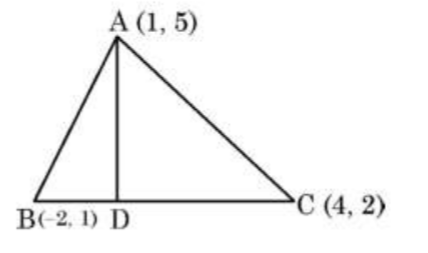
In the given figure, point D divides the side BC of $\triangle ABC$ in the ratio $1:2$. Find length AD.
figure for this question
Show SolutionHide Solution
Coordinates of point D = $(\frac{1\times 4+2\times (-2)}{1+2}, \frac{1\times 2+2\times 1}{1+2})$ i.e. $(0,\frac{4}{3})$ (1 Mark)
AD = $\sqrt{(1-0)^2 + (5-\frac{4}{3})^2} = \frac{\sqrt{130}}{3}$ units (1 Mark)
1012 Marks · March 2025 · Basicopen ↗
Find the ratio in which point $P(-1, m)$ divides the line segment joining the points $A(2, 5)$ and $B(-5, -2)$. Hence, find the value of $m$.
Show SolutionHide Solution
Let the required ratio be $k:1$
$-1 = \frac{-5k + 2}{k + 1}$ [$1$ mark]
$\Rightarrow k = \frac{3}{4}$ [$\frac{1}{2}$ mark]
$\Rightarrow$ ratio is $3:4$
$\Rightarrow m = 2$ [$\frac{1}{2}$ mark]
1022 Marks · March 2026 · Basicopen ↗
This section comprises $5$ Very Short Answer (VSA) type questions of $2$ marks each.
Find the coordinates of the point which divides the line segment joining the points $A (-6, 10)$ and $B (3, - 8)$ in the ratio $2: 7$.
Show SolutionHide Solution
Let the coordinates of point be $(x, y)$
$x = \frac{2\times3+7\times(-6)}{9} = -4$, $y = \frac{2\times(-8)+7\times10}{9} = 6$ (1+1 Mark)
Coordinates of the point are $(-4, 6)$
1032 Marks · March 2026 · Basicopen ↗
Find the coordinates of the point which divides the line segment joining the points $P(-1, 1)$ and $Q(5, -7)$ in the ratio $2: 3$.
Show SolutionHide Solution
Let the coordinates of the point be $(x, y)$
$x = \frac{2\times5+3\times(-1)}{5} = \frac{7}{5}$, $y = \frac{2\times(-7)+3\times1}{5} = -\frac{11}{5}$ (1+1 Mark)
Coordinates of the point are $(\frac{7}{5}, -\frac{11}{5})$
1042 Marks · March 2026 · Basicopen ↗
A point P divides a line segment OR in the ratio $2: 1$. If the coordinates of O are $(0, 0)$ and that of P are $(-2, -3)$, find the coordinates of R.
Show SolutionHide Solution
$2:1$
$$\begin{aligned}& O(0,0) \\ & P(-2, -3) \\ & R(x, y)\end{aligned}$$ (1 Mark)
Let coordinates of R be $(x, y)$
$-2 = \frac{2x+0}{2+1} \Rightarrow x=-3$ (1 Mark)
$-3 = \frac{2y+0}{2+1} \Rightarrow y=-\frac{9}{2}$ (1 Mark)
1052 Marks · March 2026 · Basicopen ↗
The vertices of a $\triangle ABC$ are A$(-1, 3)$, B$(2, -3)$ and C$(4, 5)$. Find the coordinates of a point P on median AD such that AP: PD = $2:3$.
Show SolutionHide Solution
Coordinates of D are $(\frac{4+2}{2}, \frac{5-3}{2})$ i.e. $(3, 1)$ (1 Mark)
Coordinates of P are $(\frac{2\times3+3\times(-1)}{2+3}, \frac{2\times1 + 3\times3}{2+3})$ i.e. $(\frac{3}{5}, \frac{11}{5})$ (1 Mark)
3 Marks Questions
1063 Marks · March 2023 · Standardopen ↗
Find the ratio in which the line segment joining the points $A(6, 3)$ and $B(-2, -5)$ is divided by $x$-axis.
Show SolutionHide Solution
Let $P(x, 0)$ be the point on $x$ axis which divides $AB$ in the ratio $k : 1$
$\frac{-5k + 3}{k+1} = 0 \Rightarrow k = \frac{3}{5}$
Ratio is $3:5$
1073 Marks · March 2024 · Standardopen ↗
Find the ratio in which the line segment joining the points $(5, 3)$ and $(-1, 6)$ is divided by Y-axis.
Show SolutionHide Solution
Let the line segment divides y-axis at $(0, y)$.
Let the required ratio be $k:1$
$\therefore 0 = \frac{(-1)k+5(1)}{k+1}$
$\Rightarrow k = 5$
Hence ratio is $5 : 1$
1083 Marks · March 2024 · Standardopen ↗
P$(-2, 5)$ and Q$(3, 2)$ are two points. Find the coordinates of the point R on line segment PQ such that $PR = 2QR$.
Show SolutionHide Solution
Let coordinates of R be $(x, y)$.
$PR : RQ = 2 : 1$
$x = \frac{2(3)+1(-2)}{2+1} = \frac{4}{3}$
$y = \frac{2(2)+1(5)}{2+1} = 3$
$\therefore$ Coordinates of the point R $(\frac{4}{3}, 3)$
1093 Marks · March 2024 · Standardopen ↗
In what ratio does the X-axis divides the line segment joining the points$(2, -3)$ and $(5, 6)$? Also, find the coordinates of the point of intersection.
Show SolutionHide Solution
Let the co ordinate of the point of intersection be $(x, 0)$.
Let ratio be $k:1$
$\frac{6k-3}{k+1} = 0$
$\Rightarrow k = \frac{1}{2}$
$\therefore$ required ratio is $1: 2$
$x = \frac{5\times1+2\times2}{1+2} = \frac{9}{3} = 3$
$\therefore$ the co ordinate of the point of intersection is $(3,0)$
1103 Marks · March 2026 · Standardopen ↗
Find the ratio in which the x-axis divides the line segment joining the points $(-6, 5)$ and $(-4, -1)$. Also, find the point of intersection.
Show SolutionHide Solution
Let coordinates of $P$ be $(x, 0)$ and $P$ divides the line segement $AB$ in the ratio $k: 1$ (I) (1/2 Mark)
$(\frac{-4k-6}{k+1}, \frac{-k+5}{k+1}) = (x, 0)$ (II) (1 Mark)
$\frac{-k+5}{k+1} = 0 \Rightarrow k = 5$ (III) (1/2 Mark)
Hence the required ratio is $5: 1$ (IV) (1/2 Mark)
$\therefore$ Coordinates of $P$ are $(\frac{-4\times5-6}{5+1}, 0) = (\frac{-13}{3}, 0)$ (V) (1/2 Mark)
1113 Marks · March 2026 · Standardopen ↗
Parthi and Alisha found a treasure that is exactly on the straight line joining their locations. Parthi's location is at point $(-6, -5)$ and Alisha's location is at point $(10, 11)$. The distance from the treasure to Parthi's location is three times that of the distance to Alisha's location. Find the coordinates of the location of the treasure.
Show SolutionHide Solution
Let the points P, A and T represent the location of Parthi, Alisha and Treasure respectively.
Let the coordinates of T be $(x, y)$
P $(-6,-5)$ T $(x, y)$ A $(10, 11)$
$PT = 3 AT$ (1 Mark)
$\frac{PT}{AT} = \frac{3}{1}$ (1/2 Mark)
Coordinates of T are $(\frac{10\times3-6}{3+1}, \frac{11\times3-5}{3+1})$ (1 Mark)
$= (6,7)$ (1/2 Mark)
1123 Marks · March 2026 · Standardopen ↗
Find the coordinates of the points of trisection of the line segment joining the points A($-1, 4$) and B($-3,-2$).
Show SolutionHide Solution
A $(-1,4)$ P Q B $(-3,-2)$
Let P and Q be the points of trisection of AB, therefore AP :PB = 1:2
Coordinates of P $= (\frac{1(-3)+2(-1)}{3}, \frac{1(-2)+2(4)}{3})$ (1 Mark)
$= (\frac{-5}{3}, 2)$ (1/2 Mark)
Q is the mid-point of PB (1 Mark)
Coordinates of Q $= (\frac{\frac{-5}{3}+(-3)}{2}, \frac{2+(-2)}{2})$ (1/2 Mark)
$= (\frac{-7}{3}, 0)$
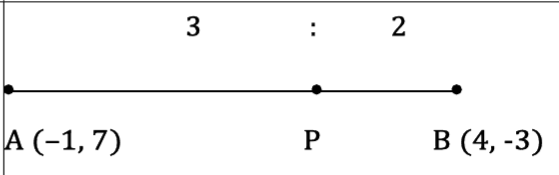
1133 Marks · March 2026 · Standardopen ↗
Prove that the point P dividing the line segment joining the points A($-1, 7$) and B($4, -3$) in the ratio $3:2$, lies on the line $x - 3y = -1$. Also find length of PA and PB.
Show SolutionHide Solution
AP: PB = $3:2$
Coordinates of P = $(\frac{3\times 4+2\times (-1)}{3+2}, \frac{3\times (-3)+2\times 7}{3+2}) = (2,1)$ (1 Mark)
Substituting $x = 2$ and $y = 1$ in the given equation
L. H. S. = $x - 3y$
= $2 - 3(1)$
= $-1$ = R. H. S.
$\therefore$ P lies on the given line (1 Mark)
PA = $\sqrt{(2 + 1)^2 + (1 - 7)^2} = \sqrt{45}$ or $3\sqrt{5}$ (1/2 Mark)
PB = $\sqrt{(2 - 4)^2 + (1 + 3)^2} = \sqrt{20}$ or $2\sqrt{5}$ (1/2 Mark)
figure for this question
1143 Marks · March 2026 · Standardopen ↗
Find the coordinates of the points of trisection of the line segment joining the points P$(5, -4)$ and Q$(-4, 2)$.
Show SolutionHide Solution
Let the points A and B trisect the line segment joining P and Q.
$\therefore$ PA : AQ = $1:2$. (1 Mark)
Coordinates of A = $(\frac{1 \times (-4) + 2 \times 5}{1+2}, \frac{1 \times 2 + 2 \times (-4)}{1+2})$ ($\frac{1}{2}$ Mark)
$= (2, -2)$ ($\frac{1}{2}$ Mark)
Now, B is mid point of the line segment joining A and Q.
Coordinates of B = $(\frac{2 - 4}{2}, \frac{-2 + 2}{2})$ ($\frac{1}{2}$ Mark)
$= (-1, 0)$ ($\frac{1}{2}$ Mark)
The line segment joining P and Q is trisected at $(2, -2)$ and $(-1, 0)$.
figure for this question
1153 Marks · March 2026 · Standardopen ↗
Find the ratio in which the point P $(6, k)$ divides the line segment joining the points M $(4, 2)$ and N $(8, -4)$. Hence find the value of $k$.
Show SolutionHide Solution
Let the point P divides the line segment joining M and N in the ratio $r : 1$.
Then, Coordinates of P = $(\frac{r \times 8 + 1 \times 4}{r+1}, \frac{r \times (-4) + 1 \times 2}{r+1}) = (6, k)$ (1 Mark)
$\Rightarrow \frac{8r + 4}{r+1} = 6$ ($\frac{1}{2}$ Mark)
$\Rightarrow r = 1$ ($\frac{1}{2}$ Mark)
Thus, the point P divides the line segment joining M and N in the ratio $1:1$. ($\frac{1}{2}$ Mark)
i.e. Coordinates of P = $(\frac{4+8}{2}, \frac{2-4}{2}) = (6, k)$ ($\frac{1}{2}$ Mark)
The value of $k$ is $-1$. ($\frac{1}{2}$ Mark)
figure for this question
1163 Marks · March 2025 · Basicopen ↗
Prove that $P(3, -3), Q(5, -2), R(6, 0)$ and $S(4, -1)$ are the vertices of a rhombus $PQRS$. Also, find if it is a square or not.
Show SolutionHide Solution
$RS = \sqrt{(6 - 4)^2 + (0 - (-1))^2} = \sqrt{5}$
$SP = \sqrt{(4 - 3)^2 + (-1 + 3)^2} = \sqrt{5}$
$PQ = \sqrt{(5 - 3)^2 + (-2 + 3)^2} = \sqrt{5}$
$QR = \sqrt{(6 - 5)^2 + (0 + 2)^2} = \sqrt{5}$
$\implies PQRS$ is a rhombus
$PR = \sqrt{(6 - 3)^2 + (0 + 3)^2} = \sqrt{18} = 3\sqrt{2}$
$QS = \sqrt{(5 - 4)^2 + (-2 + 1)^2} = \sqrt{2}$
$\implies PR \neq QS$ So, $PQRS$ is not a square
1173 Marks · March 2026 · Basicopen ↗
The line segment joining the points A $(-5, 1)$ and B $(7, 6)$ is trisected at the points P and Q such that P is nearer to A. If P lies on the line $x + y = k$, then find the value of $k$.
Show SolutionHide Solution
AP : PB = $1 : 2$ (½)
Coordinates of P are $(\frac{1\times 7+2\times(-5)}{1+2}, \frac{1\times 6+2\times 1}{1+2})$ i.e. $(-1, \frac{8}{3})$ (1½)
$\therefore$ P lies on $x + y = k$ therefore $k = -1 + \frac{8}{3} = \frac{5}{3}$ (1)

Mid-point Formula

1 Mark Questions
1181 Mark · July 2023 · Standardopen ↗
The coordinates of the point A, where AB is the diameter of the circle whose centre is $(3,-2)$ and B $(7, 4)$ is:
  • (a)$(-1,-8)$
  • (b)$(-1,8)$
  • (c)$(1,8)$
  • (d)$(1,-8)$
Show SolutionHide Solution
(a) $(-1, - 8)$
1191 Mark · July 2023 · Standardopen ↗
If A(-2,-1), B(a, 0), C(4, b) and D(1, 2) are the vertices of a parallelogram ABCD, then find the values of a and b.
Show SolutionHide Solution
Coordinates of the mid-point of AC = Coordinates of the mid-point of BD
$(\frac{-2+4}{2}, \frac{-1+b}{2}) = (\frac{a+1}{2}, \frac{0+2}{2})$
$\therefore \frac{-2+4}{2} = \frac{a+1}{2} \Rightarrow a=1$ (1/2 Mark)
and $\frac{-1+b}{2} = \frac{0+2}{2} \Rightarrow b=3$ (1/2 Mark)
1201 Mark · July 2023 · Standardopen ↗
The three vertices of a parallelogram ABCD, taken in order, are A(-1, 0), B(3, 1) and C(2, 2). Find the coordinates of the fourth vertex D.
Show SolutionHide Solution
Let the coordinates of fourth vertex D be $(x, y)$
Coordinates of the mid-point of AC = Coordinates of the mid-point of BD
$(\frac{-1+2}{2}, \frac{0+2}{2}) = (\frac{3+x}{2}, \frac{1+y}{2})$
$\therefore \frac{-1+2}{2} = \frac{3+x}{2} \Rightarrow x=-2$ (1/2 Mark)
and $\frac{0+2}{2} = \frac{1+y}{2} \Rightarrow y=1$ (1/2 Mark)
1211 Mark · July 2023 · Standardopen ↗
If $\text{P}$ is the mid-point of the line segment forming the points $\text{A}(-2, 8)$ and $\text{B}(-6, -4)$, then the coordinates of $\text{P}$ are:
  • (a)$(-4,2)$
  • (b)$(2,-4)$
  • (c)$(6,8)$
  • (d)$(-6,8)$
Show SolutionHide Solution
(a) $(-4, 2)$
1221 Mark · March 2023 · Standardopen ↗
The end-points of a diameter of a circle are (2, 4) and (-3, -1). The radius of the circle is
  • (a)$2\sqrt{5}$
  • (b)$\frac{5}{\sqrt{2}}$
  • (c)$\frac{5}{\sqrt{2}}$
  • (d)$5\sqrt{2}$
Show SolutionHide Solution
(C) $\frac{5}{\sqrt{2}}$
1231 Mark · March 2023 · Standardopen ↗
Assertion (A): If the points $A(4, 3)$ and $B(x, 5)$ lie on a circle with centre $O(2, 3)$, then the value of $x$ is $2$.
Reason (R): Centre of a circle is the mid-point of each chord of the circle.
(a) Both Assertion (A) and Reason (R) are true, and Reason (R) is the correct explanation of Assertion (A).
(b) Both Assertion (A) and Reason (R) are true, but Reason (R) is not the correct explanation of Assertion (A).
(c) Assertion (A) is true, but Reason (R) is false.
(d) Assertion (A) is false, but Reason (R) is true.
Show SolutionHide Solution
(c) Assertion (A) is true, but Reason (R) is false
1241 Mark · March 2025 · Standardopen ↗
The mid-point of the line segment joining the points $P(-4, 5)$ and $Q(4, 6)$ lies on:
  • (a)x-axis
  • (b)y-axis
  • (c)origin
  • (d)neither x-axis nor y-axis
Show SolutionHide Solution
(B) $y - \text{axis}$
1251 Mark · March 2025 · Standardopen ↗
If the mid-point of the line segment joining the points $(a, 4)$ and $(2, 2b)$ is $(2, 6)$, then the value of $(a + b)$ is given by:
  • (a)$6$
  • (b)$7$
  • (c)$8$
  • (d)$16$
Show SolutionHide Solution
(A) $6$
1261 Mark · March 2026 · Standardopen ↗
The mid-point of the line segment joining the points $(5, -4)$ and $(6, 4)$ lies on:
  • (a)$x$-axis
  • (b)$y$-axis
  • (c)origin
  • (d)neither $x$-axis nor $y$-axis
Show SolutionHide Solution
(a) $x$-axis (1 Mark)
1271 Mark · March 2025 · Basicopen ↗
The mid-point of a line segment divides the line segment in the ratio :
  • (a)$1 : 2$
  • (b)$2 : 1$
  • (c)$1 : 1$
  • (d)$\frac{1}{2} : 2$
Show SolutionHide Solution
(C) $1 : 1$
1281 Mark · March 2025 · Basicopen ↗
The mid-point of the line segment joining points $(1, 3)$ and $(1, -3)$ lies :
  • (a)at the origin
  • (b)in the second quadrant
  • (c)on x-axis
  • (d)on y-axis
Show SolutionHide Solution
(C) on x-axis
1291 Mark · March 2025 · Basicopen ↗
If point $(1, 2)$ is the mid-point of the line segment joining the points $(3, 5)$ and $(2a, b)$, then $(a, b) =$
  • (a)$(-1, -1)$
  • (b)$\left( -\frac{1}{2}, -\frac{1}{2} \right)$
  • (c)$\left( -\frac{1}{2}, -1 \right)$
  • (d)$\left( -1, -\frac{1}{2} \right)$
Show SolutionHide Solution
(C) $\left( -\frac{1}{2}, -1 \right)$
1301 Mark · March 2025 · Basicopen ↗
If point $(1, 2)$ divides the line segment joining the points $(3, 5)$ and $(2p, q)$ in the ratio $1 : 1$, then $(p, q)$ is equal to :
  • (a)$(-\frac{1}{2}, -1)$
  • (b)$(-\frac{1}{2}, -\frac{1}{2})$
  • (c)$(-1, -1)$
  • (d)$(-1, -\frac{1}{2})$
Show SolutionHide Solution
(A) $(-\frac{1}{2}, -1)$
1311 Mark · March 2025 · Basicopen ↗
If point $(a, 2b)$ is the mid-point of the line segment joining the points $(3, 5)$ and $(-1, -1)$, then $(a, b)$ is equal to :
  • (a)$(1, 2)$
  • (b)$(2, 2)$
  • (c)$(2, 1)$
  • (d)$(1, 1)$
Show SolutionHide Solution
(D) $(1, 1)$
1321 Mark · March 2026 · Basicopen ↗
The co-ordinates of the mid-point of the line segment joining points A($p-1, q + 1$) and B($p + 1, q – 1$) are given by :
  • (a)($p, q$)
  • (b)($2p, 2q$)
  • (c)$(\frac{p+1}{2}, \frac{q+1}{2})$
  • (d)$(\frac{p-1}{2}, \frac{q-1}{2})$
Show SolutionHide Solution
(A) ($p, q$)
1331 Mark · March 2026 · Basicopen ↗
The fourth vertex D of a parallelogram ABCD whose three vertices are A$(-4, 1)$, B$(4, 5)$ and C$(6, 1)$ is :
  • (a)$(-2,-3)$
  • (b)$(3,-2)$
  • (c)$(0,-1)$
  • (d)$(0, 1)$
Show SolutionHide Solution
(A) $(-2, -3)$
3 Marks Questions
1343 Marks · March 2025 · Standardopen ↗
If the mid-point of the line segment joining the points $A(3, 4)$ and $B(k, 6)$ is $P(x, y)$ and $x + y - 10 = 0$, find the value of $k$.
Show SolutionHide Solution
$P(x, y)$ is the mid – point
$\therefore (x,y) = (\frac{3+k}{2}, \frac{4+6}{2})$
$x = \frac{3+k}{2}, y = 5$
$x+y-10 = 0$
$\frac{3+k}{2} + 5 - 10 = 0$
$k = 7$
1353 Marks · March 2025 · Standardopen ↗
If $(a, b)$ is the mid-point of the line segment joining the points $A(10, -6)$ and $B(k, 4)$ and $a - 2b = 18$, then find the value of $k$.
Show SolutionHide Solution
$a = \frac{10+k}{2}$ ($1/2$ mark)
and $b = \frac{-6+4}{2} = -1$ ($1/2$ mark)
Given, $a - 2b = 18$
$\frac{10+k}{2} - 2(-1) = 18$ ($1$ mark)
$\Rightarrow k = 22$ ($1$ mark)
1363 Marks · March 2026 · Standardopen ↗
If the points A$(4, 5)$, B$(m, 6)$, C$(4, 3)$ and D$(1, n)$ taken in this order are the vertices of a parallelogram ABCD, then find the values of $m$ and $n$.
Show SolutionHide Solution
Coordinates of mid-point of AC = Coordinates of mid-point of BD (1 Mark)
$\frac{4+4}{2}$, $\frac{5+3}{2}$) = ($\frac{1+m}{2}$, $\frac{n+6}{2}$) (1 Mark)
m = 7 (1/2 Mark)
n = 2 (1/2 Mark)
1373 Marks · March 2025 · Basicopen ↗
If points $A(-5, y)$, $B(2, -2)$, $C(8, 4)$ and $D(x, 5)$ taken in order, form a parallelogram ABCD, then find the values of $x$ and $y$. Hence, find lengths of sides of the parallelogram.
Show SolutionHide Solution
ABCD is a parallelogram
$\therefore$ Coordinates of mid pt. of BD = Coordinates of mid pt. of AC
$(\frac{2+x}{2}, \frac{-2+5}{2}) = (\frac{8-5}{2}, \frac{4+y}{2})$ [$1$ mark]
Getting $x = 1$ and $y = -1$ [$\frac{1}{2} + \frac{1}{2}$ mark]
$AB = \sqrt{7^2 + (-1)^2} = \sqrt{50}$ or $5\sqrt{2}$ [$\frac{1}{2}$ mark]
$BC = \sqrt{6^2 + 6^2} = \sqrt{72}$ or $6\sqrt{2}$ [$\frac{1}{2}$ mark]
1383 Marks · March 2025 · Basicopen ↗
$A(6, -3)$, $B(0, 5)$ and $C(-2, 1)$ are vertices of $\Delta ABC$. Points $P(3, 1)$ and $Q(2, -1)$ lie on sides AB and AC respectively. Check whether $\frac{AP}{PB} = \frac{AQ}{QC}$.
Show SolutionHide Solution
$AP = \sqrt{3^2 + (-4)^2} = 5$ [$\frac{1}{2}$ mark]
$PB = \sqrt{3^2 + (-4)^2} = 5$ [$\frac{1}{2}$ mark]
$AQ = \sqrt{4^2 + (-2)^2} = 2\sqrt{5}$ [$\frac{1}{2}$ mark]
$QC = \sqrt{4^2 + (-2)^2} = 2\sqrt{5}$ [$\frac{1}{2}$ mark]
So $\frac{AP}{PB} = 1$ and $\frac{AQ}{QC} = 1$
Therefore $\frac{AP}{PB} = \frac{AQ}{QC}$ [$1$ mark]

Application

1 Mark Questions
1391 Mark · July 2023 · Standardopen ↗
If AB is a chord of a circle with centre at O(2, 3), where the coordinates of A and B are (4,3) and (x, 5) respectively, then the value of x is :
  • (a)$3$
  • (b)$2$
  • (c)$5$
  • (d)$4$
Show SolutionHide Solution
(b) $2$
1401 Mark · March 2023 · Standardopen ↗
The coordinates of the vertex A of a rectangle ABCD whose three vertices are given as B($0$, $0$), C($3$, $0$) and D($0$, $4$) are :
  • (a)($4,0$)
  • (b)($0,3$)
  • (c)($3, 4$)
  • (d)($4,3$)
Show SolutionHide Solution
(c) ($3, 4$)
1411 Mark · March 2023 · Standardopen ↗
If end points of a diameter of a circle are $(-5, 4)$ and $(1, 0)$, then the radius of the circle is :
  • (a)$2\sqrt{13}$ units
  • (b)$\sqrt{13}$ units
  • (c)$4\sqrt{2}$ units
  • (d)$2\sqrt{2}$ units
Show SolutionHide Solution
(b) $\sqrt{13}$ units
1421 Mark · March 2024 · Standardopen ↗
PQ is a diameter of a circle with centre O$(2, -4)$. If the coordinates of the point P are $(-4, 5)$, then the coordinates of the point Q will be :
  • (a)$(-3, 4.5)$
  • (b)$(-1, 0.5)$
  • (c)$(4,-5)$
  • (d)$(8,-13)$
Show SolutionHide Solution
(D) $(8, -13)$
1431 Mark · March 2024 · Standardopen ↗
AD is a median of $\triangle ABC$ with vertices $A(5, - 6)$, $B(6, 4)$ and $C(0, 0)$. Length AD is equal to :
  • (a)$\sqrt{68}$ units
  • (b)$2\sqrt{15}$ units
  • (c)$\sqrt{101}$ units
  • (d)$10$ units
Show SolutionHide Solution
(a) $\sqrt{68}$ units
1441 Mark · March 2024 · Standardopen ↗
The centre of a circle is at $(2, 0)$. If one end of a diameter is at $(6, 0)$, then the other end is at :
  • (a)$(0,0)$
  • (b)$(4,0)$
  • (c)$(-2, 0)$
  • (d)$(-6, 0)$
Show SolutionHide Solution
(c) $(-2, 0)$
1451 Mark · March 2024 · Standardopen ↗
$XOYZ$ is a rectangle with vertices $X(-3, 0)$, $O(0, 0)$, $Y(0, 4)$ and $Z(x, y)$. The length of its each diagonal is
  • (a)$5$ units
  • (b)$\sqrt{5}$ units
  • (c)$x^2 + y^2$ units
  • (d)$4$ units
Show SolutionHide Solution
(A) $5$ units
1461 Mark · March 2024 · Standardopen ↗
The distance between the points $(a \cos \theta, a \sin \theta)$ and $(a \sin \theta, a \cos \theta)$ is
  • (a)$a$
  • (b)$a\sqrt{2}$
  • (c)$0$
  • (d)$2a$
Show SolutionHide Solution
(B) $a\sqrt{2}$
1471 Mark · March 2024 · Standardopen ↗
The fourth vertex $D$ of a parallelogram $ABCD$ whose three vertices are $A(-2, 3)$, $B(6, 7)$ and $C(8, 3)$ is :
  • (a)$(0,1)$
  • (b)$(0,-1)$
  • (c)$(-1,0)$
  • (d)$(1,0)$
Show SolutionHide Solution
(B) $(0,-1)$
1481 Mark · March 2024 · Standardopen ↗
The perpendicular bisector of the line segment joining the points $A(-1, 3)$ and $B(2, 4)$ cuts the y-axis at :
  • (a)$(0,5)$
  • (b)$(0, -5)$
  • (c)$(0,4)$
  • (d)$(0, -4)$
Show SolutionHide Solution
(A) $(0, 5)$
1491 Mark · July 2025 · Standardopen ↗
ABC is a triangle. B lies on x-axis at a distance of 4 units from y-axis at its right. C is on y-axis and it is 3 units away from the origin. If the coordinates of A are (0, 0), the perimeter of $\triangle ABC$ is :
  • (a)7 units
  • (b)12 units
  • (c)6 units
  • (d)15 units
Show SolutionHide Solution
(B) 12 units
1501 Mark · July 2025 · Standardopen ↗
A circle with centre P$(4, 5)$ passes through the point A$(0, 9)$. The length of the diagonal of the largest square inside this circle is :
  • (a)$4\sqrt{2}$ units
  • (b)$8\sqrt{2}$ units
  • (c)$\sqrt{53}$ units
  • (d)$2\sqrt{53}$ units
Show SolutionHide Solution
(B) $8\sqrt{2}$ units
1511 Mark · July 2025 · Standardopen ↗
If the points A$(5, 4)$ and B$(x, 6)$ are on a circle with centre $(3, 4)$, then the value of $x$ is :
  • (a)$6$
  • (b)$7$
  • (c)$3$
  • (d)$1$
Show SolutionHide Solution
(C) $3$
1521 Mark · March 2025 · Standardopen ↗
The end points of a diameter of circle are $(2, 4)$ and $(-3, -1)$. The length of its radius is:
  • (a)$\frac{5\sqrt{2}}{2}$ units
  • (b)$5\sqrt{2}$ units
  • (c)$3\sqrt{2}$ units
  • (d)$\pm \frac{5\sqrt{2}}{2}$ units
Show SolutionHide Solution
(A) $\frac{5\sqrt{2}}{2}$ units
1531 Mark · March 2025 · Standardopen ↗
The coordinates of the end points of a diameter of a circle are $(5, - 2)$ and $(5, 2)$. The length of the radius of the circle is :
  • (a)$\pm 2$
  • (b)$\pm 4$
  • (c)$4$
  • (d)$2$
Show SolutionHide Solution
(D) $2$
1541 Mark · March 2025 · Standardopen ↗
The perimeter of the triangle formed by the vertices $(0, 0)$, $(2, 0)$ and $(0, 2)$ is :
  • (a)$4$ units
  • (b)$6$ units
  • (c)$6\sqrt{2}$ units
  • (d)$(4 + 2\sqrt{2})$ units
Show SolutionHide Solution
(D) $(4 + 2\sqrt{2})$ units
1551 Mark · March 2025 · Standardopen ↗
The line represented by $\frac{x}{4} + \frac{y}{6} = 1$, intersects $x$-axis and $y$-axis respectively at P and Q. The coordinates of the mid-point of line segment PQ are:
  • (a)$(2,3)$
  • (b)$(3,2)$
  • (c)$(2,0)$
  • (d)$(0,3)$
Show SolutionHide Solution
(A) $(2, 3)$
1561 Mark · March 2025 · Standardopen ↗
AOBC is a rectangle whose three vertices are $A(0, 2)$, $O(0, 0)$ and $B(4, 0)$. The square of the length of its diagonal is equal to :
  • (a)$36$
  • (b)$20$
  • (c)$16$
  • (d)$4$
Show SolutionHide Solution
(B) $20$
1571 Mark · March 2025 · Standardopen ↗
The distance between the points $(4 \cos \theta + 3 \sin \theta, 0)$ and $(0, 4 \sin \theta - 3 \cos \theta)$ is
  • (a)$25$
  • (b)$7$
  • (c)$5$
  • (d)$\sqrt{7}$
Show SolutionHide Solution
(C) $5$
1581 Mark · March 2025 · Basicopen ↗
For a point $(3, - 5)$, the value of (abscissa - ordinate) is :
  • (a)$- 8$
  • (b)$- 2$
  • (c)$2$
  • (d)$8$
Show SolutionHide Solution
(D) $8$
1591 Mark · March 2025 · Basicopen ↗
The coordinates of the point where the line $\frac{x}{a} + \frac{y}{b} = 5$ intersects $y$-axis are
  • (a)$(0, a)$
  • (b)$(0, b)$
  • (c)$(0, 5a)$
  • (d)$(0, 5b)$
Show SolutionHide Solution
(D) $( 0, 5b )$
2 Marks Questions
1602 Marks · March 2024 · Standardopen ↗
$A(3, 0)$, $B(6, 4)$ and $C(-1, 3)$ are vertices of a triangle $ABC$. Find length of its median $BE$.
Show SolutionHide Solution
Mid-point of $AC$ is $E (\frac{3-1}{2}, \frac{0+3}{2}) = E(1, \frac{3}{2})$
Length of median $BE = \sqrt{(6-1)^2 + (4-\frac{3}{2})^2} = \sqrt{5^2 + (\frac{5}{2})^2} = \sqrt{25 + \frac{25}{4}} = \sqrt{\frac{100+25}{4}} = \sqrt{\frac{125}{4}}$ or $\frac{5\sqrt{5}}{2}$
1612 Marks · March 2024 · Standardopen ↗
The vertices of a $\Delta ABC$ are A$(-2, 4)$, B$(4, 3)$ and C$(1, -6)$. Find length of the median BD.
Show SolutionHide Solution
Mid-point of AC is D $(\frac{-1}{2}, -1)$ (1)
Length of median BD
$= \sqrt{(4+\frac{1}{2})^2+(3+1)^2} = \sqrt{\frac{145}{4}}$ or $\frac{\sqrt{145}}{2}$ (1)
1622 Marks · March 2024 · Standardopen ↗
Points $A(-1, y)$ and $B(5, 7)$ lie on a circle with centre $O(2, -3y)$ such that $AB$ is a diameter of the circle. Find the value of $y$. Also, find the radius of the circle.
Show SolutionHide Solution
Centre $O (2, -3y)$ is the mid point of $AB$
$\frac{-1+5}{2} = 2$, $\frac{y+7}{2} = -3y$
$\Rightarrow y = -1$
Radius = $OB = \sqrt{(5 - 2)^2 + (7 - (-1))^2} = 5$
1632 Marks · March 2025 · Standardopen ↗
The coordinates of the centre of a circle are $(2a, a - 7)$. Find the value(s) of '$a$' if the circle passes through the point $(11, -9)$ and has diameter $10\sqrt{2}$ units.
Show SolutionHide Solution
Radius $= 5\sqrt{2}$ units. $(2a - 11)^2 + (a - 7 + 9)^2 = 50 \implies a^2 - 8a + 15 = 0 \implies (a - 5)(a - 3) = 0 \implies a = 5, 3$.
1642 Marks · March 2025 · Standardopen ↗
Find the length of the median through the vertex B of $\triangle ABC$ with vertices A($9$, $-2$), B($-3$, $7$) and C($-1$, $10$).
Show SolutionHide Solution
Mid point of AC = $(4,4)$
Length of median from B to AC = $\sqrt{(4+3)^2 + (4-7)^2}$
$= \sqrt{7^2 + (-3)^2} = \sqrt{49+9} = \sqrt{58}$
Hence the length of median is $\sqrt{58}$ units
3 Marks Questions
1653 Marks · March 2023 · Standardopen ↗
The centre of a circle is $(2a, a-7)$. Find the values of '$a$' if the circle passes through the point $(11,-9)$. Radius of the circle is $5\sqrt{2}$ cm.
Show SolutionHide Solution
$(2a - 11)^2 + (a - 7 + 9)^2 = (5 \sqrt{2})^2$
$\Rightarrow 5a^2 - 40a + 75 = 0$
$\Rightarrow (a-5) (5a - 15) = 0$
$a = 5, a = 3$
1663 Marks · March 2024 · Standardopen ↗
Find the length of the median AD of $\triangle ABC$ having vertices A$(0, -1)$, B$(2, 1)$ and C$(0, 3)$.
Show SolutionHide Solution
Coordinate of D$(1,2)$.
AD$= \sqrt{(1-0)^2 + (2 - (-1))^2}$
$= \sqrt{1^2 + 3^2} = \sqrt{1+9} = \sqrt{10}$
1673 Marks · July 2025 · Standardopen ↗
The points A$(3, 6)$, B$(k, 2)$ and C$(6, 2)$ are the vertices of a right triangle ABC right-angled at B. Find the value of $k$.
Show SolutionHide Solution
AC$^2 = (6 – 3)^2 + (2 – 6)^2 = 25$
AB$^2 = (k – 3)^2 + (2 – 6)^2 = k^2 – 6k + 25$
BC$^2 = (6 – k)^2 + (2 – 2)^2 = k^2 – 12k + 36$
Since $\triangle$ ABC is right angled at B.
$\therefore AB^2 + BC^2 = AC^2$
$\Rightarrow k^2 - 9k + 18 = 0$
$\Rightarrow (k – 3)(k – 6) = 0$
$\Rightarrow k = 3, 6$
1683 Marks · March 2025 · Standardopen ↗
$P (x, y)$, $Q (-2, – 3)$ and $R (2, 3)$ are the vertices of a right triangle PQR right angled at P. Find the relationship between $x$ and $y$. Hence, find all possible values of $x$ for which $y = 2$.
Show SolutionHide Solution
In $\triangle PQR$, $\angle P = 90^\circ$
$PQ^2 + PR^2 = QR^2$
$\Rightarrow (x + 2)^2 + (y + 3)^2 + (x – 2)^2 + (y – 3)^2 = 4^2 + 6^2$
$\Rightarrow x^2 + 4x + 4 + y^2 + 6y + 9 + x^2 – 4x + 4 + y^2 – 6y + 9 = 52$
gives, $x^2 + y^2 = 13$
Now for $y = 2, x = \pm 3$
1693 Marks · March 2025 · Standardopen ↗
If the points $A(6, 1)$, $B(p, 2)$, $C(9, 4)$ and $D(7, q)$ are the vertices of a parallelogram $ABCD$, then find the values of $p$ and $q$. Hence, check whether $ABCD$ is a rectangle or not.
Show SolutionHide Solution
Diagonals of a parallelogram bisect each other.
$\therefore$ Co-ordinates of mid point of diagonal $AC$ = Co-ordinates of mid-point of diagonal $BD$.
$(\frac{6+9}{2}, \frac{1+4}{2}) = (\frac{p+7}{2}, \frac{2+q}{2})$ (1 mark).
$\Rightarrow \frac{p+7}{2} = \frac{15}{2}$ and $\frac{2+q}{2} = \frac{5}{2}$. $\therefore p=8$ and $q=3$ ($\frac{1}{2}$ mark).
Diagonal $AC = \sqrt{3^2 + 3^2} = 3\sqrt{2}$ ($\frac{1}{2}$ mark).
Diagonal $BD = \sqrt{(-1)^2 + 1^2} = \sqrt{2}$ ($\frac{1}{2}$ mark).
$AC \neq BD \therefore ABCD$ is not a rectangle ($\frac{1}{2}$ mark).
1703 Marks · March 2026 · Standardopen ↗
The three vertices of a rhombus PQRS are P(2, 3), Q(6, 5) and R(-2, 1). Find the coordinates of the fourth vertex S and coordinates of the point where both the diagonals PR and QS intersect.
Show SolutionHide Solution
Let the coordinates of fourth vertex S be $(x,y)$
Coordinates of mid-point of PR = Coordinates of mid-point of QS
$(\frac{x+6}{2}, \frac{y+5}{2}) = (\frac{2-2}{2}, \frac{3+1}{2})$ (1 Mark)
x = -6 (1/2 Mark)
y = -7 (1/2 Mark)
$\therefore$ coordinates of S = (-6, -7)
mid- point of diagonal PR = (0, -1) (1 Mark)
4 Marks Questions
1714 Marks · July 2023 · Standardopen ↗
Morning assembly is an integral part of every school's schedule. In the assembly, students always stand in rows and columns and this makes a coordinate system.
In a school, there are $200$ students and they all assemble for prayer in $10$ rows. $4$ students are at A, B, C and D with the following positions of the coordinate system :
A $(3, 4)$, B $(6, 7)$, C $(9, 4)$ and D $(6, 1)$.
Based on the above, answer the following questions :
(a) Find the distance between A and B.
(b) Find the distance between C and D.
(c) Show that ABCD forms a parallelogram.
OR
(c) Find the mid-point of the line segments AC and BD.
Show SolutionHide Solution
(a) Distance between A $(3,4)$ and B $(6,7)$:
$AB = \sqrt{(6-3)^2 + (7-4)^2} = \sqrt{3^2 + 3^2} = \sqrt{9+9} = \sqrt{18} = 3\sqrt{2}$ units.
(b) Distance between C $(9,4)$ and D $(6,1)$:
$CD = \sqrt{(6-9)^2 + (1-4)^2} = \sqrt{(-3)^2 + (-3)^2} = \sqrt{9+9} = \sqrt{18} = 3\sqrt{2}$ units.
(c) (i) To show ABCD forms a parallelogram, we can show opposite sides are equal or diagonals bisect each other.
Using distance formula for all sides:
$AB = 3\sqrt{2}$ (from part a)
$CD = 3\sqrt{2}$ (from part b)
Distance between B $(6,7)$ and C $(9,4)$:
$BC = \sqrt{(9-6)^2 + (4-7)^2} = \sqrt{3^2 + (-3)^2} = \sqrt{9+9} = \sqrt{18} = 3\sqrt{2}$ units.
Distance between A $(3,4)$ and D $(6,1)$:
$AD = \sqrt{(6-3)^2 + (1-4)^2} = \sqrt{3^2 + (-3)^2} = \sqrt{9+9} = \sqrt{18} = 3\sqrt{2}$ units.
Since all sides are equal ($AB=BC=CD=DA=3\sqrt{2}$), ABCD is a rhombus, which is a type of parallelogram.
OR
(c) (ii) Mid-point of AC:
A $(3,4)$, C $(9,4)$
Mid-point $= (\frac{3+9}{2}, \frac{4+4}{2}) = (\frac{12}{2}, \frac{8}{2}) = (6,4)$.
Mid-point of BD:
B $(6,7)$, D $(6,1)$
Mid-point $= (\frac{6+6}{2}, \frac{7+1}{2}) = (\frac{12}{2}, \frac{8}{2}) = (6,4)$.
Since the mid-points of AC and BD are the same, the diagonals bisect each other. Therefore, ABCD is a parallelogram.
1724 Marks · March 2023 · Standardopen ↗
Jagdish has a field which is in the shape of a right angled triangle AQC. He wants to leave a space in the form of a square PQRS inside the field for growing wheat and the remaining for growing vegetables (as shown in the figure). In the field, there is a pole marked as O.
Based on the above information, answer the following questions :
(i) Taking O as origin, coordinates of P are $(-200, 0)$ and of Q are $(200, 0)$. PQRS being a square, what are the coordinates of R and S? (ii) (a) What is the area of square PQRS ?
OR
(b) What is the length of diagonal PR in square PQRS ?
(iii) If S divides CA in the ratio K:1, what is the value of K, where point A is $(200, 800)$ ?
figure for this question
Show SolutionHide Solution
(i) R$(200, 400)$, S$(-200, 400)$(ii) (a) side PQ = $(200+200)$ m = $400$ m
Area of square PQRS = $400 \times 400$
$= 160000$ sq. units
OR
(ii) (b) Diagonal PR = $\sqrt{(400)^2 + (400)^2}$
$= \sqrt{3200}$ or $400\sqrt{2}$
(iii) C$(-600,0)$; A$(200,800)$; S$(-200,400)$
S divides CA in the ratio k: $1$
$-200 = \frac{k(200)+1(-600)}{k+1}$
$\Rightarrow k = 1$
1734 Marks · March 2024 · Standardopen ↗
Partha, a software engineer, lives in Jerusalem for his work. He lives in the most convenient area of the city from where bank, hospital, post office and supermarket can be easily accessed. In the graph, the bank is plotted as A$(9, 5)$, hospital as B$(-3,-1)$ and supermarket as C$(5,-5)$ such that A, B, C form a triangle.
Based on the above given information, answer the following questions :
(i) Find the distance between the bank and the hospital.
(ii) In between the bank and the supermarket, there is a post office plotted at E which is their mid-point. Find the coordinates of E.
(iii) (a) In between the hospital and the supermarket, there is a bus stop plotted as D, which is their mid-point. If Partha wants to reach the bus stand from the bank, then how much distance does he need to cover ?
OR
(b) P and Q are two different garment shops lying between the bank and the hospital, such that BP = PQ = QA. If the coordinates of P and Q are $(1, a)$ and $(b, 3)$ respectively, then find the values of 'a' and 'b'.
figure for this question
Show SolutionHide Solution
(i) Distance between bank and hospital $= \sqrt{(-3-9)^2 + (-1 - 5)^2}$
$= \sqrt{180}$ units or $6\sqrt{5}$ units
(ii) Coordinates of E are $(\frac{9+5}{2}, \frac{5+(-5)}{2}) = (7,0)$
(iii) (a) Coordinates of D are $(\frac{-3+5}{2}, \frac{-1+(-5)}{2}) = (1, -3)$
Distance Partha need to cover $= \sqrt{(9-1)^2 + (5 - (-3))^2}$
$= \sqrt{128}$ units or $8\sqrt{2}$ units
OR
(iii) (b) P is mid-point of BQ
$\therefore a = \frac{-1+3}{2} = 1$
Q is mid-point of PA
$\therefore b = \frac{1+9}{2} = 5$
1744 Marks · March 2024 · Standardopen ↗
Ryan, from a very young age, was fascinated by the twinkling of stars and the vastness of space. He always dreamt of becoming an astronaut one day. So he started to sketch his own rocket designs on the graph sheet. One such design is given below :
Based on the above, answer the following questions :
(i) Find the mid-point of the segment joining F and G.
(ii) (a) What is the distance between the points A and C?
OR
(b) Find the coordinates of the point which divides the line segment joining the points A and B in the ratio $1:3$ internally.
(iii) What are the coordinates of the point D?
figure for this question
Show SolutionHide Solution
(i) Mid point of FG is $(\frac{-3+1}{2}, \frac{0+4}{2}) = (-1,2)$
(ii) (a) $$\begin{aligned}& AC = \sqrt{(1-3)^2 + (-2 - 4)^2} \\ & = \sqrt{52}\end{aligned}$$ or $2\sqrt{13}$
OR
(ii) (b) The coordinates of required point are $$\begin{aligned}& (\frac{1\times3+3\times3}{1+3}, \frac{1\times2+3\times4}{1+3}) \\ & \text{i.e. } (3,\frac{7}{2}) \\ & (iii)\end{aligned}$$D(-2, -5)
1754 Marks · March 2024 · Standardopen ↗
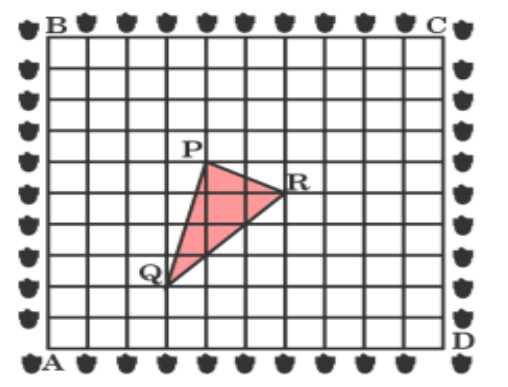
A garden is in the shape of a square. The gardener grew saplings of Ashoka tree on the boundary of the garden at the distance of $1 \text{ m}$ from each other. He wants to decorate the garden with rose plants. He chose a triangular region inside the garden to grow rose plants. In the above situation, the gardener took help from the students of class $10$. They made a chart for it which looks like the given figure.
Based on the above, answer the following questions :
(i) If A is taken as origin, what are the coordinates of the vertices of $\triangle PQR$?
(ii) (a) Find distances PQ and QR.
OR
(b) Find the coordinates of the point which divides the line segment joining points P and R in the ratio $2: 1$ internally.
(iii) Find out if $\triangle PQR$ is an isosceles triangle.
figure for this question
Show SolutionHide Solution
(i) $$\begin{aligned}& P (4,6), Q (3, 2), R (6, 5) \\ & (ii) (a) PQ = \sqrt{(4-3)^2 + (6 - 2)^2} = \sqrt{17} \\ & QR = \sqrt{(3 - 6)^2 + (2 - 5)^2} = \sqrt{18}\ \text{OR} \\ & (b) \text{ The coordinate of required point are } \left( \frac{6\times 2+1\times 4}{3}, \frac{5\times 2+1\times 6}{3} \right) \\ & \text{i.e. } \left( \frac{16}{3}, \frac{16}{3} \right) \\ & (iii) PQ = \sqrt{(4-3)^2 + (6-2)^2} = \sqrt{17} \\ & QR = \sqrt{(3 - 6)^2 + (2 - 5)^2} = \sqrt{18} \\ & PR = \sqrt{(4 - 6)^2 + (6-5)^2} = \sqrt{5} \\ & PQ \neq QR \neq PR \\ & \triangle PQR \text{ is not isosceles}\end{aligned}$$
1764 Marks · July 2025 · Standardopen ↗
Trees act the natural filters. By planting trees in and around school premises, we create cleaner and healthier air for students and local residents, reducing respiratory problems. A school in Noida has proposed and organised a community drive on tree plantation under the title "Save Earth, Plant Trees". Students of that school have planted saplings in the field such that it formed a quadrilateral as shown in the figure ABCD.
Based on the information given above, answer the following questions :
(i) Find the distance between the two saplings at A and D.
(ii) (a) One student plants one sapling at the mid-point of AD. Then he moves along a straight line parallel to DB and sows another sapling on AB. What are the coordinates of the positions of these two new saplings?
OR
(ii) (b) A new sapling is kept at a point M on DB such that DM : MB = $3:1$. Find the coordinates of M.
(iii) The line segments AC and BD bisect each other at P$(-2, 2)$. Find the coordinates of C.
figure for this question
Show SolutionHide Solution
(i) Observing the graph, coordinators of points are A $(-5, 9)$ and D $(-6, 1)$
AD = $\sqrt{(-6 + 5)^2 + (1 - 9)^2} = \sqrt{65}$
(ii) (a) Mid point of AD = $\left(\frac{-6-5}{2}, \frac{1+9}{2}\right)$ i.e. $\left(-\frac{11}{2}, 5\right)$
Student will sow another sapling at mid point of AB.
Point B is $(2, 3)$
Mid point of AB = $\left(\frac{2-5}{2}, \frac{3+9}{2}\right)$ i.e. $\left(-\frac{3}{2}, 6\right)$
OR
(b)
Coordinates of M = $\left(\frac{3 \times 2 + 1 \times (-6)}{3+1}, \frac{3 \times 3 + 1 \times 1}{3+1}\right)$
i.e. $\left(0, \frac{5}{2}\right)$
(iii) Coordinates of C are $(1, -5)$
figure for this question
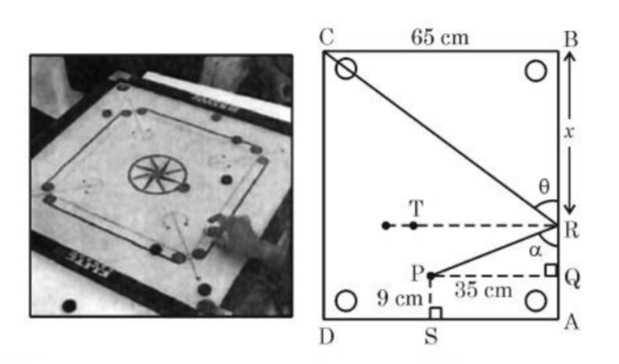
1774 Marks · March 2026 · Standardopen ↗
Carom board is a very popular game. The board is a square of side length $65$ cm. It has circular pockets in each corner.
Ansh strikes a disc, kept at position $P$ with a striker. The disc, hits the boundary of the board at $R$ and goes straight to pocket at corner $C$. It is given that $PS = 9$ cm, $PQ = 35$ cm, $BR = x$, $\angle PRQ = \alpha$ and $\angle CRB = \theta$.
Based on the above information, answer the following questions:
(i) Using law of reflection i.e. $\angle PRT = \angle CRT$, prove that $\theta = \alpha$.
(ii) Prove that $\triangle PQR \sim \triangle CBR$ given that $PQ$ is perpendicular to $AB$.
(iii) (a) Find the value of $x$ using similarity of triangles.
OR
(b) If $\frac{\text{Area } \triangle PQR}{\text{Area } \triangle CBR} = \frac{PQ^2}{CB^2}$, then find the value of $x$.
figure for this question
Show SolutionHide Solution
(i) $TR \perp AB$
$\therefore \alpha + \angle PRT = \theta + \angle TRC$
As $\angle PRT = \angle TRC$, so $\alpha = \theta$ (I) (1 Mark)
(ii) As $\theta = \alpha$, so $\angle PRQ = \angle CRB$
and $\angle PQR = \angle CBR = 90^\circ$
$\therefore \triangle PQR \sim \triangle CBR$ (I) (1 Mark)
(iii) (a) $\triangle PQR \sim \triangle CBR$
$\therefore \frac{PQ}{CB} = \frac{QR}{BR}$ (I) ($\frac{1}{2}$ Mark)
$\Rightarrow \frac{35}{65} = \frac{65-9-x}{x}$ (II) (1 Mark)
$\Rightarrow 35x = 65 (56 - x)$
$\Rightarrow x = 36.4$ cm (III) ($\frac{1}{2}$ Mark)
OR
(b) $\frac{\text{Ar. } \triangle PQR}{\text{Ar. } \triangle CBR} = \frac{PQ^2}{BC^2}$ (I) (1 Mark)
$\Rightarrow \frac{\frac{1}{2} \times 35 \times (65-x-9)}{\frac{1}{2} \times 65 \times x} = \frac{35 \times 35}{65 \times 65}$ (II) ($\frac{1}{2}$ Mark)
$\Rightarrow \frac{56-x}{x} = \frac{35}{65}$
$\Rightarrow x = 36.4$ cm (III) ($\frac{1}{2}$ Mark)
1784 Marks · March 2026 · Standardopen ↗
Observe the map of Jaipur city placed on a Cartesian plane. Taking Rambagh Palace as origin, the location of some places are given below :
Point A: $(-4, 2)$ Rajasthan High Court
Point B: $(4,-4)$ Birla Mandir
Point C: $(4, 3)$ Heera Bagh
Point D: $(-5, -2)$ Amar Jawan Jyoti
Based on the above, answer the following questions :
(i) Advocate Rehana stays at Heera Bagh. How much distance she has to cover daily to go to the court and coming back home?
(ii) There is a crossing on X-axis which divides AD in a certain ratio. Find the ratio.
(iii) (a) Is Birla Mandir equidistant from Heera Bagh and Amar Jawan Jyoti? Justify your answer.
OR
(b) Using section formula, show that points A, O and B are not collinear.
figure for this question
Show SolutionHide Solution
(i) Distance travelled $= 2 AC$
$= 2\sqrt{(-4-4)^2 + (2 - 3)^2}$ (I) ($\frac{1}{2}$ Mark)
$= 2\sqrt{64 + 1}$ (II) ($\frac{1}{2}$ Mark)
$= 2\sqrt{65}$
Hence, required distance is $2\sqrt{65}$ units.
(ii) Let the point $P(x, 0)$ divides $AD$ in the ratio $K : 1$
$\therefore AP: PD = K : 1$
Here, $0 = \frac{-2K+2}{K+1}$ (I) ($\frac{1}{2}$ Mark)
$\Rightarrow K = 1$ (II) ($\frac{1}{2}$ Mark)
$\therefore$ The required ratio is $1 : 1$
(iii) (a) $BC = \sqrt{(4 - 4)^2 + (-4 - 3)^2} = 7$ units (I) (1 Mark)
$BD = \sqrt{(4 + 5)^2 + (-4 + 2)^2} = \sqrt{85}$ units (II) (1 Mark)
$\therefore BC \neq BD$
$\therefore$ Birla Mandir is not equidistant from Heera Bagh and Amar Jawan Jyoti.
OR
(b) Let us assume that points $A, O, B$ are collinear and $AO : OB = K : 1$
Here, $0 = \frac{4K-4}{K+1}$ (I) ($\frac{1}{2}$ Mark)
$\Rightarrow K = 1$ (II) ($\frac{1}{2}$ Mark)
Also, $0 = \frac{-4K+2}{K+1}$ (III) ($\frac{1}{2}$ Mark)
$\Rightarrow K = \frac{1}{2}$ (IV) ($\frac{1}{2}$ Mark)
Since the value of $K$ is different in the above two cases, so points $A, O$ and $B$ are not collinear.
figure for this question
1794 Marks · March 2026 · Basicopen ↗
In the school garden, Arun (A), Babu (B), Chandra (C) and Daya (D) planted flower plants of Sunflower, Rose, Champa and Jasmine respectively at point A$(2, 8)$, B$(7, 8)$, C$(9, 3)$ and D$(2, 3)$ respectively.
Based on the above, answer the following questions :
(i) Find the distances AB and AD.
(ii) Find BC – CD.
(iii) (a) If Varun wants to plant his flower plant at a point M such that DM: MC = $3:2$, find the coordinates of M.
OR
(b) If N divides the line segment AC in the ratio $2: 3$, find the coordinates of N.
Show SolutionHide Solution
(i) $AB = \sqrt{(7-2)^2+(8-8)^2} = 5$ (0.5 Mark)
$AD = \sqrt{(2-2)^2+(3-8)^2} = 5$ (0.5 Mark)
(ii) $BC – CD = \sqrt{(9 – 7)^2 + (3 – 8)^2} - \sqrt{(9 – 2)^2 + (3 – 3)^2} = \sqrt{29} – 7$ (1 Mark)
(iii) (a) Let the coordinates of M be $(x, y)$
$x = \frac{3\times9+2\times2}{3+2} = \frac{31}{5}$ (1 Mark)
$y = \frac{3\times3+2\times3}{3+2} = 3$
$\therefore$ Coordinates of M are $(\frac{31}{5}, 3)$ (1 Mark)
OR
(b) Let the coordinates of N be $(x, y)$
$x = \frac{2\times9+3\times2}{2+3} = \frac{24}{5}$ (1 Mark)
$y = \frac{2\times3+3\times8}{2+3} = 6$
$\therefore$ Coordinates of N are $(\frac{24}{5}, 6)$ (1 Mark)

General

1 Mark Questions
1801 Mark · March 2025 · Standardopen ↗
If $7 \cos^2 \theta + 3 \sin^2 \theta = 4$, then the value of $\theta$ is :
  • (a)$30^\circ$
  • (b)$45^\circ$
  • (c)$60^\circ$
  • (d)$90^\circ$
Show SolutionHide Solution
(C) $60^\circ$
1811 Mark · March 2025 · Standardopen ↗
The equation of a line parallel to y-axis and at a distance of $5$ units to the right of y-axis is :
  • (a)$x = 5$
  • (b)$x = -5$
  • (c)$y = 5$
  • (d)$y = -5$
Show SolutionHide Solution
(A) $x = 5$