Solve the following system of equations algebraically : $30x+44y = 10$; $40x+55y = 13$
Show SolutionHide Solution↓
Given equations can be rewritten as $120 x + 176 y = 40$ ...(i) $120 x + 165 y = 39$ ...(ii) Subtracting to get $y = \frac{1}{11}$ Substituting to get $x = \frac{1}{5}$
Solve the following pair of equations algebraically: $101x + 102y = 304$, $102x + 101y = 305$
Show SolutionHide Solution↓
Adding equations we get $x+y=3$ ($\frac{1}{2}$ mark). Subtracting equations we get $-x+y=-1$ ($\frac{1}{2}$ mark). Solving to get $x=2$ and $y=1$ ($\frac{1}{2} + \frac{1}{2}$ marks).
Find the values of $x$ and $y$ from the following pair of linear equations : $62x+43y = 167$ $43x + 62y = 148$
Show SolutionHide Solution↓
$62 x + 43y = 167$ ...(i) $43 x + 62 y = 148$ ...(ii) Adding (i) and (ii) and simplifying, we get $x + y = 3$ ...(iii) Subtracting (ii) from (i) and simplifying, we get $x - y = 1$ ...(iv) Solving (iii) and (iv) to get $x = 2$ and $y = 1$
Solve the following pair of linear equations : $31x+43y-117 = 0$; $43x + 31y = 105$
Show SolutionHide Solution↓
$31x + 43y = 117$ ........ (i) $43x + 31y = 105$ ........ (ii) Adding (i) and (ii) we get $74x + 74y = 222 \Rightarrow x + y = 3$ ............(iii) (1 Mark) Subtracting (i) and (ii) we get $-12x + 12y = 12$ or $- x + y = 1$ ............(iv) (1 Mark) Solving (iii) and (iv) $x = 1, y = 2$ (1 Mark)
Assertion (A): The pair of linear equations $px + 3y + 59 = 0$ and $2x + 6y + 118 = 0$ will have infinitely many solutions if $p = 1$. Reason (R): If the pair of linear equations $px + 3y + 19 = 0$ and $2x + 6y + 157 = 0$ has a unique solution, then $p \neq 1$.
(a)Both Assertion (A) and Reason (R) are true and Reason (R) is the correct explanation of the Assertion (A).
(b)Both Assertion (A) and Reason (R) are true, but Reason (R) is not the correct explanation of the Assertion (A).
(c)Assertion (A) is true, but Reason (R) is false.
(d)Assertion (A) is false, but Reason (R) is true.
Show SolutionHide Solution↓
(B) Both Assertion (A) and Reason (R) are true, but Reason (R) is not the correct explanation of the Assertion (A).
Assertion (A): The system of linear equations $3x - 5y + 7 = 0$ and $-6x+10 y + 14 = 0$ is inconsistent. Reason (R) : When two linear equations don't have unique solution, they always represent parallel lines.
Show SolutionHide Solution↓
(C) Assertion (A) is true, but Reason (R) is false. (1 Mark)
If pair of linear equations given by $a_1x + b_1y + c_1 = 0$ and $a_2x + b_2y + c_2 = 0$ has infinitely many solutions, then which of the following is definitely true ?
Assertion (A) : The value of p for which the system of equations $4x + py + 8 = 0$ and $2x + 2y + 2 = 0$ is consistent is $4$. Reason (R) : The system of equations $a_1x + b_1y = c_1$ and $a_2x + b_2y = c_2$ is consistent with infinitely many solutions, if $\frac{a_1}{a_2} = \frac{b_1}{b_2} = \frac{c_1}{c_2}$.
(a)Both Assertion (A) and Reason (R) are true and Reason (R) is the correct explanation of Assertion (A).
(b)Both Assertion (A) and Reason (R) are true, but Reason (R) is not the correct explanation of Assertion (A).
(c)Assertion (A) is true, but Reason (R) is false.
(d)Assertion (A) is false, but Reason (R) is true.
Show SolutionHide Solution↓
(D) Assertion (A) is false, but Reason (R) is true.
Find the value(s) of $k$ for which the pair of linear equations $kx + y = k^2$; $x + ky = 1$ have infinitely many solutions.
Show SolutionHide Solution↓
For infintiely many solutions $\frac{k}{1} = \frac{1}{k} = \frac{k^2}{1}$ $\Rightarrow k^2 = 1$ and $k^3 = 1$ $\Rightarrow k = \pm 1$ and $k = 1$ $\therefore k = 1$
Prove that the system of equations given as $2x-3y = 7$ and $4x + ky = 9$, is inconsistent for $k = -6$. Also, obtain the solution of the system of equations, if $k = -1$.
Show SolutionHide Solution↓
$\frac{a_1}{a_2} = \frac{2}{4} = \frac{1}{2}$, $\frac{b_1}{b_2} = \frac{-3}{k}$, $\frac{c_1}{c_2} = \frac{7}{9}$ For $k = -6$, $\frac{b_1}{b_2} = \frac{-3}{-6} = \frac{1}{2}$ (1/2 Mark) $:: \frac{a_1}{a_2} = \frac{b_1}{b_2} \neq \frac{c_1}{c_2}$ $:::$ system of equations is inconsistent (1/2 Mark) For $k = -1$, the system of equations is $2x - 3y = 7$ $4x - y = 9$ solving, we get $x = 2$ and $y = -1$ (1/2+1/2 Mark)
If the system of linear equations $2x + 3y = 7$ and $2ax + (a + b)y = 28$ have infinite number of solutions, then find the values of 'a' and 'b'.
Show SolutionHide Solution↓
system has infinite number of solutions $\therefore \frac{2}{2a} = \frac{3}{a + b} = \frac{7}{28}$ $\Rightarrow \frac{1}{a} = \frac{1}{4} \Rightarrow a = 4$ and $a + b = 12 \Rightarrow b = 8$
893 Marks · 🔁 March 2023 & March 2025 · Basicopen ↗
A fraction becomes $\frac{1}{3}$, when $1$ is subtracted from the numerator and it becomes $\frac{1}{4}$, when $8$ is added to its denominator. Find the fraction.
Show SolutionHide Solution↓
Let the fraction be $\frac{x}{y}$ [$\frac{1}{2}$ mark] $\frac{x - 1}{y} = \frac{1}{3} \Rightarrow 3x - y = 3 \dots (i)$ [$\frac{1}{2}$ mark] $\frac{x}{y + 8} = \frac{1}{4} \Rightarrow 4x - y = 8 \dots (ii)$ [$\frac{1}{2}$ mark] On solving the equations $(i)$ and $(ii)$, we get $x = 5, y = 12$ [$1$ mark] Required fraction is $\frac{5}{12}$ [$\frac{1}{2}$ mark]
For what values of $m$ and $n$, does the following pair of linear equations have infinitely many solutions ? $2x + 3y = 7$; $m(x + 2y) + n(x - y) = 21$
Show SolutionHide Solution↓
For infinitely many solutions, we have $\frac{2}{m+n} = \frac{3}{2m-n} = \frac{7}{21} = \frac{1}{3} \implies m + n = 6, 2m - n = 9$. Solving the above two equations, we get $m = 5, n = 1$
Find the value of $k$ for which the following pair of linear equations will have infinitely many solutions : $kx + 3y - (k - 3) = 0$ and $12x + ky - k = 0$ Hence, find any two solutions of the given pair of equations.
Show SolutionHide Solution↓
For infinitely many solutions: $\frac{k}{12} = \frac{3}{k} = \frac{k - 3}{k}$ [$1$ mark] $k^2 = 36$ and $k^2 - 3k = 3k$ $(k = \pm 6)$ and $(k = 6, 0)$ $\therefore k = 6$ [$1$ mark] For $k = 6$, equations are $6x + 3y = 3$ and $12x + 6y = 6$ any two correct solutions [$\frac{1}{2} + \frac{1}{2}$ mark]
Draw the graph of the following equations: $x + y = 5, x - y = 5$, and (i) find the solution of the equations from the graph. (ii) shade the triangular region formed by the lines and the $y$-axis.
Show SolutionHide Solution↓
Correct graph of line for equation $x + y = 5$. Correct graph of line for equation $x - y = 5$. (i) $(5, 0)$ (ii) Correct shade the required triangular region.
An academy offering cricket coaching bought $10$ bats and $5$ balls for ₹32,500. Later, the academy bought $2$ bats and $8$ balls for ₹10,000. If there is no change in the cost of the bat and of the ball, find the cost of $1$ bat and $1$ ball.
Show SolutionHide Solution↓
Let the cost of $1$ bat be $\text{Rs}x$ and the cost of $1$ ball be $\text{Rs}y$ A.T.Q. $10x + 5y = 32500$ or $2x + y = 6500$ -------(i) [1 mark] $2x + 8y = 10000$ or $2x + 8y = 10000$ ----(ii) [1 mark] Solving (i) and (ii) to get $x = 3000$ and $y = 500$ [1/2 + 1/2 mark] Cost of $1$ bat = ₹3,000 Cost of $1$ ball = ₹500
$x$ and $y$ are complementary angles such that $x : y = 1 : 2$. Express the given information as a system of linear equations in two variables and hence solve it.
Show SolutionHide Solution↓
$x + y = 90^{\circ}$ $2x = y$ Solving to get $x = 30^{\circ}, y = 60^{\circ}$
Check graphically whether the pair of linear equations $2x + 3y = 12$; $5x - 3y = 9$ is consistent. If so, solve it graphically.
Show SolutionHide Solution↓
Correct graph of $2x + 3y = 12$ Correct graph of $5x - 3y = 9$ As lines are intersecting, therefore given system of linear equations is consistent. Solution is $x = 3, y = 2$
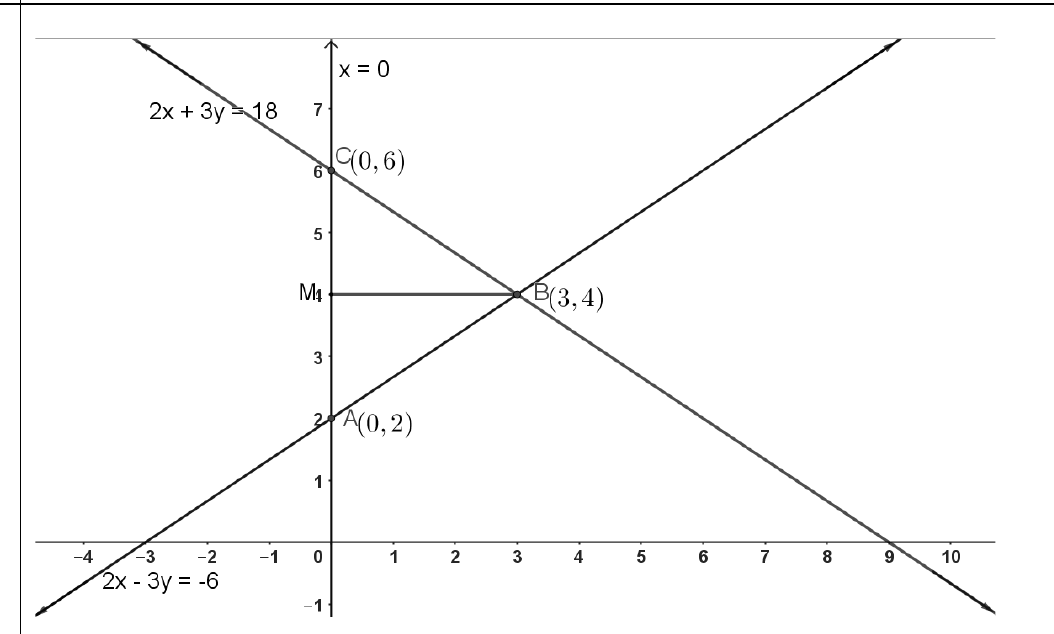
Determine graphically, the coordinates of vertices of a triangle whose equations are $2x-3y+6=0$; $2x+3y-18=0$ and $x = 0$. Also, find the area of this triangle.
Show SolutionHide Solution↓
Correct graph of the line $2x - 3y + 6 = 0$ (1 Mark) Correct graph of the line $2x + 3y - 18 = 0$ (1 Mark) Correct graph of the line $x = 0$ (1/2 Mark) Coordinates of vertices of the triangle are $A(0,2)$, $B(3,4)$ and $C(0,6)$ (1.5 Marks) Area of $\triangle ABC = \frac{1}{2} \times 4 \times 3 = 6$ sq. units (1 Mark)
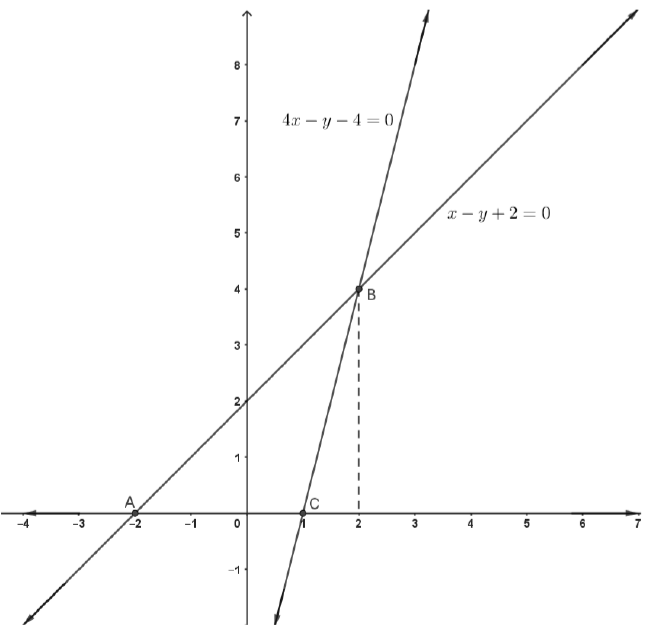
Draw the graph of the pair of linear equations $x-y+2=0$ and $4x-y-4=0$. Calculate the area of the triangle formed by the lines so drawn and the x-axis.
Show SolutionHide Solution↓
Correct graph of the equation $4x - y - 4 = 0$ (I) (2 Marks) Correct graph of the equation $x - y + 2 = 0$ (II) (2 Marks) Area of the required triangle $ABC = \frac{1}{2} \times 3 \times 4 = 6$ sq. units (III) (1 Mark)
Nidhi received simple interest of ₹1,200 when invested $\text{\text{Rs} } x$ at $6\% \text{ p.a.}$ and $\text{\text{Rs} } y$ at $5\% \text{ p.a.}$ for 1 year. Had she invested $\text{\text{Rs} } x$ at $3\% \text{ p.a.}$ and $\text{\text{Rs} } y$ at $8\% \text{ p.a.}$ for that year, she would have received simple interest of ₹1,260. Find the values of $x$ and $y$.
3 chairs and 1 table cost ₹900; whereas 5 chairs and 3 tables cost ₹2,100. If the cost of 1 chair is $x$ and the cost of 1 table is $y$, then the situation can be represented algebraically as
The sum of the age (in years) of a father and three times the age of his daughter is 59. If the age of the father is $x$ years and that of his daughter is $y$ years, the equation representing the given information is :
Sum of two numbers is $105$ and their difference is $45$. Find the numbers.
Show SolutionHide Solution↓
Let the numbers be $x, y (x > y)$ $x + y = 105 \dots (i)$ $x - y = 45 \dots (ii)$ on solving (i) and (ii) $x=75 \& y = 30$ $\therefore$ Numbers are $75, 30$
The cost of 2 kg apples and 1 kg of grapes on a day was found to be ₹ 320. The cost of 4 kg apples and 2 kg grapes was found to be ₹ 600. If cost of 1 kg of apples and 1 kg of grapes is ₹ $x$ and ₹ $y$ respectively, represent the given situation algebraically as a system of equations and check whether the system so obtained is consistent or not.
Show SolutionHide Solution↓
$2x + y = 320$ $4x + 2y = 600$ Here, $\frac{a_1}{a_2} = \frac{2}{4} = \frac{1}{2}$, $\frac{b_1}{b_2} = \frac{1}{2}$, $\frac{c_1}{c_2} = \frac{320}{600} = \frac{8}{15}$ As $\frac{a_1}{a_2} = \frac{b_1}{b_2} \neq \frac{c_1}{c_2}$ $\therefore$ System of equations is not consistent.
In a pair of supplementary angles, the greater angle exceeds the smaller by $50^\circ$. Express the given situation as a system of linear equations in two variables and hence obtain the measure of each angle.
Show SolutionHide Solution↓
Let smaller angle be $x$ and greater angle be $y$. ATQ, $x+y=180$ ($\frac{1}{2}$ mark). Also $y=x+50$ ($\frac{1}{2}$ mark). Solving we get $x=65^\circ$ and $y=115^\circ$ ($\frac{1}{2} + \frac{1}{2}$ marks).
The age of the father is twice the sum of the ages of his two children. After $20$ years, his age will be equal to the sum of the ages of his children. Find the present age of the father.
Show SolutionHide Solution↓
Let the present age of the father be '$x$' years and the sum of present ages of his two children be '$y$' years A.T.Q. $x = 2y$ ----- (1) $x + 20 = y + 40$ ----- (2) Solving (1) and (2), we get $x = 40$ Hence, the present age of the father is $40$ years.
In a $\triangle ABC$, $\angle A = x^\circ$, $\angle B = (3x-2)^\circ$ and $\angle C = y^\circ$. Also, $\angle C - \angle B = 9^\circ$. Determine the three angles of the triangle.
Show SolutionHide Solution↓
$\angle A + \angle B + \angle C = 180^\circ$ $\therefore x + (3x - 2) + y = 180$ $\Rightarrow 4x + y = 182$ -----(1) (1 Mark) Given, $\angle C - \angle B = 9^\circ$ $\therefore y - (3x - 2) = 9$ $\Rightarrow y-3x = 7$ -----(2) (1/2 Mark) Solving (1) and (2), we get $x = 25$ and $y = 82$ (1 Mark) Hence, $\angle A = 25^\circ$, $\angle B = (3 \times 25 - 2)^\circ = 73^\circ$ and $\angle C = 82^\circ$ (1/2 Mark)
Half of the difference between two numbers is 2. The sum of the greater number and twice the smaller number is 13. Find the numbers.
Show SolutionHide Solution↓
Let the numbers be $x$ and $y$, $x > y$ Therefore $\frac{1}{2} (x - y) = 2$ — (i) and $2y + x = 13$ — (ii) Solving equations (i) and (ii) $x = 7, y = 3$
Jaya scored $40$ marks in a test getting $3$ marks for each correct answer and losing $1$ mark for each incorrect answer. Had $4$ marks being awarded for each correct answer and $2$ marks were deducted for each incorrect answer then Jaya again would have scored $40$ marks. How many questions were there in the Test?
Show SolutionHide Solution↓
Let number of questions answered correctly be $$\begin{aligned}& x \\ & \text{and number of questions answered wrong be } y \\ & \text{Therefore } 3x - y = 40 \quad \text{(i)} \\ & \text{and } 4x - 2y = 40 \quad \text{(ii)} \\ & \text{solving, } x = 20, y = 20 \\ & \text{Total number of questions } = x + y = 40\end{aligned}$$
Two people are $16$ km apart on a straight road. They start walking at the same time. If they walk towards each other with different speeds, they will meet in $2$ hours. Had they walked in the same direction with same speeds as before, they would have met in $8$ hours. Find their walking speeds.
Show SolutionHide Solution↓
Let walking speeds be $x$ km/hr. and $y$ km/hr. $(x > y)$ ATQ, $2x + 2y = 16$ and $8x - 8y = 16$ Solving to get $x = 5, y = 3$ Speeds are $5$ km/hr. $3$ km/hr.
A $2$-digit number is seven times the sum of its digits. The number formed by reversing the digits is $18$ less than the given number. Find the given number.
Show SolutionHide Solution↓
Let unit's digit be $x$ and ten's digit be $y$. $\therefore$ Number $= 10y + x$ According to the first condition: $10y + x = 7(x + y)$ $10y + x = 7x + 7y$ $3y - 6x = 0$ $y = 2x$ (i) According to the second condition: Number formed by reversing digits is $10x + y$. $10x + y = (10y + x) - 18$ $10x + y - 10y - x = -18$ $9x - 9y = -18$ $x - y = -2$ $y - x = 2$ (ii) On solving (i) and (ii): Substitute (i) into (ii): $2x - x = 2 \Rightarrow x = 2$ Substitute $x=2$ into (i): $y = 2(2) = 4$ $\therefore$ required number is $10(4) + 2 = 42$
The sum of the digits of a $2$-digit number is $12$. Seven times the number is equal to four times the number obtained by reversing the order of the digits. Find the number.
Show SolutionHide Solution↓
Let the unit's place digit be $x$ and ten's place digit be $y$ $\therefore$ Number $= 10y + x$ According to question, $x + y = 12$ ...(i) and $7(10y + x) = 4(10x + y)$ $x - 2y = 0$ ...(ii) Solving (i) and (ii), we get $x = 8$ and $y = 4$ Hence, the required number is $48$
Places A and B are $160$ km apart on a highway. One car starts from A and another from B at the same time. If the cars travel in the same direction at different speeds, they meet in $4$ hours. If they travel towards each other, they meet in $1$ hour $36$ minutes. What are the speeds of the two cars ?
Show SolutionHide Solution↓
Let the speed of two cars be $x$ km/h $\& y$ km/h respectively ($x > y$). Therefore $4x - 4y = 160$ or $x - y = 40$ ----- (i) $1$ hour $36$ minutes = $1.6$ hours $\therefore 1.6x + 1.6y = 160$ or $x + y = 100$ ----- (ii) Solving (i) and (ii), we have $x = 70$ and $y = 30$ $\therefore$ speed of two cars are $70$ km/h and $30$ km/h respectively.
Three years ago, Rashmi was thrice as old as Nazma. Ten years later, Rashmi will be twice as old as Nazma. How old are Rashmi and Nazma now?
Show SolutionHide Solution↓
Let present age of Rashmi and Nazma be $x$ years and $y$ years respectively. Therefore, $x - 3 = 3 (y - 3)$ or $x - 3y + 6 = 0$ and $x + 10 = 2 (y + 10)$ or $x - 2y - 10 = 0$ Solving equations to get $x = 42, y = 16$ $\therefore$ Present age of Rashmi is $42$ years and that of Nazma is $16$ years.
In a chemistry lab, there is some quantity of $50\%$ acid solution and some quantity of $25\%$ acid solution. How much of each should be mixed to make $10$ litres of $40\%$ acid solution ?
Show SolutionHide Solution↓
Let quantity of $50\%$ and of $25\%$ acid solution be '$x$'L and '$y$'L respectively. Therefore, $x + y = 10$ ----- (i) and $\frac{50}{100} \times x + \frac{25}{100} \times y = \frac{40}{100} \times 10$ or $2x + y = 16$ ----- (ii) Solving (i) and (ii) to get $x = 6, y = 4$ Hence, $6$L of $50\%$ and $4$L of $25\%$ acid solution are mixed.
The sum of the digits of a 2-digit number is 14. The number obtained by interchanging its digits exceeds the given number by 18. Find the number.
Show SolutionHide Solution↓
Let the required number be $10x + y$ Here $x + y = 14$ ----- (i) and $10y + x = 18 + 10x + y$ $\Rightarrow y - x = 2$ ---- (ii) Solving (i) and (ii) to get $x = 6, y = 8$ $\therefore$ required number is $68$.
Rehana went to a bank to withdraw ₹2,000. She asked the cashier to give her ₹50 and ₹100 notes only. Rehana got $25$ notes in all. Find how many notes of ₹50 and ₹100 did she receive.
Show SolutionHide Solution↓
Let number of ₹50 notes $$\begin{aligned}& = x \\ & \text{and number of } \text{Rs}100 \text{ notes } = y \\ & \text{Here } x + y = 25 ------(i) \\ & 50x + 100y = 2000 \text{ or } x + 2y = 40 -------(ii) \\ & \text{Solving eq.(i) and eq.(ii), we get} \\ & x = 10 \text{ and } y = 15 \\ & \text{Therefore } 10 \text{ notes of } \text{Rs}50 \text{ and } 15 \text{ notes of } \text{Rs}100 \text{ are received.}\end{aligned}$$
A part of monthly hostel charges is fixed and the remaining depends on the number of days one has taken food in the mess. When a student A takes food for $20$ days, she has to pay ₹1,500 as hostel charges while another student B, who takes food for $26$ days, pays ₹1,800. Find the fixed charges and the cost of food.
Show SolutionHide Solution↓
Let the monthly fixed charges of hostel be $x$ and cost of food be $y$ per day. A.T.Q $x + 20y = 1500$ ---------(i) $x + 26y = 1800$ ---------(ii) Solving equations (i) & (ii) $x = 500, y = 50$ Hence, the monthly fixed charges of hostel be ₹500 and cost of food be ₹50 per day.
The monthly incomes of A and B are in the ratio $8 : 7$ and their expenditures are in the ratio $19 : 16$. If each saves ₹2500 per month, find the monthly income of each.
Show SolutionHide Solution↓
Let the monthly incomes of A and B be $\text{Rs}8x$ and $\text{Rs}7x$ respectively and the expenditures of A and B be $\text{Rs}19y$ and $\text{Rs}16y$ respectively. A.T.Q. $$\begin{aligned}& 8x - 19y = 2500 \dots (1) \\ & 7x - 16y = 2500 \dots (2) \\ & Solving (1)\end{aligned}$$ and $(2)$, we have $x = 1500\ \therefore$ Monthly income of A = $8 \times 1500 = 12000\\$and monthly income of B = $7 \times 1500 = 10500\ \therefore$ monthly incomes of A and B are ₹12000 and ₹10500 respectively.
The ratio of monthly incomes of two persons is $11 : 7$ and the ratio of their monthly expenditures is $9 : 5$. If each of them saves ₹400 per month, find their monthly incomes.
Show SolutionHide Solution↓
Let the monthly income of two persons be $\text{Rs}11x$ & $\text{Rs}7x$ and monthly expenditure be $\text{Rs}9y$ & $\text{Rs}5y$ Therefore, $11x - 9y = 400$ --- (1) $7x – 5y = 400$ --- (2) Solving (1) and (2), we get $x = 200$ $\therefore$ monthly income of two persons are ₹2200 and ₹1400
The monthly incomes of two persons are in the ratio $9: 7$ and their monthly expenditures are in the ratio $4: 3$. If each saved ₹5,000, express the given situation algebraically as a system of linear equations in two variables. Hence, find their respective monthly incomes.
Show SolutionHide Solution↓
Let us assume that income of two persons be $\text{Rs} 9x$ and $\text{Rs} 7x$ and their expenditures be $\text{Rs} 4y$ and $\text{Rs} 3y$ ATQ $9x-4y = 5000$ and $7x - 3y = 5000$ Solving the two equations, we get $x = 5000$ $\therefore$ Monthly incomes of two persons are ₹45000 and ₹35000 respectively.
The two angles of a right angled triangle other than $90^{\circ}$ are in the ratio $2:3$. Express the given situation algebraically as a system of linear equations in two variables and hence solve it.
Show SolutionHide Solution↓
Let the measures of two angles be $x$ and $y$ $ATQ$ $x + y = 90^{\circ} \dots (i)$ and $\frac{x}{y} = \frac{2}{3} \implies 3x - 2y = 0 \dots (ii)$ Solving (i) and (ii), we get $x = 36^{\circ}, y = 54^{\circ}$
The perimeter of a rectangle is $70$ cm. The length of the rectangle is $5$ cm more than twice is breadth. Express the given situation as a system of linear equations in two variables and hence solve it.
Show SolutionHide Solution↓
Let the length and breadth of rectangle be $x$ and $y$ respectively. ATQ $x + y = 35 \dots (i)$ and $x - 2y = 5 \dots (ii)$. Solving (i) and (ii), we get $x = 25$ and $y = 10$. Hence the length and breadth of rectangle are $25$ cm and $10$ cm respectively.
The sum of the numerator and the denominator of a fraction is $4$ more than twice the numerator. If the numerator and denominator are increased by $3$, they are in the ratio $2 : 3$. Determine the fraction.
Show SolutionHide Solution↓
Let the fraction be $\frac{x}{y}, y \neq 0 \therefore x + y = 4 + 2x \implies y = x + 4$ ----- (i) And $\frac{x+3}{y+3} = \frac{2}{3} \implies 3x - 2y + 3 = 0$ ------- (ii) Solving (i) and (ii), we get $x = 5, y = 9 \therefore$ Fraction is $\frac{5}{9}$
In a class test, Veer scored $6$ more than twice as many marks as Kevin scored. If one of them had scored $4$ more marks, their total score would have been $40$. Find the marks obtained by Veer and Kevin.
Show SolutionHide Solution↓
Let the marks obtained by Veer and Kevin be $V$ and $K$ respectively. According to the question, $V = 2K + 6$ .... (i) (I) (1 Mark) $V + K + 4 = 40$ .... (ii) (II) (1 Mark) Solving (i) and (ii) we get, $V = 26$ and $K = 10$ (III) ($\frac{1}{2}+\frac{1}{2}$ Mark) $\therefore$ Veer obtained $26$ marks and Kevin obtained $10$ marks.
One of the supplementary angles exceeds the other by $120^\circ$. Express the given information as a system of linear equations in two variables. Hence, find the measure of both the angles.
Show SolutionHide Solution↓
Let the angles be $x$ and $y$ $x + y = 180^\circ$ (1 Mark) $x - y = 120^\circ$ (1 Mark) solving we get $x = 150^\circ$ (1/2 Mark) $y = 30^\circ$ (1/2 Mark)
When $1$ is subtracted from the numerator and $2$ is added to the denominator of a fraction, it becomes $\frac{1}{2}$. When $7$ is subtracted from the numerator and $2$ is subtracted from the denominator, the fraction becomes $\frac{1}{3}$. Find the fraction.
Show SolutionHide Solution↓
Let numerator be $x$ and denominator be $y$ $\therefore$ fraction is $\frac{x}{y}$ $\frac{x-1}{y+2} = \frac{1}{2} \Rightarrow 2x - y = 4$ ............(i) (1 Mark) and $\frac{x-7}{y-2} = \frac{1}{3} \Rightarrow 3x - y = 19$ ............(ii) (1 Mark) Solving (i) and (ii), we get $x = 15, y = 26$ (1 Mark) $\Rightarrow$ fraction is $\frac{15}{26}$
Two schools 'P' and 'Q' decided to award prizes to their students for two games of Hockey $x$ per student and Cricket $y$ per student. School 'P' decided to award a total of ₹$9,500$ for the two games to $5$ and $4$ students respectively; while school ‘Q’ decided to award ₹$7,370$ for the two games to $4$ and $3$ students respectively. Based on the above information, answer the following questions : (i) Represent the following information algebraically (in terms of $x$ and $y$). (ii) (a) What is the prize amount for hockey ? OR (b) Prize amount on which game is more and by how much ? (iii) What will be the total prize amount if there are $2$ students each from two games ?
Show SolutionHide Solution↓
(i) $5x + 4y = 9500$ dots (1) $4x + 3y = 7370$ dots (2) (ii) (a) Solving (1) and (2), $x = 980$ $\therefore$ Prize Amount for Hockey = ₹$980$ OR (ii) (b) On solving $x = 980, y = 1,150$ $\therefore$ Prize Amount for Cricket is more by ₹$(1,150 – 980) = \text{Rs} 170$ (iii) $2(x + y) = 2(980 + 1150) = 2(2130) = \text{Rs} 4,260$
A coaching institute of Mathematics conducts classes in two batches I and II and fees for rich and poor children are different. In batch I, there are 20 poor and 5 rich children, whereas in batch II, there are 5 poor and 25 rich children. The total monthly collection of fees from batch I is ₹9000 and from batch II is ₹26,000. Assume that each poor child pays $x$ per month and each rich child pays $y$ per month. Based on the above information, answer the following questions : (i) Represent the information given above in terms of $x$ and $y$. (ii) Find the monthly fee paid by a poor child. OR Find the difference in the monthly fee paid by a poor child and a rich child. (iii) If there are 10 poor and 20 rich children in batch II, what is the total monthly collection of fees from batch II ?
Show SolutionHide Solution↓
(i) $20x + 5y = 9000$ $5x + 25y = 26000$ (ii) Solving the equations $x = 200$ Monthly fee paid by poor child = ₹200 OR (ii) getting $x=200$ and $y= 1000$ Difference in the fee = $1000 - 200 = \text{Rs}800$ (iii) $10x + 20y = 10(200) + 20(1000)$ $= \text{Rs}22000$
A school is organizing a grand cultural event to show the talent of its students. To accommodate the guests, the school plans to rent chairs and tables from a local supplier. It finds that rent for each chair is ₹50 and for each table is ₹200. The school spends ₹30,000 for renting the chairs and tables. Also, the total number of items (chairs and tables) rented are $300$. If the school rents 'x' chairs and 'y' tables, answer the following questions : (i) Write down the pair of linear equations representing the given information. (ii) (a) Find the number of chairs and number of tables rented by the school. OR (b) If the school wants to spend a maximum of ₹27,000 on $300$ items (tables and chairs), then find the number of chairs and tables it can rent. (iii) What is maximum number of tables that can be rented in ₹30,000 if no chairs are rented?
Show SolutionHide Solution↓
(i) $x + y = 300$ and $50 x + 200 y = 30000$ or $x + 4y = 600$ (ii) (a) $x + y = 300$ and $x + 4y = 600$ Solving the equations, we get $x = 200$ and $y = 100$ $\therefore$ Number of chairs and tables rented by the school are $200$ and $100$ respectively. OR (b) $x + y = 300$ and $50x + 200y = 27000$ or $x + 4y = 540$ Solving the equations, we get $x = 220$ and $y = 80$ $\therefore$ Number of chairs and tables rented by the school are $220$ and $80$ respectively. (iii) Number of tables $= \frac{30000}{200} = 150$ $\therefore$ Maximum number of tables that can be rented is $150$ if no chairs are rented.
The sum of the digit at tens place and twice the digit at unit place of a $2$-digit number is $16$. The sum of the number and the number obtained by reversing the digits is $121$. Express the given information as a system of linear equations in two variables. Hence, find the original number.
Show SolutionHide Solution↓
Let the digit at unit place be $x$ and at tens place be $y$ $\therefore 2x + y = 16$ ------ (1) (1/2 Mark) Original Number $= 10y + x$ (1/2 Mark) Reverse number $= 10x + y$ (1/2 Mark) $10y + x + 10x + y = 121$ $11x + 11y = 121$ or $x + y = 11$ ------ (2) (1/2 Mark) Solving (1) and (2), we get $x = 5$ and $y = 6$ (1 + 1/2 Mark) The original number is $65$. (1/2 Mark)
In Indian wedding ceremonies, grooms often wear garlands made with currency notes given by the relatives. One such garland (note mala) is made up of ₹200 and ₹500 notes. The total number of currency notes used in the garland is 40 and the total value of currency notes is ₹11,000. Express the given information algebraically as a system of linear equations in two variables. Hence, find the number of notes of each type used to make the garland.
Show SolutionHide Solution↓
Let number of ₹200 notes be $x$ Let number of ₹500 notes be $y$ } (1/2 Mark) $x + y = 40$ --- (1) (1/2 Mark) $2x + 5y = 110$ --- (2) (1/2 Mark) Solving (1) and (2) we get $x = 30$ and $y = 10$ (1/2 Mark)
Tara scored $40$ marks in a test, getting $3$ marks for each right answer and losing $1$ mark for each wrong answer. Had $4$ marks been awarded for each correct answer and $2$ marks been deducted for each wrong answer, then Tara would have scored $50$ marks. Assuming that Tara attempted all questions, find the total number of questions in the test.
Show SolutionHide Solution↓
Let number of correct answers be $x$ and number of incorrect answers be $y$ $3x - y = 40$ $4x - 2y = 50$ Solving, we get $x = 15, y = 5$ $\therefore$ Total number of questions $= 20$
If the length of a rectangle is reduced by $5$ cm and its breadth is increased by $2$ cm, then the area of the rectangle is reduced by $80$ cm$^2$. However, if we increase the length by $10$ cm and decrease the breadth by $5$ cm, its area is increased by $50$ cm$^2$. Find the length and breadth of the rectangle.
Show SolutionHide Solution↓
Let the length of rectangle be $x$ cm and the breadth be $y$ cm Area of rectangle = $xy$ ($\frac{1}{2}$) $(x-5) (y+2) = xy - 80 \Rightarrow 2x - 5y + 70 = 0$ (1$\frac{1}{2}$) $(x+10) (y-5) = xy + 50 \Rightarrow -5x + 10 y - 100 = 0$ (1$\frac{1}{2}$) Solving the two equations, we get $x = 40$ and $y = 30$ (1$\frac{1}{2}$) $\therefore$ Length of rectangle = $40$ cm and Breadth of rectangle = $30$ cm
If three times the greater of two numbers is divided by the smaller one, we get 4 as the quotient and 3 as the remainder. Also, if seven times the smaller number is divided by greater one, we get 5 as the quotient and 1 as the remainder. Find the numbers.
Show SolutionHide Solution↓
Let the smaller number be $x$ and the greater number be $y$ $3y = 4x + 3$ ... (i) $7x = 5y + 1$ ... (ii) Solving (i) and (ii), we get $x = 18, y = 25$ $\therefore$ Smaller number is 18 and greater number is 25
A 2-digit number is obtained by either multiplying the sum of the digits by $7$ and then adding $3$ or by multiplying the difference of the digits by $19$ and then subtracting $1$. It is given that the digit at ten's place is greater than that of unit's place. Find the 2-digit number.
Show SolutionHide Solution↓
Let the unit's place digit be $y$ and ten's digit be $x$. So, number be $10x + y$ Therefore, $10x + y = 7 (x + y) + 3$ $\Rightarrow x - 2y = 1$ --- (1) Also, $10x + y = 19 (x - y) - 1$ $\Rightarrow -9x + 20y = -1$ --- (2) Solving (1) and (2), we get $x = 9, y = 4$ $\therefore$ the required number is $94$.
Vijay invested certain amounts of money in two schemes A and B, which offer interest at the rate of $8\%$ per annum and $9\%$ per annum, respectively. He received ₹ $1860$ as the total annual interest. However, had he interchanged the amounts of investments in the two schemes, he would have received ₹ $20$ more as annual interest. How much money did he invest in each scheme?
Show SolutionHide Solution↓
Let $x$ be invested at $8\%$ and $y$ at $9\%$. $\frac{8x}{100} + \frac{9y}{100} = 1860 \implies 8x + 9y = 186000$. $\frac{9x}{100} + \frac{8y}{100} = 1880 \implies 9x + 8y = 188000$. Solving, $x = 12000, y = 10000$.
The perimeter of an isosceles triangle is $32 \operatorname{cm}$. If each equal side is $\frac{5}{6}$ th of the base, find the area of the triangle.
Show SolutionHide Solution↓
Let each equal side of triangle be $x$ and base be $y$ ATQ, $x + x + y = 32$ $2x + y = 32$ Also, $x = \frac{5}{6} y$ On solving these equations, we get $x = 10$ and $y = 12$ $\therefore$ sides of the triangle are $10 \operatorname{cm}, 10 \operatorname{cm}, 12 \operatorname{cm}$ Semi - perimeter of the triangle $= 16 \operatorname{cm}$ Area of the triangle $= \sqrt{16 \times (16-10) \times (16-10) \times (16-12)}$ $= \sqrt{16 \times 6 \times 6 \times 4}$ $= 48 \operatorname{cm}^2$
A man lent a part of his money at $10\%$ p.a. and the rest at $15\%$ p.a. His income at the end of the year is ₹1,900. If he had interchanged the rate of interest on the two sums, he would have earned ₹200 more. Find the amount lent in both cases.
Show SolutionHide Solution↓
Let amount lent for $10\%$ p. a. = $\text{Rs}x$ and amount lent for $15\%$ p. a. = $$\begin{aligned}& \text{Rs}y \\ & text{ATQ, } \frac{10x}{100} + \frac{15y}{100} = 1900 \\ & text{or } 2x + 3y = 38000 \\ & text{and } \frac{15x}{100} + \frac{10y}{100} = 2100 \\ & text{or } 3x + 2y = 42000 \\ & text{On solving these equations, we get} \\ & x = 10000 \text{ and } y = 6000 \\ & therefore \text{Amount lent for } 10\% \text{ p. a. = } \text{Rs}10000 \text{ \& money lent for } 15\% \text{ p. a. = } \text{Rs}6000\end{aligned}$$
The students of a class are made to stand equally in rows. If $3$ students are extra in each row, there would be $1$ row less. If $3$ students are less in a row, there would be $2$ more rows. Find the number of students in the class.
Show SolutionHide Solution↓
Let number of students in each row be $x$ and the number of rows be $y\ \therefore$ Total number of students $$\begin{aligned}& = xy \\ & ATQ, (x + 3)(y - 1) = xy \\ & \Rightarrow x - 3y + 3 = 0\end{aligned}$$ Also, $$\begin{aligned}& (x - 3)(y + 2) = xy \\ & \Rightarrow 2x - 3y - 6 = 0\end{aligned}$$ On solving these equations, we get $x = 9$ and $y = 4\ \therefore$ Number of students in the class $= xy = 9 \times 4 = 36$
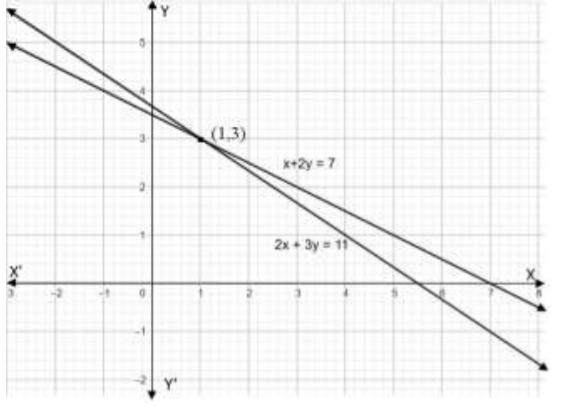
Aarush bought $2$ pencils and $3$ chocolates for ₹ $11$ and Tanish bought $1$ pencil and $2$ chocolates for ₹ $7$ from the same shop. Represent this situation in the form of a pair of linear equations. Find the price of $1$ pencil and $1$ chocolate, graphically.
Show SolutionHide Solution↓
Let the cost of $1$ pencil be $x$ and the cost of $1$ chocolate be $y$ $2x + 3y = 11$ (1 Mark) $x + 2y = 7$ (1 Mark) for correct graph of equation $2x + 3y = 11$ (1 Mark) for correct graph of equation $x + 2y = 7$ (1 Mark) $x=1, x=3$ (1/2+1/2 Mark) $\therefore$ Cost of $1$ pencil = ₹ $1$ and Cost of $1$ chocolate = ₹ $3$
Five years ago, Adil was thrice as old as Bharat. Ten years later Adil shall be twice as old as Bharat. To know the present ages of Adil and Bharat : (i) form the linear equations representing the above information. (ii) show that the system of equations is consistent with unique solution. (iii) find the present ages of Adil and Bharat.
Show SolutionHide Solution↓
Let the present ages of Adil and Bharat be '$x$' years and '$y$' years respectively. (i) According to the given statements $(x - 5) = 3 \times (y – 5)$ $\Rightarrow x - 3y = -10$ --- (1) (1 Mark) $(x + 10) = 2 \times (y + 10)$ $\Rightarrow x - 2y = 10$ --- (2) (1 Mark) (ii) Here, $\frac{a_1}{a_2} = \frac{1}{1}$, $\frac{b_1}{b_2} = \frac{-3}{-2}$ or $\frac{3}{2}$ Since $\frac{a_1}{a_2} \neq \frac{b_1}{b_2}$ (1 Mark) Therefore, system of equations is consistent with unique solution. (iii) Solving equations (1) & (2), we get $x = 50$ and $y = 20$ (1+1 Mark) Therefore, the present ages of Adil and Bharat are $50$ years and $20$ years respectively.
The sum of the digits of a $2$-digit number is $11$. The number obtained by interchanging its digits exceeds the given number by $9$. To know the number : (i) form the linear equations representing the above situation. (ii) verify that the equations have a unique solution. (iii) solve the equations to get the given $2$-digit number.
Show SolutionHide Solution↓
Let the digit at unit's place be $x$ and at ten's place be $y$. The number is $10y + x$ (1/2 Mark) (i) As per given statements $x + y = 11$ --- (1) (1 Mark) $10x + y = 10y + x + 9$ $\Rightarrow x - y = 1$ --- (2) (1 Mark) (ii) Here, $\frac{a_1}{a_2} = \frac{1}{1}$, $\frac{b_1}{b_2} = \frac{1}{-1}$ or $-1$ Since $\frac{a_1}{a_2} \neq \frac{b_1}{b_2}$ (1 Mark) Therefore, system of equations have a unique solution. (iii) Solving equations (1) & (2), we get $x = 6$ and $y = 5$ (1/2 + 1/2 Mark) Therefore, given number is $56$. (1/2 Mark)
The sum of numerator and denominator of a fraction is $4$ less than twice the denominator. If each of the numerator and denominator is decreased by $1$, the fraction becomes $\frac{1}{3}$. Find the fraction.
Show SolutionHide Solution↓
Let the fraction be $\frac{x}{y}$ ($\frac{1}{2}$ Mark) $x + y = 2y - 4$ $\Rightarrow x - y = -4$ (i) (1 Mark) $\frac{x - 1}{y - 1} = \frac{1}{3}$ ($\frac{1}{2}$ Mark) $\Rightarrow 3x - y = 2$ (ii) (1 Mark) Solving equations (i) and (ii) to get $x = 3$ and $y = 7$ (1 Mark) Required fraction = $\frac{3}{7}$ ($\frac{1}{2}$ Mark)
The sum of a $2$-digit number and the number obtained by reversing the order of its digits, is $121$. The two digits differ by $3$. (i) Represent the above information in the form of pair of linear equations. (ii) Show that the equations have unique solution. (iii) Solve the equations and find the number.
Show SolutionHide Solution↓
Let the unit digit be $y$ and tens digit be $x (x > y)$ The two-digit number will be $10x + y$ A.T.Q. $(10x + y) + (10y + x) = 121$ (i) $\Rightarrow x + y = 11 \dots (1)$ and $x - y = 3 \dots (2)$ (ii) $\frac{1}{1} \neq \frac{1}{-1}$ therefore equations have unique solution (iii) Solving equations $(1)$ and $(2)$, we get $x = 7, y = 4 \therefore$ Number is $74$ $47$ may be considered as the correct answer if $y > x$.
A fraction becomes $\frac{5}{6}$ when $3$ is added to both the numerator and the denominator. If $2$ is added to both the numerator and the denominator, the fraction becomes $\frac{9}{11}$. Express the given information algebraically as a system of linear equations in two variables. Hence, find the original fraction.
Show SolutionHide Solution↓
Let numerator be $x$ and denominator be $y$ $\therefore$ fraction is $\frac{x}{y}$ (1/2 Mark) $\frac{x+3}{y+3} = \frac{5}{6}$ (1 Mark) $\Rightarrow 6x – 5y = -3$ ---------- (i) (1/2 Mark) Also $\frac{x+2}{y+2} = \frac{9}{11}$ (1 Mark) $\Rightarrow 11x – 9y = -4$ ---------- (ii) (1/2 Mark) Solving (i) and (ii) we get $x = 7$ and $y = 9$ (1/2+1/2 Mark) Fraction is $\frac{7}{9}$ (1/2 Mark)
The difference between two numbers is 12. The greater number is 6 less than twice the smaller one. (i) Representing the above situation, frame two linear equations in two variables. (ii) Show that the equations have unique solution. (iii) Solve the equations and hence find the numbers.
Show SolutionHide Solution↓
(i) Let the larger number be $x$ and smaller number be $y$ $x - y = 12$ (1 Mark) $x - 2y = -6$ (1 Mark) (ii) $\frac{a_1}{a_2} = \frac{1}{1}$ and $\frac{b_1}{b_2} = \frac{-1}{-2}$ (1 Mark) $\frac{1}{1} \neq \frac{-1}{-2} \Rightarrow$ equations have unique solution. (1 Mark) (iii) Solving the above equations to get $x = 30$ $y = 18$ (1+1 Marks)
A bag contains some red and blue balls. Ten percent of the red balls, when added to twenty percent of the blue balls, give a total of $24$. If three times the number of red balls exceeds the number of blue balls by $20$, find the number of red and blue balls.
Show SolutionHide Solution↓
Let number of red balls be $x$ & number of blue balls be $y$ A.T.Q. $\frac{10x}{100} + \frac{20y}{100} = 24$ or $x + 2y = 240$ .....(i) Also, $3x - y = 20$ ......(ii) Solving (i) and (ii), we get $x = 40, y = 100$ $\therefore$ Number of red balls = $40$ and Number of blue balls = $100$