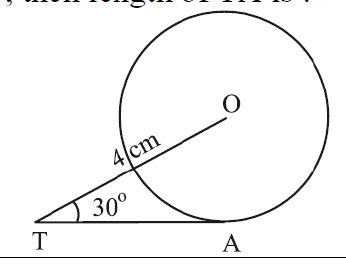
If two tangents inclined at an angle of $60^\circ$ are drawn to a circle of radius $5$ cm from an external point, then the length of each tangent is equal to :
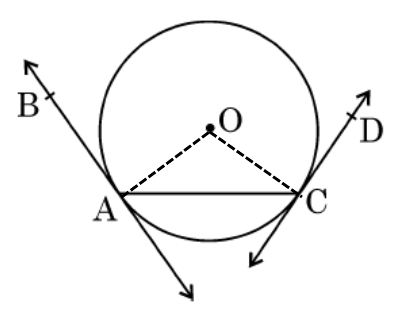
Assertion (A) : The tangents drawn at the end points of a diameter of the circle are parallel to each other. Reason (R) : The tangent to a circle is perpendicular to the radius at the point of contact.
(a)Both Assertion (A) and Reason (R) are true and Reason (R) is the correct explanation of the Assertion (A).
(b)Both Assertion (A) and Reason (R) are true, but Reason (R) is not the correct explanation of the Assertion (A).
(c)Assertion (A) is true and Reason (R) is false.
(d)Assertion (A) is false and Reason (R) is true.
Show SolutionHide Solution↓
(a) Both Assertion (A) and Reason (R) are true and Reason (R) is the correct explanation of Assertion (A).
Assertion (A): A tangent to a circle is perpendicular to the radius through the point of contact. Reason (R): The lengths of tangents drawn from an external point to a circle are equal.
Show SolutionHide Solution↓
(b) Both Assertion (A) and Reason (R) are true, but Reason (R) is not the correct explanation of the Assertion (A).
In the given figure, tangents $PA$ and $PB$ to the circle centred at $O$, from point $P$ are perpendicular to each other. If $PA = 5$ cm, then length of $AB$ is equal to
Assertion (A): If a chord AB subtends an angle of $60^{\circ}$ at the centre of a circle, then the angle between the tangents at A and B is also $60^{\circ}$. Reason (R): The length of the tangent from an external point P on a circle with centre O is always less than OP.
Show SolutionHide Solution↓
(D) Assertion (A) is false, but Reason (R) is true.
Assertion (A): Tangents drawn at the end points of a diameter of a circle are always parallel to each other. Reason (R) : The lengths of tangents drawn to a circle from a point outside the circle are always equal.
Show SolutionHide Solution↓
(b) Both Assertion (A) and Reason (R) are true but Reason (R) is not the correct explanation of Assertion (A).
Assertion (A) : A line drawn perpendicular to the tangent at point of contact passes through the centre of the circle. Reason (R) : Lengths of tangents drawn from external point to a circle are equal.
(a)Both, Assertion (A) and Reason (R) are true and Reason (R) is correct explanation of Assertion (A).
(b)Both, Assertion (A) and Reason (R) are true but Reason (R) is not the correct explanation of Assertion (A).
(c)Assertion (A) is true but Reason (R) is false.
(d)Assertion (A) is false but Reason (R) is true.
Show SolutionHide Solution↓
(b) Both Assertion (A) and Reason (R) are true but Reason (R) is not the correct explanation of Assertion (A).
For a circle with centre $O$ and radius 5 cm, which of the following statements is true? $P$: Distance between every pair of parallel tangents is 5 cm. $Q$: Distance between every pair of parallel tangents is 10 cm. $R$: Distance between every pair of parallel tangents must be between 5 cm and 10 cm. $S$: There does not exist a point outside the circle from where length of tangent is 5 cm.
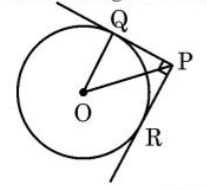
In the given figure, $PQ$ and $PR$ are tangents to a circle with centre $O$ and radius $3$ cm. If $\angle QPR = 60^\circ$, then the length of each tangent is :
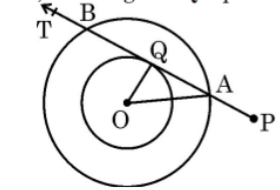
From an external point P, a tangent PT has been drawn to a circle with centre at O and radius $3$ cm, intersecting its concentric circle at A and B. If AB = $8$ cm and OA = AP, the length PQ equals.
Prove that the line segment joining the points of contact of two parallel tangents to a circle passes through its centre.
Show SolutionHide Solution↓
QQ' $||$ PP' Let P and Q be the points of contact and O is the centre of the circle. Join OP and OQ. Draw OA $||$ QQ'. $\therefore$ QQ' $\perp$ OQ $\Rightarrow \angle 1 = 90^{\circ} \Rightarrow \angle 2 = 90^{\circ}$ ----- (i) Since OQ' $||$ PP' $\therefore$ OA $||$ PP' and hence $\angle 4 = 90^{\circ}$ ----- (ii) Adding (i) and (ii), $\angle 2 + \angle 4 = 180^{\circ}$ or $\angle POQ = 180^{\circ}$ $\therefore$ POQ is a straight line.
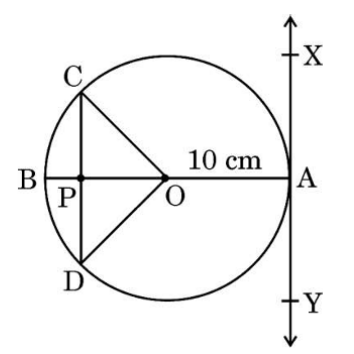
At point A on the diameter AB of a circle of radius $10$ cm, tangent XAY is drawn to the circle. Find the length of the chord CD parallel to XY at a distance of $16$ cm from A.
Show SolutionHide Solution↓
AP = $16$ cm $\therefore OP = 16 - 10 = 6$ cm XY $||$ CD $\therefore \angle CPO = 90^\circ$ In right $\triangle OPC$, $CP = \sqrt{(10)^2 - (6)^2} = 8$ cm CD = $2 \times CP$ $= 2 \times 8 = 16$ cm
In the given figure, O is the centre of the circle. PQ and PR are tangents. Show that the quadrilateral PQOR is cyclic.
Show SolutionHide Solution↓
As radius is perpendicular to tangent, $\angle PQO = 90^\circ$, $\angle PRO = 90^\circ$ (1 Mark) $\therefore \angle PQO + \angle PRO = 180^\circ$ (1/2 Mark) One pair of opposite angles is supplementary $\therefore$ Quadrilateral PQOR is cyclic (1/2 Mark)
Prove that the intercept of a tangent between two parallel tangents to a circle subtends right angle at the centre.
Show SolutionHide Solution↓
Let $XY \parallel X'Y'$ be two parallel tangents with $LM$ as diameter. $\Delta OAL \cong \Delta OAC \implies \angle 1 = \angle 2$. Similarly, $\angle 3 = \angle 4$. But $\angle 1 + \angle 2 + \angle 3 + \angle 4 = 180^\circ \implies 2 \angle 1 + 2 \angle 3 = 180^\circ$ or $\angle 1 + \angle 3 = 90^\circ \implies AB$ subtends right angle at the centre.
323 Marks · 🔁 March 2023 & March 2026 · Standardopen ↗
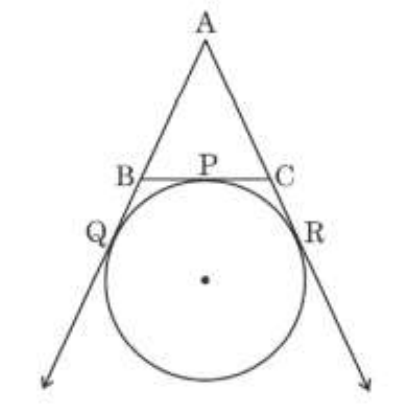
In the given figure, if a circle touches the side $QR$ of $\triangle PQR$ at $S$ and extended sides $PQ$ and $PR$ at $M$ and $N$ respectively, then prove that : $PM = \frac{1}{2} (PQ + QR + PR)$
In the given figure, $PA$ is the tangent to the circle with centre $O$ nsuch that $OA = 10$ cm, $AB = 8$ cm and $AB \perp OP$. Find the nlength of $PB$.
Show SolutionHide Solution↓
In right angled $\triangle OBA$, $OB = \sqrt{(10)^2 - (8)^2} = 6$ cm (1/2 Mark) Let $\angle AOB = \theta$ So, $\tan \theta = \frac{8}{6}$ --- (i) (1/2 Mark) In right angled $\triangle OAP$ $\frac{AP}{10} = \tan \theta$ $\therefore \frac{AP}{10} = \frac{8}{6}$ [using (i)] (1/2 Mark) $\Rightarrow AP = \frac{40}{3}$ cm (1/2 Mark) $\therefore OP = \sqrt{(\frac{40}{3})^2 + (10)^2} = \frac{50}{3}$ cm (1/2 Mark) $PB = OP - OB = \frac{50}{3} - 6 = \frac{32}{3}$ cm or $10.6$ cm (1/2 Mark) Alternate solution: In right angled $\triangle OBA$, $OB = \sqrt{(10)^2 - (8)^2} = 6$ cm (1/2 Mark) In right angled $\triangle PBA$ $PA^2 = PB^2 + (8)^2 = PB^2 + 64$ --- (i) (1/2 Mark) In right angled $\triangle PAO$ $PA^2 = OP^2 - (10)^2 = (PB + 6)^2 - 100$ --- (ii) (1 Mark) From (i) and (ii), we have $PB^2 + 64 = (PB + 6)^2 - 100 \Rightarrow PB = \frac{32}{3}$ cm or $10.6$ cm (1 Mark)
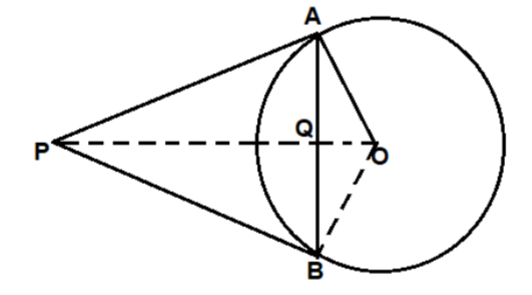
AB is a chord of length $24$ cm of a circle of radius $15$ cm. The tangents at A and B intersect at a point P. Find the length PA.
Show SolutionHide Solution↓
AB = $24$ cm OA = $15$ cm ($\frac{1}{2}$ Mark) Join OP intersecting AB at Q. Also join OB. $\triangle$ PAQ $\cong \triangle$ PBQ $\therefore \angle$ PQA = $\angle$ PQB = $90^{\circ}$ and AQ = QB = $12$ cm (1 Mark) In right $\triangle$ OQA, OQ = $9$ cm ($\frac{1}{2}$ Mark) Now, $\triangle$ OAP $\sim \triangle$ OQA ($\frac{1}{2}$ Mark) $\Rightarrow \frac{OA}{OQ} = \frac{AP}{QA}$ ($\frac{1}{2}$ Mark) $\Rightarrow AP = \frac{OA \times QA}{OQ} = \frac{15 \times 12}{9} = 20$ cm
In the given figure, $TP$ and $TQ$ are tangents to a circle with centre $M$, touching another circle with centre $N$ at $A$ and $B$ respectively. It is given that $MQ = 13$ cm, $NB = 8$ cm, $BQ = 35$ cm and $TP = 80$ cm. (i) Name the quadrilateral $MQBN$. (ii) Is $MN$ parallel to $PA$? Justify your answer. (iii) Find length $TB$. (iv) Find length $MN$.
Show SolutionHide Solution↓
(i) $BN \parallel QM$ and $QB \parallel MN$ The quadrilateral $MQBN$ is a trapezium. (I) (1 Mark) (ii) No, as $AN \neq PM$ (II) (1 Mark) (iii) $TQ = TP = 80$ cm $\therefore TB = 80 - 35 = 45$ cm (III) (1 Mark) Note: If $MNT$ is considered a straight line and similarity of triangles is used to find $TB$ then $TB = 56$ cm may be considered as correct answer. (iv) $MN^2 = NS^2 + MS^2$ $= 35^2 + (13 - 8)^2$ (IV) (1 Mark) $= 1225 + 25$ (V) ($\frac{1}{2}$ Mark) $= 1250$ $\therefore MN = 25\sqrt{2}$ cm (VI) ($\frac{1}{2}$ Mark)
PQ and PR are two tangents to a circle with centre O and radius $5$ cm. AB is another tangent to the circle at C which lies on OP. If $OP = 13$ cm, then find the length AB and PA.
Show SolutionHide Solution↓
$OP = 13$ cm, $OQ = 5$ cm $\therefore PQ = \sqrt{169 - 25} = 12$ cm (I Mark) Let $AC = x = AQ$ $PC = 13 - 5 = 8$ cm and $PA = 12 - x$ (II Mark) $AC \perp OP \therefore (12 - x)^2 = x^2 + 8^2$ (III Mark) $\Rightarrow 144 - 24x + x^2 = x^2 + 64$ $\Rightarrow x = \frac{10}{3}$ (IV Mark) $AB = 2AC = \frac{20}{3}$ cm or $6.6$ cm (approx.) (V Mark) $PA = 12 - \frac{10}{3} = \frac{26}{3}$ cm or $8.6$ cm (approx.) (VI Mark)
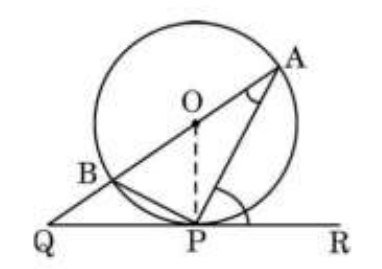
In the given figure, $O$ is the centre of the circle and $PQ$ is the chord. If the tangent $PR$ at $P$ makes an angle of $50^\circ$ with $PQ$, then the measure of $\angle POQ$ is :
In the given figure, $PA$ and $PB$ are tangents from external point $P$ to a circle with centre $C$ and $Q$ is any point on the circle. Then the measure of $\angle AQB$ is
In the given figure, PA and PB are two tangents drawn to the circle with centre O and radius $5$ cm. If $\angle APB = 60^\circ$, then the length of PA is :
(a)$\frac{5}{\sqrt{3}}$ cm
(b)$5\sqrt{3}$ cm
(c)$\frac{10}{\sqrt{3}}$ cm
(d)$10$ cm
Show SolutionHide Solution↓
(B) $5\sqrt{3}$ cm
461 Mark · 🔁 March 2024 & July 2024 · Standardopen ↗
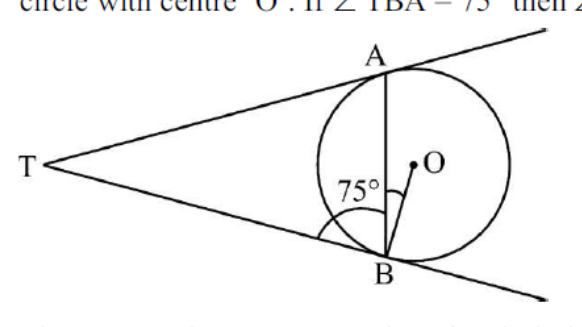
Assertion (A): TA and TB are two tangents drawn from an external point T to a circle with centre 'O'. If $\angle TBA = 75^\circ$ then $\angle ABO = 25^\circ$. Reason (R): The tangent drawn at any point of a circle is perpendicular to the radius through the point of contact.
Show SolutionHide Solution↓
(D) Assertion (A) is not true but Reason (R) is true.
In the given figure, O is the centre of the circle. MN is the chord and the tangent ML at point M makes an angle of $70^\circ$ with MN. The measure of $\angle MON$ is:
In the given figure, $PA$ is a tangent from an external point $P$ to a circle with centre $O$. If $\angle POB = 115^\circ$, then $\angle APO$ is equal to:
If tangents PA and PB drawn from an external point P to the circle with centre O are inclined to each other at an angle of $80^{\circ}$ as shown in the given figure, then the measure of $\angle POA$ is :
If $TP$ and $TQ$ are two tangents to a circle with centre $O$ from an external point $T$ so that $\angle POQ = 120^\circ$, then $\angle PTQ$ is equal to :
In the given figure, $PA$ is a tangent from an external point $P$ to a circle with centre $O$. If $\angle POB = 125^\circ$, then $\angle APO$ is equal to :
In the given figure, O is the centre of the circle. AB and AC are tangents drawn to the circle from point A. If $\angle BAC = 65^\circ$, then find the measure of $\angle BOC$.
In the given figure, $PQ$ is a chord of the circle centered at $O$. $PT$ is a tangent to the circle at $P$. If $\angle QPT = 55^\circ$, then find $\angle PRQ$.
Show SolutionHide Solution↓
$\angle QPT = 55^\circ$ Since $OP \perp PT$ (radius is perpendicular to tangent at point of contact) $\angle OPQ = 90^\circ - \angle QPT = 90^\circ - 55^\circ = 35^\circ$ In $\triangle OPQ$, $OP = OQ$ (radii of same circle) $\Rightarrow \angle OQP = \angle OPQ = 35^\circ$ $\angle POQ = 180^\circ - (\angle OPQ + \angle OQP) = 180^\circ - (35^\circ + 35^\circ) = 180^\circ - 70^\circ = 110^\circ$ The angle subtended by an arc at the centre is double the angle subtended by it at any point on the remaining part of the circle. $\angle PRQ = \frac{1}{2} \times \text{reflex } \angle POQ$ Reflex $\angle POQ = 360^\circ - 110^\circ = 250^\circ$ Hence $\angle PRQ = \frac{1}{2} \times 250^\circ = 125^\circ$
In the given figure, $PA$ is a tangent to the circle drawn from the external point $P$ and $PBC$ is the secant to the circle with $BC$ as diameter. If $\angle AOC = 130^{\circ}$, then find the measure of $\angle APB$, where $O$ is the centre of the circle.
In the given figure, PAQ and PBR are tangents to the circle with centre 'O' at the points A and B respectively. If $\angle QAT = 45^\circ$ and $\angle TBR = 65^\circ$, then find $\angle ATB$.
Show SolutionHide Solution↓
Join OA, OB and OT Now $\angle ATO = \angle TAO = 90^\circ - 45 = 45^\circ$ and $\angle BTO = \angle TBO = 90^\circ - 65^\circ = 25^\circ$ $\Rightarrow \angle ATB = \angle ATO + \angle BTO$ $= 45^\circ + 25^\circ = 70^\circ$
In the given figure, PC is a tangent to the circle at C. AOB is the diameter which when extended meets the tangent at P. Find $\angle CBA$ and $\angle BCO$, if $\angle PCA = 110^{\circ}$.
In the adjoining figure, $TP$ and $TQ$ are tangents drawn to a circle with centre $O$. If $\angle OPQ = 15^\circ$ and $\angle PTQ = \theta$, then find the value of $\sin 2\theta$.
OR In the given figure, tangents PQ and PR are drawn to a circle such that $\angle RPQ = 30^{\circ}$. A chord RS is drawn parallel to the tangent PQ. Find the measure of $\angle RQS$.
Show SolutionHide Solution↓
$PQ = PR$ (tangents drawn from an external point to the circle) $\therefore \angle PQR = \angle PRQ$ In $\triangle PQR$, $\angle PQR = \angle PRQ = \frac{1}{2}(180^{\circ} - 30^{\circ}) = 75^{\circ}$ Draw a perpendicular QL from Q to QP Now, $\angle PQL = 90^{\circ}$ $\therefore \angle RQL = 90^{\circ} - 75^{\circ} = 15^{\circ}$ $\triangle RQL \cong \triangle SQL$ (SAS ) $\therefore \angle RQL = \angle SQL = 15^{\circ}$ $\therefore \angle RQS = 15^{\circ} +15^{\circ} = 30^{\circ}$
In two concentric circles with centre O, the radius of the outer circle is $50$ cm. Chord AB of the outer circle is tangent to the inner circle at D. If length of AB is $96$ cm, then the radius of the inner circle is :
In the given figure, $QR$ is a common tangent to the two given circles touching externally at $A$. The tangent at $A$ meets $QR$ at $P$. If $AP = 4.2$ cm, then the length of $QR$ is :
In the adjoining figure, AB is the chord of the larger circle touching the smaller circle. The centre of both the circles is O. If AB = $2r$ and OP = $r$, then the radius of larger circle is :
In the adjoining figure, the sum of radii of two concentric circles is 16 cm. The length of chord $AB$ which touches the inner circle at $P$ is 16 cm. The difference of the radii of the given circles is
Two circles of radii $10$ cm and $17$ cm intersect at $P$ and $Q$. If $A$ and $B$ are their centres and $PQ = 16$ cm, then the distance $AB$ is equal to
In two concentric circles with centre O, the radius of outer circle is $25$ cm. Chord PQ of the outer circle is tangent to the inner circle at R. If PQ = $14$ cm, then the radius of the inner circle is :
Two concentric circles are of radii $5$ cm and $3$ cm. Find the length of the chord of the larger circle which touches the smaller circle.
Show SolutionHide Solution↓
AB is the chord of larger circle touching the smaller circle at P. OA = $5$ cm, OP = $3$ cm To find AB OP $\perp$ AB (radius $\perp$ tangent) AB is the chord of larger circle and OP $\perp$ AB $\therefore AP = PB$ In right-angled $\Delta AOP$, $AP^2 = 5^2-3^2 = 16$ $AP = 4$ cm
In the given figure, two concentric circles have radii $3$ cm and $5$ cm. Two tangents TR and TP are drawn to the circles from an external point T such that TR touches the inner circle at R and TP touches the outer circle at P. If TR = $4\sqrt{10}$ cm, then find the length of TP.
Show SolutionHide Solution↓
Join OR, OP and OT In $\triangle ORT$, $OT^2 = OR^2 + TR^2 = 3^2 + (4\sqrt{10})^2 = 169$ $\therefore OT = 13$ cm In $\triangle OPT$, $TP^2 = OT^2 - OP^2 = 13^2 - 5^2 = 144$ $\therefore TP = 12$ cm
Two circles with centres $O$ and $O'$ of radii $6$ cm and $8$ cm, respectively intersect at two points $P$ and $Q$ such that $OP$ and $O'P$ are tangents to the two circles. Find the length of the common chord $PQ$.
In the given figure, a circle inscribed in $\triangle ABC$, touches AB, BC and CA at X, Z and Y, respectively. If AB = $12$ cm, AY = $8$ cm and CY = $6$ cm, then the length of BC is :
A circle is touching the side BC of a $\triangle ABC$ at the point P and touching AB and AC produced at points Q and R respectively. Prove that $AQ = \frac{1}{2}$ (Perimeter of $\triangle ABC$).
Show SolutionHide Solution↓
Perimeter of $\triangle ABC = AB + BC + CA$ $= AB + BP + CP + CA$ $= AB + BQ + CR + CA$ $[BP = BQ \; ; \; CP = CR]$ $= AQ + AR$ $= AQ + AQ$ $[AQ = AR]$ $= 2 AQ$ $\therefore AQ = \frac{1}{2}$ (Perimeter of $\triangle ABC$)
In the given figure, $x, y$ and $z$ are the sides of a right triangle, where $z$ is the hypotenuse. Prove that the radius $r$ of the circle which touches the sides of the triangle is given by $r = \frac{x+y-z}{2}$.
Show SolutionHide Solution↓
Clearly OQBP is a square $OP = OQ = QB = BP = r$ $CS = PC = x-r$ $AS = AQ = y -r$ $AC = z = AS + CS = x - r + y-r$ Gives $r = \frac{x+y-z}{2}$
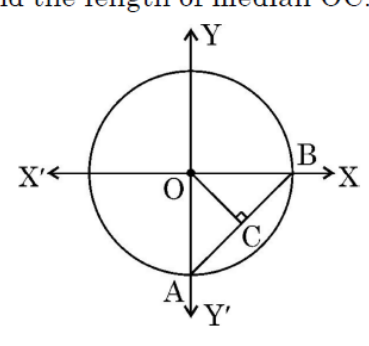
In the given figure, a circle centred at origin O has radius 7 cm, OC is median of $\Delta OAB$. Find the length of median OC.
Show SolutionHide Solution↓
$\angle AOB = 90^\circ$ $\therefore AB^2 = 7^2 +7^2$ $\Rightarrow AB = 7\sqrt{2}$ cm $\Rightarrow AC = \frac{7\sqrt{2}}{2}$ cm Now In $\Delta AOC$, $OC^2 = 7^2 - (\frac{7\sqrt{2}}{2})^2$ $\therefore OC = \frac{7\sqrt{2}}{2}$ cm
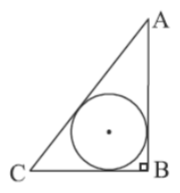
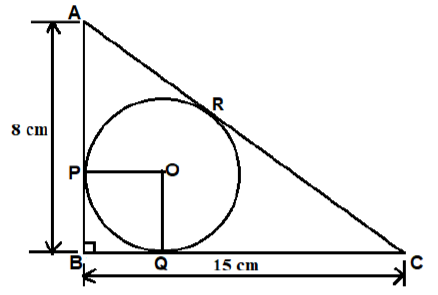
A circle is inscribed in a right triangle ABC, right angled at B. If the lengths of the two sides containing the right angle are $8$ cm and $15$ cm, find the radius of the incircle.
Show SolutionHide Solution↓
AC = $\sqrt{(15)^2 + (8)^2} = 17$ cm ($\frac{1}{2}$ Mark) Let '$r$' be the radius of the circle. Since, radius is perpendicular to the tangent through the point of contact. $\therefore$ OP is perpendicular to AB and OQ is perpendicular to BC. Thus, OPBQ is a square. $\Rightarrow$ OP = PB = BQ = OQ = $r$ ($\frac{1}{2}$ Mark) Thus, AR = AP = $8 - r$ and CR = CQ = $15 - r$ } (1 Mark) Now, AC = AR + CR ($\frac{1}{2}$ Mark) $r = 3$ cm ($\frac{1}{2}$ Mark)
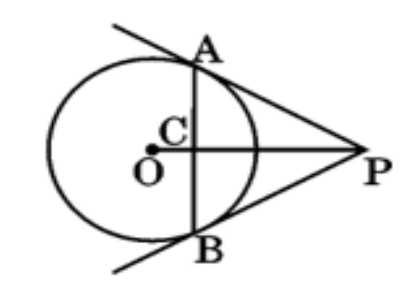
From an external point P, two tangents PA and PB are drawn to the circle with centre O. Prove that OP is the perpendicular bisector of chord AB.
Show SolutionHide Solution↓
Correct Fig. $\triangle$ACP $\cong \triangle$BCP AC=BC $\angle$ACP = $\angle$BCP $\angle$ACP + $\angle$BCP = $180^{\circ}$ $\angle$ACP = $90^{\circ}$ $\Rightarrow$ OP $\perp$ AB Hence OP is perpendicular bisector of chord AB.
In the given figure, $PB$ is a tangent to the circle with centre $O$ at $B$. $AB$ is a chord of the circle of length $24$ cm and at a distance of $5$ cm from the centre of the circle. If the length $PB$ of the tangent is $20$ cm, find the length of $OP$.
Show SolutionHide Solution↓
Join $OB$ $AB = 24$ cm, $OM = 5$ cm, $PB = 20$ cm $AM = MB = 12$ cm In $\triangle OMB$, $OB = \sqrt{5^2 + 12^2} = 13$ cm As $PB$ is tangent $\Rightarrow PB \perp OB\\$ In rt $\triangle OBP$, $OP = \sqrt{13^2 + 20^2} = \sqrt{569}$ cm
In the adjoining figure, $XY$ and $X'Y'$ are parallel tangents to a circle with centre $O$. Another tangent $AB$ touches the circle at $C$ intersecting $XY$ at $A$ and $X'Y'$ at $B$. Prove that $AB$ subtends right angle at the centre of the circle; or $\angle AOB = 90^\circ$.
In the given figure, $\Delta ABC$ is a right triangle in which $\angle B = 90^\circ$, $AB = 4$ cm and $BC = 3$ cm. Find the radius of the circle inscribed in the triangle ABC.
Show SolutionHide Solution↓
$AC = \sqrt{3^2 + 4^2} = 5$ cm (1/2 Mark) Let $BE = BD = x$ cm (1/2 Mark) $AD = 4 - x = AF$, $CE = 3 - x = CF$ (1/2 Mark) $AF + CF = AC \implies 4 - x + 3 - x = 5$ (1/2 Mark) $\therefore x = 1$ (1 Mark) $BD = BE = 1$ and $\angle B = 90^\circ$ Hence radius of circle $= x = 1$ cm (1/2 Mark) **ALTERNATE SOLUTION:** $AC = \sqrt{3^2 + 4^2} = 5$ cm (1/2 Mark) Let $r$ be the radius of the circle $ar(\Delta ABC) = \frac{1}{2} \times 4 \times 3 = 6$ cm$^2$ (1/2 Mark) Also, $ar(\Delta ABC) = (\frac{1}{2} \times r \times 4) + (\frac{1}{2} \times r \times 3) + (\frac{1}{2} \times r \times 5)$ (1 Mark) $\implies 6r = 6 \implies r = 1$ (1 Mark) Hence the radius of the circle is $1$ cm.
5 Marks Questions
1085 Marks · 🔁 March 2023 & March 2026 · Standardopen ↗
Two tangents $TP$ and $TQ$ are drawn to a circle with centre $O$ from an external point $T$. Prove that $\angle PTQ = 2 \angle OPQ$.
A triangle $ABC$ is drawn to circumscribe a circle of radius $4$ cm such that the segments $BD$ and $DC$ are of lengths $10$ cm and $8$ cm respectively. Find the lengths of the sides $AB$ and $AC$, if it is given that area $\triangle ABC = 90 \text{ cm}^2$.
Show SolutionHide Solution↓
Join $OA, OB, OC$ and draw $OE \perp AC$ and $OF \perp AB$. $BF = 10$ cm, $CE = 8$ cm, Let $AF = AE = x$ $ar \triangle ABC = ar \triangle BOC + ar \triangle COA + ar \triangle AOB$ $90 = \frac{1}{2} \cdot 4 (BC + CA + AB)$ $90 = 2(18 + 8 + x + 10 + x)$ $90 = 4(18 + x)$ $x = 4.5$ $AB = 14.5$ cm and $AC = 12.5$ cm
A triangle ABC is drawn to circumscribe a circle of radius $4$ cm such that the segments BD and DC into which BC is divided by the point of contact D are of lengths $8$ cm and $6$ cm respectively. Find the lengths of sides AB and AC.
Show SolutionHide Solution↓
Area ($\triangle$ ABC) = Area ($\triangle$ BOC) + Area ($\triangle$ AOC) + Area ($\triangle$ AOB) $= \frac{1}{2} \times 4 \times 14 + \frac{1}{2} \times 4 \times (6 + x) + \frac{1}{2} \times 4 \times (8 + x)$ $= (56 + 4x)$ or $4(14 + x)$ --- (1) Semi perimeter of $\triangle$ ABC = $\frac{14+(6+x)+(8+x)}{2} = (14 + x)$ Also, area ($\triangle$ ABC) = $\sqrt{(14 + x)(14 + x – 14)[(14 + x) – (6 + x)][(14 + x) – (8 + x)]}$ $= \sqrt{48x(14 + x)}$ --- (2) From (1) and (2), we get $x=7$ $\therefore AB = 15$ cm and $AC = 13$ cm
Assertion (A): If $PA$ and $PB$ are tangents drawn from an external point $P$ to a circle with centre $O$, then the quadrilateral $AOBP$ is cyclic. Reason (R): The angle between two tangents drawn from an external point to a circle is supplementary to the angle subtended by the line segment joining the points of contact at the centre.
(a)Both Assertion (A) and Reason (R) are true, and Reason (R) is the correct explanation of the Assertion (A).
(b)Both Assertion (A) and Reason (R) are true, but Reason (R) is not the correct explanation of the Assertion (A).
(c)Assertion (A) is true, but Reason (R) is false.
(d)Assertion (A) is false, but Reason (R) is true.
Show SolutionHide Solution↓
(a) Both Assertion (A) and Reason (R) are true, and Reason (R) is the correct explanation of the Assertion (A).
Assertion (A): If two tangents are drawn to a circle from an external point, then they subtend equal angles at the centre of the circle. Reason (R): A parallelogram circumscribing a circle is a rhombus.
Show SolutionHide Solution↓
(B) Both Assertion (A) and Reason (R) are true, but Reason (R) is not the correct explanation of the Assertion (A).
In the adjoining figure, $PA$ and $PB$ are tangents to a circle with centre $O$ such that $\angle P = 90^\circ$. If $AB = 3\sqrt{2}$ cm, then the diameter of the circle is.
Two tangents PQ and PR are drawn from an external point P to a circle with centre O. Prove that QORP is a cyclic quadrilateral.
Show SolutionHide Solution↓
PQ $\perp$ OQ $\Rightarrow \angle PQO = 90^{\circ}$ and PR $\perp$ OR $\Rightarrow \angle PRO = 90^{\circ}$ $\therefore \angle PQO + \angle PRO = 180^{\circ}$ Since opposite angles of quadrilateral QORP are supplementary, therefore QORP is a cyclic quadrilateral.
In the given figure, PQRS is a quadrilateral such that $\angle S = 90^{\circ}$. A circle with centre 'O' is inscribed in the quadrilateral. The circle touches PQ, QR, RS and SP at points M, N, T and L respectively. If MQ = 19 cm, RQ = 30 cm and SR = 21 cm, then find the radius of the circle.
Show SolutionHide Solution↓
NQ = MQ = 19 $\therefore$ RN = $30 - 19 = 11$ cm $\therefore$ RT = 11 cm $\therefore$ TS = $21 - 11 = 10$ cm Since SLOT is a square Therefore radius of the circle = TS = 10 cm
In the given figure, a circle is inscribed in a quadrilateral $ABCD$ in which $\angle B = 90^\circ$. If $AD=17$ cm, $AB = 20$ cm and $DS = 3$ cm, then find the radius of the circle.
Show SolutionHide Solution↓
$DR = DS = 3$ cm $\therefore AR = AD – DR = 17 – 3 = 14$ cm $\Rightarrow AQ = AR = 14$ cm $\therefore QB = AB – AQ = 20 – 14 = 6$ cm Since $QB = OP = r \therefore$ radius = 6 cm
From an external point, two tangents are drawn to a circle. Prove that the line joining the external point to the centre of the circle bisects the angle between the two tangents.
Show SolutionHide Solution↓
Given : PA and PB are tangents drawn from an external point P to the circle with centre O. To prove: $\angle OPA = \angle OPB\\$Construction: Join OA, OB Proof: In $\Delta OPA$ and $$\begin{aligned}& \Delta OPB \\ & OP = OP\end{aligned}$$ (common) OA = OB (radii) $\angle OAP = \angle OBP$ (each $90^\circ$, radius $\perp$ tangents) $\therefore \Delta OPA \cong \Delta OPB$ (RHS) $\Rightarrow \angle OPA = \angle OPB$ (CPCT)
A circle with centre O and radius $8$ cm is inscribed in a quadrilateral ABCD in which P, Q, R, S are the points of contact as shown. If AD is perpendicular to DC, BC = $30$ cm and BS = $24$ cm, then find the length DC.
Show SolutionHide Solution↓
Join OP and OQ. BR = BS = $24$ cm $\therefore CR = 6$ cm $\Rightarrow CQ = 6$ cm Also, DQ = OP = $8$ cm Hence, DC = $8 + 6 = 14$ cm
In the given figure, $AB, BC, CD$ and $DA$ are tangents to the circle with centre $O$ forming a quadrilateral $ABCD$. Show that $\angle AOB + \angle COD = 180^\circ$
If a regular hexagon ABCDEF circumscribes a circle, then prove that $AB + CD + EF = BC + DE + FA$.
Show SolutionHide Solution↓
correct figure (1/2 Mark) AM = AR BM=BN CN = CO DO = DP EQ=EP FQ=FR (1 Mark) LHS $= AB+CD+EF = (AM+BM) + (CO+OD) + (EQ + QF)$ (1/2 Mark) $= AR+ BN + CN + DP + EP + FR$ (1/2 Mark) $= (AR+FR) + (BN+CN)+ (DP+EP)$ (1/2 Mark) $= BC + DE+ FA = \text{RHS}$
5 Marks Questions
1265 Marks · 🔁 July 2023 & March 2025 & July 2025 · Standardopen ↗
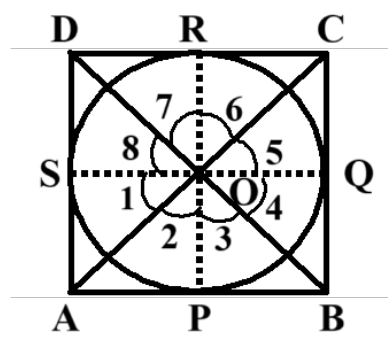
Prove that opposite sides of a quadrilateral circumscribing a circle subtend supplementary angles at the centre of the circle.
Show SolutionHide Solution↓
Let ABCD be a quadrilateral circumscribing a circle with centre O. Let the sides AB, BC, CD, DA touch the circle at P, Q, R, S respectively. Join OA, OB, OC, OD, OP, OQ, OR, OS. In $\triangle AOP$ and $\triangle AOS$: OP = OS (Radii of the same circle) OA = OA (Common side) AP = AS (Tangents from an external point A) So, $\triangle AOP \cong \triangle AOS$ (SSS congruence criterion) $\Rightarrow \angle 1 = \angle 2$ (CPCTC) Similarly, we can prove: $\triangle BOQ \cong \triangle BOP \Rightarrow \angle 3 = \angle 4$ $\triangle COR \cong \triangle COQ \Rightarrow \angle 5 = \angle 6$ $\triangle DOR \cong \triangle DOS \Rightarrow \angle 7 = \angle 8$ The sum of all angles around the centre O is $360^\circ$. $\angle 1 + \angle 2 + \angle 3 + \angle 4 + \angle 5 + \angle 6 + \angle 7 + \angle 8 = 360^\circ$ $2(\angle 1 + \angle 3 + \angle 5 + \angle 7) = 360^\circ$ (since $\angle 1=\angle 2, \angle 3=\angle 4, \angle 5=\angle 6, \angle 7=\angle 8$) $\angle 1 + \angle 3 + \angle 5 + \angle 7 = 180^\circ$ Now, consider angles subtended by opposite sides at the centre: $\angle AOB + \angle COD = (\angle 1 + \angle 4) + (\angle 5 + \angle 8)$ Since $\angle 1 = \angle 2$, $\angle 3 = \angle 4$, $\angle 5 = \angle 6$, $\angle 7 = \angle 8$ $\angle AOB + \angle COD = (\angle 1 + \angle 3) + (\angle 5 + \angle 7)$ (This step is incorrect in the provided solution, it should be $\angle 1+\angle 4$ and $\angle 5+\angle 8$) Let's re-evaluate: $\angle AOB = \angle 1 + \angle 4$, $\angle COD = \angle 5 + \angle 8$ $\angle BOC = \angle 3 + \angle 6$, $\angle DOA = \angle 2 + \angle 7$ We know $\angle 1 = \angle 2$, $\angle 3 = \angle 4$, $\angle 5 = \angle 6$, $\angle 7 = \angle 8$. So, $2(\angle 1 + \angle 3 + \angle 5 + \angle 7) = 360^\circ \Rightarrow \angle 1 + \angle 3 + \angle 5 + \angle 7 = 180^\circ$. $\angle AOB + \angle COD = (\angle 1 + \angle 4) + (\angle 5 + \angle 8) = (\angle 1 + \angle 3) + (\angle 5 + \angle 7) = 180^\circ$. Similarly, $\angle BOC + \angle DOA = (\angle 3 + \angle 6) + (\angle 2 + \angle 7) = (\angle 3 + \angle 5) + (\angle 1 + \angle 7) = 180^\circ$. Thus, opposite sides subtend supplementary angles at the centre.
1275 Marks · 🔁 March 2023 & March 2024 & July 2024 & March 2025 & March 2026 · Standardopen ↗
Prove that a parallelogram circumscribing a circle is a rhombus.
Show SolutionHide Solution↓
ABCD is a parallelogram touching the circle at P, Q, R, S by sides AB, BC, CD, DA respectively. We know that tangents drawn from the external point to a circle are equal. $\therefore AP = AS$ quad --------(i) $PB = BQ$ quad --------(ii) $CR = CQ$ quad --------(iii) $DR = DS$ quad ---------(iv) Adding (i), (ii), (iii), (iv) $(AP + PB) + (CR + DR) = (AS + DS) + (BQ + CQ)$ $AB + CD = AD + BC$ ABCD is a parallelogram $\Rightarrow AB = CD, AD = BC$ $\Rightarrow 2AB = 2AD \Rightarrow AB = AD$ $\Rightarrow \text{ABCD is a rhombus.}$
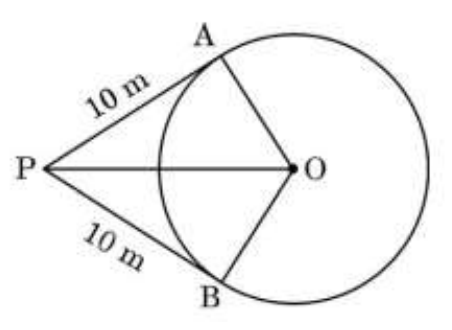
A person is standing at $P$ outside a circular ground at a distance of $26$ m from the centre of the ground. He found that his distances from the points $A$ and $B$ on the ground are $10$ m ($PA$ and $PB$ are tangents to the circle). Find the radius of the circular ground.
Show SolutionHide Solution↓
$\angle OAP = 90^\circ$. In right $\Delta OAP, (26)^2 = OA^2 + (10)^2 \implies OA = \sqrt{576} = 24$. $\therefore \text{radius} = 24$ m.
In a park, four poles are standing at positions A, B, C and D around the circular fountain such that the cloth joining the poles AB, BC, CD and DA touches the circular fountain at P, Q, R and S respectively as shown in the figure. Based on the above information, answer the following questions : (i) If O is the centre of the circular fountain, then $\angle OSA = ...$ (ii) If AB = AD, then write the name of the figure ABCD. (iii) (a) If DR = $7$ cm and AD = $11$ cm, then find the length of AP. OR (iii) (b) If O is the centre of the circular fountain with $\angle QCR = 60^\circ$, then find the measure of $\angle QOR$.
Show SolutionHide Solution↓
(i) $90^\circ$ (ii) $AB + DC = BC + DA$ Given, $AB = AD$ $\Rightarrow BC = DC$ So, ABCD is a Kite (iii) (a) $DS = DR = 7$ cm $AD = 11$ cm $7+ SA = 11$ $\Rightarrow SA = 4$ cm $\therefore AP = SA = 4$ cm OR (b) $\angle QOR = 180^\circ - 60^\circ$ $= 120^\circ$
The discus throw is an event in which an athlete attempts to throw a discus. The athlete spins anti-clockwise around one and a half times through a circle, then releases the throw. When released, the discus travels along tangent to the circular spin orbit. In the given figure, $AB$ is one such tangent to a circle of radius 75 cm. Point $O$ is centre of the circle and $\angle ABO = 30^\circ$. $PQ$ is parallel to $OA$. Based on above information: (a) find the length of $AB$. (b) find the length of $OB$. (c) find the length of $AP$. OR Find the length of $PQ$
Show SolutionHide Solution↓
(i) $\tan 30^\circ = \frac{1}{\sqrt{3}} = \frac{75}{AB}$ $\Rightarrow AB = 75\sqrt{3}$ cm (ii) $\sin 30^\circ = \frac{1}{2} = \frac{75}{OB}$ $\Rightarrow OB = 150$ cm (iii) $QB = 150 – 75 = 75$ cm $\Rightarrow Q$ is mid point. of $OB$ Since $PQ \parallel AO$ therefore $P$ is mid point of $AB$ Hence $AP = \frac{75\sqrt{3}}{2}$ cm. OR (iii) $QB = 150 – 75 = 75$ cm Now, $\triangle BQP \sim \triangle BOA$ $\Rightarrow \frac{QB}{OB} = \frac{PQ}{OA}$ $\Rightarrow \frac{1}{2} = \frac{PQ}{75}$ $\Rightarrow PQ = \frac{75}{2}$ cm
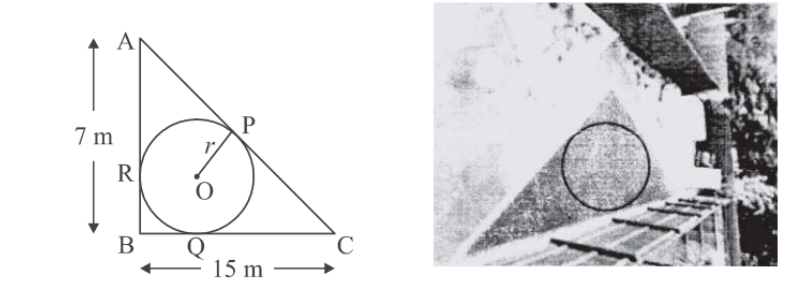
A backyard is in the shape of a triangle ABC with right angle at B. AB = $7$ m and BC = $15$ m. A circular pit was dug inside it such that it touches the walls AC, BC and AB at P, Q and R respectively such that AP = $x$ m. Based on the above information, answer the following questions : (i) Find the length of AR in terms of $x$. (ii) Write the type of quadrilateral BQOR. (iii) (a) Find the length PC in terms of $x$ and hence find the value of $x$. OR (b) Find $x$ and hence find the radius $r$ of circle.
Show SolutionHide Solution↓
(i) AR = $x$ m (ii) Quad. ORBQ is a square. (iii) (a) PC = $8 + x$ AC$^2 = (8 + 2x)^2 =49 + 225 =274$ $\Rightarrow 8 + 2x = \sqrt{274}$ $x = \frac{-8+\sqrt{274}}{2}$ or $4.28$ approx. OR (iii) (b) AC$^2 = (8 + 2x)^2 =49 + 225 =274$ $8 + 2x = \sqrt{274}$ $x = \frac{-8+\sqrt{274}}{2}$ or $4.28$ approx. Hence, radius $r= 7 - x = 7 - \left(\frac{-4 + \sqrt{274}}{2}\right)$ $= \left(11 - \frac{\sqrt{274}}{2}\right)$ or $2.72$ approx. Therefore, radius of the circle is $\left(11 - \frac{\sqrt{274}}{2}\right)$ m or $2.72$ m approx.
There is a circular park of diameter 65 m as shown in the following figure, where $AB$ is a diameter. An entry gate is to be constructed at a point $P$ on the boundary of the park such that distance of $P$ from $A$ is 35 m more than the distance of $P$ from $B$. Find distance of point $P$ from $A$ and $B$ respectively.
Show SolutionHide Solution↓
Let distance of gate at $P$ from point $B$ is $x$ m. Then distance of gate at $P$ from point $A$ is $(35+x)$ m ($\frac{1}{2}$ mark). In right $\Delta APB$, $(x+35)^2 + x^2 = (65)^2$ (1 mark). $x^2 + 35x - 1500 = 0$ (2 marks). $(x+60)(x-25) = 0$, $x=25$ ($\frac{1}{2}$ mark). Hence, $x+35=60$. Distance of $P$ from $A = 60$ m, Distance of $P$ from $B = 25$ m ($\frac{1}{2} + \frac{1}{2}$ marks).
If $\triangle$ ABC $\sim \triangle$ PQR in which AB = $6$ cm, BC = $4$ cm, AC = $8$ cm and PR = $6$ cm, then find the length of (PQ + QR).
Show SolutionHide Solution↓
$\frac{6}{\text{PQ}} = \frac{4}{\text{QR}} = \frac{8}{6}$ (1/2) $\Rightarrow \text{PQ} = \frac{9}{2}$ cm or $4.5$ cm (1/2) and QR = $3$ cm (1/2) $\therefore$ PQ + QR = $7.5$cm (1/2)
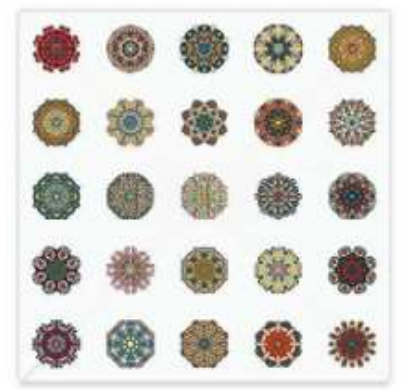
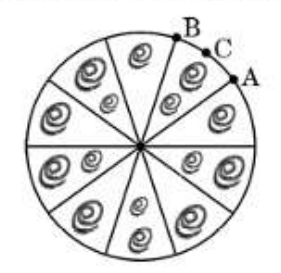
Case Study - 2: A brooch is a decorative piece often worn on clothing like jackets, blouses or dresses to add elegance. Made from precious metals and decorated with gemstones, brooches come in many shapes and designs. One such brooch is made with silver wire in the form of a circle with diameter $35$ mm. The wire is also used in making $5$ diameters which divide the circle into $10$ equal sectors as shown in the figure. (i) Find the central angle of each sector. (ii) Find the length of the arc $ACB$. (iii) (a) Find the area of each sector of the brooch. OR (iii) (b) Find the total length of the silver wire used.
Show SolutionHide Solution↓
(i) Central angle $= \frac{360^\circ}{10} = 36^\circ$. (ii) Length of arc $ACB = \frac{1}{10} \times 2 \times \frac{22}{7} \times \frac{35}{2} = 11$ mm. (iii)(a) Area $= \frac{1}{10} \times \frac{22}{7} \times \frac{35}{2} \times \frac{35}{2} = 96.25$ mm$^2$. (iii)(b) Length of wire $= 2 \times \frac{22}{7} \times \frac{35}{2} + 5 \times 35 = 285$ mm.