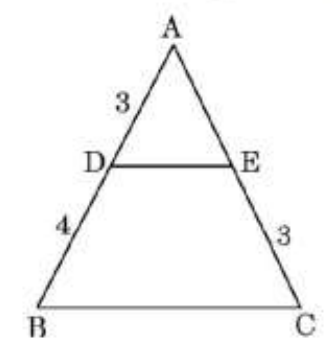
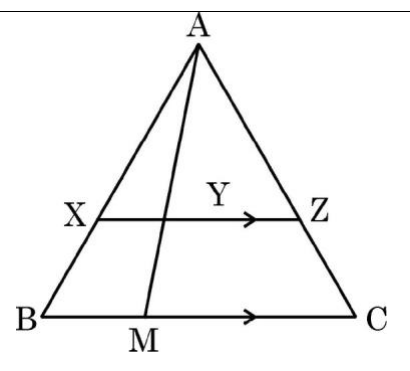
E and F are points on the sides AB and AC respectively of a $\triangle ABC$ such that $\frac{AE}{EB} = \frac{AF}{FC} = \frac{1}{2}$. Which of the following relation is true ?
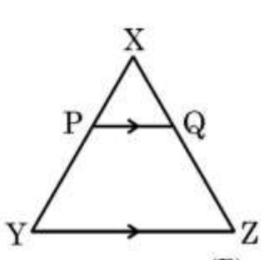
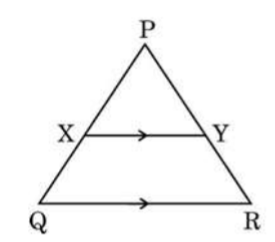
E and F are points on the sides PQ and PR respectively of a $\triangle PQR$. If EF $||$ QR and PE = $4$ cm, QE = $3$ cm and EF = $4$ cm, then the length of QR is :
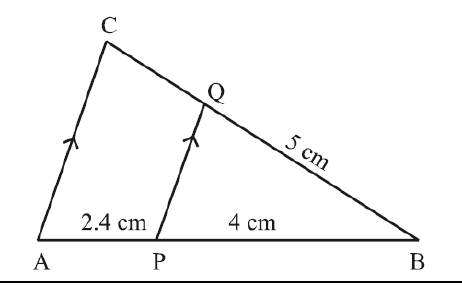
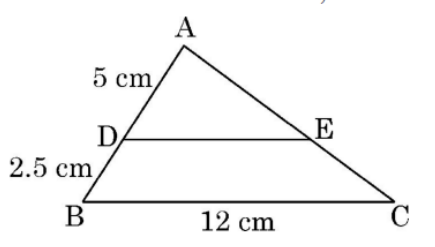
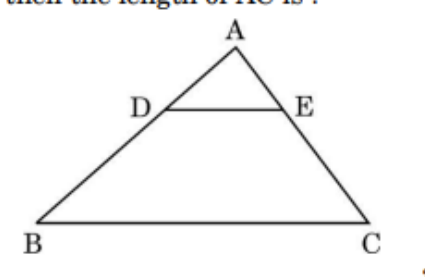
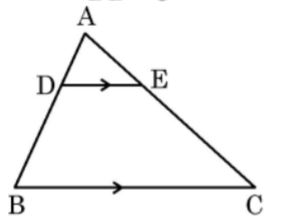
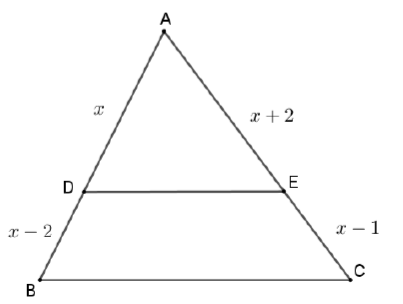
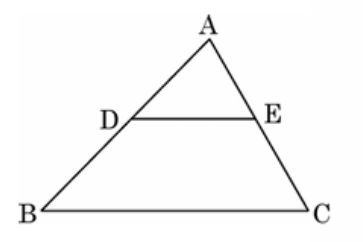
In the given figure, in $\triangle ABC$, $DE \parallel BC$. If $AD = 2.4 \text{ cm}$, $DB = 4 \text{ cm}$ and $AE = 2 \text{ cm}$, then the length of $AC$ is :
A line $l$ intersects the sides PQ and PR of a $\triangle PQR$ at L and M respectively such that LM $||$ QR. If PL = $5.7$ cm, PQ = $15.2$ cm and MR = $5.5$ cm, then the length of PM (in cm) is :
ABCD is a trapezium in which AB $||$ DC and E, F are points on AD and BC respectively such that EF $||$ DC. If ED = $36$ cm, BF = $70$ cm and FC = $30$ cm, then the length of AD is :
Line $ST$ is drawn parallel to the base $QR$ of a $\Delta PQR$, meeting $PQ$ at $S$ and $PR$ at $T$. If $\frac{PQ}{QS} = 3$ and $TR = 3$ cm, then the length of $PT$ is
Assertion (A) : In a $\Delta ABC$, $D$ and $E$ are points on the sides $AB$ and $AC$ respectively such that $DE \parallel BC$, then $\frac{AD}{AB} = \frac{AE}{AC}$. Reason (R) : If a line is drawn parallel to one side of a triangle, intersecting the other two sides, then it divides the two sides in the same ratio.
(a)Both Assertion (A) and Reason (R) are true and Reason (R) is the correct explanation of the Assertion (A).
(b)Both Assertion (A) and Reason (R) are true, but Reason (R) is not the correct explanation of Assertion (A).
(c)Assertion (A) is true, but Reason (R) is false.
(d)Assertion (A) is false, but Reason (R) is true.
Show SolutionHide Solution↓
(A) Both Assertion (A) and Reason (R) are true and Reason (R) is the correct explanation of the Assertion (A).
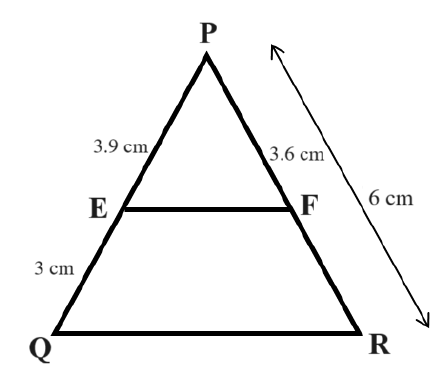
E and F are points on the sides PQ and PR respectively of a $\triangle PQR$. If PE = $3.9$ cm, EQ = $3$ cm, PF = $3.6$ cm and PR = $6$ cm, find whether EF $||$ QR.
Show SolutionHide Solution↓
FR = $6-3.6 = 2.4$ cm $\frac{PE}{EQ} = \frac{3.9}{3} = 1.3$ and $\frac{PF}{FR} = \frac{3.6}{2.4} = 1.5$ Since $\frac{PE}{EQ} \neq \frac{PF}{FR}$,∴ EF $||$ QR.
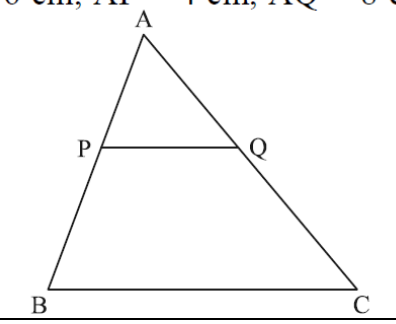
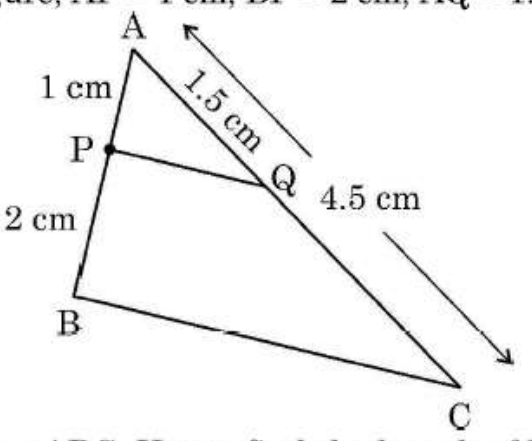
In the adjoining figure, $AP = 1$ cm, $BP = 2$ cm, $AQ = 1.5$ cm and $AC = 4.5$ cm. Prove that $\Delta APQ \sim \Delta ABC$. Hence find the length of $PQ$, if $BC = 3.6$ cm.
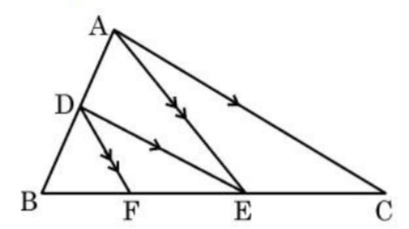
In the given figure, $DE \parallel AC$ and $DF \parallel AE$. Prove that : $\frac{BF}{FE} = \frac{BE}{EC}$
Show SolutionHide Solution↓
In $\triangle BEA$, $FD \parallel EA$ $\therefore \frac{BF}{FE} = \frac{BD}{DA}$ ...(i) (I) (1 Mark) In $\triangle BCA$, $ED \parallel CA$ $\therefore \frac{BE}{EC} = \frac{BD}{DA}$ ...(ii) (II) ($\frac{1}{2}$ Mark) Using (i) and (ii) $\frac{BF}{FE} = \frac{BE}{EC}$ (III) ($\frac{1}{2}$ Mark)
5 Marks Questions
315 Marks · 🔁 July 2023 & March 2024 & March 2025 & March 2026 · Basicopen ↗
State and Prove "Basic Proportionality Theorem".
Show SolutionHide Solution↓
Statement: If a line is drawn parallel to one side of a triangle to intersect the other two sides in distinct points, the other two sides are divided in the same ratio. (Correct Statement: $1$ mark) Given: In $\Delta ABC, DE \parallel BC$ To Prove: $\frac{AD}{DB} = \frac{AE}{EC}$ Construction: Draw $DM \perp AC, EN \perp AB$, join $BE$ and $CD$ (Given + To prove + Construction + Figure: $1$ mark) Proof: $\frac{ar(\Delta ADE)}{ar(\Delta DBE)} = \frac{\frac{1}{2} \times AD \times EN}{\frac{1}{2} \times DB \times EN} = \frac{AD}{DB} \dots (i)$ [$1$ mark] $\frac{ar(\Delta ADE)}{ar(\Delta ECD)} = \frac{\frac{1}{2} \times AE \times DM}{\frac{1}{2} \times EC \times DM} = \frac{AE}{EC} \dots (ii)$ [$1$ mark] as $\Delta DBE$ and $\Delta DCE$ lie on the same base $DE$ and between same parallels $BC$ and $DE$ $\therefore ar(\Delta DBE) = ar(\Delta ECD)$ or $\frac{ar(\Delta ADE)}{ar(\Delta DBE)} = \frac{ar(\Delta ADE)}{ar(\Delta ECD)} \dots (iii)$ [$\frac{1}{2}$ mark] From $(i), (ii)$ and $(iii)$, we get $\frac{AD}{DB} = \frac{AE}{EC}$ [$\frac{1}{2}$ mark]
If a line is drawn parallel to one side of a triangle to intersect the other two sides at distinct points, prove that the other two sides are divided in the same ratio.
Show SolutionHide Solution↓
Correct Given, to prove, figure, construction Correct proof
If a line is drawn parallel to one side of a triangle intersecting the other two sides in distinct points then it divides the two sides in the same ratio. Prove it. Also, state the converse of the above statement.
Show SolutionHide Solution↓
Correct figure, given, to prove, construction Correct proof Correct statement of converse of given statement
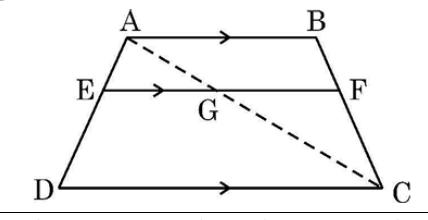
State the converse of basic proportionality theorem. Also find $\frac{BF}{FC}$ in the following figure, given that $AB || DC || EF$ and $\frac{AE}{ED} = \frac{2}{3}$. Also, find the length of EF if $AB = 10$ cm and $DC = 15$ cm.
Show SolutionHide Solution↓
Correct statement of converse of Basic Proportionality Theorem. In $\Delta ADC, EG || DC \implies \frac{AE}{ED} = \frac{AG}{GC} = \frac{2}{3}$ In $\Delta ABC, GF || AB \implies \frac{AG}{GC} = \frac{BF}{FC} = \frac{2}{3}$ $\Delta AEG \sim \Delta ADC$ $\implies \frac{AE}{AD} = \frac{AG}{AC} = \frac{EG}{DC} \implies \frac{2}{5} = \frac{EG}{DC} \implies EG = \frac{2}{5} \times 15 = 6$ cm Similarly, $\Delta CFG \sim \Delta CBA$ and $\frac{FC}{BF} = \frac{3}{2} \implies \frac{FC}{BC} = \frac{GF}{AB} = \frac{3}{5} \implies GF = \frac{3}{5} \times 10 = 6$ cm $EF = EG + GF = 6 + 6 = 12$ cm
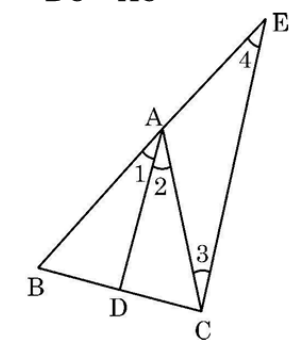
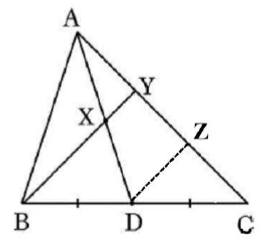
State the basic proportionality theorem. Use the theorem to do the following : In $\Delta ABC$, AD is the angle bisector of angle A. BA is produced to E such that CE $||$ AD. Prove that $\frac{BD}{DC} = \frac{BA}{AC}$.
Show SolutionHide Solution↓
Correct statement of Basic Proportionality Theorem. As DA $||$ CE $\implies \frac{BD}{DC} = \frac{BA}{AE}$ --- (1) $\angle 2 = \angle 3$ & $\angle 1 = \angle 4$. As $\angle 1 = \angle 2 \implies \angle 3 = \angle 4 \implies AC = AE$ --- (2) From (1) & (2), $\frac{BD}{DC} = \frac{BA}{AC}$
If a line drawn parallel to one side of triangle intersecting the other two sides in distinct points divides the two sides in the same ratio, then it is parallel to third side. State and prove the converse of the above statement.
Show SolutionHide Solution↓
Correct Statement of BPT (1 mark). Correct figure, Given, To Prove, Construction (2 marks). Correct Proof of BPT (2 marks). NOTE* Given statement in English version is not a correct statement. Full marks may be awarded to any attempt in English medium.
The perimeters of two similar triangles are $42$ cm and $35$ cm respectively. If one side of the first triangle is $12$ cm, then the corresponding side of the second triangle is :
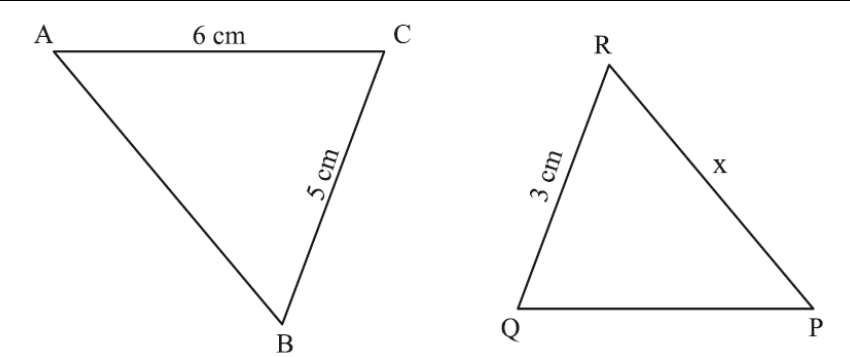
If $\triangle PQR \sim \triangle ABC$; $PQ = 6$ cm, $AB = 8$ cm and the perimeter of $\triangle ABC$ is $36$ cm, then the perimeter of $\triangle PQR$ is
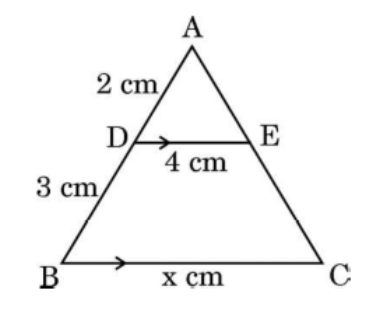
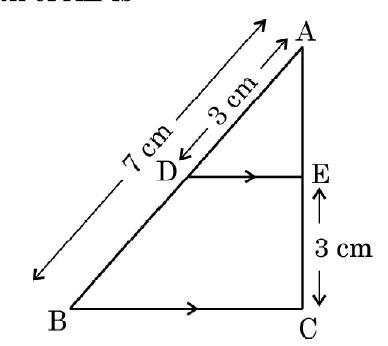
In $\triangle ABC$, $DE \parallel BC$ (as shown in the figure). If $AD = 2 \text{ cm}$, $BD = 3 \text{ cm}$, $BC = 7.5 \text{ cm}$, then the length of $DE$ (in cm) is:
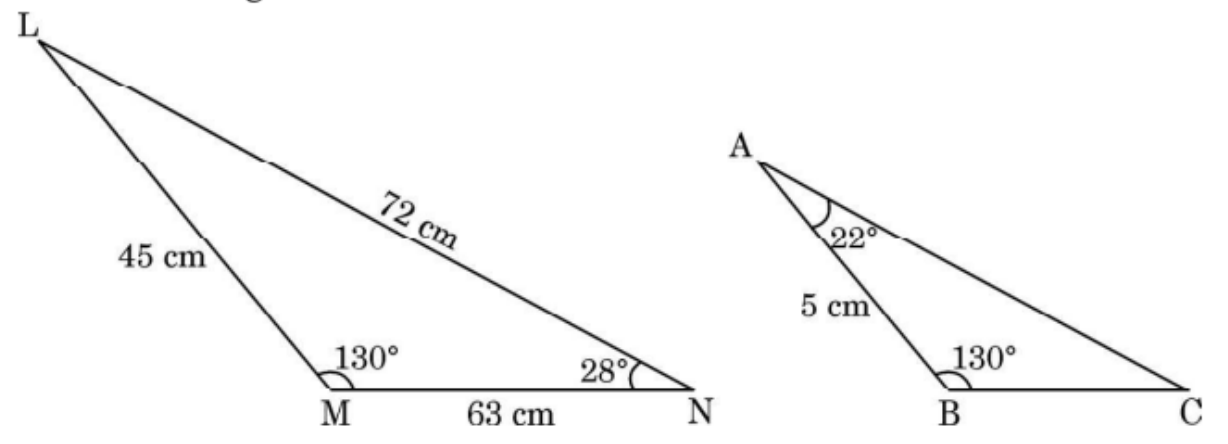
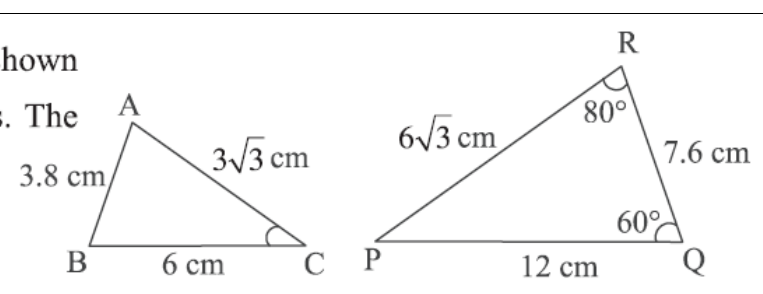
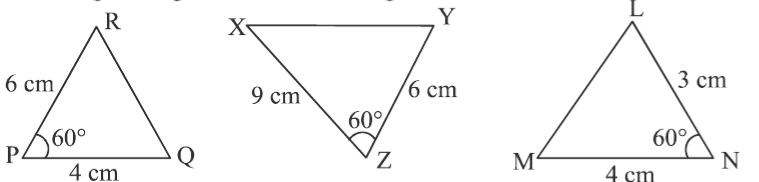
Shown below are three triangles. The measures of two adjacent sides and included angle are given for each triangle : Which of these triangles are similar?
(a)$\Delta RPQ$ and $\Delta XZY$
(b)$\Delta RPQ$ and $\Delta MNL$
(c)$\Delta XZY$ and $\Delta MNL$
(d)$\Delta RPQ$, $\Delta XZY$ and $\Delta MNL$ are similar to one another
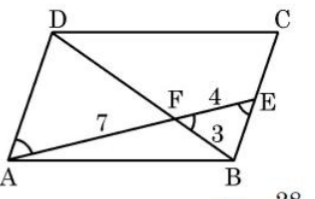
$ABCD$ is a parallelogram such that $AF = 7$ cm, $FB = 3$ cm and $EF = 4$ cm, length $FD =$ equals
(a)$\frac{21}{4}$ cm
(b)$\frac{28}{3}$ cm
(c)$\frac{12}{7}$ cm
(d)$5.5$ cm
Show SolutionHide Solution↓
(A) $\frac{21}{4}$ cm
2 Marks Questions
522 Marks · 🔁 March 2023 & July 2023 · Standardopen ↗
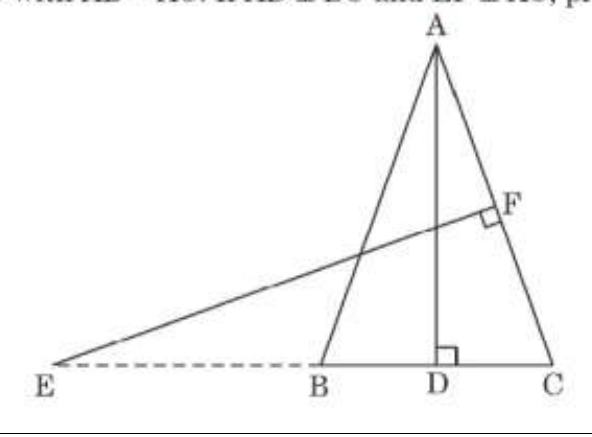
In the figure, E is a point on side CB produced of an isosceles triangle ABC with AB = AC. If AD $\perp$ BC and EF $\perp$ AC, prove that $\triangle ABD \sim \triangle ECF$.
Show SolutionHide Solution↓
In $\triangle ABC$, $AB = AC$ (Given) $\therefore \angle ACB = \angle ABC$ ----- (1) In $\triangle ABD$ and $\triangle ECF$ $\angle ADB = \angle EFC$ (each $90^\circ$) $\angle ABD = \angle ACD$ (from (1)) $\therefore \triangle ABD \sim \triangle ECF$ (AA rule)
532 Marks · 🔁 March 2024 & March 2025 · Standardopen ↗
In the given figure, $\triangle ABE \cong \triangle ACD$. Prove that $\triangle ADE \sim \triangle ABC$.
Show SolutionHide Solution↓
Given $\triangle ABE \cong \triangle ACD$ $\therefore AE = AD$ or $AD = AE$ ---- (1) ($1/2$) and $AB = AC$ ---- (2) ($1/2$) Dividing (1) by (2), we have $\frac{AD}{AB} = \frac{AE}{AC}$ ($1/2$) and $\angle DAE = \angle BAC$ $\therefore \triangle ADE \sim \triangle ABC$ ($1/2$)
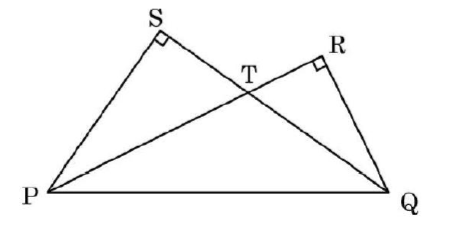
Two right triangles $PRQ$ and $PSQ$ are drawn on the same hypotenuse n$PQ$. If $PR$ and $QS$ intersect at $T$, prove that $ST \times TQ = PT \times TR$.
553 Marks · 🔁 March 2023 & July 2023 · Standardopen ↗
Sides AB and BC and the median AD of a triangle AВС are respectively proportional to the sides PQ and QR and the median PM of $\triangle PQR$. Show that $\triangle ABC \sim \triangle PQR$.
Show SolutionHide Solution↓
Given $\frac{AB}{PQ} = \frac{BC}{QR} = \frac{AD}{PM}$ Since AD and PM are medians, $BC = 2BD$ and $QR = 2QM$ So, $\frac{AB}{PQ} = \frac{2BD}{2QM} = \frac{AD}{PM} \Rightarrow \frac{AB}{PQ} = \frac{BD}{QM} = \frac{AD}{PM}$ Therefore, $\triangle ABD \sim \triangle PQM$ (SSS similarity criterion) $\Rightarrow \angle B = \angle Q$ (Corresponding angles of similar triangles) Now, in $\triangle ABC$ and $\triangle PQR$ $\frac{AB}{PQ} = \frac{BC}{QR}$ (Given) $\angle B = \angle Q$ (Proved above) Therefore, $\triangle ABC \sim \triangle PQR$ (SAS similarity criterion)
In the given figure, $CD$ is the perpendicular bisector of $AB$. $EF$ is perpendicular to $CD$. $AE$ intersects $CD$ at $G$. Prove that $\frac{CF}{CD} = \frac{FG}{DG}$.
Show SolutionHide Solution↓
$\triangle EFG \sim \triangle ADG$ $\Rightarrow \frac{EF}{AD} = \frac{FG}{DG}$ quad (i) $\triangle EFC \sim \triangle BDC$ $\Rightarrow \frac{EF}{BD} = \frac{CF}{CD}$ $\Rightarrow \frac{EF}{AD} = \frac{CF}{CD}$ quad $\{BD = AD\}$ quad (ii) Using (i) and (ii) $\frac{FG}{DG} = \frac{CF}{CD}$
PA, QB and RC are each perpendicular to AC. If AP = $x$, QB = $z$, RC = $Y$, AB = $a$ and BC = $b$, then prove that $\frac{1}{x} + \frac{1}{y} = \frac{1}{z}$
Show SolutionHide Solution↓
(a)$\triangle CQB \sim \triangle CPA$ $\Rightarrow \frac{b}{a + b} = \frac{z}{x}$ (i) Also $\triangle AQB \sim \triangle ARC$ $\Rightarrow \frac{a}{a + b} = \frac{z}{y}$ (ii) from (i) and (ii) $\frac{z}{x} + \frac{z}{y} = \frac{a + b}{a + b} = 1$ $\Rightarrow \frac{1}{x} + \frac{1}{y} = \frac{1}{z}$
584 Marks · 🔁 March 2023 & March 2026 · Standardopen ↗
In the given figure, CD and RS are respectively the medians of $\triangle ABC$ and $\triangle PQR$. If $\triangle ABC \sim \triangle PQR$ then prove that: (i) $\triangle ADC\sim\triangle PSR$ (ii) $AD \times PR = AC \times PS$
Show SolutionHide Solution↓
(i) $\triangle ABC \sim \triangle PQR$ $\angle A=\angle P$ and $\frac{AB}{PQ} = \frac{AC}{PR}$ $\Rightarrow \frac{2AD}{2PS} = \frac{AC}{PR}$ $\Rightarrow \frac{AD}{PS} = \frac{AC}{PR}$ and $\angle A = \angle P$ Therefore $\triangle ADC \sim \triangle PSR$ (ii)Hence $\frac{AD}{PS} = \frac{AC}{PR}$ $\Rightarrow AD \times PR = AC \times PS$
D is a point on the side BC of a triangle ABC such that $\angle ADC = \angle BAC$, prove that $CA^2 = CB.CD$
Show SolutionHide Solution↓
In $\Delta ABC$, D is a point on side BC such that $\angle ADC = \angle BAC$ In $\Delta CBA$ and $\Delta CDA$ $\angle C = \angle C$ (common) $\angle BAC = \angle ADC$ (given) $\therefore \Delta CBA \sim \Delta CAD$ (By AA similarity) $\therefore$ their corresponding sides are proportional $\frac{CB}{CA} = \frac{CA}{CD} \Rightarrow CA^2 = CB. CD$
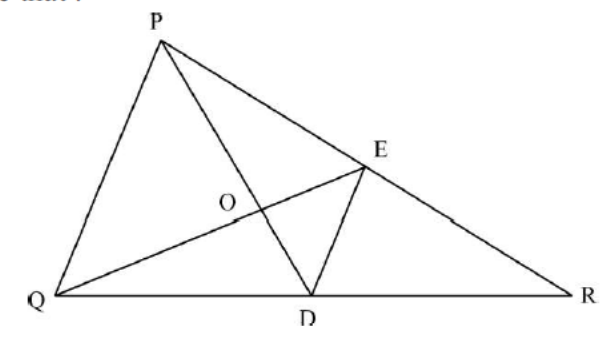
In the given figure, two medians PD and QE of $\triangle PQR$ meet each other at O. Prove that : (i) $\triangle POQ \sim \triangle DOE$ (ii) $PO = 2OD$ (iii) $PO = \frac{2}{3} PD$
Show SolutionHide Solution↓
(i) As D and E are the mid-points of RQ and RP respectively. By mid-point theorem, $ED \parallel PQ$ and $ED = \frac{1}{2} PQ$ ... (1) $\Rightarrow \triangle POQ \sim \triangle DOE$ (ii) Using part (i), $\frac{PO}{OD} = \frac{PQ}{ED}$ Using (1), $PO = 2 OD$ (iii) Using part (ii), $PO = 2 OD = 2(PD – PO)$ $\Rightarrow 3PO = 2PD$ $\Rightarrow PO = \frac{2}{3} PD$
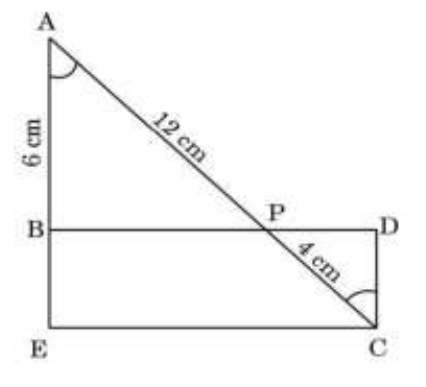
In the adjoining figure, $\Delta CAB$ is a right triangle, right angled at $A$ and $AD \perp BC$. Prove that $\Delta ADB \sim \Delta CDA$. Further, if $BC = 10$ cm and $CD = 2$ cm, find the length of $AD$.
Show SolutionHide Solution↓
$\Delta ABC \sim \Delta DAC$ (1 mark). Similarly, $\Delta ABC \sim \Delta DBA$ ($\frac{1}{2}$ mark). From equations ① and ②, $\Delta DAC \sim \Delta DBA$ or $\Delta ADB \sim \Delta CDA$ (1 mark). $\frac{AD}{CD} = \frac{BD}{AD}$ ($\frac{1}{2}$ mark). $AD^2 = BD \times CD = 8 \times 2$ ($\frac{1}{2} + 1$ marks). $\therefore AD = 4$ cm ($\frac{1}{2}$ mark).
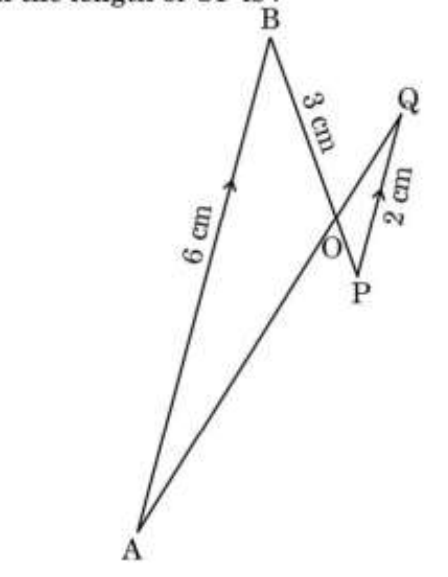
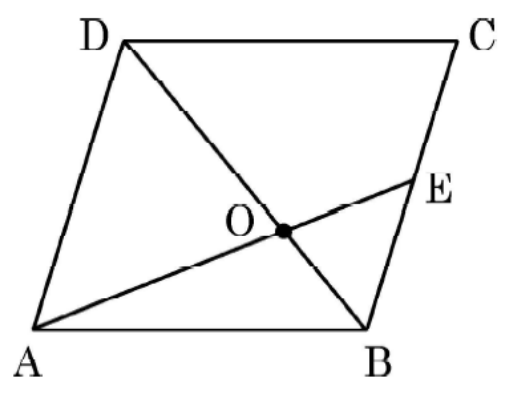
In the given figure, $ABCD$ is a parallelogram. $AE$ divides the line segment $BD$ in the ratio $1 : 2$. If $BE = 1.5$cm, then find the length of $BC$.
Show SolutionHide Solution↓
$$\begin{aligned}& \triangle OBE \sim \triangle ODA \\ & \frac{OB}{OD} = \frac{BE}{AD} \\ & \Rightarrow \frac{1}{2} = \frac{BE}{BC}\end{aligned}$$ (AD = BC) $BE = 1.5$ cm $\Rightarrow BC = 3$ cm
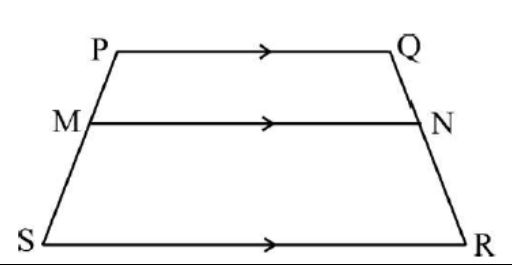
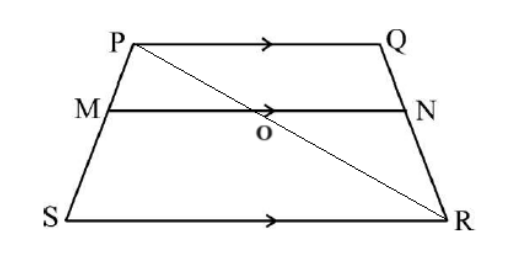
PQRS is a trapezium with PQ $||$ SR. If M and N are two points on the non-parallel sides PS and QR respectively, such that MN is parallel to PQ, then show that $\frac{PM}{MS} = \frac{QN}{NR}$.
Show SolutionHide Solution↓
Join PR PQ $||$ SR and MN $||$ PQ $\Rightarrow$ MN $||$ SR In $\triangle PSR$, $\frac{PM}{MS} = \frac{PO}{OR}$ ... (i) In $\triangle PQR$, $\frac{PO}{OR} = \frac{QN}{NR}$ ... (ii) From (i) and (ii), $\frac{PM}{MS} = \frac{QN}{NR}$
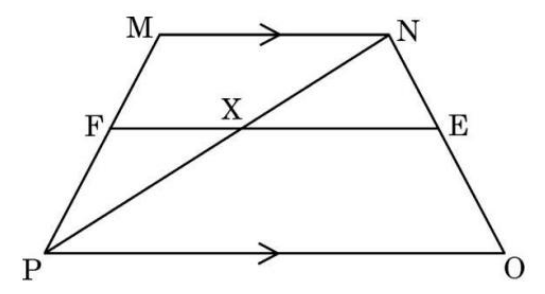
In the figure, MNOP is a trapezium with, MN $||$ PO and PO = $2$ MN. A line segment FE drawn parallel to MN intersects MP at F and NO at E such that $\frac{NE}{EO} = \frac{3}{4}$. Diagonal PN intersects FE at X. Prove that $7$ FE = $10$ MN.
Show SolutionHide Solution↓
$\frac{NE}{EO} = \frac{3}{4} \Rightarrow \frac{NE}{NO} = \frac{3}{7}$ XE $||$ PO Therefore, $\frac{NX}{NP} = \frac{NE}{NO} = \frac{XE}{PO} = \frac{3}{7}$ $\because$ PO = $2$ MN $\frac{XE}{MN} = \frac{6}{7}$ --- (1) Also, $\frac{NX}{NP} = \frac{XP}{NP} = \frac{3}{7}$ Now, FX $||$ MN $\frac{XP}{NP} = \frac{FX}{MN} = \frac{4}{7}$ --- (2) Using (1) and (2), $\frac{XE}{MN} + \frac{XF}{MN} = \frac{6}{7} + \frac{4}{7}$ $\frac{EF}{MN} = \frac{10}{7}$ or $7$ FE = $10$ MN
_q_1.png)
_a_1.png)
_q_1.png)
_a_1.png)
._q_1.png)
._q_1.png)
._q_1.png)
_a_1.png)
_a_1.png)
_q_1.png)
_q_1.png)
._q_1.png)