Surface Areas & Volumes — Class 10 Maths PYQs

Previous-year board questions (2023–2026) with marking-scheme solutions, grouped by topic and marks.

Try each question first, then press (or tap Show Solution) to reveal the answer. Press again for the next question.

Year:Marks:Level:

Surface Area

1 Mark Questions
11 Mark · 🔁 July 2023 & March 2026 · Standardopen ↗
Assertion (A): The surface area of the cuboid formed by joining two cubes of sides $4$ cm each, end to end, is $160$ cm$^2$.
Reason (R) : Surface area of a cuboid of dimensions $l \times b \times h$ is $(lb + bh + hl)$
Show SolutionHide Solution
(c) Assertion (A) is true but Reason (R) is false
21 Mark · March 2023 · Standardopen ↗
Curved surface area of a cylinder of height $5$ cm is $94.2$ cm $^2$. Radius of the cylinder is (Take $\pi = 3.14$)
  • (a)2 cm
  • (b)3 cm
  • (c)2.9 cm
  • (d)6 cm
Show SolutionHide Solution
(B) 3
31 Mark · March 2023 · Standardopen ↗
The curved surface area of a cone having height $24$ cm and radius $7$ cm, is
  • (a)$528$ cm $^2$
  • (b)$1056$ cm $^2$
  • (c)$550$ cm $^2$
  • (d)$500$ cm $^2$
Show SolutionHide Solution
(C) $550\text{cm}^2$
41 Mark · March 2023 · Standardopen ↗
The area of metal sheet required to make a closed hollow cylinder of height $2.4$m and base radius $0.7$m, is
  • (a)$10.56$ m$^2$
  • (b)$13.52$ m$^2$
  • (c)$13.64$ m$^2$
  • (d)$14.08$ m$^2$
Show SolutionHide Solution
(C) $13.64$ m$^2$
51 Mark · March 2023 · Standardopen ↗
What is the total surface area of a solid hemisphere of diameter 'd'?
  • (a)$3 \pi d^2$
  • (b)$2 \pi d^2$
  • (c)$\frac{1}{2} \pi d^2$
  • (d)$\frac{3}{4} \pi d^2$
Show SolutionHide Solution
(d) $\frac{3}{4} \pi d^2$
61 Mark · March 2024 · Standardopen ↗
Assertion (A): Two cubes each of edge length $10$ cm are joined together. The total surface area of newly formed cuboid is $1200$ cm$^2$.
Reason (R): Area of each surface of a cube of side $10$ cm is $100$ cm$^2$.
Show SolutionHide Solution
(D) Assertion (A) is not true but Reason (R) is true.
71 Mark · March 2024 · Standardopen ↗
Two identical solid cubes of side 'a' are joined end-to-end. The total surface area of the resulting cuboid is :
  • (a)$6a^2$
  • (b)$10a^2$
  • (c)$5a^2$
  • (d)$4a^2$
Show SolutionHide Solution
(B) $10a^2$
81 Mark · July 2025 · Standardopen ↗
Assertion (A): The curved surface area of a right circular cone of radius $3.5$ cm and slant height $4$ cm is $44$ sq cm.
Reason (R): The curved surface area of a right circular cone of radius $r$ and slant height $l$ is $\pi rl$.
Show SolutionHide Solution
(A) Both Assertion (A) and Reason (R) are true and Reason (R) is the correct explanation of the Assertion (A).
91 Mark · March 2025 · Standardopen ↗
Assertion (A): If we join two hemispheres of same radius along their bases, then we get a sphere. Reason (R): Total Surface Area of a sphere of radius $r$ is $3\pi r^2$.
  • (a)Both Assertion (A) and Reason (R) are true and Reason (R) is the correct explanation of the Assertion (A).
  • (b)Both Assertion (A) and Reason (R) are true, but Reason (R) is not the correct explanation of the Assertion (A).
  • (c)Assertion (A) is true, but Reason (R) is false.
  • (d)Assertion (A) is false, but Reason (R) is true.
Show SolutionHide Solution
(C) Assertion (A) is true, but Reason (R) is false.
101 Mark · March 2025 · Standardopen ↗
A cone of height 12 cm and slant height 13 cm is surmounted on a hemisphere having radius equal to that of cone. The entire height of the solid is
  • (a)17 cm
  • (b)18 cm
  • (c)22 cm
  • (d)23 cm
Show SolutionHide Solution
(A) 17 cm
111 Mark · March 2025 · Standardopen ↗
Assertion (A): If the total surface area of a solid hemisphere is $462$ cm$^2$, then its radius is $7$ cm. Reason (R): The total surface area of a solid hemisphere of radius $r$ is $3\pi r^2$.
  • (a)Both Assertion (A) and Reason (R) are true and Reason (R) is the correct explanation of Assertion (A).
  • (b)Both Assertion (A) and Reason (R) are true, but Reason (R) is not the correct explanation of Assertion (A).
  • (c)Assertion (A) is true, but Reason (R) is false.
  • (d)Assertion (A) is false, but Reason (R) is true.
Show SolutionHide Solution
(A) Both Assertion(A) and Reason(R) are true and Reason(R) is the correct explanation of Assertion(A).
121 Mark · March 2026 · Standardopen ↗
The total surface area of a solid hemisphere of diameter '$2d$' is :
  • (a)$3 \pi d^2$
  • (b)$2 \pi d^2$
  • (c)$\frac{1}{2} \pi d^2$
  • (d)$\frac{3}{4} \pi d^2$
Show SolutionHide Solution
(a) $3 \pi d^2$ (1 Mark)
131 Mark · March 2026 · Standardopen ↗
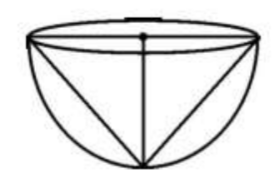
A conical cavity of maximum volume is carved out from a wooden solid hemisphere of radius $10$ cm. Curved surface area of the cavity carved out is (use $\pi = 3.14$)
figure for this question
  • (a)$314\sqrt{2}$ cm²
  • (b)$314$ cm²
  • (c)$\frac{3140}{3}$ cm²
  • (d)$3140\sqrt{2}$ cm²
Show SolutionHide Solution
(A) $314\sqrt{2}$ cm² (1 Mark)
141 Mark · March 2026 · Standardopen ↗
A camping tent in hemispherical shape of radius $1.4$ m, has a door opening of area $0.50$ m$^2$. Outer surface area of the tent is
  • (a)$11.78$ m$^2$
  • (b)$12.32$ m$^2$
  • (c)$11.82$ m$^2$
  • (d)$12.86$ m$^2$
Show SolutionHide Solution
(C) $11.82$ m$^2$
151 Mark · March 2026 · Standardopen ↗
A camping tent in hemispherical shape of radius $1.4$ m, has a door opening of area $0.50$ m². Outer surface area of the tent is
  • (a)$11.78$ m²
  • (b)$12.32$ m²
  • (c)$11.82$ m²
  • (d)$12.86$ m²
Show SolutionHide Solution
(C) $11.82$ m² (1 Mark)
161 Mark · March 2025 · Basicopen ↗
For which of the following solids is the lateral/curved surface area and total surface area the same ?
  • (a)Cube
  • (b)Cuboid
  • (c)Hemisphere
  • (d)Sphere
Show SolutionHide Solution
(D) Sphere
171 Mark · March 2025 · Basicopen ↗
A cone of height '$h$' and radius '$r$' is surmounted on a solid cylinder of same dimensions. The total surface area of the entire solid will be :
  • (a)$2\pi rh + \pi r \sqrt{h^2 + r^2}$
  • (b)$2\pi rh + \pi r^2 + \pi r \sqrt{h^2 + r^2}$
  • (c)$2\pi rh + 2\pi r^2 + \pi r \sqrt{h^2 + r^2}$
  • (d)$2\pi rh + \pi r \sqrt{h^2 + r^2} - \pi r^2$
Show SolutionHide Solution
(B) $2\pi rh + \pi r^2 + \pi r \sqrt{h^2 + r^2}$
181 Mark · March 2025 · Basicopen ↗
A cone of height '$h$' and radius '$r$' is surmounted on a hemisphere of same radius. The total surface area of the entire solid will be :
  • (a)$\pi rh + \pi r^2$
  • (b)$\pi r \sqrt{h^2 + r^2} + \pi r^2$
  • (c)$\pi r \sqrt{h^2 + r^2} + 2\pi r^2$
  • (d)$\pi r \sqrt{h^2 + r^2} + 3\pi r^2$
Show SolutionHide Solution
Answer (C) $\pi r \sqrt{h^2 + r^2} + 2\pi r^2$
191 Mark · March 2025 · Basicopen ↗
The curved surface area of a cone with base radius $7\text{ cm}$, is $550\text{ cm}^2$. The slant height of the cone is :
  • (a)$25\text{ cm}$
  • (b)$14\text{ cm}$
  • (c)$20\text{ cm}$
  • (d)$24\text{ cm}$
Show SolutionHide Solution
(a) $25\text{ cm}$
201 Mark · March 2025 · Basicopen ↗
Assertion (A) : When a hemisphere of same radius ($r$) is carved out from one side of a solid wooden cylinder, the total surface area of remaining solid is increased by $2\pi r^2$.
Reason (R) : Curved surface area of hemisphere is $2\pi r^2$.
  • (a)Both Assertion (A) and Reason (R) are true and Reason (R) is the correct explanation of Assertion (A).
  • (b)Both Assertion (A) and Reason (R) are true, but Reason (R) is not the correct explanation of Assertion (A).
  • (c)Assertion (A) is true, but Reason (R) is false.
  • (d)Assertion (A) is false, but Reason (R) is true.
Show SolutionHide Solution
(D) Assertion (A) is false, but Reason (R) is true.
211 Mark · March 2025 · Basicopen ↗
The total surface area of a solid hemisphere of radius $7$ cm is
  • (a)$98 \pi \text{ cm}^2$
  • (b)$196 \pi \text{ cm}^2$
  • (c)$147 \pi \text{ cm}^2$
  • (d)$174 \pi \text{ cm}^2$
Show SolutionHide Solution
(C) $147 \pi \text{ cm}^2$
221 Mark · March 2026 · Basicopen ↗
The total surface area of a solid cone of radius $7 \text{ cm}$ and slant height $25 \text{ cm}$, is
  • (a)$724 \text{ cm}^2$
  • (b)$704 \text{ cm}^2$
  • (c)$550 \text{ cm}^2$
  • (d)$616 \text{ cm}^2$
Show SolutionHide Solution
Answer (B) $704 \text{ cm}^2$
3 Marks Questions
233 Marks · March 2026 · Standardopen ↗
A toy is in the form of a cone mounted on a hemisphere of radius $7$ cm. The total height of the toy is $31$ cm. Find the total surface area of the toy.
figure for this question
Show SolutionHide Solution
Height of conical part $= 31 – 7 = 24$ cm
Slant height of conical part $= \sqrt{(7)^2 + (24)^2} = 25$ cm (1/2 Mark)
TSA of the toy = CSA of conical part + CSA of hemispherical part (1 Mark)
$= 2\pi r l + 2\pi r^2 = 2 \times \frac{22}{7} \times 7 \times 25 + 2 \times \frac{22}{7} \times 7 \times 7$ (1 Mark)
$= 858$ cm$^2$ (1/2 Mark)
So, the total surface area of the toy is $858$ cm$^2$.
243 Marks · March 2026 · Standardopen ↗
To protect plants from heat, a shed of iron rods covered with green cloth is made. The lower part of the shed is a cuboid mounted by semi-cylinder as shown in the figure. Find the area of the cloth required to make this shed, if dimensions of the cuboid are $14$ m $\times 25$ m $\times 16$ m
figure for this question
Show SolutionHide Solution
Area of cloth required to cover four walls $= 2(14 \times 16 + 25 \times 16)$ (I) (1 Mark)
$= 1248$ m$^2$
Radius $= \frac{14}{2} = 7$ m
Area of cloth required to cover cylindrical part $= \frac{22}{7} \times 7 \times 25 + \frac{22}{7} \times 7^2$ (II) (1 Mark)
$= 704$ m$^2$ (III) ($\frac{1}{2}$ Mark)
$\therefore$ Area of total cloth required $= 1248 + 704 = 1952$ m$^2$ (IV) ($\frac{1}{2}$ Mark)
253 Marks · March 2026 · Standardopen ↗
The internal and external radii of a hollow hemisphere are $5\sqrt{2}$ cm and $10$ cm respectively. A cone of height $5\sqrt{7}$ cm and radius $5\sqrt{2}$ cm is surmounted on the hemisphere as shown in the figure. Find the total surface area of the object in terms of $\pi$. (Use $\sqrt{2} = 1.4$)
figure for this question
Show SolutionHide Solution
Let internal and external radii be $r_1 = 5\sqrt{2}$ cm and $r_2 = 10$ cm respectively.
$\therefore$ Slant height $(l)$ of the cone $= \sqrt{(5\sqrt{2})^2 + (5\sqrt{7})^2} = 15$ cm (I) (1 Mark)
Now, the total surface area of the object $= 2\pi r_2^2 + \pi r_1 l + \pi(r_2^2 - r_1^2)$ (II) (1 Mark)
$= \pi (2\times 10^2 + 5\sqrt{2} \times 15 + 10^2 - (5\sqrt{2})^2)$ (III) (1 Mark)
$= 355 \pi$ cm$^2$
4 Marks Questions
264 Marks · July 2023 · Standardopen ↗
Case Study - 3
For the Kumbh Mela, Uttar Pradesh Government prescribed the following for the contractors to pitch the tents.
Each tent must be of cylindrical base of radius $21$ m and height $5$ m, surmounted by a conical part of height $20$ m. The cylindrical part must have a white coloured thick fabric costing ₹60 per square meter, while the conical part must have PVC coated blue fabric costing ₹70 per square meter.
Based on the above information, answer the following questions:
(a) How much blue PVC (in sq.m) is required and what will be its total cost?
(b) How much white fabric (in sq.m) is required and what will be its total cost?
Show SolutionHide Solution
Given: Radius of cylindrical base $r = 21$ m.
Height of cylindrical part $h_c = 5$ m.
Height of conical part $h_k = 20$ m.
(a) For the conical part (blue PVC):
Slant height $l = \sqrt{r^2 + h_k^2} = \sqrt{21^2 + 20^2} = \sqrt{441 + 400} = \sqrt{841} = 29$ m.
Curved Surface Area (CSA) of conical part $= \pi r l = \frac{22}{7} \times 21 \times 29 = 22 \times 3 \times 29 = 66 \times 29 = 1914$ m$^2$.
Cost of blue PVC $= 1914 \times \text{Rs}70 = \text{Rs}133980$.
(b) For the cylindrical part (white fabric):
Curved Surface Area (CSA) of cylindrical part $= 2\pi r h_c = 2 \times \frac{22}{7} \times 21 \times 5 = 2 \times 22 \times 3 \times 5 = 660$ m$^2$.
Cost of white fabric $= 660 \times \text{Rs}60 = \text{Rs}39600$.
274 Marks · March 2026 · Standardopen ↗
On a Sunday your parents took you to a fair. You could see lot of toys displayed and you wanted them to buy a Rubik's cube and a strawberry ice-cream for you.
Based on the information given above, answer the following questions :
(i) Find the length of the diagonal of Rubik's cube if each edge measures 6 cm.
(ii) Find the volume of Rubik's cube if the length of the edge is 7 cm.
(iii) (a) What is the curved surface area of hemisphere (ice-cream) if the base radius is 7 cm?
OR
(iii) (b) If two cubes of edges 4 cm are joined end-to-end, then find the surface area of the resulting cuboid.
figure for this question
Show SolutionHide Solution
(i) Length of diagonal of cube = $\sqrt{3} \times \text{side}$
$= 6\sqrt{3} \text{ cm}$ (1 Mark)
(ii) Volume of Rubik's cube = $(7)^3$
$= 343 \text{ cm}^3$ (1 Mark)
(iii) (a) CSA of hemisphere = $2 \times \frac{22}{7} \times 7 \times 7$
$= 308 \text{ cm}^2$ (1 Mark)
OR
(iii) (b) Surface area of resulting cuboid = $5(4)^2 + 5(4)^2$
$= 160 \text{ cm}^2$ (1 Mark)
ALTERNATE SOLUTION :
(iii) (b) Surface area of resulting cuboid = $2( 8\times 4 + 4 \times 4 +8\times4)$
$= 160 \text{ cm}^2$ (1 Mark)
284 Marks · March 2026 · Standardopen ↗
A wall mounted lamp, made of fabric, is shown below. Lamp has cuboidal shape, open from top and bottom. A spherical bulb of diameter $7$ cm is latched with a very thin rod. (Ignore the rod while making calculations.)
Dimensions of the cuboid are $24$ cm $\times 12$ cm $\times 17$ cm.
(i) Find the surface area of the bulb.
(ii) What could be the maximum diameter of the bulb if at least $1$ cm space is left from each side?
(iii) (a) Find the area of the fabric used if there is a fold of $2$ cm on top and bottom edges.
OR
(iii) (b) Find the space available inside the lamp.
figure for this question
Show SolutionHide Solution
(i) Surface area of the bulb = $4 \times \frac{22}{7} \times \frac{7}{2} \times \frac{7}{2} = 154$ cm$^2$ (I Mark)
(ii) Maximum diameter of the bulb = Minimum side length $- 2$ cm
$= 12 - 2 = 10$ cm (I Mark)
(iii) (a) With $2$ cm extra cloth for top and bottom edges,
new dimensions are $24$ cm $\times 12$ cm $\times 21$ cm (I Mark)
Area of fabric used = $2 \times 21 \times (24 + 12) = 1512$ cm$^2$ (II Mark)
OR
(iii) (b) Space available = $24 \times 12 \times 17 - \frac{4}{3} \times \frac{22}{7} \times \frac{7}{2} \times \frac{7}{2} \times \frac{7}{2}$ (I Mark)
$= 4896 - \frac{539}{3}$ (II Mark)
$= \frac{14149}{3}$ cm$^3$ or $4716.3$ cm$^3$ (approx.)
294 Marks · March 2026 · Basicopen ↗
In a coffee shop, coffee is served in two types of cups. One is cylindrical shape with each of diameter $8$ cm and height $7$ cm and the other hemispherical with each of diameter $14$ cm.
Based on the above, answer the following questions :
(i) What is the outer curved surface area of the cylindrical cup ?
(ii) What is the inner surface area of the hemispherical cup ?
(iii) (a) Find the difference of the capacities of the two cups.
OR
(b) Find the total volume of coffee in two cylindrical and one hemispherical cup.
Show SolutionHide Solution
(i) $r = 4$ cm
Outer C.S.A. of cylindrical cup = $2 \times \frac{22}{7} \times 4 \times 7 = 176$ cm$^2$ (1 Mark)
(ii) $R = 7$ cm,
Inner Surface Area of hemispherical cup = $2 \times \frac{22}{7} \times 7 \times 7 = 308$ cm$^2$ (1 Mark)
(iii) (a) Difference in the capacities = $\frac{22}{7} \times 4 \times 4 \times 7 - \frac{2}{3} \times \frac{22}{7} \times 7 \times 7 \times 7$ (1 Mark)
$= \frac{1100}{3}$ cm$^3$ or $366.67$ cm$^3$ (1 Mark)
OR
(b) Total Volume of coffee = $2 \times \frac{22}{7} \times 4 \times 4 \times 7 + \frac{2}{3} \times \frac{22}{7} \times 7 \times 7 \times 7$ (1 Mark)
$= \frac{4268}{3}$ cm$^3$ or $1422.67$ cm$^3$ (1 Mark)
5 Marks Questions
305 Marks · July 2023 · Standardopen ↗
A tent is in the shape of a right circular cylinder up to a height of $3$ m and then a right circular cone, with a maximum height of $13.5$ m above the ground. Calculate the cost of painting the inner side of the tent at the rate of ₹2 per square metre, if the radius of the base is $14$ m.
Show SolutionHide Solution
Height of conical part $= 13.5 - 3 = 10.5$ m
Slant height $= \sqrt{(14)^2 + (10.5)^2} = 17.5$ m
SA of tent = CSA of conical part + CSA of cylindrical part
$= (\frac{22}{7} \times 14 \times 17.5) + (2 \times \frac{22}{7} \times 14 \times 3)$
$= 1034$ m$^2$
Cost of painting @ ₹2 per m$^2 = 1034 \times 2 = 2068$
315 Marks · March 2023 · Standardopen ↗
From a solid cylinder of height $20$ cm and diameter $12$ cm, a conical cavity of height $8$ cm and radius $6$ cm is hallowed out. Find the total surface area of the remaining solid.
Show SolutionHide Solution
Height of cylinder $h = 20$ cm
radius of cylinder $= 6$ cm $=$ Radius of cone
Height of cone $= 8$ cm
Slant height $l = \sqrt{8^2 + 6^2} = \sqrt{64 + 36} = 10$ cm
Surface area of remaining solid
$= CSA \text{ of cylinder} + CSA \text{ of cone} + \text{Area of base of cylinder}$
$= 2\pi rh + \pi rl + \pi r^2 = \pi r[2h + l + r]$
$= \frac{22}{7} \times 6[2 \times 20 + 10 + 6] = \frac{22}{7} \times 6 \times 56$
$= 1056 \text{ cm}^2$
325 Marks · March 2023 · Standardopen ↗
A wooden article was made by scooping out a hemisphere from each end of a solid cylinder, as shown in the figure. If the height of the cylinder is $10$ cm and its base is of radius $3.5$ cm, find the total surface area of the article.
Show SolutionHide Solution
Height of cylinder = $10$ cm
Radius of cylinder = radius of hemisphere = $3.5 = \frac{7}{2}$ cm
Total surface area of the article
= CSA of cylinder + CSA of $2$ hemispheres
= $$\begin{aligned}& 2\pi rh + 2 \times 2\pi r^2 \\ & = 2\pi r(h + 2r) \\ & = 2 \times \frac{22}{7} \times \frac{7}{2} (10 + 2 \times \frac{7}{2}) \\ & = 22 \times 17 = 374\end{aligned}$$ cm$^2$
335 Marks · July 2024 · Standardopen ↗
A solid is in the form of a right circular cylinder with hemispherical ends. The total height of the solid is $58$ cm and the diameter of the cylinder is $28$ cm. Find the total surface area of the solid.
Show SolutionHide Solution
Height of cylindrical part = $58 - 14 - 14 = 30$ cm
Radius of cylindrical as well as hemispherical parts = $14$ cm
TSA of the solid = $4 \times \frac{22}{7} \times (14)^2 + 2 \times \frac{22}{7} \times 14 \times 30$
= $5104 \text{ cm}^2$
Therefore, total surface area of the solid is $5104 \text{ cm}^2$.
345 Marks · March 2024 · Standardopen ↗
A wooden article was made by scooping out a hemisphere from each end of a solid cylinder, as shown in the figure. If the height of the cylinder is $5.8 \text{ cm}$ and its base is of radius $2.1 \text{ cm}$, find the total surface area of the article.
figure for this question
Show SolutionHide Solution
$$\begin{aligned}& CSA \text{ of cylinder } = 2 \times \frac{22}{7} \times 2.1 \times 5.8 \\ & = 76.56 \text{ cm}^2 \\ & CSA \text{ of two hemisphere } = 4 \times \frac{22}{7} \times 2.1 \times 2.1 \\ & = 55.44 \text{ cm}^2 \\ & \text{Total Surface Area of article } = 76.56 + 55.44 = 132 \text{ cm}^2\end{aligned}$$
355 Marks · March 2024 · Standardopen ↗
A tent is in the shape of a cylinder, surmounted by a conical top. If the height and diameter of the cylindrical part are $3.5$ m and $6$ m, and slant height of the top is $4.2$ m, find the area of canvas used for making the tent. Also, find the cost of canvas of the tent at the rate of ₹500 per m$^2$.
Show SolutionHide Solution
Radius ($r$) = $3$m (1/2 Mark)
CSA of cylinder = $2\pi rh = 2 \times \frac{22}{7} \times 3 \times 3.5 = 66$ m$^2$ (1 Mark)
CSA of cone = $\pi rl = \frac{22}{7} \times 3 \times 4.2 = 39.6$ m$^2$ (1 Mark)
Area of canvas = $66 + 39.6 = 105.6$ m$^2$ (1/2 Mark)
Cost = $500 \times 105.6 = \text{\text{Rs} }52800$ (1 Mark)
365 Marks · March 2024 · Standardopen ↗
The interior of a building is in the form of a cylinder of base radius $12$ m and height $3.5$ m surmounted by a cone of equal base and slant height $14$ m. Find the internal curved surface area of the building.
Show SolutionHide Solution
Internal CSA of the building = $$\begin{aligned}& 2 \times \frac{22}{7} \times 12 \times 3.5 + \frac{22}{7} \times 12 \times 14 \\ & = 792\end{aligned}$$ m$^2$
375 Marks · July 2025 · Standardopen ↗
A toy is in the form of a cone of radius $3.5$ cm, mounted on a hemisphere of same radius. The total height of the toy is $15.5$ cm. Find the total surface area of the toy.
Show SolutionHide Solution
Height of conical part = $15.5 – 3.5 = 12$ cm
Slant height = $\sqrt{(3.5)^2 + (12)^2} = 12.5$ cm
Total surface area of toy = CSA of conical part + CSA of hemispherical part
$= \frac{22}{7} \times 3.5 \times 12.5 + 2 \times \frac{22}{7} \times (3.5)^2$
$= 214.5$ cm$^2$
figure for this question
385 Marks · March 2025 · Standardopen ↗
A wooden cubical die is formed by forming hemispherical depressions on each face of the cube such that face $1$ has one depression, face $2$ has two depressions and so on. The sum of number of hemispherical depressions on opposite faces is always $7$. If the edge of the cubical die measures $5$ cm and each hemispherical depression is of diameter $1.4$ cm, find the total surface area of the die so formed.
Show SolutionHide Solution
Number of hemispherical depressions = $21$
Total surface area of the die formed
= TSA of cube + CSA of $21$ hemispheres – Base area of $21$ hemispherical depressions
$= 6 \times 5^2 + 21 \times 2 \times \frac{22}{7} \times (0.7)^2 - 21 \times \frac{22}{7} \times (0.7)^2$
$= 182.34$ cm$^2$
395 Marks · March 2025 · Standardopen ↗
In order to provide shelter to flood victims, a shed was constructed using tin sheets which is in the form of cuboid surmounted by a half cylinder as shown below : The length, breadth and height of cuboidal portion are $10$ m, $7$ m and $3$ m respectively. The diameter of the cylindrical portion is $7$ m. Find the cost of tin sheets required to make the shed at the rate of ₹ $70$ per square metre, given that the shed is open from the front side and closed from the back side.
figure for this question
Show SolutionHide Solution
Area of the sheet required for the shed $= (\text{lateral surface area of the cuboid} - \text{front area}) + \frac{1}{2} CSA \text{ of cylinder} + \text{area of semicircle}$
$= [2 \times (10 + 7) \times 3 - 7 \times 3] + \frac{1}{2} \times 2 \times \frac{22}{7} \times \frac{7}{2} \times 10 + \frac{1}{2} \times \frac{22}{7} \times (\frac{7}{2})^2$
$= \frac{841}{4} m^2$
Cost of sheet $= \frac{841}{4} \times 70 = \text{\text{Rs} } 14717.50$
405 Marks · March 2025 · Standardopen ↗
On the day of her examination, Riya sharpened her pencil from both ends as shown below: The diameter of the cylindrical and conical part of the pencil is $4.2$ mm. If the height of each conical part is $2.8$ mm and length of entire pencil is $105.6$ mm, find the total surface area of the pencil.
figure for this question
Show SolutionHide Solution
$d = 4.2$ mm, $r = 2.1$ mm. Height of cylindrical part $(h) = 100$ mm. Height of conical part = $2.8$ mm. Slant height $(l) = \sqrt{(2.8)^2 + (2.1)^2} = 3.5$ mm. Curved Surface Area of Cylinder = $2 \times \frac{22}{7} \times 2.1 \times 100 = 1320$ mm$^2$. Curved Surface Area of Cone = $\frac{22}{7} \times 2.1 \times 3.5 = 23.1$ mm$^2$. Total Surface Area of pencil = Curved Surface Area of cylinder + Curved Surface Area of two cones = $1366.2$ mm$^2$.
415 Marks · March 2025 · Standardopen ↗
A tent is of the shape of a right circular cylinder up to a height of $3$ metres surmounted by a right circular cone of same radius such that the total height of the tent is $13.5$ metres above the ground. Calculate the cost of painting the inner side of the tent at the rate of ₹ $2$ per square metre, if the radius of the base is $14$ metres.
Show SolutionHide Solution
$l = \sqrt{14^2 + (10.5)^2} = 17.5$ m. Total Surface Area (inside) = $2 \times \frac{22}{7} \times 14 \times 3 + \frac{22}{7} \times 14 \times 17.5 = 1034$ m$^2$. Cost = $1034 \times 2 = \text{\text{Rs} } 2068$

Volume

1 Mark Questions
421 Mark · July 2023 · Standardopen ↗
A hemispherical bowl is made of steel of thickness $1$ cm. The inner radius of the bowl is $5$ cm. The volume of steel used (in cm$^3$) is :
  • (a)$182 \pi$
  • (b)$\frac{182}{3} \pi$
  • (c)$\frac{682}{3} \pi$
  • (d)$\frac{364}{3} \pi$
Show SolutionHide Solution
(b) $\frac{182}{3} \pi$
431 Mark · March 2023 · Standardopen ↗
Water in a river which is $3$ m deep and $40$ m wide is flowing at the rate of $2$ km/h. How much water will fall into the sea in $2$ minutes?
  • (a)$800 \text{ m}^3$
  • (b)$4000 \text{ m}^3$
  • (c)$8000 \text{ m}^3$
  • (d)$2000 \text{ m}^3$
Show SolutionHide Solution
(c) $8000 \text{ m}^3$
441 Mark · March 2023 · Standardopen ↗
The volume of a right circular cone whose area of the base is $156$ cm$^2$ and the vertical height is $8$ cm, is
  • (a)$2496$ cm$^3$
  • (b)$1248$ cm$^3$
  • (c)$1664$ cm$^3$
  • (d)$416$ cm$^3$
Show SolutionHide Solution
(D) $416$ cm$^3$
451 Mark · July 2024 · Standardopen ↗
A hemispherical bowl is made of steel of thickness $0.30$ cm. The inner radius of the bowl is $3$ cm. The volume of steel used (in cu cm) is :
  • (a)$595.8 \pi$
  • (b)$5.958 \pi$
  • (c)$6 \pi$
  • (d)$59.58 \pi$
Show SolutionHide Solution
(B) $5.958 \pi$
461 Mark · 🔁 March 2024 & July 2024 & March 2025 & July 2025 · Standardopen ↗
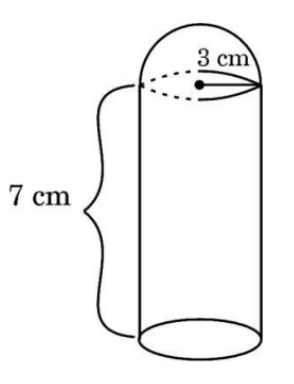
Assertion (A): In the given figure, a toy is in the form of a cylinder surmounted by a hemisphere of the same radius. If the radius of the cylinder is $3$ cm and its height is $7$ cm, then the volume of toy is $81 \pi \text{ cm}^3$. Reason (R): Volume of the given solid is the sum of the volume of the cylinder and the volume of the hemisphere.
figure for this question
  • (a)Both Assertion (A) and Reason (R) are true and Reason (R) is the correct explanation of the Assertion (A).
  • (b)Both Assertion (A) and Reason (R) are true, but Reason (R) is
  • (c)Assertion (A) is true, but Reason (R) is false.
  • (d)Assertion (A) is false, but Reason (R) is true.
Show SolutionHide Solution
(A) Both Assertion (A) and Reason (R) are true and Reason (R) is the correct explanation of the Assertion (A).
471 Mark · March 2024 · Standardopen ↗
The volume of the largest right circular cone that can be carved out from a solid cube of edge $2$ cm is :
  • (a)$\frac{4\pi}{3}$ cu cm
  • (b)$\frac{5\pi}{3}$ cu cm
  • (c)$\frac{8\pi}{3}$ cu cm
  • (d)$\frac{2\pi}{3}$ cu cm
Show SolutionHide Solution
(d) $\frac{2\pi}{3}$ cu cm
481 Mark · March 2026 · Standardopen ↗
The radius of a sphere (in cm) whose volume is $36 \pi$ cm$^3$, is :
  • (a)$3$
  • (b)$3\sqrt{3}$
  • (c)$3^{\frac{2}{3}}$
  • (d)$3^{\frac{1}{3}}$
Show SolutionHide Solution
(a) $3$
491 Mark · March 2026 · Standardopen ↗
A hemispherical bowl is made of steel of thickness $1$ cm. The outer radius of the bowl is $6$ cm. The volume of steel used (in cm$^3$) is :
  • (a)$182 \pi$
  • (b)$\frac{182}{3} \pi$
  • (c)$\frac{682}{3} \pi$
  • (d)$\frac{364}{3} \pi$
Show SolutionHide Solution
(B) $\frac{182}{3} \pi$ (1 Mark)
501 Mark · March 2026 · Standardopen ↗
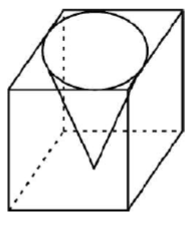
A cone of maximum size is carved out from a solid cube of edge length $l$. The volume of the cone is :
figure for this question
  • (a)$\frac{\pi l^3}{12}$
  • (b)$\frac{\pi l^3}{3}$
  • (c)$l^3 \left(1-\frac{\pi}{3}\right)$
  • (d)$\frac{\pi l^3}{8}$
Show SolutionHide Solution
(A) $\frac{\pi l^3}{12}$ (1 Mark)
511 Mark · March 2026 · Standardopen ↗
Three tennis balls are just packed in a cylindrical jar. If radius of each ball is $r$, volume of air inside the jar is
figure for this question
  • (a)$2\pi r^3$
  • (b)$3\pi r^3$
  • (c)$5\pi r^3$
  • (d)$4\pi r^3$
Show SolutionHide Solution
(A) $2\pi r^3$
521 Mark · March 2026 · Standardopen ↗
An ice-cream cone of radius $r$ and height $h$ is completely filled by two spherical scoopes of ice-cream. If radius of each spherical scoop is $\frac{r}{2}$, then $h: 2r$ equals
  • (a)$1:8$
  • (b)$1:2$
  • (c)$1:1$
  • (d)$2:1$
Show SolutionHide Solution
(B) $1:2$
531 Mark · March 2025 · Basicopen ↗
The largest possible cone is just fitted inside a hollow cube of edge $25$ cm. The radius of the base of the cone is
  • (a)$5$ cm
  • (b)$12.5$ cm
  • (c)$25$ cm
  • (d)$10$ cm
Show SolutionHide Solution
(B) $12.5$ cm
541 Mark · March 2026 · Basicopen ↗
The radius of the largest sphere that can be carved out from a solid cube of side $14$ cm is :
  • (a)$7$ cm
  • (b)$14$ cm
  • (c)$14\sqrt{2}$ cm
  • (d)$7\sqrt{2}$ cm
Show SolutionHide Solution
(A) $7$ cm
2 Marks Questions
552 Marks · March 2026 · Standardopen ↗
$1000$ small thermocol balls of radius $0.5$ cm are kept in a spherical
nballoon of radius $20$ cm. Find the volume of air in the balloon.
Show SolutionHide Solution
Volume of air in the ballon = Volume of spherical balloon $-$ Volume of $1000$
nthermocol balls
$= \frac{4}{3} \times \frac{22}{7} \times (20)^3 - 1000 \times \frac{4}{3} \times \frac{22}{7} \times (0.5)^3$ (1 Mark)
$= 33000$ cm$^3$ (1 Mark)
3 Marks Questions
563 Marks · March 2023 · Standardopen ↗
A room is in the form of cylinder surmounted by a hemi-spherical dome. The base radius of hemisphere is one-half the height of cylindrical part. Find total height of the room if it contains $\frac{1408}{21}$ m$^3$ of air. Take $\pi = \frac{22}{7}$
Show SolutionHide Solution
Let $h$ be height of cylindrical part and $r$ be radius of hemisphere
Volume of room = $2\pi r^3 + \frac{2}{3} \pi r^3 = \frac{1408}{21}$
$\Rightarrow r=2$
Therefore, $h=4$
Height of the room is = $6$m
573 Marks · March 2023 · Standardopen ↗
An empty cone is of radius 3 cm and height 12 cm. Ice-cream is filled in it so that lower part of the cone which is $(\frac{1}{6})^{\text{th}}$ of the volume of the cone is unfilled but hemisphere is formed on the top. Find volume of the ice-cream. (Take $\pi = 3.14$)
figure for this question
Show SolutionHide Solution
Volume of the cone = $\frac{1}{3}\times\pi\times9\times12=36\pi\text{cm}^3$
Volume of ice-cream in the cone = $\frac{5}{6} \times 36 \times \pi = 30\pi\text{cm}^3$
Volume of ice-cream on top = $\frac{2}{3} \times 27 \times \pi = 18\pi\text{cm}^3$
Total volume of the ice-cream = $(30\pi +18\pi) = 48\pi\text{cm}^3$
$=48\times3.14=150.72\text{cm}^3$
583 Marks · March 2023 · Standardopen ↗
An empty cone is of radius $3$ cm and height $12$ cm. Ice-cream is filled in it so that lower part of the cone which is $\left(\frac{1}{6}\right)^{\text{th}}$ of the volume of the cone is unfilled but hemisphere is formed on the top. Find volume of the ice-cream. (Take $\pi = 3.14$)
Show SolutionHide Solution
Volume of the cone = $$\begin{aligned}& \frac{1}{3}\times\pi\times9\times12=36\pi \text{cm}^3 \\ & \text{Volume of ice-cream in the cone} = \frac{5}{6} \times 36 \times \pi = 30\pi \text{cm}^3 \\ & \text{Volume of ice-cream on top} = \frac{2}{3} \times 27 \times \pi = 18\pi \text{cm}^3 \\ & \text{Total volume of the ice-cream} = (30\pi +18\pi) = 48\pi \text{cm}^3 \\ & =48\times3.14=150.72\text{cm}^3\end{aligned}$$
593 Marks · March 2024 · Standardopen ↗
The difference between the outer and inner radii of a hollow right circular cylinder of length $14$ cm is $1$ cm. If the volume of the metal used in making the cylinder is $176$ cm$^3$, find the outer and inner radii of the cylinder.
Show SolutionHide Solution
Let outer radius be $r_2$ cm and inner radius be $r_1$ cm.
$\therefore r_2 - r_1 = 1$ ----- (i)
Volume of metal used = $176$ cm$^3$
$\Rightarrow \frac{22}{7} \times 14 \times (r_2^2 - r_1^2) = 176$
$\Rightarrow r_2 + r_1=4$ ----- (ii)
Solving (i) and (ii), we get
$r_2 = \frac{5}{2}$ or $2.5$, $r_1 = \frac{3}{2}$ or $1.5$
Therefore, outer radius = $2.5$ cm and inner radius = $1.5$ cm
603 Marks · March 2025 · Standardopen ↗
A room is in the form of a cylinder surmounted by a hemispherical dome. The base radius of the hemisphere is half of the height of the cylindrical part. If the room contains $\frac{1408}{21} \text{ m}^3$ of air, find the height of the cylindrical part. (Use $\pi = \frac{22}{7}$).
Show SolutionHide Solution
Let $r$ be the radius and $h$ be the height of cylinder. $h = 2r$. Volume $= \frac{2}{3}\pi r^3 + \pi r^2 h = \frac{1408}{21} \implies \frac{2}{3}\pi r^3 + \pi r^2(2r) = \frac{1408}{21} \implies \frac{8}{3} \times \frac{22}{7} \times r^3 = \frac{1408}{21} \implies r^3 = 8 \implies r = 2$ m and $h = 4$ m.
613 Marks · March 2025 · Basicopen ↗
From each end of a solid cylinder of height $20$ cm and base radius $7$ cm, a cone of base radius $2.1$ cm and height $5$ cm is scooped out. Find the volume of the remaining solid.
Show SolutionHide Solution
Volume of cylinder $= \frac{22}{7} \times 7 \times 7 \times 20 = 3080$ cu. cm
Volume of cones $= 2 \times \frac{1}{3} \times \frac{22}{7} \times \frac{21}{10} \times \frac{21}{10} \times 5 = 46.2$ cu. cm
Volume of remaining solid $= 3080 - 46.2 = 3033.8$ cu. cm
4 Marks Questions
624 Marks · March 2026 · Standardopen ↗
A solid is in the form of a cylinder with hemispherical ends. The total height of the solid is $20$ cm and the diameter of the cylinder is $7$ cm. Find the total volume of the solid. (Use $\pi = \frac{22}{7}$)
Show SolutionHide Solution
Radius of cylinder = radius of hemisphere $= \frac{7}{2}$ cm (1/2 Mark)
Total height of solid $= 20$ cm
Height of cylinder $= (20 - \frac{7}{2} - \frac{7}{2})$ cm $= 13$ cm (1/2 Mark)
Total volume of solid $= [\frac{22}{7} \times (\frac{7}{2})^2 \times 13 + 2 \times \frac{2}{3} \times \frac{22}{7} \times (\frac{7}{2})^3]$ (1 Mark)
$= \frac{22}{7} \times (\frac{7}{2})^2 \times (13 + \frac{14}{3})$ (1 Mark)
$= \frac{4081}{6} = 680.1$ cm$^3$ (approx.) (1 Mark)
634 Marks · March 2026 · Standardopen ↗
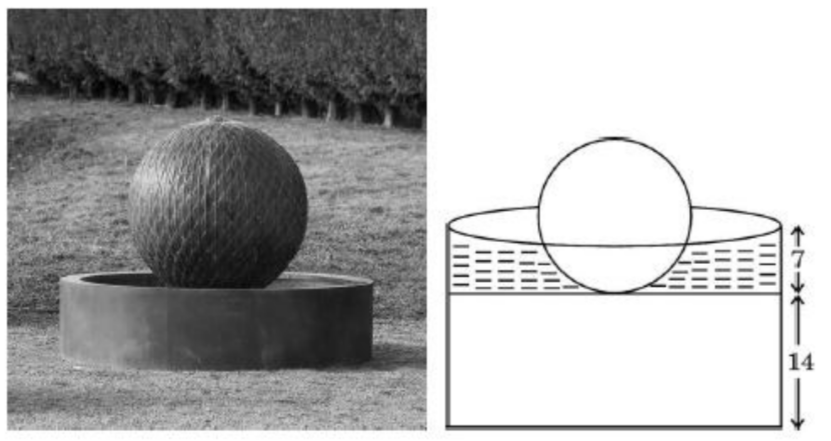
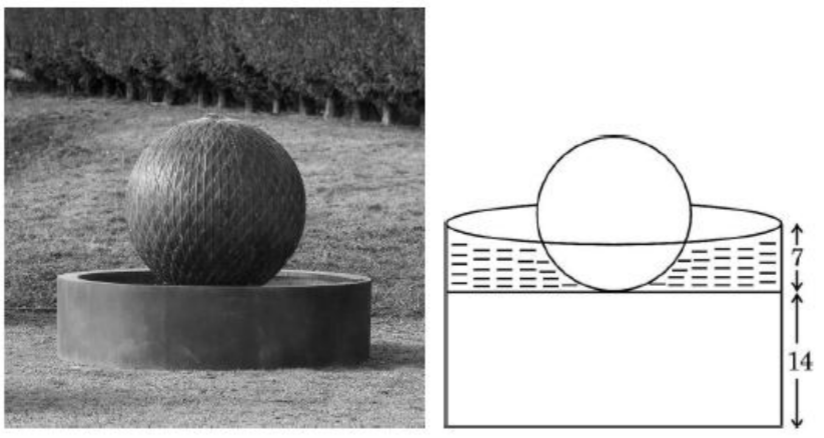
A model of Leafy Ball Fountain is made to be kept on the tabletop. Water gently cascades down the ball into a decorative cylindrical pool where it is recycled.
The diameter of spherical ball is $21$ cm.
Cylindrical pool - Outer diameter is $50$ cm and inner diameter is $40$ cm.
Height of solid base is $14$ cm.
Height of water filled is $7$ cm.
Observe the figure and answer the following questions :
(i) Determine the total height of the fountain.
(ii) Find the volume of the ball.
(iii) (a) If one-third of the ball is submerged in the water, find the volume of the water filled in the pool.
OR
(iii) (b) Find the sum of the outer curved surface area of the cylindrical part and surface area of the ball.
figure for this question
Show SolutionHide Solution
(i) Total height of the fountain $= 14 + 21 = 35$ cm (1 Mark)
(ii) Volume of the ball $= \frac{4}{3} \times \frac{22}{7} \times \frac{21}{2} \times \frac{21}{2} \times \frac{21}{2}$ (1/2 Mark)
$= 4851$ cm$^3$ (1/2 Mark)
(iii) (a) Volume of water = Volume of inner upper part – $\frac{1}{3} \times$ Volume of the ball
$= \pi \times 20 \times 20 \times 7 - \frac{1}{3} \times 4851$ (1 Mark)
$= 7183$ cm$^3$ (1 Mark)
OR
(iii) (b) Required area = Outer CSA of cylindrical part + Surface area of the ball
$= 2 \times \frac{22}{7} \times 25 \times (14 + 7) + 4 \times \frac{22}{7} \times \frac{21}{2} \times \frac{21}{2}$ (1 Mark)
$= 4686$ cm$^2$ (1 Mark)
5 Marks Questions
645 Marks · March 2023 · Standardopen ↗
A student was asked to make a model shaped like a cylinder with two cones attached to its ends by using a thin aluminium sheet. The diameter of the model is $3$ cm and its total length is $12$ cm. If each cone has a height of $2$ cm, find the volume of air contained in the model.
Show SolutionHide Solution
Radius of each cone = Radius of cylinder = $\frac{3}{2}$ cm
Height of each cone 'H' = $2$ cm
Height of cylinder ‘h' = $12 – 4 = 8$ cm
Volume of air = Volume of cylinder + Volume of $2$ cones
$= \pi r^2 h + 2 \times \frac{1}{3} \pi r^2 H$
$= \pi r^2 (h + \frac{2}{3} H) = \frac{22}{7} \times (\frac{3}{2})^2 \times (8 + \frac{2}{3} \times 2)$
$= \frac{22}{7} \times \frac{9}{4} \times \frac{28}{3} = 66$ cm$^3$
655 Marks · March 2023 · Standardopen ↗
A solid is in the shape of a right-circular cone surmounted on a hemisphere, the radius of each of them being $7$ cm and the height of the cone is equal to its diameter. Find the volume of the solid.
Show SolutionHide Solution
Radius of cone = radius of hemisphere = $7$ cm
Height of cone = $14$ cm
Volume of solid = Volume of hemisphere + volume of cone
$= \frac{2}{3}\pi(7)^3 + \frac{1}{3}\pi(7)^2(14)$
$= \frac{1}{3} \times \frac{22}{7} \times 7 \times 7(14 + 14)$
$= \frac{154}{3} \times 28 = \frac{4312}{3} \text{ cm}^2 \text{ or } 1437.33 \text{ cm}^2$
665 Marks · March 2023 · Standardopen ↗
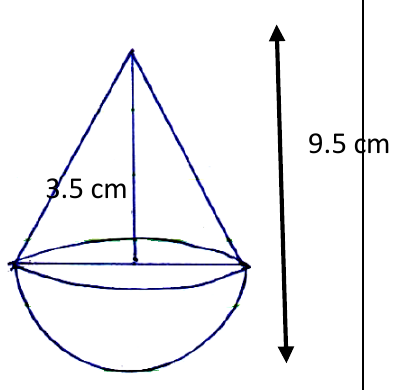
A solid is in the shape of a right-circular cone surmounted on a hemisphere, the radius of each of them being $3.5$ cm and the total height of the solid is $9.5$ cm. Find the volume of the solid.
Show SolutionHide Solution
Radius of hemisphere = Radius of cone = $3.5$ cm = $\frac{7}{2}$ cm
Height of cone = $9.5 - 3.5 = 6$ cm
Volume of solid = volume of hemisphere + volume of cone
$= \frac{2}{3} \times \frac{22}{7} \times (\frac{7}{2})^3 + \frac{1}{3} \times \frac{22}{7} \times (\frac{7}{2})^2 \times 6$
$= \frac{77}{6} \times 13 = \frac{1001}{6} = 166.8$ cm$^3$
figure for this question
675 Marks · July 2024 · Standardopen ↗
From a solid cylinder of height $36$ cm and diameter $14$ cm, a conical cavity of radius $7$ cm and height $24$ cm is drilled out. Find the volume of the remaining solid.
Show SolutionHide Solution
Radius of cylinder = $7$ cm
Volume of the remaining solid = $\frac{22}{7} \times (7)^2 \times 36 - \frac{1}{3} \times \frac{22}{7} \times (7)^2 \times 24$
= $5544 - 1232$
= $4312 \text{ cm}^3$
Therefore, volume of the remaining solid is $4312 \text{ cm}^3$.
685 Marks · March 2024 · Standardopen ↗
A solid iron pole consists of a solid cylinder of height $200 \text{ cm}$ and base diameter $28 \text{ cm}$, which is surmounted by another cylinder of height $50 \text{ cm}$ and radius $7 \text{ cm}$. Find the mass of the pole, given that $1 \text{ cm}^3$ of iron has approximately $8 \text{ g}$ mass.
Show SolutionHide Solution
Radius of lower cylinder = $14 \text{ cm}$
Volume of pole = $\frac{22}{7} \times 14 \times 14 \times 200 + \frac{22}{7} \times 7 \times 7 \times 50$
$= 130900 \text{ cm}^3$
Mass of the pole= $8 \times 130900$
$=1047200 \text{ gm}$ or $1047.2 \text{ kg}$
695 Marks · March 2024 · Standardopen ↗
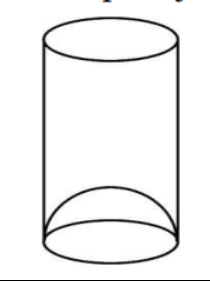
A juice seller was serving his customers using glasses as shown in the figure. The inner diameter of the cylindrical glass was $5.6$ cm, but the bottom of the glass had a hemispherical raised portion which reduced the capacity of the glass. If the height of the glass was $10$ cm, find the apparent capacity and the actual capacity of the glass.
figure for this question
Show SolutionHide Solution
Radius$(r) = 2.8$cm
Apparent capacity of glass $= \frac{22}{7} \times 2.8 \times 2.8 \times 10$
$= 246.4$ cm$^3$
Volume of hemispherical part $= \frac{2}{3} \times \frac{22}{7} \times 2.8 \times 2.8 \times 2.8$
$= 45.9$ cm$^3$
$\therefore$ Actual capacity of glass $= 246.4 - 45.9$
$= 200.5$ cm$^3$ or $200.5$ ml
705 Marks · March 2025 · Standardopen ↗
A $16$ m deep well with diameter $3.5$ m is dug up and the earth from it is spread evenly to form a platform $27.5$ m $\times 7$ m. Find the height of the platform.
Show SolutionHide Solution
(a) Volume of the earth dug up = $\frac{22}{7} \times \frac{7}{4} \times \frac{7}{4} \times 16 = 154$ m$^3$. Area of platform = $27.5 \times 7 = 192.5$ m$^2$. Height of platform = $\frac{154}{192.5} = \frac{4}{5}$ m or $80$ cm
715 Marks · March 2025 · Basicopen ↗
A toy is in the form of a cone surmounted on a hemisphere. The cone and hemisphere have the same radii. The height of the conical part of the toy is equal to the diameter of its base. If the radius of the conical part is $5\text{ cm}$, find the volume of the toy.
Show SolutionHide Solution
(a) Radius $= r = 5\text{ cm}$
Height of cone $= h = 10\text{ cm}$
Volume of toy $=$ volume of hemisphere $+$ volume of cone
$= \frac{2}{3}\pi r^3 + \frac{1}{3}\pi r^2 h$
$= \frac{2}{3} \times \frac{22}{7} \times 5 \times 5 \times 5 + \frac{1}{3} \times \frac{22}{7} \times 5 \times 5 \times 10$
$= \frac{5500}{21} + \frac{5500}{21} = \frac{11000}{21}\text{ cu. cm}$ or $523.81\text{ cu. cm}$
725 Marks · March 2025 · Basicopen ↗
A cubical block is surmounted by a hemisphere of radius $3.5\text{ cm}$. What is the smallest possible length of the edge of the cube so that the hemisphere can totally lie on the cube ? Find the total surface area of the solid so formed.
Show SolutionHide Solution
Edge of cube $= a = 3.5 \times 2 = 7\text{ cm}$
Total surface area of solid
$= 6 a^2 + 2\pi r^2 - \pi r^2$
$= 6 a^2 + \pi r^2$
$= 6 \times 7 \times 7 + \frac{22}{7} \times 3.5 \times 3.5$
$= \frac{665}{2}\text{ sq. cm}$ or $332.5\text{ sq. cm}$
735 Marks · March 2025 · Basicopen ↗
A spherical glass vessel has a cylindrical neck which is $7 \text{ cm}$ long and $2 \text{ cm}$ in diameter. The diameter of the spherical part is $14 \text{ cm}$. Find the capacity of the entire glass vessel. (Use $\pi = \frac{22}{7}$)
Show SolutionHide Solution
Radius of sphere $= R = 7 \text{ cm}$
Radius of cylinder $= r = 1 \text{ cm}$
Capacity of the entire glass vessel $= \pi r^2 h + \frac{4}{3} \pi R^3$ [2+2 marks]
$= \frac{22}{7} \times 1 \times 1 \times 7 + \frac{4}{3} \times \frac{22}{7} \times 7 \times 7 \times 7$
$= \frac{4378}{3} \text{ cu.cm}$ or $1459.33 \text{ cu.cm}$ [1 mark]

Both

1 Mark Questions
741 Mark · March 2023 · Standardopen ↗
If the area of the base of a cone is $51$ cm$^2$ and its volume is $85$ cm$^3$, then the vertical height of the cone is given as :
  • (a)$\frac{5}{6}$ cm
  • (b)$\frac{5}{3}$ cm
  • (c)$\frac{5}{2}$ cm
  • (d)$5$ cm
Show SolutionHide Solution
(d) $5$ cm
751 Mark · March 2025 · Standardopen ↗
The radii 'r' of a sphere and that of the base of a cone are same. If their volumes are also same, then the height of the cone is :
  • (a)$r$
  • (b)$2r$
  • (c)$3r$
  • (d)$4r$
Show SolutionHide Solution
(D) $4r$
4 Marks Questions
764 Marks · March 2023 · Standardopen ↗
Case Study - 2
In a coffee shop, coffee is served in two types of cups. One is cylindrical in shape with diameter $7$ cm and height $14$ cm and the other is hemispherical with diameter $21$ cm.
Based on the above, answer the following questions:
(i) Find the area of the base of the cylindrical cup.
(ii) (a) What is the capacity of the hemispherical cup?
OR
(ii) (b) Find the capacity of the cylindrical cup.
(iii) What is the curved surface area of the cylindrical cup?
figure for this question
Show SolutionHide Solution
(i) Area of base of the cylindrical cup = $\frac{22}{7} \times \frac{7}{2} \times \frac{7}{2} = \frac{77}{2}$ or $38.5$
$\therefore$ Area of base of the cylindrical cup is $\frac{77}{2}$ or $38.5$ cm$^2$
(ii) (a) Capacity of hemispherical cup = $\frac{2}{3} \times \frac{22}{7} \times \frac{21}{2} \times \frac{21}{2} \times \frac{21}{2}$
$= \frac{4851}{2}$ or $2425.5$
$\therefore$ Capacity of hemispherical cup is $\frac{4851}{2}$ cm$^3$ or $2425.5$ cm$^3$
OR
(ii) (b) Capacity of cylindrical cup = $\frac{22}{7} \times (7)^2 \times 14$
$= 539$
$\therefore$ Capacity of cylindrical cup is $539$ cm$^3$
(iii) External Curved surface area of cylindrical cup = $2 \times \frac{22}{7} \times \frac{7}{2} \times 14 = 308$
$\therefore$ External Curved surface area of cylindrical cup is $308$ cm$^2$
774 Marks · March 2024 · Standardopen ↗
The word 'circus' has the same root as 'circle'. In a closed circular area, various entertainment acts including human skill and animal training are presented before the crowd.
A circus tent is cylindrical upto a height of $8$ m and conical above it. The diameter of the base is $28$ m and total height of tent is $18.5$ m.
Based on the above, answer the following questions :
(i) Find slant height of the conical part.
(ii) Determine the floor area of the tent.
(iii) (a) Find area of the cloth used for making tent.
OR
(iii) (b) Find total volume of air inside an empty tent.
figure for this question
Show SolutionHide Solution
(i) Height of conical part $= 18.5 - 8 = 10.5$ m
Radius of conical part $= 14$ m
Slant height $= \sqrt{(10.5)^2 + (14)^2} = 17.5$ m
(ii) Floor area $= \frac{22}{7} \times 14 \times 14 = 616$ m$^2$
(iii) (a) Area of cloth used
$= 2 \times \frac{22}{7} \times 14 \times 8 + \frac{22}{7} \times 14 \times 17.5$
$= 1474$ m$^2$
OR
(iii) (b) Volume of air inside the tent
$= \frac{22}{7} \times 14 \times 14 \times 8 + \frac{1}{3} \times \frac{22}{7} \times 14 \times 14 \times 10.5$
$= 7084$ m$^3$
784 Marks · March 2024 · Standardopen ↗
Case Study - 3
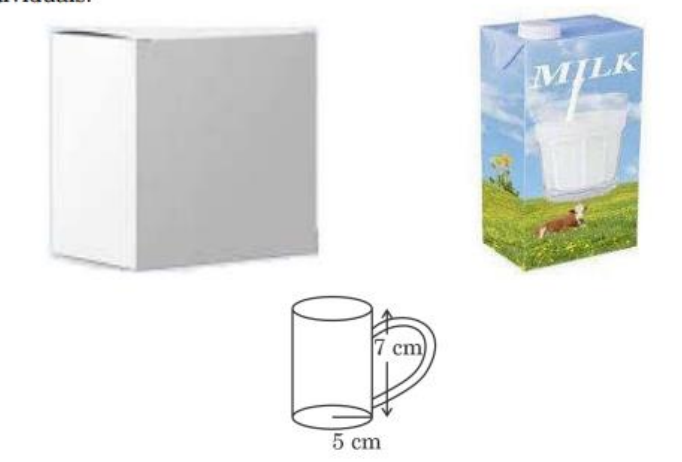
Tamper-proof tetra-packed milk guarantees both freshness and security. This milk ensures uncompromised quality, preserving the nutritional values within and making it a reliable choice for health-conscious individuals.
$500$ mL milk is packed in a cuboidal container of dimensions $15$ cm x $8$ cm x $5$ cm. These milk packets are then packed in cuboidal cartons of dimensions $30$ cm x $32$ cm x $15$ cm.
Based on the above given information, answer the following questions :
(i) Find the volume of the cuboidal carton.
(ii) (a) Find the total surface area of a milk packet.
OR
(b) How many milk packets can be filled in a carton ?
(iii) How much milk can the cup (as shown in the figure) hold ?
figure for this question
Show SolutionHide Solution
(i) Volume of cuboidal carton $$\begin{aligned}& = 30\times32\times15 \\ & = 14400 \text{ cm}^3 \\ & \text{(ii)(a) Total surface area of milk packet } = 2(15\times8+8\times5+5\times15) \\ & = 470 \text{ cm}^2\ \text{OR} \\ & \text{(ii) (b) Number of milk packets in carton } = \frac{30\times32\times15}{15\times8\times5} \\ & = 24 \\ & \text{(iii) Capacity of the cup } = \frac{22}{7} \times 5 \times 5 \times 7 \\ & = 550 \text{ cm}^3 \text{ or } 550 \text{ ml}\end{aligned}$$
794 Marks · March 2025 · Standardopen ↗
A skilled carpenter decided to craft a special rolling pin for the local baker. He carefully joined three cylindrical pieces of wood two small ones on the ends and one larger in the centre to create a perfect tool. The baker loved the rolling pin, as it rolled out the smoothest dough for breads and pastries.
The length of the bigger cylindrical part is $12$ cm and diameter is $7$ cm and the length of each smaller cylindrical part is $5$ cm and diameter is $2.1$ cm.
Based on the above information, answer the following questions :
(i) Find the volume of the bigger cylindrical part.
(ii) Find the curved surface area of the bigger cylindrical part.
(iii) (a) Find the ratio of the volume of the bigger cylindrical part to the total volume of the two smaller (identical) cylindrical parts.
OR
(b) Find the sum of the curved surface areas of the two identical smaller cylindrical parts.
figure for this question
Show SolutionHide Solution
(i) Volume of the bigger cylindrical part $= \pi r^2 h = \frac{22}{7} \times \frac{7}{2} \times \frac{7}{2} \times 12$
$= 462$ cm$^3$
(ii) The Curved Surface Area of bigger cylindrical part $= 2 \pi r h = 2 \times \frac{22}{7} \times \frac{7}{2} \times 12$
$= 264$ cm$^2$
(iii) (a) Total volume of the two smaller cylindrical parts $= 2 \times \pi r^2 h = 2 \times \frac{22}{7} \times \frac{2.1}{2} \times \frac{2.1}{2} \times 5$
$= 34.65$ cm$^3$
Required ratio $= \frac{462}{34.65} = \frac{3080}{231}$
$\therefore$ Required ratio is $3080 : 231$
OR
(b) The Sum of Curved Surface Area of two smaller cylindrical parts $= 2 \times 2 \pi r h = 2 \times 2 \times \frac{22}{7} \times \frac{2.1}{2} \times 5$
$= 66$ cm$^2$
804 Marks · March 2025 · Standardopen ↗
To make the teaching-learning process easier, creative and innovative, a teacher brings clay in the classroom to teach the topic of mensuration. She forms a cylinder of radius $2.1$ cm and height $5$ cm with the clay and put a hemisphere of same radius on its top in such a way that the base of hemisphere covers the top of cylinder. Using the above information, and $\pi = \frac{22}{7}$, find : (a) The volume of cylinder so formed. (b) The volume of hemispherical part. (c) (i) The surface area of the complete solid. OR (c) (ii) The surface area of the cylindrical part, if hemisphere is not put on it.
Show SolutionHide Solution
(a) Volume of cylinder = $\frac{22}{7} \times \frac{21}{10} \times \frac{21}{10} \times 5 = 69.3$ cm$^3$
(b) Volume of hemispherical part = $\frac{2}{3} \times \frac{22}{7} \times \frac{21}{10} \times \frac{21}{10} \times \frac{21}{10} = 19.404$ cm$^3$
(c) (i) Surface area of the complete solid = $2 \times \frac{22}{7} \times \frac{21}{10} \times 5 + 3 \times \frac{22}{7} \times \frac{21}{10} \times \frac{21}{10} = 107.58$ cm$^2$
OR
(c) (ii) Required surface area = $2 \times \frac{22}{7} \times \frac{21}{10} \times 5 + 2 \times \frac{22}{7} \times \frac{21}{10} \times \frac{21}{10} = 93.72$ cm$^2$
814 Marks · March 2026 · Standardopen ↗
A model of Leafy Ball Fountain is made to be kept on the tabletop. Water≥ntly cascades down the ball into a decorative cylindrical pool where it is
recycled.
The diameter of spherical ball is $21$ cm.
Cylindrical pool - Outer diameter is $50$ cm and inner diameter is $40$ cm.
Height of solid base is $14$ cm.
Height of water filled is $7$ cm.
(i) Determine the total height of the fountain.
(ii) Find the volume of the ball.
(iii) (a) If one-third of the ball is submerged in the water, find the volume of the water filled in the pool.
OR
(iii) (b) Find the sum of the outer curved surface area of the cylindrical part and surface area of the ball.
figure for this question
Show SolutionHide Solution
(i) Total height of the fountain $= 14 + 21 = 35$ cm (1 Mark)
(ii) Volume of the ball $= \frac{4}{3} \times \frac{22}{7} \times \frac{21}{2} \times \frac{21}{2} \times \frac{21}{2}$ (1/2 Mark)
$= 4851$ cm$^3$ (1/2 Mark)
(iii) (a) Volume of water = Volume of inner upper part - $\frac{1}{3} \times$ Volume of the ball
$= \frac{22}{7} \times 20 \times 20 \times 7 - \frac{1}{3} \times 4851$ (1 Mark)
$= 7183$ cm$^3$ (1 Mark)
OR
(iii) (b) Required area = Outer CSA of cylinderical part + Surface area of the ball
$= 2 \times \frac{22}{7} \times 25 \times (14 + 7) + 4 \times \frac{22}{7} \times \frac{21}{2} \times \frac{21}{2}$ (1 Mark)
$= 4686$ cm$^2$ (1 Mark)
5 Marks Questions
825 Marks · July 2023 · Standardopen ↗
A solid wooden toy is in the shape of a right circular cone mounted on a hemisphere of same radius. If the radius of the hemisphere is $4.2$ cm and the total height of the toy is $10.2$ cm, find the volume of the wooden toy. Also, find the total surface area of the toy.
Show SolutionHide Solution
Height of conical part $= 10.2 - 4.2 = 6$ cm
Volume of toy = Volume of conical part + Volume of hemispherical part
$= (\frac{1}{3} \times \frac{22}{7} \times (4.2)^2 \times 6) + (\frac{2}{3} \times \frac{22}{7} \times (4.2)^3)$
$= 266.112$
Hence, Volume of toy is $266.112$ cm$^3$
Slant height of conical part $= \sqrt{(4.2)^2 + (6)^2} \approx 7.32$ cm
TSA of the toy = CSA of hemispherical part + CSA of conical part
$= (2 \times \frac{22}{7} \times (4.2)^2) + (\frac{22}{7} \times 4.2 \times 7.32)$
$= 207.504$
Hence, TSA of toy is $207.504$ cm$^2$
835 Marks · March 2024 · Standardopen ↗
The largest possible hemisphere is drilled out from a wooden cubical block of side $21$ cm such that the base of the hemisphere is on one of the faces of the cube. Find :
(i) the volume of wood left in the block,
(ii) the total surface area of the remaining solid.
Show SolutionHide Solution
Diameter of hemisphere $=$ side of the cube $= 21$ cm
$\therefore$ radius of hemisphere $= \frac{21}{2}$ cm
(i) Volume of the wood left $=$ volume of cube $-$ volume of hemisphere
$= 21^3 - \frac{2}{3} \times \frac{22}{7} \times (\frac{21}{2})^3$
$= 6835.5$ cm$^3$
(ii) Total surface area of remaining solid $=$ TSA of cube $-$ base area of hemisphere $+$ CSA of hemisphere
$= 6 \times 21^2 - \frac{22}{7} \times (\frac{21}{2})^2 + 2 \times \frac{22}{7} \times (\frac{21}{2})^2$
$= 2992.5$ cm$^2$
845 Marks · March 2024 · Standardopen ↗
A vessel is in the form of a hollow hemisphere mounted by a hollow cylinder. The diameter of the hemisphere is $14$ cm and the total height of the vessel is $13$ cm. Find the inner surface area and the volume of the vessel.
Show SolutionHide Solution
Radius = $7$ cm Height of cylindrical portion = $13 - 7 = 6$ cm Inner surface area of the vessel = $2\pi r^2 + 2\pi rh = 2 \times \frac{22}{7} \times 7 \times 7 + 2 \times \frac{22}{7} \times 7 \times 6 = 572 \text{ cm}^2$ Volume of the vessel $= \frac{2}{3} \pi r^3 + \pi r^2h = \frac{2}{3} \times \frac{22}{7} \times 7 \times 7 \times 7 + \frac{22}{7} \times 7 \times 7 \times 6 = \frac{4928}{3}$ or $1642.67 \text{ cm}^3$ approx. Therefore, inner surface area and volume of the vessel is $572 \text{ cm}^2$ and $1642.67 \text{ cm}^3$ respectively.
855 Marks · March 2024 · Standardopen ↗
A medicine capsule is in the shape of a cylinder with two hemispheres stuck to each of its ends. The length of the entire capsule is $14 \text{ mm}$ and the diameter of the capsule is $4 \text{ mm}$, find its surface area. Also, find its volume.
figure for this question
Show SolutionHide Solution
Radius of hemisphere= radius of cylinder = $2 \text{ mm}$
Length of cylindrical part = $14 - 4 = 10 \text{ mm}$.
Surface area of the capsule = CSA of cylinder + $2$(CSA of hemisphere)
$= 2\pi r h + 2(2\pi r^2) = 2 \times \frac{22}{7} \times 2 \times 10 + 2 \times 2 \times \frac{22}{7} \times 2 \times 2$
$= 176 \text{ mm}^2$
Volume of the capsule = volume of cylinder + $2$(volume of hemisphere)
$= \pi r^2 h + 2(\frac{2}{3}\pi r^3) = \frac{22}{7} \times 2 \times 2 \times 10 + 2 \times \frac{2}{3} \times \frac{22}{7} \times 2 \times 2 \times 2$
$= \frac{3344}{21} \text{ mm}^3$ or $159.24 \text{ mm}^3$
865 Marks · July 2025 · Standardopen ↗
From a solid cylinder of height $2.4$ cm and radius $0.7$ cm, a conical cavity of the same height and same radius is hollowed out. Find the volume and total surface area of the remaining solid.
Show SolutionHide Solution
Volume of the remaining solid = Volume of cylinder - volume of cone
$= \pi \times (0.7)^2 \times 2.4 - \frac{1}{3} \times \pi \times (0.7)^2 \times 2.4$
$= 2.464 \text{ cm}^3$
Slant height of cone = $\sqrt{(0.7)^2 + (2.4)^2} = 2.5$ cm
Total Surface area = CSA of cylinder + CSA of cone + Area of base
$= 2 \times \frac{22}{7} \times 0.7 \times 2.4 + \frac{22}{7} \times 0.7 \times 2.5 + \frac{22}{7} \times (0.7)^2$
$= 17.6 \text{ cm}^2$
figure for this question
875 Marks · July 2025 · Standardopen ↗
A spherical glass vessel has a cylindrical neck $8$ cm long, $2$ cm in diameter; the diameter of the spherical part is $8.5$ cm. Find the amount of water it can hold, when it is full up to the top. Also, find its external curved surface area. [Use $\pi = 3.14$]
Show SolutionHide Solution
Radius of cylindrical neck = $1$ cm
Radius of spherical part = $\frac{8.5}{2}$ or $\frac{85}{20}$ cm
Amount of water hold by vessel = Volume of spherical part + Volume of cylindrical part
$= \frac{4}{3} \times 3.14 \times (\frac{85}{20})^3 + 3.14 \times (1)^2 \times 8$
$= 346.51$ cm$^3$ approx.
External CSA = CSA of spherical part + CSA of cylindrical part
$= 4 \times 3.14 \times (\frac{85}{20})^2 + 2 \times 3.14 \times 1 \times 8$
$= 277.11$ cm$^2$ approx.
885 Marks · March 2025 · Standardopen ↗
A solid toy is in the form of a hemisphere surmounted by a right circular cone. The height of the cone is $2$ cm and the diameter of the base is $4$ cm. Determine the volume of the toy. Also, find the surface area of the toy. (Take $\pi = 3\cdot14$)
Show SolutionHide Solution
Height of the cone $(h) = 2$ cm
Radius of the hemisphere $=$ radius of the base of the cone $= r = 2$ cm
Volume of the toy $$\begin{aligned}& = \frac{1}{3} \times 3.14 \times (2)^2 \times 2 + \frac{2}{3} \times 3.14 \times (2)^3 \\ & = 25.12 \text{ cm}^3\end{aligned}$$ Slant height of the cone $(l) = \sqrt{2^2 + 2^2} = 2\sqrt{2}$ cm
Surface area of the toy $$\begin{aligned}& = 3.14 \times 2 \times 2\sqrt{2} + 2 \times 3.14 \times (2)^2 \\ & = 12.56 (2 + \sqrt{2}) \text{ cm}^2\end{aligned}$$
895 Marks · March 2025 · Standardopen ↗
A bat manufacturing company made a huge bat for charity and got it signed by world cup winning team. The dimensions of the bat which is in the form of a cuboid with a cylindrical handle at the top are as follows : length = $2$ m, width = $0.5$ m, thickness = $0.1$ m, diameter of cylindrical part = $0.1$ m, height of cylindrical part = $0.7$ m. Find the volume of wood used in the bat. Also, find the total surface area of the wooden bat.
Show SolutionHide Solution
Radius of cylindrical part = $\frac{0.1}{2}$ m or $\frac{1}{20}$ m. Volume of wood = Volume of cuboid + volume of cylinder = $2 \times 0.5 \times 0.1 + \frac{22}{7} \times \frac{0.1}{2} \times \frac{0.1}{2} \times 0.7 = \frac{211}{2000}$ or $0.1055$ m$^3$. Total surface area of bat = TSA of cuboid + CSA of cylinder = $2(2 \times 0.5 + 0.5 \times 0.1 + 0.1 \times 2) + 2 \times \frac{22}{7} \times \frac{0.1}{2} \times 0.7 = \frac{5}{2} + \frac{11}{50} = \frac{68}{25}$ or $2.72$ m$^2$.
905 Marks · March 2025 · Standardopen ↗
From a solid cylinder of height 24 cm and radius 5 cm, two cones of height 12 cm and radius 5 cm are hollowed out. Find the volume and surface area of the remaining solid.
Show SolutionHide Solution
Volume of remaining solid = Volume of cylinder - Volume of two cones
$= \frac{22}{7} \times 5 \times 5 \times 24 - 2 \times \frac{1}{3} \times \frac{22}{7} \times 5 \times 5 \times 12 = \frac{8800}{7}$ or 1257.14 cm$^3$ approx.
$l = \sqrt{(12)^2 + (5)^2} = 13$ cm
Surface Area of remaining solid = Curved Surface Area of cylinder + Curved Surface Area of two cones
$= 2 \times \frac{22}{7} \times 5 \times 24 + 2 \times \frac{22}{7} \times 5 \times 13 = \frac{8140}{7}$ or 1162.85 cm$^2$ approx.
915 Marks · March 2025 · Standardopen ↗
From one face of a solid cube of side 14 cm, the largest possible cone is carved out. Find the volume and surface area of the remaining solid. (Use $\pi = \frac{22}{7}, \sqrt{5} = 2.2$)
Show SolutionHide Solution
Diameter of cone = 14 cm, Radius = 7 cm, Height of cone = 14 cm ($\frac{1}{2} + \frac{1}{2}$ marks). Slant height $l = \sqrt{14^2 + 7^2} = 7\sqrt{5} = 15.4$ cm (1 mark). Volume of remaining solid = Volume of cube - Volume of cone = $(14)^3 - \frac{1}{3} \times \frac{22}{7} \times (7)^2 \times 14 = \frac{6076}{3}$ cm$^3$ (1 + $\frac{1}{2}$ marks). Surface area of remaining solid = Surface area of cube - Area of circle + Curved surface area of cone = $6 \times 14 \times 14 - \frac{22}{7} \times 7 \times 7 + \frac{22}{7} \times 7 \times 15.4 = 1360.8$ cm$^2$ (1 + $\frac{1}{2}$ marks).
925 Marks · March 2025 · Standardopen ↗
Fermentation tanks are designed in the form of cylinder mounted on a cone as shown below : The total height of the tank is $3.3$ m and height of conical part is $1.2$ m. The diameter of the cylindrical as well as conical part is $1$ m. Find the capacity of the tank. If the level of liquid in the tank is $0.7$ m from the top, find the surface area of the tank in contact with liquid.
figure for this question
Show SolutionHide Solution
Diameter $= 1$ m, $r = 0.5$ m. Height of Cylinder $(H) = 3.3 - 1.2 = 2.1$ m.
Capacity of the tank = Volume of cylinder + Volume of cone $= \frac{22}{7} \times (0.5)^2 \times 2.1 + \frac{1}{3} \times \frac{22}{7} \times (0.5)^2 \times 1.2 = 1.96$ m$^3$.
Slant height $(l) = \sqrt{(1.2)^2 + (0.5)^2} = 1.3$ m.
Height of cylindrical part in contact with liquid $= 2.1 - 0.7 = 1.4$ m.
Surface area of tank in contact with liquid = Curved Surface Area of Cylindrical part in contact with liquid + Curved surface Area of cone $= 2 \times \frac{22}{7} \times 0.5 \times 1.4 + \frac{22}{7} \times 0.5 \times 1.3 = 6.44$ m$^2$ (approx.)
figure for this question
935 Marks · March 2026 · Standardopen ↗
From a solid cylinder whose height is $2.8$ cm and radius $2.1$ cm, a conical cavity of the same height and same radius is hollowed out. Find the volume and the total surface area of the remaining solid.
Show SolutionHide Solution
Height of cylinder ($h$) = $2.8$ cm
Radius of cylinder ($r$) = $2.1$ cm
Volume of remaining solid = $\frac{22}{7} \times 2.1 \times 2.1 \times 2.8 - \frac{1}{3} \times \frac{22}{7} \times 2.1 \times 2.1 \times 2.8$ (1 Mark)
$= 25.872$ cm$^3$ ($\frac{1}{2}$ Mark)
Slant height ($l$) = $\sqrt{(2.1)^2 + (2.8)^2} = 3.5$ cm ($\frac{1}{2}$ Mark)
Total surface area of the remaining solid
$= 2 \times \frac{22}{7} \times 2.1 \times 2.8 + \frac{22}{7} \times 2.1 \times 3.5 + \frac{22}{7} \times 2.1 \times 2.1$ (1 Mark)
$= 73.92$ cm$^2$ ($\frac{1}{2}$ Mark)

Number of Units

1 Mark Questions
941 Mark · March 2025 · Standardopen ↗
On the top face of the wooden cube of side $7$ cm, hemispherical depressions of radius $0.35$ cm are to be formed by taking out the wood. The maximum number of depressions that can be formed is :
  • (a)$400$
  • (b)$100$
  • (c)$20$
  • (d)$10$
Show SolutionHide Solution
(b) $100$
951 Mark · March 2026 · Standardopen ↗
The number of conical bottles of radius $2$ cm and height $1.2$ cm that can be filled from a cylindrical bottle of radius $6$ cm and height $8$ cm, full of liquid, is
  • (a)$60$
  • (b)$130$
  • (c)$180$
  • (d)$18$
Show SolutionHide Solution
(C) $180$
5 Marks Questions
965 Marks · March 2025 · Standardopen ↗
A vessel is in the form of an inverted cone. Its height is $8 \operatorname{cm}$ and the radius of its top, which is open, is $5 \operatorname{cm}$. It is filled with water up to the brim. When lead shots, each of which is a sphere of radius $0.5 \operatorname{cm}$, are dropped into the vessel, one-fourth of the water flows out. Find the number of lead shots dropped in the vessel.
Show SolutionHide Solution
Radius of cone $= 5 \operatorname{cm}$, height of cone $= 8 \operatorname{cm}$
Volume of water in the cone $= \frac{1}{3} \pi \times (5)^2 \times 8$
$= \frac{200\pi}{3} \operatorname{cm}^3$
Volume of water flows out $= \frac{1}{4}$ (Volume of water in the cone)
$= \frac{1}{4} \times \frac{200\pi}{3} = \frac{50\pi}{3} \operatorname{cm}^3$
Radius of sphere (lead shot) $= 0.5 = \frac{1}{2} \operatorname{cm}$
Volume of one lead shot $= \frac{4}{3} \pi \times (\frac{1}{2})^3$
$= \frac{\pi}{6} \operatorname{cm}^3$
Number of lead shots $= \frac{\frac{50\pi}{3}}{\frac{\pi}{6}} = 100$
975 Marks · March 2025 · Standardopen ↗
From one of the faces of a solid wooden cube of side 14 cm, maximum number of hemispheres of diameter 1.4 cm are scooped out. Find the total number of hemispheres that can be scooped out. Also, find the total surface area of the remaining solid.
Show SolutionHide Solution
Total number of hemispheres $= \frac{14 \times 14}{1.4 \times 1.4} = 100$
Total Surface Area of remaining solid = Surface Area of Cube + Curved Surface Area of 100 hemispheres - Area of 100 circles
$= 6 \times 14 \times 14 + 100 \times 2 \times \frac{22}{7} \times 0.7 \times 0.7 - 100 \times \frac{22}{7} \times 0.7 \times 0.7$
$= 1330$
$\therefore$ Total surface area of remaining solid is 1330 cm$^2$.
985 Marks · March 2025 · Basicopen ↗
A hemispherical bowl of internal diameter $42$ cm contains a liquid. This liquid is to be filled in cylindrical bottles of radius $3$ cm and height $8$ cm. How many bottles are required to empty the bowl ?
Show SolutionHide Solution
Volume of hemisphere $= \frac{2}{3} \times \pi \times 21 \times 21 \times 21$
Volume of cylinder $= \pi \times 3 \times 3 \times 8$
$\therefore$ Numbers of bottles $= \frac{\text{volume of hemisphere}}{\text{volume of cylinder}} = 85.75$
Hence, $86$ bottles are required to empty the bowl

Ratio

1 Mark Questions
991 Mark · March 2024 · Standardopen ↗
A cap is cylindrical in shape, surmounted by a conical top. If the volume of the cylindrical part is equal to that of the conical part, then the ratio of the height of the cylindrical part to the height of the conical part is :
  • (a)$1:2$
  • (b)$1:3$
  • (c)$2:1$
  • (d)$3:1$
Show SolutionHide Solution
(B) $1:3$
1001 Mark · March 2024 · Standardopen ↗
A solid sphere is cut into two hemispheres. The ratio of the surface areas of sphere to that of two hemispheres taken together, is :
  • (a)$1:1$
  • (b)$1:4$
  • (c)$2:3$
  • (d)$3:2$
Show SolutionHide Solution
(c) $2:3$
1011 Mark · March 2024 · Standardopen ↗
The ratio of total surface area of a solid hemisphere to the square of its radius is:
  • (a)$2\pi : 1$
  • (b)$4\pi : 1$
  • (c)$3\pi : 1$
  • (d)$1:4\pi$
Show SolutionHide Solution
(C) $3\pi:1$
1021 Mark · March 2025 · Standardopen ↗
If the volumes of two cubes are in the ratio $8: 125$, then the ratio of their surface areas is :
  • (a)$8:125$
  • (b)$4:25$
  • (c)$2:5$
  • (d)$16:25$
Show SolutionHide Solution
(B) $4:25$
1031 Mark · March 2025 · Standardopen ↗
If a cone of greatest possible volume is hollowed out from a solid wooden cylinder, then the ratio of the volume of remaining wood to the volume of cone hollowed out is
  • (a)1:1
  • (b)1:3
  • (c)2:1
  • (d)3:1
Show SolutionHide Solution
(C) 2:1
1041 Mark · March 2025 · Basicopen ↗
A cone and a cylinder have the same base radius and volume. The (height of cone : height of cylinder) is :
  • (a)$1 : 1$
  • (b)$3 : 1$
  • (c)$1 : 3$
  • (d)$3 : 2$
Show SolutionHide Solution
(B) $3:1$
1051 Mark · March 2025 · Basicopen ↗
A cone and cylinder have same height and same radius. The volume of the cone and the volume of the cylinder are in the ratio :
  • (a)$1 : 1$
  • (b)$1 : 3$
  • (c)$3 : 1$
  • (d)$1 : 2$
Show SolutionHide Solution
(B) $1 : 3$
1061 Mark · March 2025 · Basicopen ↗
Two right circular cylinders of equal volumes have their heights in the ratio $1:2$. The ratio of their radii is :
  • (a)$\sqrt{2}:1$
  • (b)$1:2$
  • (c)$1:4$
  • (d)$1:\sqrt{2}$
Show SolutionHide Solution
(a) $\sqrt{2}:1$
1071 Mark · March 2026 · Basicopen ↗
Volumes of two spheres are in the ratio $64:27$. The ratio of their surface areas is :
  • (a)$4:3$
  • (b)$3:4$
  • (c)$16:9$
  • (d)$9:16$
Show SolutionHide Solution
(C) $16:9$
3 Marks Questions
1083 Marks · March 2025 · Standardopen ↗
If the radii of the bases of a cylinder and a cone are in the ratio $3: 4$ and their heights are in the ratio $2: 3$, find the ratio of their volumes.
Show SolutionHide Solution
Let radius of cylinder = $r_1$& height of cylinder = $h_1$
Let radius of cone = $r_2$& height of cone = $h_2$
$\frac{r_1}{r_2} = \frac{3}{4}$, $\frac{h_1}{h_2} = \frac{2}{3}$ (1)
$\frac{\text{volume of cylinder}}{\text{volume of cone}} = \frac{\pi r_1^2 h_1}{\frac{1}{3}\pi r_2^2 h_2} = 3 \times \left(\frac{r_1}{r_2}\right)^2 \times \left(\frac{h_1}{h_2}\right)$ (1)
$= 3 \times \left(\frac{3}{4}\right)^2 \times \left(\frac{2}{3}\right)$
$= 3 \times \frac{9}{16} \times \frac{2}{3} = \frac{9}{8}$ (1)
Hence, required ratio is $9:8$
1093 Marks · March 2026 · Standardopen ↗
A right circular cylinder and a right circular cone have equal bases and equal heights. If their curved surface areas are in the ratio $8: 5$, then find the ratio between the radius of their bases to their height.
Show SolutionHide Solution
Let $r$ and $h$ be the radius and height of cylinder as well as cone respectively
$\frac{2\pi rh}{\pi r l} = \frac{8}{5}$ (I) (1 Mark)
$\Rightarrow \frac{2h}{\sqrt{r^2+h^2}} = \frac{8}{5}$
$\Rightarrow 100 h^2 = 64 r^2 + 64 h^2$
$\Rightarrow 36 h^2 = 64 r^2$ (II) (1 Mark)
$\therefore \frac{r}{h} = \frac{3}{4}$ (III) (1 Mark)
Hence the required ratio is $3: 4$
5 Marks Questions
1105 Marks · March 2024 · Standardopen ↗
A solid toy is in the form of a hemisphere surmounted by a right circular cone. Ratio of the radius of the cone to its slant height is $3: 5$. If the volume of the toy is $240\pi$ cm$^3$, then find the total height of the toy.
Show SolutionHide Solution
Let the radius and the slant height of the cone be $3x$ cm and $5x$ cm respectively
$\therefore$ height of the cone (h) $= \sqrt{(5x)^2 - (3x)^2} = 4x$ cm
According to question, volume of toy $= 240\pi$
$\frac{2}{3}\pi(3x)^3 + \frac{1}{3}\pi(3x)^2(4x) = 240\pi$
Solving, we get $x = 2$
$\therefore$ Total height of toy $= [4(2) + 3(2)]$ cm $= 14$ cm
1115 Marks · March 2024 · Standardopen ↗
Determine the ratio of the volume of a cube to that of the sphere which will exactly fit inside the cube.
Show SolutionHide Solution
Let the side of the cube be '$x$' units
$\therefore$ Radius of the sphere = $\frac{x}{2}$ units
$$\begin{aligned}& \frac{\text{Volume of cube}}{\text{Volume of sphere}} = \frac{x^3}{\frac{4}{3}\pi \times (\frac{x}{2})^3} \\ & = \frac{6}{\pi}\ \therefore\end{aligned}$$ required ratio is $6 : \pi$

General

5 Marks Questions
1125 Marks · March 2025 · Standardopen ↗
Calculate the mode and the median for the following distribution : Class $5-10, 10-15, 15-20, 20-25, 25-30, 30-35, 35-40, 40-45$; Frequency $5, 6, 15, 10, 5, 4, 2, 2$
figure for this question
Show SolutionHide Solution
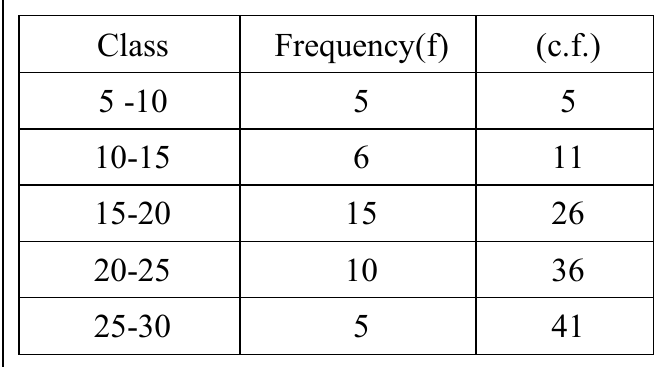
Class Frequency(f) (c.f.)
$5-10$ $5$ $5$
$10-15$ $6$ $11$
$15-20$ $15$ $26$
$20-25$ $10$ $36$
$25-30$ $5$ $41$
$30-35$ $4$ $45$
$35-40$ $2$ $47$
$40-45$ $2$ $49$
Median Class is $15-20$. Median = $15 + \frac{\frac{49}{2} - 11}{15} \times 5 = \frac{39}{2}$ or $19.5$. Modal Class is $15-20$. Mode = $15 + \frac{15-6}{30-6-10} \times 5 = \frac{255}{14}$ or $18.21$
figure for this question