Previous-year board questions (2023–2026) with marking-scheme solutions, grouped by topic and marks.
Find T-ratio or value of Expression 1 Mark Questions
1 1 Mark · July 2023 · Standard open ↗ If $\tan A = \frac{3}{4}$, then the value of $\frac{4 \sin A-2 \cos A}{4 \sin A + 2 \cos A}$ is :
(a) $5$ (b) $\frac{1}{5}$ (c) $6$ (d) $\frac{1}{6}$ Show Solution Hide Solution ↓
2 1 Mark · March 2023 · Standard open ↗ If $2 \tan A = 3$, then the value of $\frac{4 \sin A +3 \cos A}{4 \sin A-3 \cos A}$ is
(a) $\frac{7}{\sqrt{13}}$ (b) $\frac{1}{\sqrt{13}}$ (c) $3$ (d) does not exist Show Solution Hide Solution ↓
3 1 Mark · March 2023 · Standard open ↗ If $\tan \theta = \frac{5}{12}$, then the value of $\frac{\sin \theta + \cos \theta}{\sin \theta - \cos \theta}$ is:
(a) $\frac{17}{7}$ (b) $\frac{17}{7}$ (c) $\frac{17}{13}$ (d) $\frac{7}{13}$ Show Solution Hide Solution ↓
4 1 Mark · March 2023 · Standard open ↗ If $\tan \theta = \frac{x}{y}$, then $\cos \theta$ is equal to
(a) $\frac{x}{\sqrt{x^2 + y^2}}$ (b) $\frac{y}{\sqrt{x^2 + y^2}}$ (c) $\frac{x}{\sqrt{x^2-y^2}}$ (d) $\frac{y}{\sqrt{x^2-y^2}}$ Show Solution Hide Solution ↓ (B) $\frac{y}{\sqrt{x^2 + y^2}}$
5 1 Mark · July 2024 · Standard open ↗ If $\cos \theta = \frac{x}{y}$, $(x, y \neq 0)$, then $\tan \theta$ is equal to :
(a) $\frac{y}{\sqrt{y^2 - x^2}}$ (b) $\frac{x}{\sqrt{x^2 + y^2}}$ (c) $\frac{\sqrt{y^2 - x^2}}{x}$ (d) $\frac{x}{\sqrt{y^2 - x^2}}$ Show Solution Hide Solution ↓ (C) $\frac{\sqrt{y^2 - x^2}}{x}$
6 1 Mark · July 2024 · Standard open ↗ If $5 \tan \theta = 2$, then the value of $\frac{10 \sin \theta - 2 \cos \theta}{5 \sin \theta + 3\cos \theta}$ is :
(a) $\frac{2}{5}$ (b) $\frac{5}{2}$ (c) $1$ (d) $\frac{46}{31}$ Show Solution Hide Solution ↓
7 1 Mark · July 2024 · Standard open ↗ If $\text{cosec } \theta = \sqrt{10}$, then the value of $\text{sec } \theta$ is :
(a) $\frac{3}{\sqrt{10}}$ (b) $\frac{\sqrt{10}}{3}$ (c) $\frac{1}{\sqrt{10}}$ (d) $\frac{2}{\sqrt{10}}$ Show Solution Hide Solution ↓ (B) $\frac{\sqrt{10}}{3}$
8 1 Mark · March 2024 · Standard open ↗ If $\sin A = \frac{2}{3}$, then value of $\cot A$ is :
(a) $\frac{\sqrt{5}}{2}$ (b) $\frac{3}{2}$ (c) $\frac{5}{4}$ (d) $\frac{2}{3}$ Show Solution Hide Solution ↓
9 1 Mark · March 2024 · Standard open ↗ If $4 \sec \theta - 5 = 0$, then the value of $\cot \theta$ is:
(a) $\frac{3}{4}$ (b) $\frac{4}{5}$ (c) $\frac{5}{4}$ (d) $\frac{4}{3}$ Show Solution Hide Solution ↓
10 1 Mark · March 2024 · Standard open ↗ If $5 \tan \theta - 12 = 0$, then the value of $\sin \theta$ is :
(a) $\frac{5}{12}$ (b) $\frac{12}{13}$ (c) $\frac{5}{13}$ (d) $\frac{12}{5}$ Show Solution Hide Solution ↓
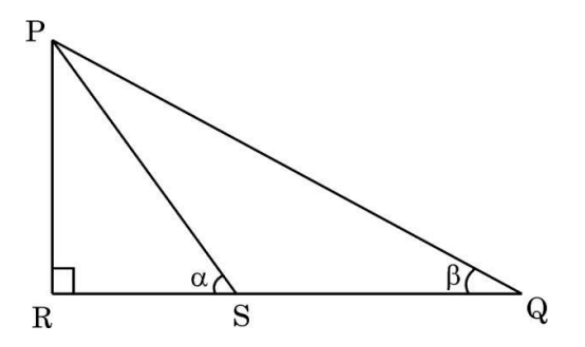
11 1 Mark · July 2025 · Standard open ↗ Find the value of $\frac{\tan \alpha}{\tan \beta}$ from the following diagram. It is given that RS: SQ = $1:2$.
Show Solution Hide Solution ↓
12 1 Mark · July 2025 · Standard open ↗ If $\triangle$ ABC is right-angled at C, then the value of $\cos (A + B)$ is :
(a) $1$ (b) $\frac{1}{2}$ (c) $\frac{\sqrt{3}}{2}$ (d) $0$ Show Solution Hide Solution ↓
13 1 Mark · March 2026 · Standard open ↗ Given that $\sin \theta = \frac{a}{b}$, then $\cos \theta$ is equal to :
(a) $\frac{b}{\sqrt{b^2-a^2}}$ (b) $\frac{b}{a}$ (c) $\frac{\sqrt{b^2-a^2}}{b}$ (d) $\frac{a}{\sqrt{b^2-a^2}}$ Show Solution Hide Solution ↓ (c) $\frac{\sqrt{b^2-a^2}}{b}$
14 1 Mark · March 2026 · Standard open ↗ If $\cos y = 0$, then what is the value of $\frac{1}{2} \cos y$ ?
(a) $0$ (b) $\frac{1}{2}$ (c) $\frac{1}{\sqrt{2}}$ (d) $\frac{1}{2\sqrt{2}}$ Show Solution Hide Solution ↓ (d) $\frac{1}{2\sqrt{2}}$
15 1 Mark · March 2026 · Standard open ↗ If $\cos A = \frac{4}{5}$, then the value of $\tan A$ is :
(a) $\frac{3}{5}$ (b) $\frac{3}{4}$ (c) $\frac{4}{3}$ (d) $\frac{5}{3}$ Show Solution Hide Solution ↓ (B) $\frac{3}{4}$ (1 Mark)
16 1 Mark · March 2026 · Standard open ↗ Given $\cot \theta = 3$, the value of $\cos \theta$ is:
(a) $\frac{1}{3}$ (b) $\frac{1}{\sqrt{10}}$ (c) $\frac{3}{\sqrt{10}}$ (d) $\frac{\sqrt{10}}{3}$ Show Solution Hide Solution ↓ (C) $\frac{3}{\sqrt{10}}$
17 1 Mark · March 2026 · Standard open ↗ When $\sin A = \frac{1}{3}$, the value of $\cot A$ is
(a) $\frac{2\sqrt{2}}{3}$ (b) $2\sqrt{2}$ (c) $\frac{1}{2\sqrt{2}}$ (d) $3$ Show Solution Hide Solution ↓
18 1 Mark · March 2026 · Standard open ↗ For an acute angle $\theta$, if $\sin \theta = \frac{1}{9}$, then value of $\frac{9 cosec \theta+1}{9 cosec \theta-1}$ is
(a) $0$ (b) $\frac{80}{81}$ (c) $1$ (d) $\frac{82}{80}$ Show Solution Hide Solution ↓ (D) $\frac{82}{80}$ (1 Mark)
19 1 Mark · March 2026 · Standard open ↗ For an acute angle $\theta$, if $\cos \theta = \frac{8}{17}$, then $\frac{8 \sec \theta + 1}{8 \sec \theta - 1}$ equals
(a) $\frac{64}{63}$ (b) $0$ (c) $\frac{65}{63}$ (d) $1$ Show Solution Hide Solution ↓ 2 Marks Questions
20 2 Marks · March 2026 · Standard open ↗ Vertices of a right triangle ABC with $\angle B = 90^\circ$ are $A(3, 4)$, $B(1, 1)$ and $C(-8, 7)$. Find the value of $\tan A$.
Show Solution Hide Solution ↓ $BC = \sqrt{(-8 - 1)^2 + (7 - 1)^2} = \sqrt{117} = 3\sqrt{13}$ (I Mark)
3 Marks Questions
21 3 Marks · March 2024 · Standard open ↗ Prove that $\frac{\text{cosec}^2 \theta - \sec^2 \theta}{\text{cosec}^2 \theta + \sec^2 \theta} = \frac{3}{4}$, if $\tan \theta = \frac{1}{\sqrt{7}}$
Show Solution Hide Solution ↓ $\tan \theta = \frac{1}{\sqrt{7}}$
4 Marks Questions
22 4 Marks · March 2025 · Basic open ↗ A teacher asked his students to draw a right triangle $ABC$ with $AB = 8$ cm, $\angle B = 90^\circ$ and $BC = 15$ cm. Based on the above, answer the following :
Show Solution Hide Solution ↓ (i) Hypotenuse $AC = 17$ cm $\implies \sin^2 A - \cos^2 A = (\frac{15}{17})^2 - (\frac{8}{17})^2 = \frac{161}{289}$
Specific Angles Expression 1 Mark Questions
24 1 Mark · March 2023 · Standard open ↗ $\frac{5}{8} - \sec^2 60^{\circ} - \tan^2 60^{\circ} + \cos^2 45^{\circ}$ is equal to
(a) $-\frac{5}{3}$ (b) $-\frac{1}{2}$ (c) 0 (d) $-\frac{1}{4}$ Show Solution Hide Solution ↓
25 1 Mark · March 2025 · Standard open ↗ $\frac{1-\tan^2 30^\circ}{1+\tan^2 30^\circ}$ is equal to
(a) $\sin 60^\circ$ (b) $\cos 60^\circ$ (c) $\tan 60^\circ$ (d) $\sec 60^\circ$ Show Solution Hide Solution ↓
26 1 Mark · March 2025 · Standard open ↗ If $x\left(\frac{2 \tan 30^\circ}{1 + \tan^2 30^\circ}\right) = y\left(\frac{2 \tan 30^\circ}{1 - \tan^2 30^\circ}\right)$, then $x:y=$
Show Solution Hide Solution ↓
27 1 Mark · March 2025 · Standard open ↗ If $x = 2 \sin 60^{\circ} \cos 60^{\circ}$ and $y = \sin^2 30^{\circ} - \cos^2 30^{\circ}$ and $x^2 = ky^2$, the value of $k$ is
(a) $\sqrt{3}$ (b) $-\sqrt{3}$ (c) $3$ (d) $-3$ Show Solution Hide Solution ↓
28 1 Mark · March 2026 · Standard open ↗ The value of $\frac{1}{2}(\cot^2 30^{\circ} - \sec^2 60^{\circ})$ is :
(a) $-1$ (b) $-2$ (c) $\frac{5}{8}$ (d) $\frac{7}{8}$ Show Solution Hide Solution ↓
29 1 Mark · March 2026 · Standard open ↗ If $x \tan 45^{\circ} - \sin 30^{\circ} = \cos 30^{\circ} - \cot 60^{\circ}$, then $x$ is equal to
(a) $\sqrt{3}$ (b) $\frac{1}{\sqrt{3}}$ (c) $1$ (d) $\frac{1}{2}$ Show Solution Hide Solution ↓
30 1 Mark · March 2025 · Basic open ↗ The value of $\frac{2 \tan 60^\circ}{1 - \tan^2 60^\circ}$ is :
(a) $-3$ (b) $\sqrt{3}$ (c) $-\frac{1}{\sqrt{3}}$ (d) $-\sqrt{3}$ Show Solution Hide Solution ↓ 2 Marks Questions
31 2 Marks · March 2023 · Standard open ↗ If $4 \cot^2 45^\circ - \sec^2 60^\circ + \sin^2 60^\circ + p = \frac{3}{4}$, then find the value of p.
Show Solution Hide Solution ↓ $4 \cot^2 45^\circ - \sec^2 60^\circ + \sin^2 60^\circ + p = \frac{3}{4}$
32 2 Marks · March 2023 · Standard open ↗ Evaluate : $\frac{5}{\cot^2 30^\circ} + \frac{1}{\sin^2 60^\circ} - \cot^2 45^\circ + 2 \sin^2 90^\circ$
Show Solution Hide Solution ↓ $$\begin{aligned}& \frac{5}{\cot^2 30^\circ} + \frac{1}{\sin^2 60^\circ} - \cot^2 45^\circ + 2 \sin^2 90^\circ \\ & = \frac{5}{(\sqrt{3})^2} + \frac{1}{(\sqrt{3}/2)^2} - (1)^2 + 2(1)^2 = \frac{5}{3} + \frac{4}{3} - 1 + 2 \\ & = \frac{9}{3} + 1 = 4 \\ & = 3 + 1 = 4\ \text{OR}\end{aligned}$$
33 2 Marks · March 2023 · Standard open ↗ Evaluate $2\sec^2\theta + 3\text{cosec}^2\theta - 2\sin\theta\cos\theta$ if $\theta = 45^\circ$.
Show Solution Hide Solution ↓ $$\begin{aligned}& 2 \sec^2 45^\circ + 3 \text{cosec}^2 45^\circ - 2 \sin 45^\circ \cos 45^\circ \\ & = 2(\sqrt{2})^2 + 3(\sqrt{2})^2 - 2(\frac{1}{\sqrt{2}})(\frac{1}{\sqrt{2}}) \\ & = 4 + 6 - 1 = 9\end{aligned}$$
34 2 Marks · March 2024 · Standard open ↗ Evaluate: $\frac{\cos 45^\circ + \sin 60^\circ}{\sec 30^\circ + \operatorname{cosec} 30^\circ}$
Show Solution Hide Solution ↓ $\frac{\cos 45^\circ + \sin 60^\circ}{\sec 30^\circ + \operatorname{cosec} 30^\circ}$
35 2 Marks · March 2025 · Standard open ↗ If $4k = \tan^2 60^{\circ} - 2 \operatorname{cosec}^2 30^{\circ} -2 \tan^2 30^{\circ}$, then find the value of $k$.
Show Solution Hide Solution ↓ $4k = (\sqrt{3})^2 - 2(2)^2 - 2(\frac{1}{\sqrt{3}})^2$
36 2 Marks · March 2025 · Standard open ↗ It is given that $\sin(A-B) = \sin A \cos B - \cos A \sin B$. Use it to find the value of $\sin 15^\circ$.
Show Solution Hide Solution ↓ $\sin 15^\circ = \sin(45^\circ - 30^\circ)$
37 2 Marks · March 2025 · Standard open ↗ Evaluate : $\frac{5 \tan^2 30^\circ + 3 \cos^2 45^\circ - 4 \sin^2 30^\circ}{\sqrt{3} \sin 60^\circ \cos 60^\circ + \cot^2 45^\circ}$
Show Solution Hide Solution ↓ $\frac{5(\frac{1}{\sqrt{3}})^2 + 3(\frac{1}{\sqrt{2}})^2 - 4(\frac{1}{2})^2}{\sqrt{3} .(\frac{\sqrt{3}}{2}). \frac{1}{2} + (1)^2} = \frac{26}{21}$
38 2 Marks · March 2026 · Standard open ↗ Evaluate : $\frac{\sin^3 60^\circ - \tan 30^\circ}{\cos^2 45^\circ}$
Show Solution Hide Solution ↓ $\frac{(\frac{\sqrt{3}}{2})^3 - \frac{1}{\sqrt{3}}}{(\frac{1}{\sqrt{2}})^2}$ (1/2 Mark)
5 Marks Questions
39 5 Marks · July 2023 · Standard open ↗ Evaluate: $\frac{\tan^2 60^\circ + 4 \sin^2 45^\circ + 3 \sec^2 60^\circ + 5 \cos^2 90^\circ}{\text{cosec } 30^\circ + \sec 60^\circ - \cot^2 30^\circ}$
Show Solution Hide Solution ↓ $\frac{(\sqrt{3})^2+4(\frac{1}{\sqrt{2}})^2+3(2)^2+5(0)^2}{2+2-(\sqrt{3})^2}$ (3 Marks)
Find Angle of T-Ratio 1 Mark Questions
40 1 Mark · 🔁 March 2024 & March 2025 · Standard open ↗ If $\sin \theta = \cos \theta$, ($0^\circ < \theta < 90^\circ$), then value of $(\sec \theta \sin \theta)$ is :
(a) $\frac{1}{\sqrt{2}}$ (b) $\sqrt{2}$ (c) $1$ (d) $0$ Show Solution Hide Solution ↓
41 1 Mark · March 2025 · Standard open ↗ $\tan 2A = 3 \tan A$ is true, when the measure of $\angle A$ is :
(a) $90^\circ$ (b) $60^\circ$ (c) $45^\circ$ (d) $30^\circ$ Show Solution Hide Solution ↓
42 1 Mark · March 2026 · Standard open ↗ $\sin 2\theta = 2 \sin \theta$ is true, when $\theta$ is equal to
(a) $90^{\circ}$ (b) $60^{\circ}$ (c) $45^{\circ}$ (d) $0^{\circ}$ Show Solution Hide Solution ↓ 2 Marks Questions
43 2 Marks · March 2025 · Standard open ↗ If $\tan A = \sqrt{3}$; where $A$ is an acute angle, then find the value of $\frac{\sin^2 A}{1 + \cos^2 A}$.
Show Solution Hide Solution ↓ $\tan A = \sqrt{3} = \tan 60^\circ$
44 2 Marks · March 2026 · Standard open ↗ For acute angles A and B and A + 2B and 2A + B are acute if $\tan (A + 2B) = \sqrt{3}$ and $\sin (2A + B) = \frac{1}{\sqrt{2}}$ then find the measures of angles A and B.
Show Solution Hide Solution ↓ $\tan(A + 2B) = \sqrt{3} \Rightarrow A + 2B = 60^\circ$ (I) (1/2)
45 2 Marks · March 2026 · Standard open ↗ For acute angles A and B, if $\sec (2A - B) = \sqrt{2}$ and $\operatorname{cosec} (A + B) = 2$, then find the values of A and B.
Show Solution Hide Solution ↓ $\sec(2A - B) = \sqrt{2} \Rightarrow 2A - B = 45^\circ$ (I Mark)
3 Marks Questions
46 3 Marks · March 2026 · Basic open ↗ If $\sin(A + 2B) = 1$ and $\cos(2A + B) = \frac{1}{2}$, find the values of A and B.
Show Solution Hide Solution ↓ $\sin (A + 2B) = 1 \Rightarrow A + 2B = 90^\circ$ --------(i) (1/2 Mark)
Prove Given Result 2 Marks Questions
50 2 Marks · March 2023 · Standard open ↗ If $a \cos \theta + b \sin \theta = m$ and $a \sin \theta - b \cos \theta = n$, then prove that $a^2 + b^2 = m^2 + n^2$.
Show Solution Hide Solution ↓ $m^2 + n^2 = (a \cos \theta + b \sin \theta)^2 + (a \sin \theta - b \cos \theta)^2$
51 2 Marks · March 2026 · Basic open ↗ If $\sin A = \frac{1}{2}$ and $\tan B = \sqrt{3}$, then verify that $\cos (A + B) = \cos A \cos B - \sin A \sin B$.
Show Solution Hide Solution ↓ $\sin A = \frac{1}{2} \Rightarrow A = 30^\circ$, $\tan B = \sqrt{3} \Rightarrow B = 60^\circ$ (1 Mark)
3 Marks Questions
52 3 Marks · 🔁 July 2023 & March 2024 & March 2026 · Standard open ↗ Prove that : $\frac{\sin \theta}{1 + \cos \theta} + \frac{1 + \cos \theta}{\sin \theta} = 2 \operatorname{cosec} \theta$
Show Solution Hide Solution ↓ LHS = $\frac{\sin^2 \theta + (1 + \cos \theta)^2}{\sin \theta (1 + \cos \theta)}$ (1 Mark)
53 3 Marks · 🔁 July 2023 & March 2024 · Standard open ↗ Prove that :
Show Solution Hide Solution ↓ $$\begin{aligned}& LHS = \frac{\frac{\sin A}{\cos A}}{1 - \frac{\cos A}{\sin A}} + \frac{\frac{\cos A}{\sin A}}{1 - \frac{\sin A}{\cos A}} \\ & = \frac{\frac{\sin A}{\cos A}}{\frac{\sin A - \cos A}{\sin A}} + \frac{\frac{\cos A}{\sin A}}{\frac{\cos A - \sin A}{\cos A}} \\ & = \frac{\sin^2 A}{\cos A (\sin A - \cos A)} - \frac{\cos^2 A}{\sin A (\sin A - \cos A)} \\ & = \frac{1}{(\sin A - \cos A)} \left[ \frac{\sin^3 A - \cos^3 A}{\sin A \cos A} \right] \\ & = \frac{1}{(\sin A - \cos A)} \frac{(\sin A - \cos A)(\sin^2 A + \cos^2 A + \sin A \cos A)}{\sin A \cos A} \\ & = \frac{1 + \sin A \cos A}{\sin A \cos A} \\ & = \frac{1}{\sin A \cos A} + 1 \\ & = 1 + \sec A cosec A = RHS\end{aligned}$$
54 3 Marks · 🔁 March 2023 & March 2024 & March 2025 & July 2025 & March 2026 · Standard open ↗ Prove that : $\frac{\sin \theta - \cos \theta + 1}{\cos \theta + \sin \theta - 1} = \frac{1}{\sec \theta - \tan \theta}$
Show Solution Hide Solution ↓ LHS = $\frac{\sin \theta - \cos \theta + 1}{\cos \theta + \sin \theta - 1}$
55 3 Marks · March 2023 · Standard open ↗ Prove that : $\frac{\sin \theta}{1 + \cos \theta} + \frac{1 + \cos \theta}{\sin \theta} = 2 cosec \theta$
Show Solution Hide Solution ↓ $LHS = \frac{\sin^2 \theta + (1 + \cos \theta)^2}{(1 + \cos \theta) \sin \theta}$
56 3 Marks · 🔁 March 2023 & March 2025 · Standard open ↗ Prove that: $\frac{\tan \theta}{1-\cot \theta} + \frac{\cot \theta}{1-\tan \theta} = 1 + \sec \theta \operatorname{cosec} \theta$
Show Solution Hide Solution ↓ LHS $= \frac{\frac{\sin \theta}{\cos \theta}}{1-\frac{\cos \theta}{\sin \theta}} + \frac{\frac{\cos \theta}{\sin \theta}}{1-\frac{\sin \theta}{\cos \theta}}$
57 3 Marks · 🔁 July 2024 & March 2025 · Basic open ↗ Prove that $(\text{cosec } A + \sin A)^2 + (\sec A + \cos A)^2 = 7 + \tan^2 A + \cot^2 A$.
Show Solution Hide Solution ↓ $LHS = \text{cosec}^2 A + \sin^2 A + 2 \text{cosec } A \sin A + \sec^2 A + \cos^2 A + 2 \cos A \sec A$
58 3 Marks · 🔁 March 2024 & March 2025 · Standard open ↗ Prove that: $\frac{\sin A + \cos A}{\sin A - \cos A} + \frac{\sin A - \cos A}{\sin A + \cos A} = \frac{2}{2 \sin^2 A - 1}$
Show Solution Hide Solution ↓ LHS $= \frac{(\sin A + \cos A)^2 + (\sin A - \cos A)^2}{(\sin A - \cos A)(\sin A + \cos A)} = \frac{\sin^2 A + \cos^2 A + 2 \sin A \cos A + \sin^2 A + \cos^2 A - 2 \sin A \cos A}{\sin^2 A - \cos^2 A} = \frac{1 + 1}{\sin^2 A - (1 - \sin^2 A)} = \frac{2}{2 \sin^2 A - 1} = \text{RHS}$.
59 3 Marks · March 2024 · Standard open ↗ Prove that :
Show Solution Hide Solution ↓ L.H.S.=$(\frac{1}{\sin \theta} - \sin \theta) (\frac{1}{\cos \theta} - \cos \theta) (\frac{\sin \theta}{\cos \theta} + \frac{\cos \theta}{\sin \theta})$
60 3 Marks · 🔁 March 2024 & March 2025 · Standard open ↗ Prove that : $\sqrt{\sec^2 \theta + \text{cosec}^2 \theta} = \tan \theta + \cot \theta$
Show Solution Hide Solution ↓ LHS $= \sqrt{\frac{1}{\cos^2 \theta} + \frac{1}{\sin^2 \theta}}$ ($1/2$)
4 Marks Questions
61 4 Marks · July 2023 · Standard open ↗ If $x \sin^3 \theta + y \cos^3 \theta = \sin \theta \cos \theta$ and $x \sin \theta = y \cos \theta$, prove that $x^2 + y^2 = 1$.
Show Solution Hide Solution ↓ Given, $x \sin^3 \theta + y \cos^3 \theta = \sin \theta \cos \theta$
5 Marks Questions
62 5 Marks · July 2023 · Standard open ↗ Prove that : $\frac{1+\sin \theta}{1-\sin \theta} - \frac{1-\sin \theta}{1+\sin \theta} = 4 \tan \theta \sec \theta$
Show Solution Hide Solution ↓ LHS $= \frac{(1+\sin\theta)^2-(1-\sin \theta)^2}{(1+\sin \theta) (1-\sin \theta)}$ (2 Marks)