Probability — Class 10 Maths PYQs

Previous-year board questions (2023–2026) with marking-scheme solutions, grouped by topic and marks.

Try each question first, then press (or tap Show Solution) to reveal the answer. Press again for the next question.

Year:Marks:Level:

Probability of events

1 Mark Questions
11 Mark · July 2023 · Standardopen ↗
In a family of two children, the probability of having at least one girl is :
  • (a)$\frac{1}{2}$
  • (b)$\frac{2}{5}$
  • (c)$\frac{3}{4}$
  • (d)$\frac{1}{4}$
Show SolutionHide Solution
(c) $\frac{3}{4}$
21 Mark · July 2023 · Standardopen ↗
If a letter of English alphabet is chosen at random, then the probability of this letter to be a consonant is:
  • (a)$\frac{5}{26}$
  • (b)$\frac{21}{26}$
  • (c)$\frac{10}{13}$
  • (d)$\frac{11}{13}$
Show SolutionHide Solution
(b) $\frac{21}{26}$
31 Mark · July 2023 · Standardopen ↗
The probability that a leap year selected at random will contain $53$ Sundays and $53$ Mondays, is :
  • (a)$\frac{1}{7}$
  • (b)$\frac{2}{7}$
  • (c)$\frac{3}{7}$
  • (d)$\frac{4}{7}$
Show SolutionHide Solution
(a) $\frac{1}{7}$
41 Mark · March 2023 · Standardopen ↗
In a group of 20 people, 5 can't swim. If one person is selected at random, then the probability that he/she can swim, is
  • (a)$\frac{3}{4}$
  • (b)$\frac{1}{3}$
  • (c)1
  • (d)$\frac{1}{4}$
Show SolutionHide Solution
(A) 3/4
51 Mark · March 2023 · Standardopen ↗
In a survey, it is found that every fifth person has a vehicle. The probability of a person NOT having a vehicle is,
  • (a)$\frac{1}{5}$
  • (b)$5\%$
  • (c)$\frac{4}{5}$
  • (d)$95\%$
Show SolutionHide Solution
(C) $\frac{4}{5}$
61 Mark · March 2023 · Standardopen ↗
In a lottery, there are $5$ prizes and $20$ blanks. The probability of getting a prize is:
  • (a)$\frac{1}{4}$
  • (b)$\frac{1}{20}$
  • (c)$\frac{1}{25}$
  • (d)$\frac{1}{5}$
Show SolutionHide Solution
(d) $\frac{1}{5}$
71 Mark · 🔁 March 2023 & March 2026 · Standardopen ↗
Assertion (A) : The probability that a leap year has $53$ Mondays is $\frac{2}{7}$.
Reason (R) : The probability that a non-leap year has $53$ Mondays is $\frac{5}{7}$.
  • (a)Both, Assertion (A) and Reason (R) are true and Reason (R) is the correct explanation of the Assertion (A).
  • (b)Both, Assertion (A) and Reason (R) are true, but Reason (R) is not the correct explanation of the Assertion (A).
  • (c)Assertion (A) is true, but Reason (R) is false.
  • (d)Assertion (A) is false, but Reason (R) is true.
Show SolutionHide Solution
(c) Assertion (A) is true, but Reason (R) is false.
81 Mark · March 2023 · Standardopen ↗
A bag contains 5 pink, 8 blue and 7 yellow balls. One ball is drawn at random from the bag. What is the probability of getting neither a blue nor a pink ball?
  • (a)$\frac{1}{4}$
  • (b)$\frac{2}{5}$
  • (c)$\frac{7}{20}$
  • (d)$\frac{13}{20}$
Show SolutionHide Solution
(C) $\frac{7}{20}$
91 Mark · July 2024 · Standardopen ↗
The probability for a leap year (selected at random) to have $52$ Mondays and $53$ Sundays is :
  • (a)$\frac{1}{366}$
  • (b)$\frac{1}{52}$
  • (c)$\frac{2}{7}$
  • (d)$\frac{1}{7}$
Show SolutionHide Solution
(D) $\frac{1}{7}$
101 Mark · July 2024 · Standardopen ↗
The probability that in a family of three children, there will be at least two boys, is :
  • (a)$\frac{1}{8}$
  • (b)$\frac{7}{8}$
  • (c)$\frac{4}{8}$
  • (d)$\frac{6}{8}$
Show SolutionHide Solution
(C) $\frac{4}{8}$
111 Mark · March 2024 · Standardopen ↗
A bag contains $3$ red balls, $5$ white balls and $7$ black balls. The probability that a ball drawn from the bag at random will be neither red nor black is :
  • (a)$\frac{1}{3}$
  • (b)$\frac{1}{5}$
  • (c)$\frac{7}{15}$
  • (d)$\frac{8}{15}$
Show SolutionHide Solution
(A) $\frac{1}{3}$
121 Mark · March 2024 · Standardopen ↗
From the letters of the word "MOBILE", a letter is selected at random. The probability that the selected letter is a vowel, is :
  • (a)$\frac{3}{7}$
  • (b)$\frac{1}{6}$
  • (c)$\frac{1}{2}$
  • (d)$\frac{1}{3}$
Show SolutionHide Solution
(C) $\frac{1}{2}$
131 Mark · March 2024 · Standardopen ↗
Two friends were born in the year $2000$. The probability that they have the same birthday is :
  • (a)$\frac{1}{365}$
  • (b)$\frac{364}{365}$
  • (c)$\frac{1}{366}$
  • (d)$\frac{365}{366}$
Show SolutionHide Solution
(C) $\frac{1}{366}$
141 Mark · March 2025 · Standardopen ↗
In a cricket match, a batsman hits the boundary $7$ times out of the $42$ balls he plays. The probability of his not hitting a boundary is :
  • (a)$\frac{1}{7}$
  • (b)$\frac{2}{7}$
  • (c)$\frac{5}{6}$
  • (d)$\frac{1}{6}$
Show SolutionHide Solution
(C) $\frac{5}{6}$
151 Mark · March 2025 · Standardopen ↗
If in a lottery, there are $10$ prizes and $30$ blanks, then the probability of winning a prize is :
  • (a)$\frac{1}{4}$
  • (b)$\frac{1}{3}$
  • (c)$\frac{3}{4}$
  • (d)$\frac{2}{3}$
Show SolutionHide Solution
(A)$\frac{1}{4}$
161 Mark · March 2025 · Standardopen ↗
Letters A to F are mentioned on six faces of a die such that each face has a different letter. Two such die are thrown simultaneously. The probability that vowels turn up on both the dice is :
  • (a)$\frac{1}{4}$
  • (b)$\frac{1}{3}$
  • (c)$\frac{1}{9}$
  • (d)$\frac{1}{36}$
Show SolutionHide Solution
(c) $\frac{1}{9}$
171 Mark · March 2025 · Standardopen ↗
A bag contains red balls and black balls in the ratio $3:7$. A ball is drawn at random. The probability that ball so drawn is black in colour, is
  • (a)$\frac{3}{7}$
  • (b)0.3
  • (c)0.7
  • (d)$\frac{1}{7}$
Show SolutionHide Solution
(C) 0.7
181 Mark · March 2025 · Standardopen ↗
A piggy bank contains ₹ 1 coins and ₹ 2 coins in the ratio 9 : 11 respectively. The piggy bank is accidently dropped and a coin pops out of it. The probability that it is a ₹ 2 coin is
  • (a)$\frac{9}{11}$
  • (b)0.45
  • (c)0.55
  • (d)$\frac{1}{11}$
Show SolutionHide Solution
(C) 0.55
191 Mark · March 2025 · Standardopen ↗
A bag contains red coloured, blue coloured and green coloured balls in the ratio $2 : 3 : 4$. A ball is drawn at random from the given bag. The probability that the ball so drawn being not of blue colour is
  • (a)$\frac{1}{9}$
  • (b)$\frac{1}{3}$
  • (c)$\frac{2}{3}$
  • (d)$\frac{8}{9}$
Show SolutionHide Solution
(C) $\frac{2}{3}$
201 Mark · March 2026 · Standardopen ↗
A die is thrown once. Probability of getting a number other than $3$ is :
  • (a)$\frac{1}{6}$
  • (b)$\frac{3}{6}$
  • (c)$\frac{5}{6}$
  • (d)$1$
Show SolutionHide Solution
(c) $\frac{5}{6}$
211 Mark · March 2026 · Basicopen ↗
A letter is selected from the letters of the word FEBRUARY. The
probability that it is a vowel is:
  • (a)$\frac{1}{8}$
  • (b)$\frac{2}{8}$
  • (c)$\frac{3}{8}$
  • (d)$\frac{3}{7}$
Show SolutionHide Solution
(c) $\frac{3}{8}$
221 Mark · March 2026 · Basicopen ↗
Assertion (A): From a bag containing 5 red balls, 2 white balls and
3 green balls, the probability of drawing a non-white ball
is $\frac{4}{5}$
Reason (R) : For any event E, $P(E) + P (not E) = 1$
Show SolutionHide Solution
(a) Both Assertion (A) and Reason (R) are true, and Reason (R) is the correct
explanation of the Assertion (A).
231 Mark · March 2026 · Basicopen ↗
Assertion (A): The probability of a certain event E is 1.
Reason (R): The sum of probabilities of all elementary events of an experiment is 1.
  • (a)Both Assertion (A) and Reason (R) are true and Reason (R) is the correct explanation of Assertion (A).
  • (b)Both Assertion (A) and Reason (R) are true, but Reason (R) is not the correct explanation of Assertion (A).
  • (c)Assertion (A) is true, but Reason (R) is false.
  • (d)Assertion (A) is false, but Reason (R) is true.
Show SolutionHide Solution
(A) Both Assertion (A) and Reason (R) are true and Reason (R) is the correct explanation of Assertion (A).
Note: “The probability of a certain event E is 1” because certain event consists of all the elementary events and “The sum of probabilities of all elementary events of an experiment is 1".
241 Mark · March 2026 · Basicopen ↗
From a bag containing yellow, red and green balls, the probability of drawing a yellow or red ball is equal to that of drawing a green ball. The probability of drawing a green ball from the bag is :
  • (a)$\frac{1}{3}$
  • (b)$\frac{1}{2}$
  • (c)$1$
  • (d)Not possible to find
Show SolutionHide Solution
(B) $\frac{1}{2}$
251 Mark · March 2026 · Basicopen ↗
Assertion (A): The events "getting $2$" and "not getting $2$" in a single throw of an unbiased die are not equally likely events.
Reason (R): The probability of getting $2$ in a single throw of an unbiased die is $\frac{1}{6}$.
(A) Both Assertion (A) and Reason (R) are true and Reason (R) is the correct explanation of the Assertion (A).
(B) Both Assertion (A) and Reason (R) are true, but Reason (R) is not the correct explanation of the Assertion (A).
(C) Assertion (A) is true, but Reason (R) is false.
(D) Assertion (A) is false, but Reason (R) is true.
Show SolutionHide Solution
(A) Both Assertion (A) and Reason (R) are true and Reason (R) is the correct explanation of Assertion (A).
261 Mark · March 2026 · Basicopen ↗
Probability of getting an irrational number at random from the numbers $\sqrt{3}$, $\sqrt{4}$, $3\sqrt{9}$, $3\sqrt{8}$, $\sqrt{5}$, $0$, $4^2$ is:
  • (a)$0$
  • (b)$\frac{4}{7}$
  • (c)$\frac{3}{7}$
  • (d)$1$
Show SolutionHide Solution
(C) $\frac{3}{7}$
271 Mark · March 2026 · Basicopen ↗
Assertion (A): The probability that the date of birth of a man is in the month of June is $\frac{1}{12}$
Reason (R) : There are $12$ months in a year.
Show SolutionHide Solution
(D) Assertion (A) is false, but Reason (R) is true.
2 Marks Questions
282 Marks · March 2023 · Standardopen ↗
A bag contains 4 red, 3 blue and 2 yellow balls. One ball is drawn at random from the bag. Find the probability that drawn ball is
(i) red (ii) yellow.
Show SolutionHide Solution
Total No of Balls=9
(i) P(drawn ball is red) = $\frac{4}{9}$
(ii) P(drawn ball is yellow) = $\frac{2}{9}$
292 Marks · March 2024 · Standardopen ↗
A carton consists of $60$ shirts of which $48$ are good, $8$ have major defects and $4$ have minor defects. Nigam, a trader, will accept the shirts which are good but Anmol, another trader, will only reject the shirts which have major defects. One shirt is drawn at random from the carton. Find the probability that it is acceptable to Anmol.
Show SolutionHide Solution
Number of Shirts without major defects = $52$
$P(\text{ Anmol will accept the shirt}) = \frac{52}{60} \text{ or } \frac{13}{15}$
302 Marks · March 2025 · Standardopen ↗
Two friends Anil and Ashraf were born in the December month in the year $2010$. Find the probability that :
(i) they share same date of birth.
(ii) they have different dates of birth.
Show SolutionHide Solution
Number of days in December $2010 = 31$
(i) P (same date of birth) = $\frac{1}{31}$
(ii) P (different dates of birth) = $\frac{30}{31}$
312 Marks · March 2026 · Standardopen ↗
A bag contains $25$ balls. Some of them are yellow and others are green. One ball is drawn at random. If probability of getting a green ball is $\frac{3}{5}$, then find the number of yellow balls.
Show SolutionHide Solution
P(getting a yellow ball) = $1$ – P(getting a green ball) (1 Mark)
$\frac{\text{Number of yellow balls}}{25} = 1 - \frac{3}{5} = \frac{2}{5}$ (1 Mark)
Number of yellow balls = $25 \times \frac{2}{5} = 10$
322 Marks · March 2026 · Basicopen ↗
A box consists of 60 wall clocks, out of which 40 are good, 15 have minor
defects and the remaining are broken. A trader will reject the box, if the
clock taken out from the box is broken. The trader randomly takes out one
clock from the box. What is the probability that :
(i) the box will be rejected ?
(ii) the clock taken out of the box has minor defect ?
Show SolutionHide Solution
(i) $P(box \text{ will be rejected}) = \frac{5}{60} \text{ or } \frac{1}{12}$ (1 Mark)
(ii) $P(clock \text{ has minor defect}) = \frac{15}{60} \text{ or } \frac{1}{4}$ (1 Mark)
332 Marks · March 2026 · Basicopen ↗
Each letter of the word 'MATHEMATICS' is written on separate slips and slips are put in a box and shuffled. A slip is selected at random from the box. Find the probability that the letter written on the slip is :
(i) a vowel,
(ii) either M or T.
Show SolutionHide Solution
(i) $P$ (getting a vowel) $= \frac{4}{11}$ (1 Mark)
(ii) $P$ (getting either M or T) $= \frac{4}{11}$ (1 Mark)
342 Marks · March 2026 · Basicopen ↗
A bag contains $10$ red pens, out of which $3$ are defective and $8$ blue pens, out of which $4$ are defective. A pen is taken out from the bag at random. Find the probability that
(i) it is a defective pen,
(ii) it is a non-defective red pen.
Show SolutionHide Solution
(i) $P (\text{getting a defective pen}) = \frac{7}{18}$ (1 Mark)
(ii) $P (\text{getting a non-defective red pen}) = \frac{7}{18}$ (1 Mark)
3 Marks Questions
353 Marks · March 2025 · Standardopen ↗
If $65\%$ of the population has black eyes, $25\%$ have brown eyes and the remaining have blue eyes, what is the probability that a person selected at random has :
(a) blue eyes?
(b) brown or black eyes?
Show SolutionHide Solution
Population having blue eyes = $$\begin{aligned}& (100 - 65 - 25)\% = 10\% \\ & (a) \text{ P(blue eyes)} = 10\% \text{ or } \frac{1}{10} \\ & (b) \text{ P(brown or black eyes)} = 90\% \text{ or } \frac{9}{10}\end{aligned}$$
363 Marks · March 2025 · Basicopen ↗
A lot consists of $200$ pens of which $180$ are good and the rest are defective. A customer will buy a pen if it is not defective. The shopkeeper draws a pen at random and gives it to the customer. What is the probability that the customer will not buy it ? Another lot of $100$ pens containing $80$ good pens is mixed with the previous lot of $200$ pens. The shopkeeper draws one pen at random from the entire lot and gives it to the customer. What is the probability that the customer will buy the pen ?
Show SolutionHide Solution
$P(\text{customer will not buy the pen}) = \frac{20}{200} = \frac{1}{10}$
After mixing the two lots
Total pens $= 200 + 100 = 300$
Number of good pens $= 180 + 80 = 260$
$P(\text{customer will buy the pen}) = \frac{260}{300}$ or $\frac{13}{15}$
373 Marks · March 2025 · Basicopen ↗
A lot consists of 200 pens of which 180 are good and the rest are defective. A customer will buy a pen if it is not defective. The shopkeeper draws a pen at random and gives it to the customer. What is the probability that the customer will not buy it ? Another lot of 100 pens containing 80 good pens is mixed with the previous lot of 200 pens. The shopkeeper now draws one pen at random from the entire lot and gives it to the customer. What is the probability that the customer will buy the pen ?
Show SolutionHide Solution
$P(\text{customer will not buy the pen}) = \frac{20}{200} = \frac{1}{10}$
After mixing the two lots
Total pens $= 200 + 100 = 300$
Number of good pens $= 180 + 80 = 260$
$P(\text{customer will buy the pen}) = \frac{260}{300}$ or $\frac{13}{15}$
383 Marks · March 2025 · Basicopen ↗
A box contains $6$ blue, $4$ white and $8$ red marbles. A marble is drawn at random from this box. Find the probability that the marble so drawn is :
(i) white
(ii) white or red
(iii) not red
Show SolutionHide Solution
(i) $P(\text{white marble}) = \frac{4}{18} \text{ or } \frac{2}{9}$ [$1$ mark]
(ii) $P(\text{white or red marble}) = \frac{12}{18} \text{ or } \frac{2}{3}$ [$1$ mark]
(iii) $P(\text{not a red marble}) = \frac{10}{18} \text{ or } \frac{5}{9}$ [$1$ mark]
4 Marks Questions
394 Marks · March 2023 · Standardopen ↗
Case Study - 3
Computer-based learning (CBL) refers to any teaching methodology that makes use of computers for information transmission. At an elementary school level, computer applications can be used to display multimedia lesson plans. A survey was done on $1000$ elementary and secondary schools of Assam and they were classified by the number of computers they had.
Number of Computers
Number of Schools
1-10
250
11-20
200
21-50
290
51-100
180
101 and more
80
One school is chosen at random. Then :
(i) Find the probability that the school chosen at random has more than $100$ computers.
(ii) (a) Find the probability that the school chosen at random has $50$ or fewer computers.
OR
(ii) (b) Find the probability that the school chosen at random has no more than $20$ computers.
(iii) Find the probability that the school chosen at random has $10$ or less than $10$ computers.
figure for this question
Show SolutionHide Solution
(i) P (more than $100$ computers) = $\frac{80}{1000}$ or $0.08$
(ii)(a) $50$ or fewer computers = $250 + 200 + 290 = 740$
Required probability = $\frac{740}{1000}$ or $0.74$
OR
(ii)(b) No more than $20$ computers = $250 + 200 = 450$
Required probability = $\frac{450}{1000}$ or $0.45$
(iii) P ($10$ or less than $10$ computer) = $\frac{250}{1000}$ or $0.25$
404 Marks · March 2024 · Standardopen ↗
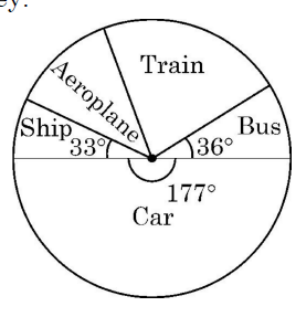
In a survey on holidays, $120$ people were asked to state which type of transport they used on their last holiday. The following pie chart shows the results of the survey.
Observe the pie chart and answer the following questions :
(i) If one person is selected at random, find the probability that he/she travelled by bus or ship.
(ii) Which is most favourite mode of transport and how many people used it?
(iii) (a) A person is selected at random. If the probability that he did not use train is $4/5$, find the number of people who used train.
OR
(iii) (b) The probability that randomly selected person used aeroplane is $7/60$. Find the revenue collected by air company at the rate of ₹5,000 per person.
figure for this question
Show SolutionHide Solution
(i) $P$ (travelling by bus or ship) $= \frac{36+33}{360} = \frac{69}{360}$ or $\frac{23}{120}$
(ii) Car
Number of people who used car $= \frac{177}{360} \times 120 = 59$
(iii) (a) $P$ (person used train)$= 1 - \frac{4}{5} = \frac{1}{5}$
$\therefore$ Number of people who used train $= \frac{1}{5} \times 120 = 24$
OR
(iii) (b) Number of people who used aeroplane $= \frac{7}{60} \times 120 = 14$
$\therefore$ Revenue generated$= 14 \times 5000 = \text{Rs}70,000$

Number Based

1 Mark Questions
411 Mark · 🔁 July 2023 & March 2026 · Standardopen ↗
The probability for a randomly selected number out of $1, 2, 3, 4, \ldots, 25$ to be a prime number is :
  • (a)$\frac{8}{25}$
  • (b)$\frac{10}{25}$
  • (c)$\frac{11}{25}$
  • (d)$\frac{9}{25}$
Show SolutionHide Solution
(d) $\frac{9}{25}$
421 Mark · March 2023 · Standardopen ↗
A bag contains $100$ cards numbered $1$ to $100$. A card is drawn at random from the bag. What is the probability that the number on the card is a perfect cube ?
  • (a)$\frac{1}{20}$
  • (b)$\frac{3}{50}$
  • (c)$\frac{1}{25}$
  • (d)$\frac{7}{100}$
Show SolutionHide Solution
(c) $\frac{1}{25}$
431 Mark · March 2023 · Standardopen ↗
A box contains $90$ discs, numbered from $1$ to $90$. If one disc is drawn at random from the box, the probability that it bears a prime number less than $23$ is
  • (a)$\frac{7}{90}$
  • (b)$\frac{1}{9}$
  • (c)$\frac{4}{45}$
  • (d)$\frac{9}{89}$
Show SolutionHide Solution
(C) $\frac{4}{45}$
441 Mark · March 2023 · Standardopen ↗
Cards bearing numbers $3$ to $20$ are placed in a bag and mixed thoroughly. A card is taken out of the bag at random. What is the probability that the number on the card taken out is an even number ?
  • (a)$\frac{9}{17}$
  • (b)$\frac{1}{2}$
  • (c)$\frac{5}{9}$
  • (d)$\frac{7}{18}$
Show SolutionHide Solution
(B) $\frac{1}{2}$
451 Mark · March 2024 · Standardopen ↗
From the data $1, 4, 7, 9, 16, 21, 25$, if all the even numbers are removed, then the probability of getting at random a prime number from the remaining is :
  • (a)$\frac{2}{5}$
  • (b)$\frac{1}{5}$
  • (c)$\frac{1}{7}$
  • (d)$\frac{2}{7}$
Show SolutionHide Solution
(b) $\frac{1}{5}$
461 Mark · March 2024 · Standardopen ↗
A box contains cards numbered $6$ to $55$. A card is drawn at random from the box. The probability that the drawn card has a number which is a perfect square, is
  • (a)$\frac{7}{50}$
  • (b)$\frac{7}{55}$
  • (c)$\frac{1}{10}$
  • (d)$\frac{5}{49}$
Show SolutionHide Solution
(C) $\frac{1}{10}$
471 Mark · March 2024 · Standardopen ↗
If a digit is chosen at random from the digits $1, 2, 3, 4, 5, 6, 7, 8, 9$; then the probability that this digit is an odd prime number is :
  • (a)$\frac{1}{3}$
  • (b)$\frac{2}{3}$
  • (c)$\frac{4}{9}$
  • (d)$\frac{5}{9}$
Show SolutionHide Solution
(A) $\frac{1}{3}$
481 Mark · March 2024 · Standardopen ↗
One ticket is drawn at random from a bag containing tickets numbered $1$ to $40$. The probability that the selected ticket has a number which is a multiple of $7$ is:
  • (a)$\frac{1}{7}$
  • (b)$\frac{1}{8}$
  • (c)$\frac{1}{5}$
  • (d)$\frac{7}{40}$
Show SolutionHide Solution
(B) $\frac{1}{8}$
491 Mark · March 2024 · Standardopen ↗
What is the probability that a number selected randomly from the numbers $1, 2, 3, ..., 15$ is a multiple of $4$ ?
  • (a)$\frac{4}{15}$
  • (b)$\frac{6}{15}$
  • (c)$\frac{3}{15}$
  • (d)$\frac{5}{15}$
Show SolutionHide Solution
(C) $\frac{3}{15}$
501 Mark · July 2025 · Standardopen ↗
Cards numbered $10, 11, 12, \dots, 30$ are kept in a box and shuffled thoroughly. Rohit draws a card at random from the box. The probability that the number on the card is a multiple of $4$ or $5$ is :
  • (a)$\frac{9}{20}$
  • (b)$\frac{9}{21}$
  • (c)$\frac{10}{20}$
  • (d)$\frac{10}{21}$
Show SolutionHide Solution
(B) $\frac{9}{21}$
511 Mark · March 2025 · Standardopen ↗
The probability of drawing an even prime number out of numbers from $1$ to $30$ is:
  • (a)$\frac{1}{30}$
  • (b)$\frac{4}{15}$
  • (c)$\frac{7}{30}$
  • (d)$0$
Show SolutionHide Solution
(A) $\frac{1}{30}$
521 Mark · March 2025 · Standardopen ↗
The probability of getting a composite number greater than 3 on throwing a die is
  • (a)$\frac{1}{6}$
  • (b)$\frac{1}{3}$
  • (c)$\frac{1}{2}$
  • (d)$\frac{2}{3}$
Show SolutionHide Solution
(B) $\frac{1}{3}$
531 Mark · March 2025 · Standardopen ↗
The probability that a $2$-digit number less than $20$, selected at random will be a multiple of $2$ and not a multiple of $3$, is
  • (a)$\frac{1}{2}$
  • (b)$\frac{1}{5}$
  • (c)$\frac{3}{10}$
  • (d)$\frac{3}{11}$
Show SolutionHide Solution
(C) $\frac{3}{10}$
541 Mark · March 2026 · Standardopen ↗
One ticket is drawn at random from a bag containing $50$ tickets numbered $1$ to $50$. The probability that the drawn ticket has a number which is a multiple of $7$ is:
  • (a)$\frac{1}{5}$
  • (b)$\frac{7}{50}$
  • (c)$\frac{3}{25}$
  • (d)$\frac{4}{25}$
Show SolutionHide Solution
(B) $\frac{7}{50}$
551 Mark · March 2026 · Basicopen ↗
Probability of getting an irrational number at random from the numbers $\sqrt{3}$, $\sqrt{4}$, $3\sqrt{9}$, $3\sqrt{8}$, $\sqrt{5}$, $0$, $4^{\frac{3}{2}}$ is :
  • (a)$0$
  • (b)$\frac{4}{7}$
  • (c)$\frac{3}{7}$
  • (d)$1$
Show SolutionHide Solution
(C) $\frac{3}{7}$
561 Mark · March 2026 · Basicopen ↗
A card is drawn from a packet of $50$ identical cards numbered from $1$ to $50$. The probability of drawing a number which is a perfect square, is :
  • (a)$\frac{7}{50}$
  • (b)$\frac{8}{50}$
  • (c)$\frac{6}{50}$
  • (d)$\frac{10}{50}$
Show SolutionHide Solution
(A) $\frac{7}{50}$
2 Marks Questions
572 Marks · March 2025 · Standardopen ↗
A bag contains cards which are numbered from $5$ to $100$ such that each card bears a different number. A card is drawn at random. Find the probability that number on the card is
(i) a perfect square
(ii) a $2$-digit number
Show SolutionHide Solution
Total possible outcomes = $96$
(i) Number of favourable outcomes for perfect square = $8$
$P(\text{perfect square}) = \frac{8}{96}$ or $\frac{1}{12}$
(ii) Number of favourable outcomes for a $2$-digit number = $90$
$P(\text{a } 2\text{-digit number}) = \frac{90}{96}$ or $\frac{15}{16}$
582 Marks · March 2025 · Standardopen ↗
A bag contains balls numbered $2$ to $91$ such that each ball bears a different number. A ball is drawn at random from the bag. Find the probability that (i) it bears a $2$-digit number (ii) it bears a multiple of $1$.
Show SolutionHide Solution
Total possible outcomes = $90$
(i) Number of favourable outcomes for a $2$-digit number = $82$
$P(2\text{-digit number}) = \frac{82}{90}$ or $\frac{41}{45}$
(ii) Number of favourable outcomes for multiple of $1 = 90$
$P(\text{a number multiple of } 1) = \frac{90}{90}$ or $1$
592 Marks · March 2025 · Basicopen ↗
A box contains 120 discs, which are numbered from 1 to 120. If one disc is drawn at random from the box, find the probability that
(i) it bears a 2-digit number
(ii) the number is a perfect square.
Show SolutionHide Solution
(i) $P(\text{2-digit number}) = \frac{90}{120} \text{ or } \frac{3}{4}$ (1 mark)
(ii) $P(\text{the number is a perfect square}) = \frac{10}{120} \text{ or } \frac{1}{12}$ (1 mark)
602 Marks · March 2025 · Basicopen ↗
A card is drawn at random from a pack of $50$ cards numbered $1$ to $50$. Find the probability of drawing a number which is a perfect square.
Show SolutionHide Solution
Favourable outcomes are $1, 4, 9, 16, 25, 36, 49$
$\therefore P(\text{Perfect square} < 50) = \frac{7}{50}$
612 Marks · March 2025 · Basicopen ↗
A piggy bank contains fifty ₹1 coins, hundred ₹2 coins and one hundred and fifty ₹5 coins. If it is equally likely any one of the coins will fall out when the bank is turned upside down, find the probability that ₹2 coin has not fallen out, when the bank is turned upside down.
Show SolutionHide Solution
No. of Rs $ 2$ coins $= 100$
Total no. of coins $= 50 + 100 + 150 = 300$
$\therefore P(\text{not getting a Rs 2 coin}) = \frac{200}{300} = \frac{2}{3}$
622 Marks · March 2026 · Basicopen ↗
Find the probability that a number selected at random from the numbers $30, 31, 32, 33, \text{......}, 60$ is (i) a prime number (ii) a multiple of $6$.
Show SolutionHide Solution
(i) Prime numbers are $31, 37, 41, 43, 47, 53, 59$
$\text{P (a prime number)} = \frac{7}{31}$ (1 Mark)
(ii) Multiples of $6$ are $30, 36, 42, 48, 54, 60$
$\text{P (a multiple of 6)} = \frac{6}{31}$ (1 Mark)
3 Marks Questions
633 Marks · March 2024 · Standardopen ↗
A box contains $90$ discs which are numbered $1$ to $90$. If one disc is drawn at random from the box, find the probability that it bears a :
(i) $2$-digit number less than $40$.
(ii) number divisible by $5$ and greater than $50$.
(iii) a perfect square number.
Show SolutionHide Solution
Total outcomes $$\begin{aligned}& = 90 \\ & \text{(i) P (2 digit number less than 40) } = \frac{30}{90} \text{ or } \frac{1}{3} \\ & \text{(ii) P (a number divisible by 5 and greater than 50) } = \frac{8}{90} \text{ or } \frac{4}{45} \\ & \text{(iii) P (a perfect square number) } = \frac{9}{90} \text{ or } \frac{1}{10}\end{aligned}$$
4 Marks Questions
644 Marks · March 2025 · Standardopen ↗
Rahul is a lucky charm for his cricket team. He has a jar of cards with numbers from $10$ to $74$. Before each match, he draws a card from the jar. If the card bears an even number, the team wins. If the number is even and divisible by $5$, they win by a big margin. If the number is an odd number less than $30$, they win by a small margin. And if the number is a prime number between $50$ and $74$, they lose.
Answer the following questions if Rahul draws a card today:
(i) What is the probability that Rahul draws a card with an even number?
(ii) What is the probability that Rahul draws a card with an odd number less than $30$?
(iii) (a) What is the probability that Rahul draws a card with a prime number between $50$ and $74$?
OR
(b) What is the probability that Rahul draws a card with an even number divisible by $5$?
figure for this question
Show SolutionHide Solution
(i) Total possible outcomes = $74 - 10 + 1 = 65$
P (even number) = $\frac{33}{65}$
(ii) P (odd number less than $30$) = $\frac{10}{65}$ or $\frac{2}{13}$
(iii) (a) Favourable outcomes are $53, 59, 61, 67, 71, 73$
Number of favourable outcomes = $6$
P (prime number between $50$ and $74$) = $\frac{6}{65}$
OR
(b) Favourable outcomes are $10, 20, 30, 40, 50, 60, 70$
Number of favourble outcomes = $7$
P (even number divisble by $5$) = $\frac{7}{65}$

↳ nature 0 <= p(E) <= 1

1 Mark Questions
651 Mark · March 2023 · Standardopen ↗
Which of the following numbers cannot be the probability of happening of an event?
  • (a)$0$
  • (b)$\frac{7}{0.01}$
  • (c)$0.07$
  • (d)$\frac{0.07}{3}$
Show SolutionHide Solution
(b) $\frac{7}{0.01}$
661 Mark · March 2024 · Standardopen ↗
Which of the following is not probability of an event ?
  • (a)$0.89$
  • (b)$52\%$
  • (c)$\frac{1}{13}\%$
  • (d)$\frac{1}{0.89}$
Show SolutionHide Solution
(d) $\frac{1}{0.89}$
671 Mark · March 2026 · Standardopen ↗
Assertion (A) : If probability of happening of an event is $0.2p$, $p > 0$, then $p$ can't be more than $5$.
Reason (R) : $P(E) = 1 - P(\bar{E})$ for an event $E$.
(a) Both Assertion (A) and Reason (R) are true, and (R) is the correct explanation of (A).
(b) Both Assertion (A) and Reason (R) are true, but (R) is not the correct explanation of (A).
(c) (A) is true, but (R) is false.
(d) (A) is false, but (R) is true.
Show SolutionHide Solution
(B) Both Assertion (A) and Reason (R) are true, but Reason (R) is not the correct explanation of Assertion (A).
681 Mark · March 2026 · Standardopen ↗
Which of the following can not be the probability of an event ?
  • (a)$\frac{39}{100}$
  • (b)$\frac{0.001}{20}$
  • (c)$\frac{10}{0.2}$
  • (d)$10\%$
Show SolutionHide Solution
(C) $\frac{10}{0.2}$
691 Mark · March 2025 · Basicopen ↗
In a random experiment of throwing a die, which of the following is a sure event ?
  • (a)Getting a number between 1 and 6
  • (b)Getting an odd number < 7
  • (c)Getting an even number < 7
  • (d)Getting a natural number < 7
Show SolutionHide Solution
(D) Getting a natural number < 7
701 Mark · March 2026 · Basicopen ↗
Assertion (A): The probability of an event can not be $\frac{1}{0.9}$.
Reason (R): $0 \le P(E) \le 1$ for an event E.
  • (a)Both Assertion (A) and Reason (R) are true and Reason (R) is the correct explanation of Assertion (A).
  • (b)Both Assertion (A) and Reason (R) are true, but Reason (R) is not the correct explanation of Assertion (A).
  • (c)Assertion (A) is true, but Reason (R) is false.
  • (d)Assertion (A) is false, but Reason (R) is true.
Show SolutionHide Solution
(A) Both Assertion (A) and Reason (R) are true and Reason (R) is the correct explanation of Assertion (A)

Coin Based

1 Mark Questions
711 Mark · July 2023 · Standardopen ↗
Lali tosses two different coins simultaneously. The probability that she gets at most one head is:
  • (a)$1$
  • (b)$\frac{3}{4}$
  • (c)$\frac{1}{2}$
  • (d)$\frac{1}{7}$
Show SolutionHide Solution
(b) $\frac{3}{4}$
721 Mark · March 2023 · Standardopen ↗
If three coins are tossed simultaneously, what is the probability of getting at most one tail?
  • (a)$\frac{3}{8}$
  • (b)$\frac{4}{8}$
  • (c)$\frac{5}{8}$
  • (d)$\frac{7}{8}$
Show SolutionHide Solution
(b) $\frac{4}{8}$
731 Mark · March 2023 · Standardopen ↗
Two coins are tossed together. The probability of getting at least one tail is:
  • (a)$\frac{1}{4}$
  • (b)$\frac{1}{2}$
  • (c)$\frac{3}{4}$
  • (d)$1$
Show SolutionHide Solution
(c) $\frac{3}{4}$
741 Mark · 🔁 March 2024 & March 2025 · Standardopen ↗
Two coins are tossed simultaneously. The probability of getting at most one tail is:
  • (a)$\frac{1}{2}$
  • (b)$\frac{1}{4}$
  • (c)$\frac{3}{4}$
  • (d)$1$
Show SolutionHide Solution
(C) $\frac{3}{4}$
751 Mark · March 2024 · Standardopen ↗
The probability of throwing a number greater than $2$ with a fair die is :
  • (a)$\frac{2}{3}$
  • (b)$\frac{1}{3}$
  • (c)$\frac{1}{2}$
  • (d)$\frac{5}{6}$
Show SolutionHide Solution
(A) $\frac{2}{3}$
761 Mark · March 2026 · Standardopen ↗
Three coins are tossed together. The probability of getting exactly one
nhead, is:
  • (a)$\frac{1}{8}$
  • (b)$\frac{3}{4}$
  • (c)$\frac{1}{2}$
  • (d)$\frac{3}{8}$
Show SolutionHide Solution
(D) $\frac{3}{8}$
771 Mark · March 2025 · Basicopen ↗
Three coins are tossed together. The probability that only one coin shows tail, is :
  • (a)$\frac{1}{2}$
  • (b)$\frac{3}{8}$
  • (c)$\frac{7}{8}$
  • (d)$1$
Show SolutionHide Solution
(b) $\frac{3}{8}$
781 Mark · March 2025 · Basicopen ↗
Three coins are tossed together. The probability that at least one head comes up, is
  • (a)$\frac{3}{8}$
  • (b)$\frac{7}{8}$
  • (c)$\frac{1}{8}$
  • (d)$\frac{3}{4}$
Show SolutionHide Solution
(B) $\frac{7}{8}$
2 Marks Questions
792 Marks · March 2023 · Standardopen ↗
If a fair coin is tossed twice, find the probability of getting 'atmost one head'.
Show SolutionHide Solution
Total outcomes are HH, HT, TH, TT
Favourable outcomes are HT, TH, TT
P (at most one head) = $\frac{3}{4}$
802 Marks · July 2025 · Standardopen ↗
Three different coins are tossed together. Find the probability of getting at least two tails.
Show SolutionHide Solution
Total number of possible outcomes = $8$
P (atleast two tails) = $\frac{4}{8}$ or $\frac{1}{2}$
3 Marks Questions
813 Marks · July 2023 · Standardopen ↗
Three different coins are tossed simultaneously. Find the probability of getting :
(i) At least one head,
(ii) At most two heads.
Show SolutionHide Solution
Total possible outcomes = $2^3 = 8$ (HHH, HHT, HTH, THH, HTT, THT, TTH, TTT)
(i) P (at least one head) = $1 - P(\text{no head}) = 1 - P(TTT) = 1 - \frac{1}{8} = \frac{7}{8}$
(ii) P (at most two heads) = $1 - P(\text{three heads}) = 1 - P(HHH) = 1 - \frac{1}{8} = \frac{7}{8}$
823 Marks · March 2024 · Standardopen ↗
Three coins are tossed simultaneously. What is the probability of getting
(i) at least one head?
(ii) exactly two tails ?
(iii) at most one tail?
Show SolutionHide Solution
Total number of outcomes $$\begin{aligned}& = 8 \\ & \text{(i) P (at least one head) } = \frac{7}{8} \\ & \text{(ii) P (exactly 2 tails) } = \frac{3}{8} \\ & \text{(iii) P (at most one tail) } = \frac{4}{8} \text{ or } \frac{1}{2}\end{aligned}$$
833 Marks · March 2024 · Standardopen ↗
Three unbiased coins are tossed simultaneously. Find the probability of getting :
(i) at least one head.
(ii) exactly one tail.
(iii) two heads and one tail.
Show SolutionHide Solution
Total number of possible outcomes = $8$
(i) $P(\text{at least one head}) = \frac{7}{8}$
(ii) $P (\text{exactly one tail}) = \frac{3}{8}$
(iii) $P (\text{2 heads and one tail}) = \frac{3}{8}$
843 Marks · March 2026 · Standardopen ↗
Two different coins are tossed simultaneously. What is the probability of getting:
(i) at least one head?
(ii) at most one tail ?
(iii) a head and a tail ?
Show SolutionHide Solution
Possible Outcomes are $HH, HT, TH, TT$
(i) $P$ (at least one head) $= \frac{3}{4}$ (I) (1 Mark)
(ii) $P$ (at most one tail) $= \frac{3}{4}$ (II) (1 Mark)
(iii) $P$ (a head and a tail) $= \frac{2}{4}$ or $\frac{1}{2}$ (III) (1 Mark)
4 Marks Questions
854 Marks · March 2025 · Standardopen ↗
Three unbiased coins are tossed simultaneously. Find the probability of getting :
(a) exactly two tails
(b) at least one head
(c) at most two heads
Show SolutionHide Solution
Possible outcomes are HHH, HHT, HTH, HTT, THH, THT, TTH, TTT
(a) P(exactly two tails) $= \frac{3}{8}$
(b) P(atleast one head) $= \frac{7}{8}$
(c) P(atmost two heads) $= \frac{7}{8}$

Reverse question of probability

1 Mark Questions
861 Mark · March 2023 · Standardopen ↗
A girl calculates that the probability of her winning the first prize in a lottery is $0.08$. If $6000$ tickets are sold, how many tickets has she bought?
  • (a)40
  • (b)240
  • (c)480
  • (d)750
Show SolutionHide Solution
(C) 480
871 Mark · March 2023 · Standardopen ↗
A bag contains $5$ red balls and $n$ green balls. If the probability of drawing a green ball is three times that of a red ball, then the value of $n$ is :
  • (a)$18$
  • (b)$15$
  • (c)$10$
  • (d)$20$
Show SolutionHide Solution
(b) $15$
881 Mark · March 2024 · Standardopen ↗
The probability of getting a chocolate flavoured ice cream at random, in a lot of $600$ ice creams is $0.055$. The number of chocolate flavoured ice creams in the lot is :
  • (a)$33$
  • (b)$55$
  • (c)$11$
  • (d)$44$
Show SolutionHide Solution
(A) $33$
891 Mark · March 2024 · Standardopen ↗
The probability of guessing the correct answer to a certain test question is $\frac{x}{6}$. If the probability of not guessing the correct answer to this question is $\frac{2}{3}$, then the value of $x$ is:
  • (a)$2$
  • (b)$3$
  • (c)$4$
  • (d)$6$
Show SolutionHide Solution
(A) $2$
901 Mark · March 2024 · Standardopen ↗
The probability of getting a bad egg in a lot of $400$ eggs is $0.045$. The number of good eggs in the lot is:
  • (a)$18$
  • (b)$180$
  • (c)$382$
  • (d)$220$
Show SolutionHide Solution
(C) $382$
911 Mark · March 2025 · Standardopen ↗
The number of red balls in a bag is $10$ more than the number of black balls. If the probability of drawing a red ball at random from this bag is $\frac{3}{5}$, then the total number of balls in the bag is :
  • (a)$50$
  • (b)$60$
  • (c)$80$
  • (d)$40$
Show SolutionHide Solution
(a) $50$
921 Mark · March 2026 · Standardopen ↗
Meena calculates that the probability of her winning the first prize in a lottery is $0.08$. If total $800$ tickets were sold, the number of tickets bought by her, is
  • (a)$64$
  • (b)$640$
  • (c)$100$
  • (d)$10$
Show SolutionHide Solution
(A) $64$
2 Marks Questions
932 Marks · March 2025 · Standardopen ↗
The probability of guessing the correct answer of a certain test question is $\frac{x}{12}$. If the probability of not guessing the correct answer is $\frac{5}{6}$, then find the value of $x$.
Show SolutionHide Solution
$\frac{x}{12} + \frac{5}{6} = 1$
$x = 2$
942 Marks · March 2025 · Standardopen ↗
The number of red balls in a bag is three more than the number of black balls. If the probability of drawing a red ball at random from the given bag is $\frac{12}{23}$, find the total number of balls in the given bag.
Show SolutionHide Solution
Let number of black balls = $x$,
then number of red balls = $x+3$.
$\therefore$ total number of balls = $2x+3$ ($\frac{1}{2}$ mark).
ATQ,
$\frac{x+3}{2x+3} = \frac{12}{23}$ ($\frac{1}{2}$ mark).
$x = 33$ ($\frac{1}{2}$ mark).
Total number of balls = 69 ($\frac{1}{2}$ mark).
952 Marks · March 2025 · Basicopen ↗
A bag contains $40$ marbles out of which some are white and others are black. If the probability of drawing a black marble is $\frac{3}{5}$, then find the number of white marbles.
Show SolutionHide Solution
(a) Let the number of black marbles be $n$.
$P(\text{drawing a black marble}) = \frac{n}{40}$
$\therefore \frac{3}{5} = \frac{n}{40} \Rightarrow n = 24$
Hence, number of white marbles $= 16$
962 Marks · March 2025 · Basicopen ↗
In a pre-primary class, a teacher put cards numbered $20$ to $59$ in a bowl. A student picked up a card at random and read the number. Find the probability that the number read was (i) a prime number (ii) a perfect square.
Show SolutionHide Solution
Total number of cards $= 40$
(i) $P(\text{a prime number}) = \frac{9}{40}$
(ii) $P(\text{no. is perfect square}) = \frac{3}{40}$
3 Marks Questions
973 Marks · March 2024 · Standardopen ↗
A jar contains $54$ marbles, each of which is blue, green or white. The probability of selecting a blue marble at random from the jar is $\frac{1}{3}$, and the probability of selecting a green marble at random is $\frac{4}{9}$. How many white marbles does this jar contain ?
Show SolutionHide Solution
Let number of white marbles in the jar = $x$
$\therefore P(\text{white marbles}) = \frac{x}{54}$ (1 Mark)
$P(\text{white}) = 1 - \frac{1}{3} - \frac{4}{9} = \frac{9-3-4}{9} = \frac{2}{9}$ (1 Mark)
$\frac{x}{54} = \frac{2}{9}$
$x = 12$ (1 Mark)
Hence, the number of white marbles = $12$
983 Marks · March 2026 · Standardopen ↗
A bag contains $30$ balls out of which '$m$' number of balls are blue in colour.
(i) Find the probability that a ball drawn at random from the bag is not blue.
(ii) If $6$ more blue balls are added in the bag, then the probability of drawing a blue ball will be $\frac{5}{4}$ times the probability of drawing a blue ball in the first case. Find the value of $m$.
Show SolutionHide Solution
(i) $P(\text{ball drawn is not blue}) = \frac{30 - m}{30}$ or $1 - \frac{m}{30}$ (I) (1 Mark)
(ii) Total number of balls now $= 36$
Number of blue balls now $= m + 6$
$P(\text{ball drawn is blue}) = \frac{m+6}{36}$ (II) (1 Mark)
According to question, $\frac{m+6}{36} = \frac{5}{4} \times \frac{m}{30}$ (III) ($\frac{1}{2}$ Mark)
$\Rightarrow m = 12$ (IV) ($\frac{1}{2}$ Mark)

Creating sample space from given situation and find probability

1 Mark Questions
991 Mark · July 2023 · Standardopen ↗
A number is chosen from the numbers $1, 2, 3$ and denoted as $x$, and a number is chosen from the numbers $1, 4, 9$ and denoted as $y$. Then $P(xy < 9)$ is:
  • (a)$\frac{1}{9}$
  • (b)$\frac{3}{9}$
  • (c)$\frac{5}{9}$
  • (d)$\frac{7}{9}$
Show SolutionHide Solution
(c) $\frac{5}{9}$
1001 Mark · March 2025 · Basicopen ↗
The total number of outcomes in the experiment of simultaneous throw of three dice is :
  • (a)$6$
  • (b)$18$
  • (c)$36$
  • (d)$216$
Show SolutionHide Solution
(D) $216$
2 Marks Questions
1012 Marks · March 2026 · Basicopen ↗
Slips of letters of the word 'BACKGROUND' are put in a bowl and thoroughly mixed. One slip is picked up at random. Find the probability that picked up slip's letter is (i) a vowel (ii) present in the word 'BALL'.
Show SolutionHide Solution
(i) $\text{P (a vowel)} = \frac{3}{10}$ (1 Mark)
(ii) $\text{P (present in the word 'BALL')} = \frac{2}{10}$ or $\frac{1}{5}$ (1 Mark)
4 Marks Questions
1024 Marks · March 2023 · Standardopen ↗
A middle school decided to run the following spinner game as a fund-raiser on Christmas Carnival.
Making Purple: Spin each spinner once. Blue and red make purple. So, if one spinner shows Red (R) and another Blue (B), then you 'win'. One such outcome is written as 'RB'.
Based on the above, answer the following questions :
(i) List all possible outcomes of the game.
(ii) Find the probability of 'Making Purple'.
(iii) (a) For each win, a participant gets ₹10, but if he/she loses, he/she has to pay ₹5 to the school. If $99$ participants played, calculate how much fund could the school have collected.
OR
(iii) (b) If the same amount of ₹5 has been decided for winning or losing the game, then how much fund had been collected by school? (Number of participants = $99$)
figure for this question
Show SolutionHide Solution
(i) All possible outcomes: RR, RG, RB, GR, GB, GG, YR, YB, YG
(ii) Number of favourable outcome (RB) $= 1$
$P (\text{Making purple}) = \frac{1}{9}$
(iii)(a) As $P(\text{winning}) = \frac{1}{9}$
Therefore, number of people must win $= \frac{1}{9} \times 99 = 11$
$\therefore$ Game lost by $88$ persons.
Funds collected $= 5 \times 88 - 10 \times 11 = \text{Rs}330$
OR
(iii)(b) Number of participants $= 99$
$P(\text{winning the game}) = \frac{1}{9}$
Number of persons won $= 11$
Number of persons lost $= 88$
Funds collected $= 88 \times 5 - 11 \times 5 = \text{Rs}385$
1034 Marks · March 2023 · Standardopen ↗
"Eight Ball" is a game played on a pool table with 15 balls numbered 1 to 15 and a "cue ball" that is solid and white. Of the 15 numbered balls, eight are solid (non-white) coloured and numbered 1 to 8 and seven are striped balls numbered 9 to 15.
The 15 numbered pool balls (no cue ball) are placed in a large bowl and mixed, then one ball is drawn out at random.
Based on the above information, answer the following questions :
(i) What is the probability that the drawn ball bears number 8 ?
(ii) What is the probability that the drawn ball bears an even number?
OR
What is the probability that the drawn ball bears a number, which is a multiple of 3?
(iii) What is the probability that the drawn ball is a solid coloured and bears an even number?
figure for this question
Show SolutionHide Solution
(i)P (drawing ball bearing number 8) $= \frac{1}{15}$
(ii)Even numbers = 2, 4, 6, 8, 10, 12, 14
No. of favourable outcomes = 7
P (even number ball) $= \frac{7}{15}$
OR
(ii)Multiples of 3 are 3, 6, 9, 12, 15
No. of favourable outcomes = 5
$\therefore P(\text{multiple of } 3) = \frac{5}{15} = \frac{1}{3}$
(iii) Solid colour and even number 2, 4, 6, 8
P(solid colour and bear an even no.) $= \frac{4}{15}$
1044 Marks · March 2026 · Standardopen ↗
Raghav has a collection of balls of different colours. He has a total of $35$ balls in his basket out of which seven are black in colour and eight are yellow in colour. Out of remaining balls, some are white and the rest are red.
Based on the above, answer the following questions :
(a) If the probability of drawing a red ball at random from the basket is three times that of a white ball, then find the number of red balls in the basket.
(b) Find the probability of drawing a ball at random from the basket which is either a black or a white ball.
Show SolutionHide Solution
Total number of balls = $35$
Number of black balls = $7$
Number of yellow balls = $8$
(a) Number of white and red balls = $35 - 15 = 20$ ($\frac{1}{2}$ Mark)
Let number of white balls = $x$, then number of red balls = $(20 - x)$ ($\frac{1}{2}$ Mark)
Since, P (a red ball) = $3 \times$ P (a white ball), ($\frac{1}{2}$ Mark)
$\therefore \frac{20 - x}{35} = 3 \times \frac{x}{35}$ (1 Mark)
$\Rightarrow x = 5$ ($\frac{1}{2}$ Mark)
Number of white balls = $5$
and number of red balls = $15$ ($\frac{1}{2}$ Mark)
(b) P (a black ball) = $\frac{7}{35}$ ($\frac{1}{2}$ Mark)
P (a white ball) = $\frac{5}{35}$ ($\frac{1}{2}$ Mark)
P (either a black or a white ball) = $\frac{7 + 5}{35} = \frac{12}{35}$ (1 Mark)

Complement of event

1 Mark Questions
1051 Mark · 🔁 July 2023 & March 2024 · Standardopen ↗
Assertion (A): Two players, Sania and Ashnam play a tennis match. The probability of Sania winning the match is $0.79$ and that of Ashnam winning the match is $0.21$.
Reason (R): The sum of probabilities of two complementary events is $1$.
  • (a)Both Assertion (A) and Reason (R) are true and Reason (R) is the correct explanation of the Assertion (A).
  • (b)Both Assertion (A) and Reason (R) are true, but Reason (R) is not the correct explanation of the Assertion (A).
  • (c)Assertion (A) is true, but Reason (R) is false.
  • (d)Assertion (A) is false, but Reason (R) is true.
Show SolutionHide Solution
(a) Both Assertion (A) and Reason (R) are true and Reason (R) is the correct explanation of the Assertion (A).
1061 Mark · March 2023 · Standardopen ↗
Probability of happening of an event is denoted by $p$ and probability of non-happening of the event is denoted by $q$. Relation between $p$ and $q$ is
  • (a)$p+q=1$
  • (b)$p = 1,q = 1$
  • (c)$p =q-1$
  • (d)$p+q+1= 0$
Show SolutionHide Solution
(A) $p + q = 1$
1071 Mark · March 2024 · Standardopen ↗
If the probability of a player winning a game is $0.79$, then the probability of his losing the same game is :
  • (a)$1.79$
  • (b)$0.31$
  • (c)$0.21\%$
  • (d)$0.21$
Show SolutionHide Solution
(d) $0.21$
1081 Mark · March 2024 · Standardopen ↗
Assertion (A): In a cricket match, a batsman hits a boundary $9$ times out of $45$ balls he plays. The probability that in a given ball, he does not hit the boundary is $\frac{4}{5}$.
Reason (R): $P(E) + P(\text{not } E) = 1$
(a) Both Assertion (A) and Reason (R) are true, and (R) is the correct explanation of (A).
(b) Both Assertion (A) and Reason (R) are true, but (R) is not the correct explanation of (A).
(c) (A) is true, but (R) is false.
(d) (A) is false, but (R) is true.
Show SolutionHide Solution
(A) Both Assertion (A) and Reason(R) are true and Reason (R) is the correct explanation of the Assertion (A).
1091 Mark · March 2024 · Standardopen ↗
For an event $E$, if $P(E) + P(\overline{E}) = q$, then the value of $q^2-4$ is:
  • (a)$-3$
  • (b)$3$
  • (c)$5$
  • (d)$-5$
Show SolutionHide Solution
(A) $-3$
1101 Mark · March 2025 · Standardopen ↗
Assertion (A): The probability of selecting a number at random from the numbers $1$ to $20$ is $1$. Reason (R): For any event $E$, if $P(E) = 1$, then $E$ is called a sure event.
  • (a)Both Assertion (A) and Reason (R) are true and Reason (R) is the correct explanation of the Assertion (A).
  • (b)Both Assertion (A) and Reason (R) are true, but Reason (R) is not the correct explanation of the Assertion (A).
  • (c)Assertion (A) is true, but Reason (R) is false.
  • (d)Assertion (A) is false, but Reason (R) is true.
Show SolutionHide Solution
(A) Both Assertion (A) and Reason (R) are true and Reason (R) is the correct explanation of the Assertion (A).
1111 Mark · 🔁 March 2025 & March 2026 · Standardopen ↗
If for any event E, $P(E) + P(\bar{E}) = q$, then the value of $q^2-3$ is:
  • (a)$0$
  • (b)$- 2$
  • (c)$2$
  • (d)$1$
Show SolutionHide Solution
(B) $- 2$
1121 Mark · March 2025 · Standardopen ↗
In an experiment of throwing a die, Assertion (A): Event $E_1$: getting a number less than 3 and Event $E_2$: getting a number greater than 3 are complementary events. Reason (R): If two events $E$ and $F$ are complementary events, then $P(E) + P(F) = 1$.
  • (a)Both Assertion (A) and Reason (R) are true and Reason (R) is correct explanation of Assertion (A).
  • (b)Both Assertion (A) and Reason (R) are true, but Reason (R) is not the correct explanation of Assertion (A).
  • (c)Assertion (A) is true, but Reason (R) is false.
  • (d)Assertion (A) is false, but Reason (R) is true.
Show SolutionHide Solution
(D) Assertion (A) is false, but Reason (R) is true.
1131 Mark · March 2025 · Basicopen ↗
A bag contains 3 red, 4 white and 7 green balls. A ball is drawn at random. The probability that the ball drawn is $not$ of red colour is :
  • (a)$\frac{1}{11}$
  • (b)$\frac{3}{14}$
  • (c)$\frac{11}{14}$
  • (d)$\frac{3}{11}$
Show SolutionHide Solution
(C) $\frac{11}{14}$
1141 Mark · March 2025 · Basicopen ↗
Assertion (A) : If $E$ is an event such that $P(E) = \frac{1}{999}$, then $P(\bar{E}) = 0.001$.
Reason (R) : $P(E) + P(\bar{E}) = 1$
  • (a)Both Assertion (A) and Reason (R) are true and Reason (R) is the correct explanation of Assertion (A).
  • (b)Both Assertion (A) and Reason (R) are true, but Reason (R) is not the correct explanation of Assertion (A).
  • (c)Assertion (A) is true, but Reason (R) is false.
  • (d)Assertion (A) is false, but Reason (R) is true.
Show SolutionHide Solution
(d) Assertion (A) is false, but Reason (R) is true.
1151 Mark · March 2025 · Basicopen ↗
If $E$ is an event such that $P(E) = 0.1$, then $P(\bar{E})$ is equal to
  • (a)$0.9$
  • (b)$\frac{1}{2}$
  • (c)$0.99$
  • (d)$-1$
Show SolutionHide Solution
(A) $0.9$
1161 Mark · March 2025 · Basicopen ↗
If $E$ is an event such that $P(E) = 1\%$, then $P(\overline{E})$ is equal to
  • (a)$0.09$
  • (b)$0.99$
  • (c)$\frac{1}{99}$
  • (d)$0.90$
Show SolutionHide Solution
(B) $0.99$
1171 Mark · March 2025 · Basicopen ↗
If probability of happening of an event is $57\%$, then probability of non-happening of the event is
  • (a)$0.43$
  • (b)$0.57$
  • (c)$53\%$
  • (d)$\frac{1}{57}$
Show SolutionHide Solution
(A) $0.43$
1181 Mark · March 2026 · Basicopen ↗
A bag contains some red and some white balls. A ball is drawn at random from the bag. If the probability of getting a red ball is $\frac{2}{7}$, then the probability of getting a white ball is
  • (a)$\frac{1}{14}$
  • (b)$\frac{5}{7}$
  • (c)$\frac{1}{7}$
  • (d)$\frac{2}{7}$
Show SolutionHide Solution
(B) $\frac{5}{7}$

Dice Based

1 Mark Questions
1191 Mark · July 2023 · Standardopen ↗
In a single throw of two dice, the probability of getting a sum of $10$ is:
  • (a)$\frac{1}{12}$
  • (b)$\frac{1}{36}$
  • (c)$\frac{1}{6}$
  • (d)$\frac{1}{4}$
Show SolutionHide Solution
(a) $\frac{1}{12}$
1201 Mark · March 2023 · Standardopen ↗
In a single throw of two dice, the probability of getting $12$ as a product of two numbers obtained is:
  • (a)$\frac{1}{9}$
  • (b)$\frac{2}{9}$
  • (c)$\frac{4}{9}$
  • (d)$\frac{5}{9}$
Show SolutionHide Solution
(a) $\frac{1}{9}$
1211 Mark · March 2023 · Standardopen ↗
Two dice are thrown together. The probability of getting the difference of numbers on their upper faces equals to $3$ is :
  • (a)$\frac{1}{9}$
  • (b)$\frac{2}{9}$
  • (c)$\frac{1}{6}$
  • (d)$\frac{1}{12}$
Show SolutionHide Solution
(c) $\frac{1}{6}$
1221 Mark · March 2023 · Standardopen ↗
Two dice are rolled together. What is the probability of getting a sum greater than $10$?
  • (a)$\frac{1}{9}$
  • (b)$\frac{1}{6}$
  • (c)$\frac{1}{12}$
  • (d)$\frac{5}{18}$
Show SolutionHide Solution
(c) $\frac{1}{12}$
1231 Mark · March 2024 · Standardopen ↗
Two dice are thrown at the same time and the product of the numbers appearing on them is noted. The probability that the product of the numbers lies between $8$ and $13$ is:
  • (a)$\frac{7}{36}$
  • (b)$\frac{5}{36}$
  • (c)$\frac{2}{9}$
  • (d)$\frac{1}{4}$
Show SolutionHide Solution
(A) $\frac{7}{36}$
1241 Mark · March 2024 · Standardopen ↗
Two dice are rolled together. The probability of getting sum of numbers on the two dice as $2, 3$ or $5$, is :
  • (a)$\frac{7}{36}$
  • (b)$\frac{11}{36}$
  • (c)$\frac{5}{36}$
  • (d)$\frac{4}{9}$
Show SolutionHide Solution
(a) $\frac{7}{36}$
1251 Mark · March 2024 · Standardopen ↗
Two dice are rolled together. The probability of getting the sum of the two numbers to be more than $10$, is
  • (a)$\frac{1}{9}$
  • (b)$\frac{1}{6}$
  • (c)$\frac{7}{12}$
  • (d)$\frac{1}{12}$
Show SolutionHide Solution
(D) $\frac{1}{12}$
1261 Mark · March 2024 · Standardopen ↗
Two dice are thrown together. The probability that they show different numbers is :
  • (a)$1/6$
  • (b)$5/6$
  • (c)$1/3$
  • (d)$2/3$
Show SolutionHide Solution
(B) $5/6$
1271 Mark · March 2024 · Standardopen ↗
Two dice are tossed simultaneously. The probability of getting odd numbers on both the dice is :
  • (a)$\frac{6}{36}$
  • (b)$\frac{3}{36}$
  • (c)$\frac{12}{36}$
  • (d)$\frac{9}{36}$
Show SolutionHide Solution
(D) $\frac{9}{36}$
1281 Mark · March 2024 · Standardopen ↗
The probability of getting a sum of $8$, when two dice are thrown simultaneously, is :
  • (a)$\frac{1}{12}$
  • (b)$\frac{1}{9}$
  • (c)$\frac{1}{6}$
  • (d)$\frac{5}{36}$
Show SolutionHide Solution
(D) $\frac{5}{36}$
1291 Mark · July 2025 · Standardopen ↗
Two dice are thrown simultaneously and the product of the numbers appearing on the tops is noted. The probability of the product to be less than $6$ is:
  • (a)$\frac{1}{6}$
  • (b)$\frac{1}{4}$
  • (c)$\frac{5}{18}$
  • (d)$\frac{7}{18}$
Show SolutionHide Solution
(C) $\frac{5}{18}$
1301 Mark · July 2025 · Standardopen ↗
Two dice are thrown at the same time. The probability that the sum appearing on the tops is $8$, is :
  • (a)$\frac{5}{8}$
  • (b)$\frac{5}{12}$
  • (c)$\frac{5}{36}$
  • (d)$\frac{1}{9}$
Show SolutionHide Solution
(C) $\frac{5}{36}$
1311 Mark · March 2025 · Standardopen ↗
A die is thrown once. The probability of getting a number which is
textbf{not} a factor of $36$, is :
  • (a)$\frac{1}{2}$
  • (b)$\frac{2}{3}$
  • (c)$\frac{1}{6}$
  • (d)$\frac{5}{6}$
Show SolutionHide Solution
(C) $\frac{1}{6}$
1321 Mark · March 2025 · Standardopen ↗
A pair of dice is thrown. The probability that sum of numbers appearing on top faces is at most $10$ is :
  • (a)$\frac{1}{11}$
  • (b)$\frac{10}{11}$
  • (c)$\frac{5}{6}$
  • (d)$\frac{11}{12}$
Show SolutionHide Solution
(d) $\frac{11}{12}$
1331 Mark · March 2025 · Standardopen ↗
A pair of dice is thrown once. The probability that sum of numbers appearing on top faces is at least $4$ is :
  • (a)$\frac{1}{11}$
  • (b)$\frac{10}{11}$
  • (c)$\frac{5}{6}$
  • (d)$\frac{11}{12}$
Show SolutionHide Solution
(d) $\frac{11}{12}$
1341 Mark · March 2026 · Standardopen ↗
Two dice are rolled together. The probability that the sum of the numbers obtained is divisible by $6$, is:
  • (a)$\frac{1}{6}$
  • (b)$\frac{11}{36}$
  • (c)$\frac{1}{12}$
  • (d)$\frac{1}{4}$
Show SolutionHide Solution
(A) $\frac{1}{6}$ (1 Mark)
1351 Mark · March 2026 · Standardopen ↗
Two different dice are rolled together. The probability that both the obtained numbers are less than $4$, is
  • (a)$\frac{2}{9}$
  • (b)$\frac{7}{36}$
  • (c)$\frac{1}{4}$
  • (d)$\frac{2}{3}$
Show SolutionHide Solution
(C) $\frac{1}{4}$
1361 Mark · March 2026 · Standardopen ↗
Two dice are rolled together. The probability that sum of the numbers obtained is atmost $12$, is
  • (a)$1$
  • (b)$0$
  • (c)$\frac{1}{2}$
  • (d)$\frac{35}{36}$
Show SolutionHide Solution
(A) $1$
1371 Mark · March 2026 · Standardopen ↗
Two dice are rolled together. The probability of getting an outcome $(x, y)$ where $x > y$, is
  • (a)$\frac{5}{12}$
  • (b)$\frac{5}{6}$
  • (c)$1$
  • (d)$0$
Show SolutionHide Solution
(A) $\frac{5}{12}$
1381 Mark · March 2026 · Standardopen ↗
Two dice are thrown simultaneously. The probability of getting a sum of $7$ is:
  • (a)$\frac{2}{9}$
  • (b)$\frac{1}{9}$
  • (c)$\frac{5}{36}$
  • (d)$\frac{1}{6}$
Show SolutionHide Solution
(D) $\frac{1}{6}$
1391 Mark · March 2025 · Basicopen ↗
In an experiment of throwing a pair of dice, the probability of not getting a doublet is :
  • (a)$\frac{1}{6}$
  • (b)$\frac{5}{6}$
  • (c)$\frac{1}{5}$
  • (d)$\frac{1}{30}$
Show SolutionHide Solution
(B) $\frac{5}{6}$
1401 Mark · March 2025 · Basicopen ↗
A pair of dice is thrown simultaneously. Let $E$ denote the event that "The sum of numbers obtained on both dice is at least 9." The number of outcomes in favour of event $E$ is :
  • (a)$4$
  • (b)$6$
  • (c)$10$
  • (d)$26$
Show SolutionHide Solution
(C) $10$
1411 Mark · March 2025 · Basicopen ↗
Two dice are rolled together. The probability that at least one of them shows a six, is :
  • (a)$\frac{12}{36}$
  • (b)$\frac{5}{36}$
  • (c)$\frac{11}{36}$
  • (d)$\frac{6}{36}$
Show SolutionHide Solution
(c) $\frac{11}{36}$
1421 Mark · March 2025 · Basicopen ↗
Two dice are rolled together. The probability that only one die shows number $4$, is
  • (a)$\frac{11}{36}$
  • (b)$\frac{1}{3}$
  • (c)$\frac{5}{18}$
  • (d)$\frac{1}{4}$
Show SolutionHide Solution
(C) $\frac{5}{18}$
1431 Mark · March 2025 · Basicopen ↗
Two dice are rolled together. The probability of getting a sum more than 9 is
  • (a)$\frac{5}{6}$
  • (b)$\frac{5}{18}$
  • (c)$\frac{1}{6}$
  • (d)$\frac{1}{2}$
Show SolutionHide Solution
(C) $\frac{1}{6}$
1441 Mark · March 2025 · Basicopen ↗
Two dice are rolled together. The probability of getting an outcome $(a, b)$ such that $b = 2a$, is
  • (a)$\frac{1}{6}$
  • (b)$\frac{1}{12}$
  • (c)$\frac{1}{36}$
  • (d)$\frac{1}{9}$
Show SolutionHide Solution
(B) $\frac{1}{12}$
1451 Mark · March 2026 · Basicopen ↗
An unbiased die is thrown once. The probability of getting an even prime number greater than 2 is:
  • (a)$\frac{1}{2}$
  • (b)$\frac{1}{3}$
  • (c)$\frac{1}{6}$
  • (d)0
Show SolutionHide Solution
(D) 0
1461 Mark · March 2026 · Basicopen ↗
An unbiased die is thrown once. The probability of getting an odd prime number less than $3$ is:
  • (a)$\frac{1}{2}$
  • (b)$\frac{1}{3}$
  • (c)$\frac{1}{6}$
  • (d)$0$
Show SolutionHide Solution
(D) $0$
1471 Mark · March 2026 · Basicopen ↗
An unbiased die is thrown once. The probability of getting an even multiple of $3$ is:
  • (a)$0$
  • (b)$\frac{1}{2}$
  • (c)$\frac{1}{3}$
  • (d)$\frac{1}{6}$
Show SolutionHide Solution
(D) $\frac{1}{6}$
1481 Mark · March 2026 · Basicopen ↗
Assertion (A): The events "getting $2$" and "not getting $2$" in a single throw of an unbiased die are not equally likely events.
Reason (R): The probability of getting $2$ in a single throw of an unbiased die is $\frac{1}{6}$.
  • (a)Both Assertion (A) and Reason (R) are true and Reason (R) is the correct explanation of Assertion (A).
  • (b)Both Assertion (A) and Reason (R) are true, but Reason (R) is not the correct explanation of the Assertion (A).
  • (c)Assertion (A) is true, but Reason (R) is false.
  • (d)Assertion (A) is false, but Reason (R) is true.
Show SolutionHide Solution
(A) Both Assertion (A) and Reason (R) are true and Reason (R) is the correct explanation of Assertion (A).
1491 Mark · March 2026 · Basicopen ↗
The probability of getting sum greater than $10$, when two dice are rolled together, is
  • (a)$\frac{1}{9}$
  • (b)$\frac{1}{18}$
  • (c)$\frac{1}{12}$
  • (d)$1$
Show SolutionHide Solution
(C) $\frac{1}{12}$
1501 Mark · March 2026 · Basicopen ↗
The probability of getting a sum of $7$, when two dice are thrown simultaneously, is :
  • (a)$\frac{1}{9}$
  • (b)$\frac{1}{12}$
  • (c)$\frac{1}{6}$
  • (d)$\frac{5}{36}$
Show SolutionHide Solution
(C) $\frac{1}{6}$
2 Marks Questions
1512 Marks · March 2025 · Basicopen ↗
A die is thrown twice. What is the probability that (i) difference between two numbers obtained is 3? (ii) sum of the numbers obtained is 8?
Show SolutionHide Solution
(i) $P(\text{difference between two numbers obtained is 3}) = \frac{6}{36}$ or $\frac{1}{6}$ [$1$ mark]
(ii) $P(\text{sum of numbers obtained is 8}) = \frac{5}{36}$ [$1$ mark]
1522 Marks · March 2025 · Basicopen ↗
A die is thrown twice. Find the probability that $5$ will come up atleast once.
Show SolutionHide Solution
Total outcomes $= 36$
Favourable outcomes : $(1,5) (2, 5) (3,5) (4,5) (5,5) (6,5) (5,1) (5,2) (5,3) (5,4) (5,6)$
$P(5 \text{ will come at least once}) = \frac{11}{36}$
3 Marks Questions
1533 Marks · March 2025 · Standardopen ↗
Two dice are thrown at the same time. Determine the probability that the difference of the numbers on the two dice is $2$.
Show SolutionHide Solution
Total outcomes $= 36$.
Outcomes with difference $2 = 8$
$ $(1,3), (3,1), (4,2), (2,4), (5,3), (3,5), (4,6), (6,4)$.$
$P(\text{difference is } 2) = \frac{8}{36} = \frac{2}{9}$.
1543 Marks · March 2025 · Standardopen ↗
Two dice are rolled together. Find the probability of getting:
(i) a multiple of $2$ on one and a multiple of $3$ on the other die.
(ii) the product of two numbers on the top of the two dice is a perfect square number.
Show SolutionHide Solution
Total outcomes = $36$
(i) $(2, 3), (2, 6), (3, 2), (3, 4), (3, 6), (4, 3), (4, 6), (6, 2), (6, 3), (6, 4), (6, 6)$
Number of outcomes having multiple of $2$ on one die and a multiple of $3$ on other die = $11$
Hence, $P(E) = \frac{11}{36}$
(ii) $(1, 1), (2, 2), (3, 3), (1, 4), (4, 1), (4, 4), (5, 5), (6, 6)$
Number of outcomes having product of two numbers on the top of the dice is a perfect square number = $8$
$P(E) = \frac{8}{36}$ or $\frac{2}{9}$
1553 Marks · March 2026 · Standardopen ↗
Two dice of different colours are thrown at the same time. Write down all the possible outcomes. What is the probability that :
(i) same number appears on both the dice ?
(ii) different number appears on both the dice ?
Show SolutionHide Solution
Possible outcomes are
$(1,1)(1,2), (1,3), (1,4), (1,5), (1,6)$
$(2,1), (2,2), (2,3), (2,4), (2,5), (2,6)$
$(3,1)(3,2), (3,3), (3,4), (3,5), (3,6)$
$(4,1)(4,2), (4,3), (4,4), (4,5), (4,6)$
$(5,1), (5,2), (5,3), (5,4), (5,5), (5,6)$
$(6,1), (6,2), (6,3), (6,4), (6,5), (6,6)$ (1 Mark)
(i) $P(\text{same number appears on both the dice}) = \frac{6}{36}$ or $\frac{1}{6}$ (1 Mark)
(ii) $P(\text{different numbers appear on both the dice}) = 1 - \frac{1}{6} = \frac{5}{6}$ (1 Mark)
1563 Marks · March 2026 · Standardopen ↗
Two dice are thrown at the same time. Determine the probability that the (i) sum of the numbers on the two dice is $5$, and (ii) difference of the numbers on the two dice is $3$.
Show SolutionHide Solution
Total outcomes $= 36$ (1/2 Mark)
(i) Number of outcomes with sum of the numbers on the two dice is $5 = 4$
$ (1,4) (4,1) (2,3) (3,2)$ (1 Mark)
P(sum of the numbers on two dice is $5$) $= \frac{4}{36}$ or $\frac{1}{9}$ (1/2 Mark)
(ii) Number of outcomes with difference of the numbers on the two dice is $3 = 6$
$ (1,4) (4,1) (5,2) (2,5) (6,3) (3,6)$ (1 Mark)
P(difference of the numbers on the two dice is $3$) $= \frac{6}{36}$ or $\frac{1}{6}$ (1/2 Mark)
1573 Marks · March 2026 · Standardopen ↗
Two different dice are thrown together. Find the probability that the numbers obtained have :
(i) even sum,
(ii) even product.
Show SolutionHide Solution
(i) Number of outcomes with even sum =18
(1,1) (1,3) (1,5) (3,1) (3,3) (3,5) (5,1) (5,3) (5,5), (2,2) (2,4) (2,6) (4,2) (4,4) (4,6) (6,2) (6,4) (6,6)
P(even sum) = $\frac{18}{36}$ or $\frac{1}{2}$ (1½ Mark)
(ii) Number of outcomes with even product = 27
(1,2) (1,4) (1,6) (2,1) (2,2) (2,3) (2,4) (2,5) (2,6) (3,2) (3,4) (3,6) (4,1) (4,2) (4,3) (4,4) (4,5) (4,6) (5,2) (5,4) (5,6) (6,1) (6,2) (6,3) (6,4) (6,5) (6,6)
P(even product) = $\frac{27}{36}$ or $\frac{3}{4}$ (1½ Mark)
1583 Marks · March 2026 · Basicopen ↗
Two dice are rolled together. Find the probability that :
(i) the sum of the numbers obtained is 10.
(ii) the product of the numbers obtained is 6.
Show SolutionHide Solution
(i) P(sum of the numbers obtained is 10) = $\frac{3}{36}$ or $\frac{1}{12}$ (1 1/2 Marks)
(ii) P(product of the numbers obtained is 6) = $\frac{4}{36}$ or $\frac{1}{9}$ (1 1/2 Marks)
1593 Marks · March 2026 · Basicopen ↗
Two dice are rolled together. Find the probability that at least one of the numbers obtained is a multiple of $3$.
Show SolutionHide Solution
Total number of outcomes = $36$ (1)
Number of favourable outcomes = $20$ (1)
P( at least one of the numbers obtained is multiple of $3$) = $\frac{20}{36}$ or $\frac{5}{9}$ (1)
1603 Marks · March 2026 · Basicopen ↗
Two dice are rolled together. Find the probability that (i) in the obtained outcomes one number is twice the another. (ii) both the numbers obtained are greater than $4$.
Show SolutionHide Solution
(i) P ( one number is twice the other) = $\frac{6}{36}$ or $\frac{1}{6}$ (1.5 Mark)
(ii) P (both the numbers obtained are greater than $4$) = $\frac{4}{36}$ or $\frac{1}{9}$ (1.5 Mark)

Playing Cards

1 Mark Questions
1611 Mark · March 2023 · Standardopen ↗
A card is drawn at random from a well-shuffled pack of $52$ cards. The probability that the card drawn is not an ace is :
  • (a)$\frac{1}{13}$
  • (b)$\frac{9}{13}$
  • (c)$\frac{4}{13}$
  • (d)$\frac{12}{13}$
Show SolutionHide Solution
(d) $\frac{12}{13}$
1621 Mark · March 2023 · Standardopen ↗
One card is drawn at random from a well shuffled pack of $52$ playing cards. The probability that the drawn card is a queen, is :
  • (a)$\frac{4}{13}$
  • (b)$\frac{4}{52}$
  • (c)$\frac{2}{13}$
  • (d)$\frac{1}{26}$
Show SolutionHide Solution
(b) $\frac{4}{52}$
1631 Mark · March 2023 · Standardopen ↗
A card is drawn at random from a well shuffled deck of 52 playing cards. The probability of getting a face card is
  • (a)$\frac{1}{4}$
  • (b)$\frac{3}{13}$
  • (c)$\frac{4}{13}$
  • (d)$\frac{1}{13}$
Show SolutionHide Solution
(B) $\frac{3}{13}$
1641 Mark · March 2024 · Standardopen ↗
All queens, jacks and aces are removed from a pack of $52$ playing cards. The remaining cards are well-shuffled and one card is picked up at random from it. The probability of that card to be a king is :
  • (a)$\frac{1}{10}$
  • (b)$\frac{1}{13}$
  • (c)$\frac{3}{10}$
  • (d)$\frac{3}{13}$
Show SolutionHide Solution
(A) $\frac{1}{10}$
1651 Mark · March 2024 · Standardopen ↗
One card is drawn at random from a well shuffled deck of 52 playing cards. The probability that it is a red ace card, is :
  • (a)$\frac{1}{13}$
  • (b)$\frac{1}{26}$
  • (c)$\frac{1}{52}$
  • (d)$\frac{1}{2}$
Show SolutionHide Solution
(b) $\frac{1}{26}$
1661 Mark · March 2025 · Standardopen ↗
A card is selected at random from a deck of $52$ playing cards. The probability of it being a red face card is:
  • (a)$\frac{3}{13}$
  • (b)$\frac{2}{13}$
  • (c)$\frac{1}{2}$
  • (d)$\frac{3}{26}$
Show SolutionHide Solution
(D) $\frac{3}{26}$
1671 Mark · March 2025 · Standardopen ↗
A card is drawn at random from a pack of $52$ cards. What is the probability that the card drawn is a spade or a king?
  • (a)$\frac{1}{13}$
  • (b)$\frac{2}{13}$
  • (c)$\frac{4}{13}$
  • (d)$\frac{9}{13}$
Show SolutionHide Solution
(C) $\frac{4}{13}$
1681 Mark · March 2025 · Standardopen ↗
If all the red face cards are removed from the deck of $52$ playing cards, then the probability of getting a black jack from the remaining cards is :
  • (a)$\frac{2}{46}$
  • (b)$\frac{2}{52}$
  • (c)$\frac{4}{48}$
  • (d)$\frac{2}{23}$
Show SolutionHide Solution
(A) $\frac{2}{46}$
1691 Mark · March 2025 · Standardopen ↗
A card is drawn at random from a deck of $52$ playing cards. The probability that the drawn card is not a red face card, is
  • (a)$\frac{3}{26}$
  • (b)$\frac{23}{26}$
  • (c)$\frac{7}{52}$
  • (d)$\frac{23}{52}$
Show SolutionHide Solution
(B) $\frac{23}{26}$
1701 Mark · March 2026 · Standardopen ↗
A card is drawn at random from a well shuffled deck of 52 playing cards. The probability that it is either a ten or a king is
  • (a)$\frac{1}{26}$
  • (b)$\frac{2}{13}$
  • (c)$\frac{1}{13}$
  • (d)$\frac{8}{26}$
Show SolutionHide Solution
(B) $\frac{2}{13}$
1711 Mark · March 2025 · Basicopen ↗
A card is drawn at random from a well shuffled deck of $52$ playing cards. The probability that drawn card shows number '9' is :
  • (a)$\frac{1}{26}$
  • (b)$\frac{4}{13}$
  • (c)$\frac{1}{52}$
  • (d)$\frac{1}{13}$
Show SolutionHide Solution
(d) $\frac{1}{13}$
1721 Mark · March 2025 · Basicopen ↗
A black card is lost from a deck of $52$ playing cards. Rest of the cards are shuffled and one card is drawn at random from the available cards. The probability that drawn card is 'king of hearts', is
  • (a)$\frac{1}{52}$
  • (b)$\frac{1}{4}$
  • (c)$\frac{1}{51}$
  • (d)$\frac{1}{26}$
Show SolutionHide Solution
(C) $\frac{1}{51}$
1731 Mark · March 2026 · Basicopen ↗
A card is drawn from a well shuffled deck of 52 cards. The probability of getting an ace or a ten is:
  • (a)$\frac{1}{13}$
  • (b)$\frac{2}{13}$
  • (c)$\frac{1}{26}$
  • (d)$\frac{4}{13}$
Show SolutionHide Solution
(B) $\frac{2}{13}$
1741 Mark · March 2026 · Basicopen ↗
A card is drawn from a well shuffled deck of $52$ cards. The probability that it is not a diamond card is :
  • (a)$\frac{1}{4}$
  • (b)$0$
  • (c)$\frac{1}{2}$
  • (d)$\frac{3}{4}$
Show SolutionHide Solution
(D) $\frac{3}{4}$
1751 Mark · March 2026 · Basicopen ↗
A card is drawn from a well-shuffled deck of $52$ playing cards. The probability of getting a queen of spade is
  • (a)$\frac{1}{26}$
  • (b)$\frac{1}{52}$
  • (c)$0$
  • (d)$\frac{1}{4}$
Show SolutionHide Solution
(B) $\frac{1}{52}$
2 Marks Questions
1762 Marks · March 2024 · Standardopen ↗
In a pack of $52$ playing cards one card is lost. From the remaining cards, a card is drawn at random. Find the probability that the drawn card is queen of heart, if the lost card is a black card.
Show SolutionHide Solution
Total number of remaining cards = $51$
P (getting queen of heart) = $\frac{1}{51}$
1772 Marks · March 2024 · Standardopen ↗
One card is drawn at random from a well shuffled deck of $52$ cards. Find the probability that the card drawn
(i) is queen of hearts;
(ii) is not a jack.
Show SolutionHide Solution
Total outcomes = $52$
(i) $P (\text{card is queen of hearts}) = \frac{1}{52}$
(ii) $P (\text{not a jack}) = \frac{48}{52}$ or $\frac{12}{13}$
1782 Marks · March 2024 · Standardopen ↗
This section comprises Very Short Answer (VSA) type questions of $2$ marks each
The king, queen and ace of clubs and diamonds are removed from a deck of $52$ playing cards and the remaining cards are shuffled. A card is randomly drawn from the remaining cards. Find the probability of getting
(i) a card of clubs.
(ii) a red coloured card.
Show SolutionHide Solution
Total cards left $= 52 - 3 - 3 = 46$
(i) $P$ (card of clubs) $= \frac{10}{46}$ or $\frac{5}{23}$
(ii) $P$ (red coloured card) $= \frac{23}{46}$ or $\frac{1}{2}$
1792 Marks · July 2025 · Standardopen ↗
From a pack of $52$ playing cards, jack, queen and king of diamonds are removed. A card is drawn at random from the remaining cards. Find the probability of getting a face card or a card of spades.
Show SolutionHide Solution
Number of cards after removing jack, queen and king of diamonds = $52 – 3 = 49$
Favourable outcomes = $19$
P (getting a face card or a card of spades) = $\frac{19}{49}$
1802 Marks · March 2025 · Standardopen ↗
While shuffling a pack of 52 cards, one card was accidentally dropped. Find the probability that the dropped card (i) is not a face card. (ii) is a black king.
Show SolutionHide Solution
(i) $P(\text{not a face card}) = \frac{40}{52}$ or $\frac{10}{13}$
(ii) $P(\text{black king}) = \frac{2}{52}$ or $\frac{1}{26}$
1812 Marks · March 2025 · Standardopen ↗
All the face cards are removed from the pack of 52 cards and a card is drawn at random from the remaining cards. Find the probability that the card so drawn is
(i) a spade.
(ii) not an ace.
Show SolutionHide Solution
Remaining cards = 52 - 12 = 40
(i) $P (a \text{ spade}) = \frac{10}{40}$ or $\frac{1}{4}$
(ii) $P (\text{not an ace}) = \frac{36}{40}$ or $\frac{9}{10}$
1822 Marks · March 2025 · Standardopen ↗
From a pack of $52$ cards, all aces and all kings are removed. A card is drawn at random from the remaining cards. Find the probability that the card so drawn is (i) a face card. (ii) a card of red colour.
Show SolutionHide Solution
Remaining cards = $52 - 8 = 44$
(i) $P(\text{a face card}) = \frac{8}{44}$ or $\frac{2}{11}$
(ii) $P(\text{a card of red colour}) = \frac{22}{44}$ or $\frac{1}{2}$
1832 Marks · March 2026 · Basicopen ↗
All the red face cards are removed from a pack of $52$ playing cards. The remaining cards are well shuffled and then a card is drawn at random. Find the probability of getting a :
(i) red card
(ii) a king or queen
Show SolutionHide Solution
Total number of cards = $52 - 6 = 46$
(i) P (a red card) = $\frac{20}{46}$ or $\frac{10}{23}$ (1 Mark)
(ii) P (a king or queen) = $\frac{4}{46}$ or $\frac{2}{23}$ (1 Mark)
3 Marks Questions
1843 Marks · March 2025 · Standardopen ↗
All face cards of spades are removed from a pack of $52$ playing cards and the remaining pack is shuffled well. A card is then drawn at random from the remaining pack. Find the probability of getting :
(a) a face card
(b) an ace or a jack
Show SolutionHide Solution
After removing face cards of spades, total number of cards $$\begin{aligned}& = 52 - 3 = 49 \\ & (a) P(\text{a face card}) = \frac{9}{49} \\ & (b) P(\text{an ace or a jack}) = \frac{7}{49} \text{ or } \frac{1}{7}\end{aligned}$$
4 Marks Questions
1854 Marks · March 2026 · Standardopen ↗
A group of friends wanted to play cards with two identical packs together. While shuffling the cards, three cards are dropped. Rest of the cards are shuffled and one card is drawn at random. Assuming that the dropped cards were a queen of hearts, a ten of spades and an ace of clubs, answer the following questions:
(i) Find the probability that the drawn card is a face card.
(ii) Find the probability that the drawn card is either a king or a queen.
(iii) (a) Do you think that the probability of getting a queen was higher if none of the cards were dropped? Justify your answer.
OR
(iii) (b) Find the probability that the drawn card is a jack. Compare it with the probability when none of the cards were dropped. In which case is the probability of getting a jack higher?
figure for this question
Show SolutionHide Solution
Total number of cards $= 2 \times 52 - 3 = 101$
(i) P (a face card) $= \frac{23}{101}$ (1 Mark)
(ii) P (either a king or a queen) $= \frac{15}{101}$ (1 Mark)
(iii) (a)Yes (1/2 Mark)
P (a queen when no cards were dropped) $= \frac{8}{104}$ (1/2 Mark)
P (a queen when cards were dropped) $= \frac{7}{101}$ (1/2 Mark)
$\therefore \frac{8}{104} > \frac{7}{101}$ as $808 > 728$ (1/2 Mark)
So probability of getting a queen was higher if none of the cards were dropped.
OR
(iii) (b) P (a jack when cards were dropped) $= \frac{8}{101}$ (1/2 Mark)
P (a jack when no cards were dropped) $= \frac{8}{104}$ (1/2 Mark)
Since $\frac{8}{101} > \frac{8}{104}$ as $101 < 104$ (1 Mark)
Therefore probability of getting a jack is higher when $3$ cards were dropped.
1864 Marks · March 2026 · Standardopen ↗
A group of friends wanted to play cards with two identical packs together.
nWhile shuffling the cards, three cards are dropped. Rest of the cards are
nshuffled and one card is drawn at random. Assuming that the dropped
ncards were a queen of hearts, a ten of spades and an ace of clubs, answer
nthe following questions :
n(i) Find the probability that the drawn card is a face card.
n(ii) Find the probability that the drawn card is either a king or a
nqueen.
n(iii) (a) Do you think that the probability of getting a queen was
nhigher if none of the cards were dropped? Justify your
nanswer.
nOR
n(iii) (b) Find the probability that the drawn card is a jack. Compare
nit with the probability when none of the cards were dropped.
nIn which case is the probability of getting a jack higher?
figure for this question
Show SolutionHide Solution
Total number of cards $= 2 \times 52 - 3 = 101$
(i) $P$ (a face card) $= \frac{23}{101}$ (1 Mark)
(ii) $P$ (either a king or a queen) $= \frac{15}{101}$ (1 Mark)
(iii) (a) Yes (1/2 Mark)
$P$ (a queen when no cards were dropped) $= \frac{8}{104}$ (1/2 Mark)
$P$ (a queen when cards were dropped) $= \frac{7}{101}$ (1/2 Mark)
$\therefore \frac{8}{104} > \frac{7}{101}$ as $808 > 728$ (1/2 Mark)
So probability of getting a queen was higher if none of the cards were
ndropped.
OR
(iii) (b) $P$ (a jack when cards were dropped) $= \frac{8}{101}$ (1/2 Mark)
$P$ (a jack when no cards were dropped) $= \frac{8}{104}$ (1/2 Mark)
Since $\frac{8}{101} > \frac{8}{104}$ as $101 < 104$ (1/2 Mark)
Therefore probability of getting a jack is higher when $3$ cards were
ndropped. (1 Mark)