Quadratic Equations — Class 10 Maths PYQs

Previous-year board questions (2023–2026) with marking-scheme solutions, grouped by topic and marks.

Try each question first, then press (or tap Show Solution) to reveal the answer. Press again for the next question.

Year:Marks:Level:

Is it quadratic equation or not?

1 Mark Questions
11 Mark · March 2025 · Standardopen ↗
Which of the following equations is a quadratic equation?
  • (a)$x^2+1=(x-1)^2$
  • (b)$(x+\sqrt{x})^2=2x\sqrt{x}$
  • (c)$x^3+3x^2=(x+1)^3$
  • (d)$(x+1)(x-1)=(x+1)^2$
Show SolutionHide Solution
(B) $(x+\sqrt{x})^2=2x\sqrt{x}$
21 Mark · March 2025 · Basicopen ↗
The equation $x + \frac{1}{x} = 3$ ($x \neq 0$) is expressed as a quadratic equation in the form of $ax^2 + bx + c = 0$. The value of $a - b + c$ is :
  • (a)$5$
  • (b)$2$
  • (c)$1$
  • (d)$- 1$
Show SolutionHide Solution
(A) $5$
31 Mark · March 2025 · Basicopen ↗
If $x = \sqrt{x}$, ($x \neq 0$) is expressed as a quadratic equation in the form $ax^2 + bx + c = 0$, then the value of $a + b + c$ is :
  • (a)$0$
  • (b)$1$
  • (c)$2$
  • (d)$3$
Show SolutionHide Solution
(A) $0$
41 Mark · March 2025 · Basicopen ↗
If $(\sqrt{x} + 1)^2 = x^2 + 2\sqrt{x}$ is expressed as a quadratic equation in the form of $ax^2 + bx + c = 0$, then the value of $a - b + c$ is :
  • (a)$-1$
  • (b)$0$
  • (c)$1$
  • (d)$2$
Show SolutionHide Solution
(C) $1$
51 Mark · March 2025 · Basicopen ↗
If $(x + 1)^3 = x^3 + 1$ is expressed as a quadratic equation in the form $px^2 + qx + r = 0$, then the value of $p - q + r$ is :
  • (a)$0$
  • (b)$1$
  • (c)$3$
  • (d)$6$
Show SolutionHide Solution
(A) $0$
61 Mark · March 2026 · Basicopen ↗
Which of the equations among the following is/are quadratic equation(s) ?
$q_1 : x^2 + x = (x+1)^2$, $q_2 : x-1= x^2 -1$, $q_3 : x^4 = x^2$, $q_4 : \sqrt{x} = x^2\sqrt{x} +1$
  • (a)$q_1$ only
  • (b)$q_1,q_2$ and $q_3$ only
  • (c)$q_2$ only
  • (d)$q_2$ and $q_4$ only
Show SolutionHide Solution
(c) $q_2$ only
71 Mark · March 2026 · Basicopen ↗
Which of the following equations is/are quadratic equation(s) ?
$q_1: (y+1)^2 = 2y$,
$q_2: (y-1)^2 = y^2$
$q_3 : (y+1)^3 = (y-1)^3$,
$q_4:1+\sqrt{y} = (\sqrt{y} +1)^2$
  • (a)$q_1, q_2$ and $q_4$
  • (b)$q_1$ and $q_2$
  • (c)$q_1, q_3$ and $q_4$
  • (d)$q_1$ and $q_3$
Show SolutionHide Solution
(d) $q_1$ and $q_3$
81 Mark · March 2026 · Basicopen ↗
Which of the following equations is/are not quadratic ?
$q_1: (x-1)^2 = x^2$,
$q_2: (x-1)^3 = x^3$
$q_3: (x+1)^3 = 3x^2$,
$q_4: (\sqrt{x}+1)^2 = 2\sqrt{x}$
  • (a)$q_1, q_3$ and $q_4$
  • (b)$q_2$ and $q_3$
  • (c)$q_2, q_3$ and $q_4$
  • (d)$q_1$ and $q_4$
Show SolutionHide Solution
(a) $q_1, q_3$ and $q_4$

verify the solution of quadratic equation

1 Mark Questions
91 Mark · March 2023 · Standardopen ↗
If $x = 0.3$, is a root of the equation $x^2 -0.9k = 0$, then $k$ is equal to :
  • (a)$1$
  • (b)$10$
  • (c)$0.1$
  • (d)$100$
Show SolutionHide Solution
(c) $0.1$
101 Mark · March 2023 · Standardopen ↗
A quadratic equation whose roots are $(2 + \sqrt{3})$ and $(2 - \sqrt{3})$ is:
  • (a)$x^2 - 4x + 1 = 0$
  • (b)$x^2 + 4x + 1 = 0$
  • (c)$4x^2-3 = 0$
  • (d)$x^2-1 = 0$
Show SolutionHide Solution
(a) $x^2 - 4x + 1 = 0$
111 Mark · March 2023 · Standardopen ↗
A quadratic equation whose roots are $(3 - \sqrt{2})$ and $(3 + \sqrt{2})$ is :
  • (a)$x^2 - 6x + 7 = 0$
  • (b)$x^2 + 6x + 7 = 0$
  • (c)$9x^2 - 2 = 0$
  • (d)$x^2 - 7 = 0$
Show SolutionHide Solution
(a) $x^2 - 6x + 7 = 0$
121 Mark · March 2023 · Standardopen ↗
If the zeroes of the quadratic polynomial $x^2 + (a + 1) x + b$ are $2$ and $-3$, then
  • (a)$a = -7, b = -1$
  • (b)$a = 5, b = -1$
  • (c)$a = 2, b = - 6$
  • (d)$a = 0, b =-6$
Show SolutionHide Solution
(D) $a = 0, b = - 6$
131 Mark · March 2023 · Standardopen ↗
If 'p' is a root of the quadratic equation $x^2 - (p + q) x + k = 0$, then the value of 'k' is
  • (a)$p$
  • (b)$q$
  • (c)$p+q$
  • (d)$pq$
Show SolutionHide Solution
(D) $pq$
141 Mark · March 2024 · Standardopen ↗
If $x = 5$ is a solution of the quadratic equation $2x^2 + (k - 1)x + 10 = 0$, then the value of $k$ is:
  • (a)$11$
  • (b)$-11$
  • (c)$13$
  • (d)$-13$
Show SolutionHide Solution
(B) $-11$
151 Mark · March 2024 · Standardopen ↗
Value of k for which $x = 2$ is a solution of the equation $5x^2 - 4x + (2 + k) = 0$, is
  • (a)$10$
  • (b)$-10$
  • (c)$14$
  • (d)$-14$
Show SolutionHide Solution
(D) $-14$
161 Mark · March 2024 · Standardopen ↗
If $y = 1$ is one of the solutions of the quadratic equation $py^2 + py + 3 = 0$, then the value of $p$ is :
  • (a)$-3$
  • (b)$2$
  • (c)$-\frac{3}{2}$
  • (d)$-2$
Show SolutionHide Solution
(C) $-\frac{3}{2}$
171 Mark · March 2025 · Standardopen ↗
The quadratic equation whose roots are $7$ and $\frac{1}{7}$ is :
  • (a)$7x^2-50x + 7 = 0$
  • (b)$7x^2-50x + 1 = 0$
  • (c)$7x^2 + 50x-7=0$
  • (d)$7x^2 + 50x - 1 = 0$
Show SolutionHide Solution
(A) $7x^2 - 50 x + 7 = 0$
181 Mark · March 2026 · Basicopen ↗
If $x = - 1$ is a root of the equation $ax^2 – bx + 3 = 0$, then :
  • (a)$-a+b-3=0$
  • (b)$a-b-3=0$
  • (c)$-a-b+3=0$
  • (d)$a+b+3 = 0$
Show SolutionHide Solution
(D) $a + b + 3 = 0$
191 Mark · March 2026 · Basicopen ↗
If $x = \sqrt{3}$ is a solution of the equation $ax^2 + \sqrt{3}x - 12 = 0$, then
  • (a)$a = 3$
  • (b)$a = 2$
  • (c)$a = 1$
  • (d)$a = \sqrt{3}$
Show SolutionHide Solution
(A) $a = 3$

Word Problems

3 Marks Questions
203 Marks · July 2023 · Standardopen ↗
Two water taps together can fill a tank in $3\frac{1}{3}$ hours. The tap of larger diameter takes $5$ hours less than the smaller one to fill the tank separately. Find the time in which each tap can fill the tank separately.
Show SolutionHide Solution
Let the time taken by the tap of smaller diameter to fill the tank separately be '$x$' hours and the time taken by the tap of larger diameter to fill the tank separately be $(x - 5)$ hours.
A.T.Q.
$\frac{1}{x} + \frac{1}{x-5} = \frac{3}{10}$
$\Rightarrow 3x^2 - 35x + 50 = 0$
$\Rightarrow (x - 10) (3x - 5) = 0$
$x = 10$ or $x = \frac{5}{3}$
But $x = \frac{5}{3}$ is not possible, so $x = 10$
$\therefore$ time taken by the tap of smaller diameter to fill the tank separately is $10$ hours
and time taken by the tap of larger diameter to fill the tank separately is $10-5=5$ hours
213 Marks · July 2023 · Standardopen ↗
Sum of the areas of two squares is $468$ m$^2$. If the difference of their perimeters is $24$ m, find the lengths of the sides of the two squares.
Show SolutionHide Solution
Let the lengths of the sides of the two squares be '$x$' m and '$y$' m s.t. $x > y$
A.T.Q.
$x^2 + y^2 = 468$ -----(1) (1/2 Mark)
$4x - 4y = 24$
$\Rightarrow x-y=6$ -----(2) (1/2 Mark)
From (1) and (2), we get
$y^2 + 6y - 216 = 0$
$\Rightarrow y = 12$ and $y = -18$ (1 Mark)
But side of a square is always positive,
So, $y = 12$
and $x = 18$ (1 Mark)
Hence, the lengths of the sides of two squares are $12$ m and $18$ m.
223 Marks · March 2023 · Standardopen ↗
The sum of two numbers is $15$. If the sum of their reciprocals is $\frac{3}{10}$, find the two numbers.
Show SolutionHide Solution
Let one number be $x \Rightarrow \text{another number} = 15 - x$
Therefore, $\frac{1}{x} + \frac{1}{15-x} = \frac{3}{10}$
$\frac{15-x + x}{x(15 - x)} = \frac{3}{10} \Rightarrow 150 = 3x(15 - x)$
$3x^2 - 45x + 150 = 0$
$x^2 - 15x + 50 = 0 \Rightarrow (x - 10)(x - 5) = 0$
$\Rightarrow x = 10, 5$
Numbers are $10, 5$ or $5, 10$
233 Marks · March 2024 · Standardopen ↗
In a $2$-digit number, the digit at the unit's place is $5$ less than the digit at the ten's place. The product of the digits is $36$. Find the number.
Show SolutionHide Solution
Let digit at ten's place be $x$
then digit at unit's place $= x - 5$
$x(x - 5) = 36$
$\Rightarrow x^2 - 5x - 36 = 0$
$(x-9)(x + 4) = 0$
$x \ne -4$ so, $x = 9$
$\therefore$ Required number is $94$
243 Marks · March 2024 · Standardopen ↗
Three consecutive integers are such that sum of the square of second and product of other two is $161$. Find the three integers.
Show SolutionHide Solution
Let the three numbers be $x, x+1$ and $x+2$ ($\frac{1}{2}$)
$(x + 1)^2 + x(x + 2) = 161$
$\Rightarrow x^2+2x-80 = 0$ (1)
$\Rightarrow (x+10)(x-8)=0$
$\therefore x= 8$ or $-10$ (1)
So, the numbers are $8, 9, 10$ or $-10, -9, -8$ ($\frac{1}{2}$)
253 Marks · March 2024 · Standardopen ↗
A dealer sells an article for ₹75 and gains as much percent as the cost price of the article. Find the cost price of the article.
Show SolutionHide Solution
Let the cost price of the article be $x$
$\therefore$ Gain % $= x$
$x = \frac{75-x}{x} \times 100$
$\Rightarrow x^2+ 100x - 7500 = 0$
$\Rightarrow (x - 50)(x + 150) = 0$
$x \ne -150 \therefore x = 50$
So, the cost price of the article is ₹50
263 Marks · March 2026 · Standardopen ↗
Find two consecutive negative integers, sum of whose squares is $481$.
Show SolutionHide Solution
Let two consecutive negative integers be $x$ and $(x + 1)$
According to given statement,
$x^2 + (x + 1)^2 = 481$ (1 Mark)
$\Rightarrow x^2 + x - 240 = 0$ (1/2 Mark)
$\Rightarrow (x + 16) (x - 15) = 0$ (1 Mark)
$x = -16$ or $15$
$x = 15$ does not satisfy the given condition.
So, required integers are $-16$ and $-15$. (1/2 Mark)
273 Marks · March 2025 · Basicopen ↗
The sum of the squares of two consecutive even numbers is $452$. Find the numbers.
Show SolutionHide Solution
Let the two consecutive even numbers be $x$ and $x + 2$.
A.T.Q.
$x^2 + (x + 2)^2 = 452$
$\Rightarrow x^2 + 2x - 224 = 0$
$\Rightarrow (x + 16)(x - 14) = 0$
$\Rightarrow x = 14$
Required numbers are $14$ and $16$.
283 Marks · March 2025 · Basicopen ↗
A rectangular field is $16$ m long and $10$ m wide. There is a path of equal width all around it, having an area of $120$ sq.m. Find the width of the path.
Show SolutionHide Solution
Let the width of the path be $x$ m.
A. T. Q. $$\begin{aligned}& (16 + 2x)(10 + 2x) - 16 \times 10 = 120 \\ & \Rightarrow 4x^2 + 52x - 120 = 0 \text{ or } x^2 + 13x - 30 = 0 \\ & \Rightarrow (x - 2)(x + 15) = 0 \\ & \Rightarrow x = 2 \text{ (Rejecting } x = -15) \\ & \therefore \text{Width of the path is } 2 \text{ m.}\end{aligned}$$
293 Marks · March 2025 · Basicopen ↗
The sum of the squares of two consecutive odd numbers is 514. Find the numbers.
Show SolutionHide Solution
Let two consecutive odd numbers be x and $x + 2$
A.T.Q.
$x^2 + (x + 2)^2 = 514$
$\Rightarrow 2x^2 + 4x - 510 = 0$ or $x^2 + 2x - 255 = 0$
$\Rightarrow (x + 17) (x - 15) = 0$
$\Rightarrow x = 15$
Required numbers are 15 and 17
303 Marks · March 2025 · Basicopen ↗
Find length and breadth of a rectangular park whose perimeter is $100 \text{ m}$ and area is $600 \text{ m}^2$.
Show SolutionHide Solution
Let length and breadth of the park be $a$ metres and $b$ metres respectively.
$2(a + b) = 100 \dots(i)$ ($\frac{1}{2}$ mark)
$ab = 600 \dots(ii)$ ($\frac{1}{2}$ mark)
using (i) & (ii) we get $a^2 - 50a + 600 = 0$ (1 mark)
$\Rightarrow a = 30 \text{ or } 20$ ($\frac{1}{2}$ mark)
and $b = 20 \text{ or } 30$ ($\frac{1}{2}$ mark)
$\therefore \text{length} = 30 \text{ m, breadth} = 20 \text{ m or vice versa}$
313 Marks · March 2025 · Basicopen ↗
The sum of a number and its reciprocal is $\frac{13}{6}$. Find the number.
Show SolutionHide Solution
Let the number be $x$. $x + \frac{1}{x} = \frac{13}{6} \Rightarrow 6x^2 - 13x + 6 = 0 \Rightarrow (2x-3)(3x-2) = 0 \Rightarrow x = \frac{3}{2}$ or $\frac{2}{3}$
323 Marks · March 2025 · Basicopen ↗
$A$ takes $6$ days less than the time taken by $B$ to finish a piece of work. If both $A$ and $B$ together can finish the work in $4$ days, find the time taken by $B$ alone to finish the work.
Show SolutionHide Solution
If time taken by $B$ be $x$ days, then $A$ takes $(x - 6)$ days
A.T.Q. $\frac{1}{x-6} + \frac{1}{x} = \frac{1}{4}$
$\implies x^2 - 14x + 24 = 0$
$\implies (x-12)(x-2) = 0$
$\implies x = 12$
$x = 2$ (rejected)
$\therefore B$ will take $12$ days to finish the work
4 Marks Questions
334 Marks · July 2023 · Standardopen ↗
In an auditorium, seats are arranged in rows and columns.
The number of rows are equal to the number of seats in each row in the beginning. When the number of rows are doubled and the number of seats in each row is reduced by $10$, the total number of seats increases by $300$.
Based on the above, answer the following questions :
(a) Taking $x$ as the number of rows in the beginning, represent the above situation by a quadratic equation.
(b) (i) How many rows are there in the original arrangement ?
OR
(ii) How many seats are there in the auditorium in the beginning?
(c) How many seats are there in the auditorium after re-arrangement ?
Show SolutionHide Solution
Let no. of rows be $x = $ no. of seats in each row.
Total seats in beginning $= x \times x = x^2$.
New number of rows $= 2x$.
New number of seats in each row $= x-10$.
New total seats $= 2x(x-10)$.
According to the problem, new total seats = original total seats + $300$.
(a) $2x(x - 10) = x^2 + 300$
$2x^2 - 20x = x^2 + 300$
$x^2 - 20x - 300 = 0$
(b) (i) To find $x$ (number of rows in original arrangement):
$x^2 - 20x - 300 = 0$
$(x - 30)(x + 10) = 0$
$x = 30$ or $x = -10$.
Since number of rows cannot be negative, $x = 30$.
So, there are $30$ rows in the original arrangement.
OR
(ii) Number of seats in the auditorium in the beginning $= x^2 = 30^2 = 900$.
(c) Number of seats after re-arrangement $= x^2 + 300 = 900 + 300 = 1200$.
344 Marks · March 2023 · Standardopen ↗
While designing the school year book, a teacher asked the student that the length and width of a particular photo is increased by $x$ units each to double the area of the photo. The original photo is 18 cm long and 12 cm wide. Based on the above information, answer the following questions:
(I) Write an algebraic equation depicting the above information.
(II) Write the corresponding quadratic equation in standard form.
(III) What should be the new dimensions of the enlarged photo?
OR
Can any rational value of $x$ make the new area equal to $220\text{cm}^2$
figure for this question
Show SolutionHide Solution
(i) $(18 + x) (12 + x) = 2(18\times12)$
(ii) $x^2 + 30x - 216 = 0$
(iii) Solving : $x^2 + 30x – 216 = 0$
$\Rightarrow (x + 36) (x – 6) = 0$
$x \neq -36 \therefore x = 6$.
new dimensions are $24$ cm $\times 18$ cm
OR
(iii) If $(18+ x) (12 + x) = 220$
then $x^2 + 30x - 4=0$
Here $D = 900 + 16 = 916$ which is not a perfect square.
Thus we can't have any such rational value of $x$.
354 Marks · March 2025 · Standardopen ↗
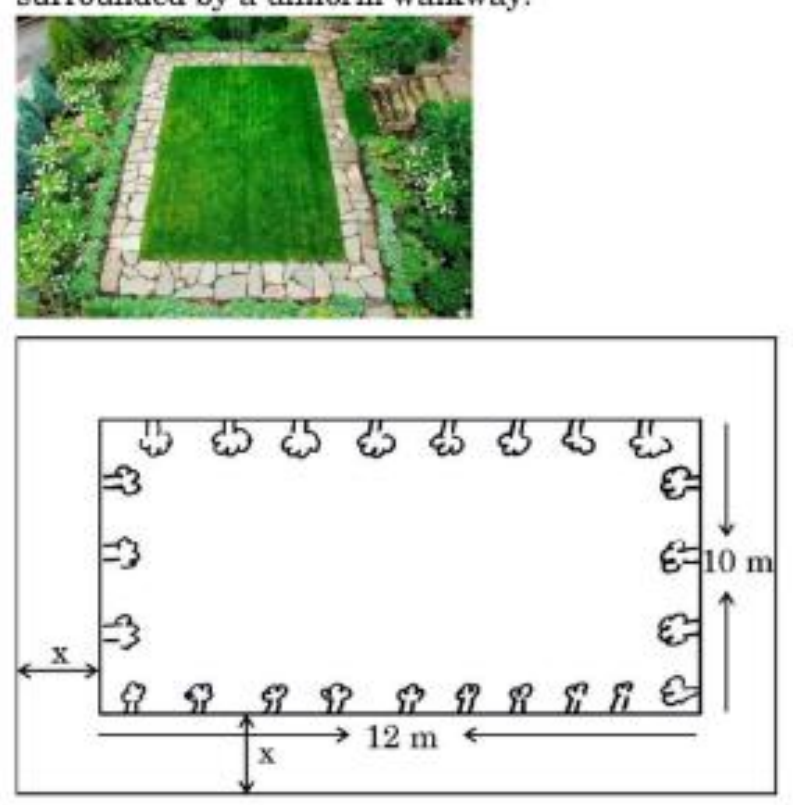
A garden designer is planning a rectangular lawn that is to be surrounded by a uniform walkway.
The total area of the lawn and the walkway is $360$ square metres. The width of the walkway is same on all sides. The dimensions of the lawn itself are $12$ metres by $10$ metres.
Based on the information given above, answer the following questions:
(i) Formulate the quadratic equation representing the total area of the lawn and the walkway, taking width of walkway $= x \operatorname{m}$.
(ii) (a) Solve the quadratic equation to find the width of the walkway 'x'.
OR
(b) If the cost of paving the walkway at the rate of ₹50 per square metre is ₹12,000, calculate the area of the walkway.
(iii) Find the perimeter of the lawn.
figure for this question
Show SolutionHide Solution
(i) $(12 + 2x)(10 + 2x) = 360$
$4x^2 + 44x - 240 = 0$ or $x^2 + 11x - 60 = 0$
(ii)(a) $(x + 15)(x - 4) = 0$
$x = 4$
$\therefore$ width of the walkway $= 4 \operatorname{m}$
OR
(ii)(b) Area of the walkway $= \frac{12000}{50}$
$= 240 \operatorname{m}^2$
(iii) Perimeter of the lawn $= 2(12 + 10) = 44 \operatorname{m}$
364 Marks · March 2026 · Standardopen ↗
A person on a tour has ₹ $4,200$ for expenses. If he extends his tour for $3$ days, he has to cut down his daily expenses by ₹ $70$. Find the original duration of the tour.
Show SolutionHide Solution
Let the original duration of the tour be $x$ days
Original daily expenses = ₹ $\frac{4200}{x}$
New daily expenses = ₹ $\frac{4200}{x+3}$
$\frac{4200}{x} - \frac{4200}{x+3} = 70$ (2 Marks)
$\Rightarrow x^2 + 3x - 180 = 0$ (1 1/2 Marks)
$\Rightarrow (x + 15)(x – 12) = 0$ (1 Mark)
$\Rightarrow x = -15, x = 12$
$x = -15$ (rejected)
$x = 12$ (1/2 Mark)
$\therefore$ Original duration of the tour = $12$ days
374 Marks · March 2026 · Standardopen ↗
The area of a right-angled triangle is $600$ cm$^2$. If the base of the triangle exceeds the altitude by $10$ cm, find all the three dimensions of the triangle.
Show SolutionHide Solution
Let the altitude of triangle be $x$ cm
then Base of triangle = $(x + 10)$ cm
Area of triangle = $600$ cm$^2$
$\frac{1}{2} \times x \times (x + 10) = 600$ (1 1/2 Marks)
$\Rightarrow x^2+10x-1200 = 0$ (1 Mark)
$\Rightarrow (x + 40)(x – 30) = 0$ (1 Mark)
$\Rightarrow x = -40, x = 30$
$x = -40$ (rejected)
$x = 30$ (1/2 Mark)
$\therefore$ Altitude = $30$ cm
Base = $40$ cm (1/2 Mark)
Hypotenuse = $\sqrt{(30)^2 + (40)^2}= 50$ cm (1/2 Mark)
5 Marks Questions
385 Marks · March 2023 · Standardopen ↗
A train travels at a certain average speed for a distance of $54$ km and then travels a distance of $63$ km at an average speed of $6$ km/h more than the first speed. If it takes $3$ hours to complete the journey, what was its first average speed ?
Show SolutionHide Solution
Let first average speed of the train be $x$ km/hr.
$\frac{54}{x} + \frac{63}{x + 6} = 3$
$\Rightarrow 54(x + 6) + 63x = 3x^2 + 18x$
$\Rightarrow 3x^2 - 99x - 324 = 0$ or $x^2 - 33x - 108 = 0$
$\Rightarrow (x - 36) (x + 3) = 0$
$\Rightarrow x = 36, -3$ (rejected)
Therefore, first average speed of the train was $36$ km/hr.
395 Marks · March 2023 · Standardopen ↗
Two pipes together can fill a tank in $\frac{15}{8}$ hours. The pipe with larger diameter takes $2$ hours less than the pipe with smaller diameter to fill the tank separately. Find the time in which each pipe can fill the tank separately.
Show SolutionHide Solution
Let the time taken by smaller diameter tap be $x$ hrs.
Time taken by larger diameter tap is $(x - 2)$ hrs.
Therefore $\frac{1}{x-2} + \frac{1}{x} = \frac{8}{15}$
$\Rightarrow 15(2x - 2) = 8x(x - 2)$
$\Rightarrow 8x^2 - 46x + 30 = 0$
$\Rightarrow 4x^2 - 23x + 15 = 0$
$\Rightarrow (4x - 3)(x - 5) = 0$
$\Rightarrow x = \frac{3}{4}$ as $x-2 < 0$ (rejected) or $x = 5$
Smaller diameter tap fills in $5$ hrs.
Larger diameter tap fills in $3$ hrs.
405 Marks · March 2024 · Standardopen ↗
If Nidhi were $7$ years younger than what she actually is, then the square of her age (in years) would be $1$ more than $5$ times her actual age. What is her present age?
Show SolutionHide Solution
Let the present age of Nidhi be $x$ years.
According to question, $(x - 7)^2 = 5x + 1$
$x^2- 19x + 48 = 0$
$(x - 16)(x - 3) = 0$
$x = 16,3$
$x \neq 3$
$\therefore x = 16$
Hence, the present age of Nidhi $= 16$ years
415 Marks · March 2024 · Standardopen ↗
A shopkeeper buys a number of books for ₹1,800. If he had bought $15$ more books for the same amount, then each book would have cost him ₹20 less. Find how many books he bought initially.
Show SolutionHide Solution
Let the number of books bought initially be $x$
According to question,
$\frac{1800}{x} - \frac{1800}{x+15} = 20$
$x^2 + 15x - 1350 = 0$
$(x + 45)(x - 30) = 0$
$x = -45$
$\therefore x = 30$
So, the number of books bought initially $= 30$
425 Marks · July 2024 · Standardopen ↗
Some students planned a picnic. The total budget for food was ₹500, but $5$ of them failed to go and thus the cost of food for each student increased by ₹5. How many students attended the picnic?
Show SolutionHide Solution
Let number of students who attended picnic be $x$.
A.T.Q.
$\frac{500}{x} - \frac{500}{x+5} = 5$
$\Rightarrow x^2 + 5x - 500 = 0$
$\Rightarrow (x + 25) (x - 20) = 0$
$x = -25, x = 20$
But number of students can't be negative.
Hence, $x = 20$
Therefore, number of students who attended picnic is $20$.
435 Marks · March 2024 · Standardopen ↗
In a flight of $2800 \text{ km}$, an aircraft was slowed down due to bad weather. Its average speed is reduced by $100 \text{ km/h}$ and by doing so, the time of flight is increased by $30$ minutes. Find the original duration of the flight.
Show SolutionHide Solution
Let original speed of aircraft be $x \text{ km/hr}$.
A.T.Q.
$\frac{2800}{x-100} - \frac{2800}{x} = \frac{1}{2}$
$\Rightarrow x^2 - 100x - 560000 = 0$
$\Rightarrow (x-800)(x + 700) = 0$
$x \neq -700$ So, $x = 800$
Original Duration $\frac{2800}{800} = \frac{7}{2}$ hrs or $3$ hrs $30$ min.
445 Marks · March 2024 · Standardopen ↗
The denominator of a fraction is one more than twice the numerator. If the sum of the fraction and its reciprocal is $\frac{16}{21}$, find the fraction.
Show SolutionHide Solution
Let numerator be $x$,
then denominator be $(2x + 1)$
Fraction = $\frac{x}{2x+1}$
A.T.Q.
$\frac{x}{2x+1} + \frac{2x+1}{x} = \frac{58}{21}$
$\Rightarrow 11x^2 - 26x - 21 = 0$
$\Rightarrow (x - 3)(11x + 7) = 0$
$x \neq -\frac{7}{11}$ So, $x = 3$
$\therefore$ Fraction = $\frac{3}{7}$
455 Marks · March 2024 · Standardopen ↗
A train travels a distance of $90$ km at a constant speed. Had the speed been $15$ km/h more, it would have taken $30$ minutes less for the journey. Find the original speed of the train.
Show SolutionHide Solution
Let the original speed be $x$ km/h
New speed $= (x + 15)$ km/h
A.T.Q.
$$\begin{aligned}& \frac{90}{x} - \frac{90}{x+15} = \frac{1}{2} \\ & \Rightarrow x^2 + 15x - 2700 = 0 \\ & \Rightarrow(x + 60) (x - 45) = 0 \\ & x \neq -60 \text{ , } x = 45 \\ & \text{The original speed of the train } = 45\text{km/h}\end{aligned}$$
465 Marks · March 2024 · Standardopen ↗
A $2$-digit number is such that the product of its digits is $18$. When $63$ is subtracted from the number, the digits interchange their places. Find the number.
Show SolutionHide Solution
Let the required no. be $10x + y$
Here $xy = 18$ ---- (i)
$(10x + y) - 63 = 10y + x$
or $x - y = 7$ ---- (ii)
Solving (i) and (ii) to get
$x=9$ and $y=2$
Hence required number is $92$.
475 Marks · March 2024 · Standardopen ↗
The age of a man is twice the square of the age of his son. Eight years hence, the age of the man will be $4$ years more than three times the age of his son. Find their present ages.
Show SolutionHide Solution
Let present age of son = $x$ years
and present age of man = $2x^2$ years
A.T.Q.
$$\begin{aligned}& 3(x + 8) + 4 = 2x^2 + 8 \\ & \Rightarrow 2x^2 - 3x - 20 = 0 \\ & \Rightarrow (2x+5) (x - 4) = 0 \\ & x \neq -\frac{5}{2}\end{aligned}$$ So, $x = 4$
Present age of son = $4$ years
Present age of man = $32$ years
485 Marks · March 2024 · Standardopen ↗
A $2$-digit number is such that the product of the digits is $14$. When $45$ is added to the number, the digits are reversed. Find the number.
Show SolutionHide Solution
Let the two digit number be $10x + y$
$xy = 14$ ..... (i) (1 Mark)
$10x + y + 45 = 10y + x$
$y-x = 5$ .....(ii) (1 Mark)
From (i) and (ii)
$x(x+5) = 14 \Rightarrow x^2 + 5x - 14 = 0$ (1/2 Mark)
$(x+7)(x-2) = 0$ (1/2 Mark)
$x = 2$ (as $x \neq -7$) (1 Mark)
Number = $27$ (1 Mark)
495 Marks · March 2024 · Standardopen ↗
The side of a square exceeds the side of another square by $4$ cm and the sum of the areas of the two squares is $400$ cm$^2$. Find the sides of the squares.
Show SolutionHide Solution
Let the side of first square = $x$ cm (1/2 Mark)
$\therefore$ Side of second square = $(x + 4)$ cm (1/2 Mark)
$x^2 + (x + 4)^2 = 400$ (1 Mark)
$x^2 + x^2 + 8x + 16 = 400 \Rightarrow 2x^2 + 8x - 384 = 0 \Rightarrow x^2 + 4x - 192 = 0$ (1 Mark)
$(x + 16)(x - 12) = 0$ (1/2 Mark)
$x = 12$ (as $x \neq -16$) (1/2 Mark)
Side of squares = $12$cm and $16$cm (1 Mark)
505 Marks · March 2024 · Standardopen ↗
The sum of two numbers is $18$ and the sum of their reciprocals is $\frac{1}{4}$. Find the numbers.
Show SolutionHide Solution
Let two numbers be $x$ and $$\begin{aligned}& (18 - x) \\ & A.T.Q. \\ & \frac{1}{x} + \frac{1}{18-x} = \frac{1}{4} \\ & \Rightarrow x^2 - 18x + 72 = 0 \\ & \Rightarrow (x - 12)(x - 6) = 0 \\ & \Rightarrow x = 12, x = 6\ \therefore\end{aligned}$$ two numbers are $12$ and $6$.
515 Marks · July 2025 · Standardopen ↗
At present, Sourav's age is $3$ years more than the square of his son Ravi's age. When Ravi grows to his father's present age, Sourav's age would be $6$ years less than $13$ times the present age of Ravi. Find present ages of Ravi and Sourav.
Show SolutionHide Solution
Let the present age of Ravi be 'r' years
and the present age of Sourav be 's' years
Therefore, $s = 3 + r^2$ --- (1)
Ravi grows to father's present age in $(s - r)$ years.
$\therefore$ father's age after $(s - r)$ years = $(2s - r)$ years
and Ravi's age after $(s - r)$ years = 's' years
Therefore, $2s - r = 13r - 6$ or $s = 7r - 3$ --- (2)
Using (1) and (2),
$r^2 - 7r + 6 = 0$
$\Rightarrow (r - 6)(r - 1) = 0$
$\Rightarrow r = 6, 1$
Ignoring $r = 1$ as $s \neq 4$
r = $6$
Hence $s = 39$
525 Marks · March 2025 · Standardopen ↗
The perimeter of a right triangle is $60$ cm and its hypotenuse is $25$ cm. Find the lengths of other two sides of the triangle.
Show SolutionHide Solution
Let sides be $x, y$. $x + y + 25 = 60 \implies y = 35 - x$. $x^2 + y^2 = 25^2 \implies x^2 + (35 - x)^2 = 625 \implies x^2 - 35x + 300 = 0 \implies (x - 20)(x - 15) = 0 \implies x = 20, 15$. Sides are $15$ cm and $20$ cm.
535 Marks · March 2025 · Standardopen ↗
A train travels a distance of $480$ km at a uniform speed. If the speed had been $8$ km/h less, then it would have taken $3$ hours more to cover the same distance. Find the speed of the train.
Show SolutionHide Solution
Let speed be $x$ km/h. $\frac{480}{x - 8} - \frac{480}{x} = 3 \implies x^2 - 8x - 1280 = 0 \implies (x - 40)(x + 32) = 0 \implies x = 40$. Speed $= 40$ km/h.
545 Marks · March 2025 · Standardopen ↗
A two-digit number is such that the product of its digits is $12$. When $36$ is added to this number, the digits interchange their places. Find the number.
Show SolutionHide Solution
Let unit digit be $y$
and ten's digit = $x$
hence, the two digit number = $10x + y$, (1/2)
ATQ
$xy = 12$ ..............(i) (1)
$10x + y + 36 = 10y + x$
$x - y + 4 = 0$ ....... (ii) (1)
From (i) and (ii)
$x^2 + 4x - 12 = 0$ (1/2)
$(x + 6)(x - 2) = 0$ (1/2)
Hence, $x = 2$
and $y = 6$ (1/2)
$\therefore$ Number = $26$ (1/2)
555 Marks · March 2025 · Standardopen ↗
A student scored a total of $32$ marks in class tests in Mathematics and Science. Had he scored $2$ marks less in Science and $4$ marks more in Mathematics, the product of his marks would have been $253$. Find his marks in the two subjects.
Show SolutionHide Solution
Let marks scored in Mathematics be $x$
and marks scored in Science be $y$
ATQ,
$x + y = 32$ ..............(i) (1)
and $(x + 4)(y - 2) = 253$ ...... (ii) (1)
from (i) and (ii)
$x^2 - 26x + 133 = 0$ (1)
$(x - 19)(x - 7) = 0$ (1)
$x = 19, 7$ (1/2)
$x = 19 \Rightarrow y = 13$
$x = 7 \Rightarrow y = 25$ (1/2)
Hence, marks in Mathematics and Science are $19, 13$ or $7, 25$
565 Marks · March 2025 · Standardopen ↗
The sum of the areas of two squares is $52$ cm$^2$ and difference of their perimeters is $8$ cm. Find the lengths of the sides of the two squares.
Show SolutionHide Solution
Let the lengths of the sides of two squares be 'x' cm and 'y' cm such that $x > y$.
ATQ
$x^2 + y^2 = 52$ ----- (1)
$4x - 4y = 8$ or $x - y = 2$ ----- (2)
From (1) and (2), we have
$y^2 + 2y - 24 = 0$
$\Rightarrow (y + 6) (y - 4) = 0$
$\therefore y = 4$
So, $x = 2 + 4 = 6$
$\therefore$ Lengths of the sides of two squares are $6$ cm and $4$ cm respectively.
575 Marks · March 2025 · Standardopen ↗
The time taken by a person to travel an upward distance of $150$ km was $2 \frac{1}{2}$ hours more than the time taken in the downward return journey. If he returned at a speed of $10$ km/h more than the speed while going up, find the speeds in each direction.
Show SolutionHide Solution
Let the speed in upward direction be 'x' km/h
and the speed in downward direction = $(x + 10)$ km/h
ATQ
$\frac{150}{x} - \frac{150}{x+10} = \frac{5}{2}$
$\Rightarrow x^2 + 10 x - 600 = 0$
$\Rightarrow (x+30)(x - 20) = 0$
$\therefore x = 20$
and $x + 10 = 20 + 10 = 30$
Therefore, speeds in upward and downward direction are $20$ km/h and $30$ km/h respectively.
585 Marks · March 2025 · Standardopen ↗
The numerator of a fraction is $3$ less than its denominator. If $2$ is added to both numerator and denominator, then the sum of the new fraction and the original fraction is $\frac{29}{20}$. Find the original fraction.
Show SolutionHide Solution
Let denominator be $x$
$\therefore$ Numerator $= (x - 3)$
Therefore, fraction $= \frac{x-3}{x}$ ($1$)
ATQ
$\frac{x-3}{x} + \frac{x-3+2}{x+2} = \frac{29}{20}$ ($1$)
$\Rightarrow 11x^2 - 98x - 120 = 0$ ($1$)
$\Rightarrow (x-10)(11x + 12) = 0$ ($1/2$)
So, $x = 10$ ($1/2$)
$\therefore$ Fraction $= \frac{7}{10}$ ($1$)
595 Marks · March 2025 · Standardopen ↗
A train travelling at a uniform speed for $360$ km would have taken $48$ minutes less to travel the same distance if its speed were $5$ km/h more. Find the original speed of the train.
Show SolutionHide Solution
Let the original speed of train be 'x' km/h
ATQ
$\frac{360}{x} - \frac{360}{x + 5} = \frac{48}{60}$ ($2$)
$\Rightarrow x^2 + 5x - 2250 = 0$ ($1$)
$\Rightarrow (x + 50)(x - 45) = 0$ ($1$)
So, $x = 45$
$\therefore$ Original speed of the train is $45$ km/h. ($1$)
605 Marks · March 2025 · Standardopen ↗
The sides of a right triangle are such that the longest side is $4$ m more than the shortest side and the third side is $2$ m less than the longest side. Find the length of each side of the triangle. Also, find the difference between the numerical values of the area and the perimeter of the given triangle.
Show SolutionHide Solution
Let the length of shortest side be $x$ m
$\therefore$ length of longest side = $(x + 4)$ m
and length of third side = $(x + 2)$ m
Now, $(x + 4)^2 = x^2 + (x + 2)^2$
$\Rightarrow x^2 - 4x - 12 = 0$
$\Rightarrow (x – 6)(x + 2) = 0$
$\Rightarrow x = 6$
$\therefore$ sides are $6$ m, $8$ m and $10$ m
Area = $\frac{1}{2} \times 6 \times 8 = 24$ m$^2$
Perimeter = $6+8+10 = 24$ m
Difference = $0$
615 Marks · March 2025 · Standardopen ↗
A 2-digit number is seven times the sum of its digits and two (2) more than 5 times the product of its digits. Find the number.
Show SolutionHide Solution
Let digit at unit place be $x$ and digit at tens place be $y$
$\therefore$ number $= 10y + x$
$ATQ$
$10y + x = 7(x + y)$
$\implies 3y = 6x$ or $y = 2x$ --- (1)
Also, $10y + x = 5xy + 2$ --- (2)
from (1) and (2), we get $10x^2 - 21x + 2 = 0$
$\implies (x - 2)(10x - 1) = 0$
$\therefore x = 2$
So, $y = 4$
$\therefore$ Required number is 42.
625 Marks · March 2025 · Standardopen ↗
Find two consecutive odd numbers, sum of whose squares is $650$.
Show SolutionHide Solution
Let the consecutive odd numbers be $x$ and $x + 2 \implies x^2 + (x + 2)^2 = 650 \implies 2x^2 + 4x - 646 = 0$ or $x^2 + 2x - 323 = 0 \implies (x + 19)(x - 17) = 0 \implies x = 17 \therefore$ Odd numbers are $17, 19$
635 Marks · March 2026 · Standardopen ↗
A faster train takes one hour less than a slower train for a journey of $200$ km. If the speed of the slower train is $10$ km/hr less than that of the faster train, find the speeds of the two trains.
Show SolutionHide Solution
Let the speed of faster train be $x$ km/h
$\therefore$ speed of slower train $= (x – 10)$ km/h
According to the question,
$\frac{200}{x-10} - \frac{200}{x} = 1$ (I) (2 Marks)
$\Rightarrow x^2 - 10x - 2000 = 0$ (II) (1 Mark)
$\Rightarrow (x - 50)(x + 40) = 0$ (III) (1 Mark)
$\therefore x = 50$
$x = -40$ (Rejected) (IV) (1/2 Mark)
Hence, speed of faster train $= 50$ km/h
and speed of slower train $= 40$ km/h (V) (1/2 Mark)
645 Marks · March 2026 · Standardopen ↗
The sum of the areas of two squares is $640$ m$^2$. If the difference in their perimeters is $64$ m, find the sides of the two squares.
Show SolutionHide Solution
Let the sides of the two squares be $x$ m and $y$ m $(x > y)$
$x^2 + y^2 = 640$ (I) (1 Mark)
and $4x – 4y = 64 \Rightarrow y = x - 16$ (II) (1 Mark)
$\therefore x^2 + (x – 16)^2 = 640$ (III) (1 Mark)
$\Rightarrow x^2 - 16x – 192 = 0$ (IV) (1 Mark)
$\Rightarrow (x – 24)(x + 8) = 0$
$\therefore x = 24$ (V) (1/2 Mark)
$x = -8$ (Rejected)
$\Rightarrow y = 24 – 16 = 8$ (VI) (1/2 Mark)
Hence the sides of the two squares are $24$ m and $8$ m
655 Marks · March 2026 · Standardopen ↗
In a flight of $600$ km, an aircraft slowed down its speed due to bad weather. Its average speed for the trip reduced by $200$ km/h from its usual speed and time of flight increased by $30$ minutes. Find the scheduled duration of the flight.
Show SolutionHide Solution
Let the average speed of the aircraft be $x$ km/h
Time taken by aircraft $= \frac{600}{x}$
Time taken by aircraft when flight is delayed by $30$ min $= \frac{600}{x-200}$
$\frac{600}{x-200}$ - $\frac{600}{x}$ = ½ (2 Marks)
x²-200x - 240000 = 0 (1 Mark)
⇒ (x-600)(x + 400) = 0 (1 Mark)
x = 600, x = - 400
x = - 400 (rejected) (1/2 Mark)
∴ x = 600$\\therefore$ Scheduled duration of the flight $= \frac{600}{600} = 1$ hour (1/2 Mark)
665 Marks · March 2026 · Standardopen ↗
Two pipes are used to fill a swimming pool. If the pipe of the larger diameter is used for $4$ hours and the pipe of the smaller diameter for $9$ hours, only half of the pool can be filled. Find how long it would take for each pipe to fill the pool, separately, if the pipe of smaller diameter takes $10$ hours more than the pipe of larger diameter to fill the pool.
Show SolutionHide Solution
Let time taken to fill the pool by larger diameter pipe alone be $x$ hours
Time taken to fill the pool by smaller diameter pipe alone = $(x + 10)$ hours
$\frac{4}{x}$ + $\frac{9}{x + 10}$ = ½ (2 Marks)
x² - 16x - 80 = 0 (1 Mark)
⇒ (x + 4)(x - 20) = 0 (1 Mark)
⇒ x = -4, x = 20
x = -4 (rejected) (1/2 Mark)
∴ x = 20
Time taken to fill the pool by larger diameter pipe alone = $20$ hours
Time taken to fill the pool by smaller diameter pipe alone = $30$ hours (1/2 Mark)
675 Marks · March 2026 · Standardopen ↗
In a class test, the sum of Anamika's marks obtained in Maths and Science is 30. Had she got 2 marks more in Maths and 3 marks less in Science, the product of the marks would have been 210. Find the marks she got in the two subjects.
Show SolutionHide Solution
Let the marks obtained in Maths be $x$
Then the marks obtained in Science = $30 - x$
$(x + 2)(30 - x - 3) = 210$ (2 Marks)
$\Rightarrow x^2 - 25x + 156 = 0$ (1 Mark)
$\Rightarrow (x-13)(x - 12) = 0$ (1/2 Mark)
$\therefore x = 13, x = 12$ (1/2 Mark)
Either marks in Maths and Science are 13 and 17 respectively (1/2 Mark)
or marks in Maths and Science are 12 and 18 respectively (1/2 Mark)
685 Marks · March 2026 · Standardopen ↗
The length of hypotenuse (in cm) of a right-angled triangle is 6 cm more than twice the length of its shortest side. If the length of its third side is 6 cm less than thrice the length of its shortest side, find the dimensions of the triangle.
Show SolutionHide Solution
Let the shortest side be $x$ cm
Then hypotenuse = $(2x + 6)$ cm
and the third side = $(3x - 6)$ cm
$x^2 + (3x - 6)^2 = (2x + 6)^2$ (2 Marks)
$\Rightarrow 6x^2 - 60x = 0$ (1 Mark)
$\Rightarrow 6x(x - 10) = 0$ (1/2 Mark)
$\Rightarrow x = 0, x = 10$
x = 0 (rejected) (1/2 Mark)
$\therefore x = 10$
and hypotenuse = 26 cm (1/2 Mark)
and third side = 24 cm (1/2 Mark)
695 Marks · March 2026 · Standardopen ↗
A person on tour has ₹$5,400$ for his expenses. If he extends his tour by $5$ days, he has to cut down his daily expenses by ₹$180$. Find the original duration of the tour and daily expense.
Show SolutionHide Solution
Let original duration of the tour be $x$ days.
$\therefore$ Daily expense is $\frac{5400}{x}$
According to the question,
$\frac{5400}{x} - \frac{5400}{x+5} = 180$ (I) (2 Marks)
$\Rightarrow x^2 + 5x - 150 = 0$ (II) (1 Mark)
$\Rightarrow (x + 15) (x - 10) = 0$ (III) (1 Mark)
$\Rightarrow x = -15, 10$
$\therefore x \neq -15$
$\therefore x = 10$ (IV) ($\frac{1}{2}$ Mark)
$\therefore$ Original duration of tour is $10$ days and daily expense is ₹$540$. (V) ($\frac{1}{2}$ Mark)
705 Marks · March 2026 · Standardopen ↗
The total cost of certain piece of cloth was ₹$2,100$. During special sale time, the shopkeeper offered $2$ m extra cloth for free thus reducing the price of cloth per metre by ₹$120$. What was the original per metre price of cloth and its length ?
Show SolutionHide Solution
Let the original length of cloth be $x$ metre.
$\therefore$ Original cost is $\frac{2100}{x}$ per metre.
According to the question,
$\frac{2100}{x} - \frac{2100}{x+2} = 120$ (I) (2 Marks)
$\Rightarrow x^2 + 2x - 35 = 0$ (II) (1 Mark)
$\Rightarrow (x + 7) (x - 5) = 0$ (III) (1 Mark)
$\Rightarrow x = -7,5$
$\therefore x \neq -7$
$\therefore x = 5$ (IV) ($\frac{1}{2}$ Mark)
$\therefore$ The original price of cloth per metre is ₹$420$ and original length is $5$ m. (V) ($\frac{1}{2}$ Mark)
715 Marks · March 2026 · Standardopen ↗
Venkat can row a boat in still water at the speed of 12 km/h. He ferries tourists 15 km upstream and 18 km downstream in 3 hours. Find the speed of the stream.
Show SolutionHide Solution
Let speed of the stream be $x$ km/h
$\frac{15}{12 - x} + \frac{18}{12 + x} = 3$ (I) (2)
$\Rightarrow x^2 - x - 12 = 0$ (II) (1)
$\Rightarrow (x - 4)(x + 3) = 0$ (III) (1)
$\Rightarrow x = 4, -3$
x = -3 (rejected)
$\therefore x = 4$ (IV) (1)
The speed of the stream = 4 km/h
725 Marks · March 2026 · Standardopen ↗
By selling an article for ₹$48$, a trader loses as much percent as half of the cost price of the article. Calculate the cost price and loss amount of the article.
Show SolutionHide Solution
Let the cost price (CP)of the article be $x$
Loss = $\frac{x}{2}\%$ of $x = \frac{x^2}{200}$ (I Mark)
Selling price = $48 = x - \frac{x^2}{200}$ (II Mark)
$\Rightarrow x^2 - 200x + 9600 = 0$ (III Mark)
$\Rightarrow (x - 120)(x - 80) = 0$ (IV Mark)
$\Rightarrow x = 120,80$ (V Mark)
When CP = ₹$120$, Loss = $120 - 48 = 72$ (VI Mark)
When CP = ₹$80$, Loss = $80 - 48 = 32$ (VII Mark)
735 Marks · March 2026 · Standardopen ↗
Two water taps together can fill a tank in $8\frac{8}{3}$ hours. The tap of larger diameter takes $4$ hours less than the smaller one to fill the tank separately. Find the time in which each tap can separately fill the tank.
Show SolutionHide Solution
Let tap of smaller diameter takes $x$ hours to fill the tank.
$\therefore$ tap of larger diameter takes $x - 4$ hours to fill the tank.
$\frac{1}{x} + \frac{1}{x-4} = \frac{9}{80}$ (2 Marks)
$\Rightarrow 9x^2-196x + 320 = 0$ (1 Mark)
$\Rightarrow (x-20)(9x – 16) = 0$ (1 Mark)
$\Rightarrow x = 20, \frac{16}{9}$
$x = \frac{16}{9}$ (rejected) (1/2 Mark)
$\therefore x = 20$
Hence, tap of smaller diameter and larger diameter takes $20$ hours & $16$ hours respectively, to fill the tank. (1/2 Mark)
745 Marks · March 2026 · Standardopen ↗
Three consecutive positive integers are such that sum of square of the first and the product of the other two is $67$, find the integers.
Show SolutionHide Solution
Let the consecutive integers be $x, (x + 1)$ and $(x + 2)$ (1 Mark)
$x^2 + (x + 1)(x + 2) = 67$ (1 Mark)
$\Rightarrow 2x^2 + 3x - 65 = 0$ (1 Mark)
$\Rightarrow (x - 5)(2x + 13) = 0$ (1 Mark)
$\Rightarrow x = 5$ or $x = -\frac{13}{2}$ (1 Mark)
neglecting $x = -\frac{13}{2}$, as $x$ is a positive integer. ($\frac{1}{2}$ Mark)
So, $x = 5$
Thus, integers are $5, 6$ and $7$ ($\frac{1}{2}$ Mark)
755 Marks · March 2025 · Basicopen ↗
The sum of areas of two squares is $2650 \text{ cm}^2$. If the sum of their perimeters is $280 \text{ cm}$, find the sides of the two given squares.
Show SolutionHide Solution
(a) Let the sides of squares be $x$ and $y$
A.T.Q.
$x^2 + y^2 = 2650$ --------(i) [1 mark]
$4x + 4y = 280 \Rightarrow x + y = 70$ ---(ii) [1 mark]
getting $2x^2 - 140x + 2250 = 0$ or $x^2 - 70x + 1125 = 0$ [1 mark]
$\Rightarrow (x - 25)(x - 45) = 0$
$\Rightarrow x = 25$ and $x = 45$ [1 mark]
$\therefore y = 45$ and $y = 25$
sides of square are $25 \text{ cm}$ and $45 \text{ cm}$. [1 mark]
765 Marks · March 2025 · Basicopen ↗
Express the equation $\frac{1}{x} - \frac{1}{x - 2} = 3, (x \neq 0, 2)$ as a quadratic equation in standard form. Hence, find the roots of the quadratic equation so obtained.
Show SolutionHide Solution
$\frac{x - 2 - x}{x (x - 2)} = 3$ [1 mark]
$\Rightarrow 3x^2 - 6x + 2 = 0$ [1 mark]
$\text{Discriminant} = 36 - 24 = 12$ [1 mark]
$\text{Roots are } \frac{6 + \sqrt{12}}{6} \text{ and } \frac{6 - \sqrt{12}}{6}$
$\text{or } 1 + \frac{\sqrt{3}}{3} \text{ and } 1 - \frac{\sqrt{3}}{3}$ [1+1 marks]
775 Marks · March 2025 · Basicopen ↗
Find two consecutive odd integers, sum of whose squares is $290$.
Show SolutionHide Solution
Let the two consecutive odd integers be $x$ and $x + 2$ [$\frac{1}{2}$ mark]
$x^2 + (x + 2)^2 = 290$ [$1\frac{1}{2}$ marks]
$2x^2 + 4x - 286 = 0$ or $x^2 + 2x - 143 = 0$ [$1\frac{1}{2}$ marks]
$(x - 11)(x + 13) = 0$
$x = 11$ [$1$ mark]
Required odd integers are $11$ and $13$ [$\frac{1}{2}$ mark]
785 Marks · March 2025 · Basicopen ↗
A charity trust decides to build a rectangular hall having an area of $300\text{ m}^2$. The length of the hall is one metre more than twice its width. Find the length and breadth of the hall.
Show SolutionHide Solution
Let width be $x\text{ m}$ and length be $(2x + 1)\text{ m}$ [$\frac{1}{2}$ mark]
A.T.Q. $(2x + 1)x = 300$ [$1\frac{1}{2}$ marks]
$2x^2 + x - 300 = 0$ [$1\frac{1}{2}$ marks]
$(x - 12)(2x + 25) = 0$
$x = 12$ [$1$ mark]
(Rejecting $x = -\frac{25}{2}$)
$\text{length} = 25\text{ m and width} = 12\text{ m}$ [$\frac{1}{2}$ mark]
795 Marks · March 2026 · Basicopen ↗
The sum of squares of two positive numbers is 100. If one number exceeds the other by 2, find the numbers.
Show SolutionHide Solution
Let the numbers be $x, x + 2$
$x^2 + (x + 2)^2 = 100$ (1½ Mark)
simplifying we get
$2x^2 + 4x - 96 = 0$ or $x^2 + 2x - 48 = 0$ (1 Mark)
which gives $(x + 8) (x - 6) = 0$ (1/2 Mark)
$x = 6, - 8$ (1/2 Mark)
As $x > 0$ thus, numbers are 6, 8 (1/2 Mark)
805 Marks · March 2026 · Basicopen ↗
A motor boat, whose speed in still water is $20$ km/h, takes $1$ hour more to go $48$ km upstream than to return downstream to the same point. Find the speed of the stream.
Show SolutionHide Solution
Let speed of stream be $x$ km/h (0.5 Mark)
Speed of boat upstream= $(20 – x)$ km/h
Speed of boat downstream = $(20 + x)$ km/h (0.5 Mark)
$\therefore \frac{48}{20-x} - \frac{48}{20+x} = 1$ (1.5 Mark)
$x^2 + 96x – 400 = 0$
$(x + 100) (x - 4) = 0$ (1 Mark)
$x = 4, x = -100$ (rejected)
Hence, speed of stream is $4$ km/h. (1.5 Mark)

Find roots

1 Mark Questions
811 Mark · March 2023 · Standardopen ↗
The roots of the equation $x^2 + 3x – 10 = 0$ are :
  • (a)$2,-5$
  • (b)$-2,5$
  • (c)$2,5$
  • (d)$-2, -5$
Show SolutionHide Solution
(a) $2,-5$
821 Mark · March 2024 · Standardopen ↗
The roots of the quadratic equation $x^2 + x - p (p + 1) = 0$ are :
  • (a)$p, p + 1$
  • (b)$-p, p + 1$
  • (c)$-p, -(p + 1)$
  • (d)$p, -(p + 1)$
Show SolutionHide Solution
(D) $p, -(p + 1)$
831 Mark · March 2025 · Standardopen ↗
If $\frac{x}{12} - \frac{3}{x} = 0$, then the values of $x$ are:
  • (a)$\pm 6$
  • (b)$\pm 4$
  • (c)$\pm 12$
  • (d)$\pm 3$
Show SolutionHide Solution
(A) $\pm 6$
841 Mark · March 2026 · Standardopen ↗
The roots of the quadratic equation $(x – 1)^2 = 16$ are :
  • (a)$5,3$
  • (b)$4,-4$
  • (c)$5,-3$
  • (d)$-5,3$
Show SolutionHide Solution
(C) $5, -3$
851 Mark · March 2026 · Standardopen ↗
The roots of the quadratic equation $4x^2 - (a - 1)^2 = 0$ are :
  • (a)$a-1, a + 1$
  • (b)$\frac{a-1}{2}, -\frac{a+1}{2}$
  • (c)$\frac{a-1}{2}, -\frac{a-1}{2}$
  • (d)$\pm(a-1)$
Show SolutionHide Solution
(B) $\frac{a-1}{2}, -\frac{a+1}{2}$
861 Mark · March 2025 · Basicopen ↗
The roots of the equation $x^2 - 8 = 0$ are
  • (a)rational and distinct
  • (b)irrational and distinct
  • (c)real and equal
  • (d)not real
Show SolutionHide Solution
(B) irrational and distinct
871 Mark · March 2026 · Basicopen ↗
The roots of the quadratic equation $x^2 + 9 = 0$ are
  • (a)real and equal
  • (b)not real
  • (c)real and negative of each other
  • (d)rational numbers
Show SolutionHide Solution
Answer (B) not real
2 Marks Questions
882 Marks · March 2025 · Basicopen ↗
Solve the quadratic equation $\sqrt{3}x^2 + 10x + 7\sqrt{3} = 0$ using quadratic formula.
Show SolutionHide Solution
Discriminant $= 16$
$x = \frac{-10 \pm \sqrt{16}}{2\sqrt{3}}$
$x = -\frac{3}{\sqrt{3}}, -\frac{7}{\sqrt{3}}$ or $x = -\sqrt{3}, -\frac{7}{3}\sqrt{3}$
892 Marks · March 2025 · Basicopen ↗
Find the nature of roots of the equation $4x^2 - 4a^2x + a^4 - b^4 = 0, b \neq 0$
Show SolutionHide Solution
Discriminant $= (-4a^2)^2 - 4 \times 4 \times (a^4 - b^4) = 16b^4$
Since, Discriminant $> 0$
Therefore, the given equation has real and distinct roots
3 Marks Questions
903 Marks · July 2025 · Standardopen ↗
Solve the following equation for $x$: $\frac{1}{x+4} - \frac{1}{x-7} = \frac{11}{30}$; $x \neq -4,7$
Show SolutionHide Solution
$\frac{1}{x+4} - \frac{1}{x-7} = \frac{11}{30}$
$\Rightarrow x^2 – 3x + 2 = 0$
$\Rightarrow (x - 2)(x – 1) = 0$
$\Rightarrow x = 1, 2$
5 Marks Questions
915 Marks · March 2024 · Standardopen ↗
Solve for $x: \frac{4}{x} - \frac{5}{2x + 3} = 3$
Show SolutionHide Solution
$$\begin{aligned}& 4 (2x + 3) - 5x = 3x (2x + 3) \\ & \Rightarrow 6x^2 + 6x - 12 = 0\end{aligned}$$ or $$\begin{aligned}& x^2 + x - 2 = 0 \\ & \Rightarrow (x - 1) (x + 2) = 0 \\ & \Rightarrow x = 1, x = -2\end{aligned}$$
925 Marks · March 2025 · Standardopen ↗
Express the equation $\frac{x-2}{x-3} + \frac{x-4}{x-5} = \frac{10}{3}$; $(x\neq3,5)$ as a quadratic equation in standard form. Hence, find the roots of the equation so formed.
Show SolutionHide Solution
$\frac{x-2}{x-3} + \frac{x-4}{x-5} = \frac{10}{3}$
$\frac{(x-2)(x-5)+(x-4)(x-3)}{(x-3)(x-5)} = \frac{10}{3}$
Simplifying, we get $2 x^2 - 19x + 42 = 0$
$\Rightarrow (x – 6)(2x – 7) = 0$
$\Rightarrow x = 6$ or $x = \frac{7}{2}$
935 Marks · March 2025 · Standardopen ↗
Solve the following equation for $x$ : $\frac{1}{x-2} + \frac{2}{x-1} = \frac{6}{x}, x \neq 0, 1, 2$
Show SolutionHide Solution
$\frac{1}{x-2} + \frac{2}{x-1} = \frac{6}{x} \implies x[x - 1 + 2(x - 2)] = 6(x - 1)(x - 2) \implies 3x^2 - 13x + 12 = 0 \implies (3x - 4)(x - 3) = 0 \implies x = 3, x = \frac{4}{3}$
945 Marks · March 2025 · Basicopen ↗
It is given that $p^2x^2 + (p^2 - q^2)x - q^2 = 0; (p \neq 0)$
(i) Show that the discriminant (D) of above equation is a perfect square.
(ii) Find the roots of the equation.
Show SolutionHide Solution
(i) Discriminant $= (p^2 - q^2)^2 + 4p^2q^2 = (p^2 + q^2)^2$ [$1 + 1$ mark]
(ii) $\therefore x = \frac{-(p^2 - q^2) \pm \sqrt{(p^2 + q^2)^2}}{2p^2}$ [$1$ mark]
$= \frac{q^2}{p^2}, -1$ [$1 + 1$ mark]
955 Marks · March 2025 · Basicopen ↗
Three consecutive positive integers are such that the sum of the square of smallest and product of other two is 67. Find the numbers, using quadratic equation.
Show SolutionHide Solution
Let the three consecutive positive integers be $x, x + 1, x + 2$ [$1$ mark]
A.T.Q. $x^2 + (x + 1) (x + 2) = 67$ [$1$ mark]
$\Rightarrow 2x^2 + 3x - 65 = 0$ [$1$ mark]
$\Rightarrow (2x + 13) (x - 5) = 0$ [$1$ mark]
$\Rightarrow x = 5, x = -\frac{13}{2}$ (rejected)
So the three consecutive positive integers are 5, 6 and 7 [$1$ mark]
965 Marks · March 2026 · Basicopen ↗
(A) Express $\frac{24}{18-x} - \frac{24}{18+x} = 1$ as a quadratic equation in standard form and find the discriminant of the quadratic equation, so obtained. Also, find the roots of the equation.
OR
(B) The sum of squares of two positive numbers is $100$. If one number exceeds the other by $2$, find the numbers.
Show SolutionHide Solution
(A) Given equation can be written as
$24(18 + x) – 24(18 – x) = 324 – x^2$ (1 Mark)
i.e., $x^2 + 48x – 324 = 0$ (1 Mark)
$D = 48^2 – 4(-324) = 3600$ (1 Mark)
Roots are $\frac{-48 \pm 60}{2}$ (1 Mark)
i.e., $6, -54$ (1 Mark)
OR
(B) Let the numbers be $x, x + 2$ (1/2 Mark)
$x^2 + (x + 2)^2 = 100$ (1 1/2 Mark)
simplifying we get
$2x^2 + 4x-96 = 0$ or $x^2 + 2x - 48 = 0$ (1 Mark)
which gives $(x + 8) (x – 6) = 0$ (1 Mark)
$x = 6, - 8$ (1/2 Mark)
As $x > 0$ thus, numbers are $6, 8$ (1/2 Mark)
975 Marks · March 2026 · Basicopen ↗
Express $\frac{24}{18-x} - \frac{24}{18+x} = 1$ as a quadratic equation in standard form and find the discriminant of the quadratic equation, so obtained. Also, find the roots of the equation.
Show SolutionHide Solution
Given equation can be written as
$24(18 + x) - 24(18 - x) = 324 - x^2$ (1 Mark)
i.e., $x^2 + 48x - 324 = 0$ (1 Mark)
$D = 48^2 - 4(-324) = 3600$ (1 Mark)
Roots are $\frac{-48 \pm 60}{2}$ (1 Mark)
i.e., 6, -54 (1/2 Mark)
985 Marks · March 2026 · Basicopen ↗
Solve for $x$: $\frac{x-2}{x-3} + \frac{x-4}{x-5} = \frac{10}{3}$; $x \neq 3,5$
Show SolutionHide Solution
$\frac{x-2}{x-3} + \frac{x-4}{x-5} = \frac{10}{3}$
$\Rightarrow 3[(x - 2) (x – 5) + (x – 3) (x − 4)] = 10 (x – 3) (x - 5)$ (1.5 Mark)
$\Rightarrow 4x^2 - 38x + 84 = 0$ or $2x^2 - 19x + 42 = 0$ (1.5 Mark)
$\Rightarrow (x – 6) (2x – 7) = 0$ (1 Mark)
$\Rightarrow x = 6, x = \frac{7}{2}$ (1 Mark)

Discriminant

1 Mark Questions
991 Mark · March 2024 · Standardopen ↗
If the discriminant of the quadratic equation $3x^2 - 2x + c = 0$ is $16$, then the value of $c$ is :
  • (a)$1$
  • (b)$0$
  • (c)$-1$
  • (d)$\sqrt{2}$
Show SolutionHide Solution
(C) $-1$
1001 Mark · March 2025 · Standardopen ↗
The discriminant of the quadratic equation $bx^2 + ax + c = 0$; $b \neq 0$ is given by:
  • (a)$b^2-4ac$
  • (b)$\sqrt{b^2 - 4ac}$
  • (c)$\sqrt{a^2 - 4bc}$
  • (d)$a^2-4bc$
Show SolutionHide Solution
(D) $a^2 - 4bc$
1011 Mark · March 2025 · Basicopen ↗
The discriminant of the quadratic equation $x^2 - 3x - 2 = 0$ is :
  • (a)$1$
  • (b)$17$
  • (c)$\sqrt{17}$
  • (d)$-\sqrt{17}$
Show SolutionHide Solution
(B) $17$
1021 Mark · March 2025 · Basicopen ↗
The discriminant of the quadratic equation $- x^2 - 5x + 6 = 0$ is :
  • (a)1
  • (b)$- 1$
  • (c)49
  • (d)7
Show SolutionHide Solution
(C) 49
1031 Mark · March 2025 · Basicopen ↗
The discriminant of the quadratic equation $2x^2 - 3x - 5 = 0$ is :
  • (a)$-31$
  • (b)$49$
  • (c)$7$
  • (d)$\sqrt{-31}$
Show SolutionHide Solution
(B) $49$
1041 Mark · March 2026 · Basicopen ↗
The discriminant of the quadratic equation $ax^2 + x + a = 0$ is :
  • (a)$\sqrt{1-4a^2}$
  • (b)$1-4a^2$
  • (c)$4a^2-1$
  • (d)$\sqrt{4a^2-1}$
Show SolutionHide Solution
(b) $1-4a^2$
2 Marks Questions
1052 Marks · March 2023 · Standardopen ↗
Find the discriminant of the quadratic equation $4x^2 – 5 = 0$ and hence comment on the nature of roots of the equation.
Show SolutionHide Solution
$4x^2-5 = 0$
$a = 4, b = 0, c=-5$
Discriminant = $b^2 - 4ac = 0-4 (4) (-5) = 80 > 0$
$\Rightarrow$ roots are real and distinct.
4 Marks Questions
1064 Marks · March 2024 · Standardopen ↗
A rectangular floor area can be completely tiled with $200$ square tiles. If the side length of each tile is increased by $1$ unit, it would take only $128$ tiles to cover the floor.
(i) Assuming the original length of each side of a tile be $x$ units, make a quadratic equation from the above information.
(ii) Write the corresponding quadratic equation in standard form.
(iii) (a) Find the value of $x$, the length of side of a tile by factorisation.
OR
(b) Solve the quadratic equation for $x$, using quadratic formula.
figure for this question
Show SolutionHide Solution
(i) $200 x^2 = 128 (x + 1)^2$
(ii) $25x^2 = 16x^2 + 32x + 16$
$\Rightarrow 9x^2 - 32x - 16 = 0$
(iii) (a) $9x^2 - 32x - 16 = 0$
$\Rightarrow (9x + 4) (x - 4) = 0$
$x \neq -\frac{4}{9}$ so, $x = 4$
OR
(iii) (b) $x = \frac{32\pm\sqrt{1024+576}}{18} = \frac{32\pm 40}{18}$
$x \neq -\frac{4}{9}$ so, $x = 4$

Relationship of Roots

1 Mark Questions
1071 Mark · July 2023 · Standardopen ↗
If one root of the equation $2x^2 - 5x + (\lambda - 4) = 0$ be the reciprocal of the other, then the value of $\lambda$ is :
  • (a)$5$
  • (b)$4$
  • (c)$6$
  • (d)$8$
Show SolutionHide Solution
(c) $6$
1081 Mark · March 2023 · Standardopen ↗
Which of the following quadratic equations has sum of its roots as $4$?
  • (a)$2x^2 - 4x + 8 = 0$
  • (b)$- x^2 + 4x + 4 = 0$
  • (c)$\sqrt{2}x^2 - \frac{4}{\sqrt{2}}x + 1 = 0$
  • (d)$4x^2 - 4x + 4 = 0$
Show SolutionHide Solution
(b) $- x^2 + 4x + 4 = 0$
1091 Mark · March 2023 · Standardopen ↗
If the quadratic equation $ax^2 + bx + c = 0$ has two real and equal roots, then 'c' is equal to
  • (a)$-\frac{b}{2a}$
  • (b)$\frac{b}{2a}$
  • (c)$\frac{b^2}{4a}$
  • (d)$\frac{b^2}{4a}$
Show SolutionHide Solution
(D) $\frac{b^2}{4a}$
1101 Mark · July 2024 · Standardopen ↗
If the sum and the product of the roots of the quadratic equation $ax^2 + 6x + 4a = 0$ are equal, then 'a' is equal to :
  • (a)$\frac{3}{2}$
  • (b)$-\frac{3}{2}$
  • (c)$\frac{2}{3}$
  • (d)$-\frac{2}{3}$
Show SolutionHide Solution
(B) $-\frac{3}{2}$
1111 Mark · March 2024 · Standardopen ↗
If the sum and the product of zeroes of a quadratic polynomial are $2\sqrt{3}$ and $3$ respectively, then a quadratic polynomial is :
  • (a)$x^2 + 2\sqrt{3}x - 3$
  • (b)$(x-\sqrt{3})^2$
  • (c)$x^2 - 2\sqrt{3}x - 3$
  • (d)$x^2 + 2\sqrt{3}x + 3$
Show SolutionHide Solution
(b) $(x - \sqrt{3})^2$
1121 Mark · July 2025 · Standardopen ↗
If one root of the quadratic equation $3x^2 - 9x+k-1 = 0$ is reciprocal of the other, then the value of $k$ is:
  • (a)$4$
  • (b)$-4$
  • (c)$-2$
  • (d)$3$
Show SolutionHide Solution
(A) $4$
1131 Mark · March 2025 · Standardopen ↗
The quadratic equation whose sum and product of roots are 'a' and $\frac{1}{a}$, respectively is :
  • (a)$ax^2 - ax + 1 = 0$
  • (b)$ax^2-a^2x + 1 = 0$
  • (c)$ax^2 + ax + 1 = 0$
  • (d)$ax^2 + a^2x - 1 = 0$
Show SolutionHide Solution
(B) $ax^2 - a^2x + 1 = 0$
1141 Mark · March 2026 · Basicopen ↗
If the quadratic equation $lx^2 - mx + n = 0$ has roots which are reciprocal of each other, then which of the following is true?
  • (a)$l = n$
  • (b)$l = m$
  • (c)$m = n$
  • (d)$l = \frac{1}{n}$
Show SolutionHide Solution
(A) $l = n$
2 Marks Questions
1152 Marks · March 2023 · Standardopen ↗
Find the sum and product of the roots of the quadratic equation $2x^2-9x + 4 = 0$.
Show SolutionHide Solution
$2x^2 - 9x + 4 = 0$
$a = 2, b = -9, c = 4$
Let $\alpha, \beta$ be roots of $2x^2 – 9x + 4 = 0$
Sum = $\alpha + \beta = -\frac{b}{a} = -\frac{-9}{2} = \frac{9}{2}$
Product of roots = $\alpha\beta = \frac{c}{a} = \frac{4}{2} = 2$
3 Marks Questions
1163 Marks · March 2026 · Basicopen ↗
Each root of a quadratic equation $ax^2 + bx + c = 0$ is $2$ more than each of the roots of the equation $3x^2 – 2x = 1$. Find the roots of the quadratic equation $ax^2 + bx + c = 0$.
Show SolutionHide Solution
Roots of $3x^2-2x-1=0$ are $-\frac{1}{3}, 1$ (1+1 Mark)
Roots of the quadratic equation $ax^2+bx+c=0$ are $\frac{5}{3}$ and $3$ (1/2+1/2 Mark)
1173 Marks · March 2026 · Basicopen ↗
A quadratic equation $ax^2 + bx + c = 0$ has roots which are twice the roots of the quadratic equation $2x^2 – 5x + 2 = 0$. Find the roots of the equation $ax^2 + bx + c = 0$.
Show SolutionHide Solution
Roots of $2x^2 - 5x + 2 = 0$ are $2$ and $\frac{1}{2}$ (1 + 1 Mark)
Roots of quadratic equation $ax^2 + bx + c = 0$ are $4$ and $1$ (1/2 + 1/2 Mark)
1183 Marks · March 2026 · Basicopen ↗
A quadratic equation $ax^2 + bx + c = 0$ has roots which are $1$ less than the roots of the quadratic equation $5x^2 - 2x - 3 = 0$. Find the roots of the equation $ax^2 + bx + c = 0$.
Show SolutionHide Solution
Roots of $5x^2 - 2x - 3 = 0$ are $1, -\frac{3}{5}$ (1+1 Mark)
Roots of equation $ax^2 + bx + c = 0$ are $0$ and $-\frac{8}{5}$ (1/2+1/2 Mark)

Nature of Roots

1 Mark Questions
1191 Mark · July 2023 · Standardopen ↗
The values of $k$ for which the equation $4x^2 + kx + 9 = 0$ has real and equal roots are:
  • (a)$+11$
  • (b)$+12$
  • (c)$+6$
  • (d)$+3$
Show SolutionHide Solution
(b) $+ 12$
1201 Mark · July 2023 · Standardopen ↗
The value of $k$ for which the quadratic equation $2x^2-10x+ k = 0$ has real and equal roots, is:
  • (a)$\frac{25}{2}$
  • (b)$\frac{1}{5}$
  • (c)$-\frac{5}{2}$
  • (d)$\frac{1}{2}$
Show SolutionHide Solution
(a) $\frac{25}{2}$
1211 Mark · July 2023 · Standardopen ↗
The value(s) of $k$ for which the equation $2x^2- kx + 1 = 0$ has real and equal roots is/are:
  • (a)$2\sqrt{2}$
  • (b)$-2\sqrt{2}$
  • (c)$\pm2\sqrt{2}$
  • (d)$2$
Show SolutionHide Solution
(c) $\pm 2\sqrt{2}$
1221 Mark · March 2023 · Standardopen ↗
The least positive value of $k$, for which the quadratic equation $2x^2 + kx-4 = 0$ has rational roots, is
  • (a)$\pm2\sqrt{2}$
  • (b)$2$
  • (c)$\pm2$
  • (d)$\sqrt{2}$
Show SolutionHide Solution
(B) $2$
1231 Mark · March 2024 · Standardopen ↗
If the roots of equation $ax^2 + bx + c = 0$, $a \neq 0$ are real and equal, then which of the following relation is true ?
  • (a)$a = \frac{b^2}{c}$
  • (b)$b^2 = ac$
  • (c)$ac=\frac{b^2}{4}$
  • (d)$c=\frac{b^2}{a}$
Show SolutionHide Solution
(c) $ac=\frac{b^2}{4}$
1241 Mark · March 2024 · Standardopen ↗
The quadratic equation $x^2 + x + 1 = 0$ has ______ roots.
  • (a)real and equal
  • (b)irrational
  • (c)real and distinct
  • (d)not-real
Show SolutionHide Solution
(D) not-real
1251 Mark · March 2024 · Standardopen ↗
The roots of the quadratic equation $4x^2 - 5x + 4 = 0$ are
  • (a)irrational
  • (b)rational and distinct
  • (c)not real
  • (d)rational and equal
Show SolutionHide Solution
(C) not real
1261 Mark · March 2024 · Standardopen ↗
If the quadratic equation $ax^2 + bx + c = 0$ has real and equal roots, then the value of $c$ is :
  • (a)$-\frac{b}{2a}$
  • (b)$\frac{b}{2a}$
  • (c)$\frac{b^2}{4a}$
  • (d)$-\frac{b^2}{4a}$
Show SolutionHide Solution
(C) $\frac{b^2}{4a}$
1271 Mark · July 2025 · Standardopen ↗
Assertion (A) : The quadratic equation $x^2 + 4x + 5 = 0$ has real roots.
Reason (R): The quadratic equation $ax^2 + bx + c = 0$, $a \neq 0$ has real roots if $b^2 - 4ac \geq 0$.
Show SolutionHide Solution
(D) Assertion (A) is false, but Reason (R) is true.
1281 Mark · July 2025 · Standardopen ↗
Value(s) of $k$ for which the quadratic equation $2x^2 – kx + k = 0$ has equal roots is/are :
  • (a)$0$ only
  • (b)$0,4$
  • (c)$8$ only
  • (d)$0,8$
Show SolutionHide Solution
(D) $0, 8$
1291 Mark · March 2025 · Standardopen ↗
The value of 'a' for which $ax^2 + x + a = 0$ has equal and positive roots is :
  • (a)$2$
  • (b)$-2$
  • (c)$\frac{1}{2}$
  • (d)$-\frac{1}{2}$
Show SolutionHide Solution
(d) $-\frac{1}{2}$
1301 Mark · March 2025 · Standardopen ↗
If $x^2+bx+b=0$ has two real and distinct roots, then the value of $b$ can be
  • (a)0
  • (b)4
  • (c)3
  • (d)-3
Show SolutionHide Solution
(D) -3
1311 Mark · March 2025 · Standardopen ↗
Which of the following quadratic equations has real and equal roots?
  • (a)$(x+1)^2 = 2x+1$
  • (b)$x^2+x=0$
  • (c)$x^2-4=0$
  • (d)$x^2+x+1=0$
Show SolutionHide Solution
(A) $(x+1)^2 = 2x+1$
1321 Mark · March 2025 · Standardopen ↗
Which of the following quadratic equations has real and distinct roots?
  • (a)$x^2 + 2x = 0$
  • (b)$x^2 + x + 1 = 0$
  • (c)$(x - 1)^2 = 1 - 2x$
  • (d)$2x^2 + x + 1 = 0$
Show SolutionHide Solution
(A) $x^2 + 2x = 0$
1331 Mark · March 2025 · Standardopen ↗
Which of the following equations does not have a real root ?
  • (a)$x^2 = 0$
  • (b)$2x - 1 = 3$
  • (c)$x^2 + 1 = 0$
  • (d)$x^3 + x^2 = 0$
Show SolutionHide Solution
(C) $x^2 + 1 = 0$
1341 Mark · March 2026 · Standardopen ↗
If the roots of the quadratic equation $\sqrt{3}x^2 - kx + 2\sqrt{3} = 0$ are real and equal, then the value(s) of $k$ is/are :
  • (a)$\pm \sqrt{24}$
  • (b)$0$
  • (c)$4$
  • (d)$-5$
Show SolutionHide Solution
(A) $\pm\sqrt{24}$
1351 Mark · March 2026 · Standardopen ↗
If the quadratic equation $9x^2 + 8kx + 16 = 0$ has real and equal roots, then the value of $k$ is
  • (a)$3$
  • (b)$-3$
  • (c)$-4$
  • (d)$\frac{3}{2}$
Show SolutionHide Solution
(A) $3$ OR (B) $-3$
1361 Mark · March 2026 · Standardopen ↗
If roots of the quadratic equation $x^2 - k\sqrt{3}x + 2 = 0$ are real and equal, then value of $k$ is
  • (a)$-2$
  • (b)$\sqrt{\frac{8}{3}}$
  • (c)$1$
  • (d)$2$
Show SolutionHide Solution
(B) $\sqrt{\frac{8}{3}}$
1371 Mark · March 2026 · Standardopen ↗
The value of $k$ for which the equation $kx^2-6x-4=0$ has real and equal roots, is
  • (a)$\frac{9}{4}$
  • (b)$-4$
  • (c)$-\frac{9}{4}$
  • (d)$-2$
Show SolutionHide Solution
(C) $-\frac{9}{4}$
1381 Mark · March 2026 · Standardopen ↗
The value of $p$ for which roots of the quadratic equation $x^2 - px + 6 = 0$ are rational, is
  • (a)$1$
  • (b)$-5$
  • (c)$25$
  • (d)$\sqrt{5}$
Show SolutionHide Solution
(B) $-5$ (1 Mark)
1391 Mark · March 2026 · Standardopen ↗
The value of $m$ for which the quadratic equation $3x^2 - 7x + m = 0$ has real and equal roots, is
  • (a)$7$
  • (b)$\frac{49}{12}$
  • (c)$\frac{49}{3}$
  • (d)$4$
Show SolutionHide Solution
(B) $\frac{49}{12}$ (1 Mark)
1401 Mark · March 2025 · Basicopen ↗
The value of '$a$' for which $ax^2 + 3x + 1 = 0$ has real and equal roots is :
  • (a)$\frac{4}{9}$
  • (b)$\frac{9}{4}$
  • (c)$\frac{3}{2}$
  • (d)$\frac{2}{3}$
Show SolutionHide Solution
(B) $\frac{9}{4}$
1411 Mark · March 2025 · Basicopen ↗
The value of '$a$' for which the equation $x^2 + 3x + a = 0$ has real and equal roots is :
  • (a)$\frac{4}{9}$
  • (b)$\frac{9}{4}$
  • (c)$\frac{3}{2}$
  • (d)$\frac{2}{3}$
Show SolutionHide Solution
(B) $\frac{9}{4}$
1421 Mark · March 2025 · Basicopen ↗
One of the values of '$p$' for which $px^2 + 4x + p = 0$ has real and equal roots is :
  • (a)$4$
  • (b)$-4$
  • (c)$2$
  • (d)$0$
Show SolutionHide Solution
Answer (C) $2$
1431 Mark · March 2025 · Basicopen ↗
Assertion (A) : Every quadratic equation has two real roots.
Reason (R) : A quadratic polynomial can have at most two zeroes.
  • (a)Both Assertion (A) and Reason (R) are true and Reason (R) is the correct explanation of Assertion (A).
  • (b)Both Assertion (A) and Reason (R) are true, but Reason (R) is not the correct explanation of Assertion (A).
  • (c)Assertion (A) is true, but Reason (R) is false.
  • (d)Assertion (A) is false, but Reason (R) is true.
Show SolutionHide Solution
(D) Assertion (A) is false, but Reason (R) is True.
1441 Mark · March 2025 · Basicopen ↗
The value of $k$ for which the roots of the quadratic equation $6x^2 + 4kx + k = 0$ are real and equal, is
  • (a)$0$
  • (b)$\frac{3}{4}$
  • (c)$\frac{-3}{2}$
  • (d)$\frac{2}{3}$
Show SolutionHide Solution
(A) $0$
1451 Mark · March 2025 · Basicopen ↗
The value of $k$ for which roots of quadratic equation $kx(x - 2) + 6 = 0$ are real and equal, is
  • (a)$0$ only
  • (b)$0, 6$
  • (c)$6$ only
  • (d)$-6$ only
Show SolutionHide Solution
(C) $6$ only
1461 Mark · March 2025 · Basicopen ↗
The value of $k$ for which the quadratic equation $x^2 + k(2x + k - 1) + 2 = 0$ has real and equal roots of $x$ is
  • (a)$2$
  • (b)$3$
  • (c)$4$
  • (d)$5$
Show SolutionHide Solution
(A) $2$
1471 Mark · March 2025 · Basicopen ↗
The number of possible solutions of a quadratic equation are
  • (a)exactly two
  • (b)atmost two
  • (c)atleast two
  • (d)atleast one
Show SolutionHide Solution
(B) atmost two
1481 Mark · March 2026 · Basicopen ↗
If the equation $qx^2 + px - r = 0$ ($q \neq 0$) has real and equal roots, then which of the following is true?
  • (a)$p^2 = qr$
  • (b)$p^2 = -4qr$
  • (c)$q^2 = 4pr$
  • (d)$q^2 = -4pr$
Show SolutionHide Solution
(B) $p^2 = -4qr$
1491 Mark · March 2026 · Basicopen ↗
If the quadratic equation $ax^2 + 2bx - c = 0$ ($a \neq 0$) has real and equal roots, then which of the following is true?
  • (a)$b^2-ac$
  • (b)$b^2 = 4ac$
  • (c)$b^2 = ac$
  • (d)$b^2 = -4ac$
Show SolutionHide Solution
(A) $b^2 = ac$
1501 Mark · March 2026 · Basicopen ↗
The value of 'm' for which the quadratic equation $x^2 – 2x + m = 0$ has real and equal roots is :
  • (a)$1$
  • (b)$0$
  • (c)$4$
  • (d)$1$
Show SolutionHide Solution
(D) $1$
1511 Mark · March 2026 · Basicopen ↗
Which of the following statements is true for the quadratic equation $ax^2 + x + a = 0$ ($a \neq 0$) ?
  • (a)The roots of the given equation are reciprocal of each other.
  • (b)The roots of the given equation are always real.
  • (c)The roots of the given equation are always positive.
  • (d)The sum of roots of the given equation is $0$.
Show SolutionHide Solution
(A) The roots of the given equation are reciprocal of each other.
1521 Mark · March 2026 · Basicopen ↗
The value of '$p$' for which the equation $x^2 – 2x – p = 0$ has real and equal roots is:
  • (a)$-1$
  • (b)$0$
  • (c)$1$
  • (d)$4$
Show SolutionHide Solution
(A) $-1$
1531 Mark · March 2026 · Basicopen ↗
The value of 'm' for which the equation $x^2 - mx - m = 0$ has real and equal roots is :
  • (a)$0$ only
  • (b)$4$ only
  • (c)$0$ or $4$
  • (d)$0$ or $-4$
Show SolutionHide Solution
$0$ or $-4$
1541 Mark · March 2026 · Basicopen ↗
The value of $k$ for which the equation $2kx^2 - 6x + 3 = 0$ has real and equal roots, is:
  • (a)$\frac{3}{2}$
  • (b)$\frac{1}{2}$
  • (c)$-\frac{3}{2}$
  • (d)$2$
Show SolutionHide Solution
(A) $\frac{3}{2}$
1551 Mark · March 2026 · Basicopen ↗
The value of $k$ for which the equation $5x^2 - 2x + k = 0$ has equal real roots, is:
  • (a)$5$
  • (b)$-\frac{1}{5}$
  • (c)$\frac{1}{5}$
  • (d)$0$
Show SolutionHide Solution
(C) $\frac{1}{5}$
2 Marks Questions
1562 Marks · March 2025 · Standardopen ↗
Find the value(s) of 'k' so that the quadratic equation $4x^2 + kx + 1 = 0$ has real and equal roots.
Show SolutionHide Solution
For real and equal roots, $D = 0$
$k^2 - 16 = 0$
$k = \pm 4$
1572 Marks · March 2026 · Standardopen ↗
Verify that roots of the quadratic equation $(p-q)x^2 + (q - r)x + (r - p) = 0$ are equal when $q + r = 2p$.
Show SolutionHide Solution
Discriminant $(D) = (q - r)^2 - 4 (p - q) (r - p)$ (I) ($\frac{1}{2}$ Mark)
$= (q + r - 2p)^2$ (II) ($\frac{1}{2}$ Mark)
Substituting, $q + r = 2p$
$\Rightarrow D = (2p - 2p)^2 = 0$ (III) ($\frac{1}{2}$ Mark)
$\therefore$ Roots of the given equation are equal. (IV) ($\frac{1}{2}$ Mark)
1582 Marks · March 2025 · Basicopen ↗
Solve the equation $4x^2 - 9x + 3 = 0$, using quadratic formula.
Show SolutionHide Solution
Discriminant $= 33$
$\Rightarrow x = \frac{9 \pm \sqrt{33}}{8}$
1592 Marks · March 2025 · Basicopen ↗
Find the nature of roots of the equation $3x^2 - 4\sqrt{3}x + 4 = 0$.
Show SolutionHide Solution
Discriminant $= (-4\sqrt{3})^2 - 4 \times 4 \times 3 = 0$
$\Rightarrow$ The given equation has real and equal roots
3 Marks Questions
1603 Marks · March 2023 · Standardopen ↗
Find the value of 'p' for which the quadratic equation $px(x - 2) + 6 = 0$ has two equal real roots.
Show SolutionHide Solution
$px(x - 2) + 6 = 0 \Rightarrow px^2 – 2px + 6 = 0$
$a = p, b = -2p, c = 6$
Quadratic equation has equal roots, $\therefore D = 0$
$b^2-4ac = 0 \Rightarrow 4p^2-24p = 0$
$4p (p – 6) = 0$
$p = 0, p = 6$
$p = 0$ rejected $\therefore p = 6$
1613 Marks · March 2023 · Standardopen ↗
Find the value of 'p' for which one root of the quadratic equation $px^2 - 14x + 8 = 0$ is $6$ times the other.
Show SolutionHide Solution
Let roots of the quadratic equation be $$\begin{aligned}& \alpha, 6\alpha \\ & px^2 - 14x + 8 = 0 \\ & therefore \alpha + 6\alpha = -\frac{-14}{p} \Rightarrow 7\alpha = \frac{14}{p} \Rightarrow \alpha = \frac{2}{p}\end{aligned}$$and $$\begin{aligned}& \alpha \cdot 6\alpha = \frac{8}{p} \Rightarrow 6\alpha^2 = \frac{8}{p} \Rightarrow 6 \cdot (\frac{2}{p})^2 = \frac{8}{p} \\ & \Rightarrow 6 \cdot \frac{4}{p^2} = \frac{8}{p} \\ & \Rightarrow \frac{24}{p^2} = \frac{8}{p} \\ & \Rightarrow 24p = 8p^2 \Rightarrow 8p^2 - 24p = 0 \Rightarrow 8p(p-3) = 0 \\ & \Rightarrow p = 0 \text{ or } p = 3 \\ & \text{Since } p \neq 0 \text{ (coefficient of } x^2 \text{ cannot be zero)} \\ & \Rightarrow p = 3\end{aligned}$$
1623 Marks · March 2025 · Standardopen ↗
Find the value of $p$ for which the quadratic equation $(2p + 1)x^2 - (7p + 2)x + (7p - 3) = 0$ has equal roots. Also, find these roots.
Show SolutionHide Solution
For equal roots, $D = 0$
$[-(7p + 2)^2] - 4(2p + 1)(7p - 3) = 0 \implies 7p^2 - 24p - 16 = 0 \implies (7p + 4)(p - 4) = 0 \implies p = 4, p = -\frac{4}{7}$
For $p = 4$, the equation is $9x^2 - 30x + 25 = 0$ whose roots are $\frac{5}{3}, \frac{5}{3}$
For $p = -\frac{4}{7}$, the equation is $x^2 - 14x + 49 = 0$ whose roots are $7, 7$
5 Marks Questions
1635 Marks · July 2024 · Standardopen ↗
Find the value of $p$ if the equation $(2p + 1)x^2 - (7p+2)x + 7p-3=0$ has real and equal roots.
Show SolutionHide Solution
Given equation has real and equal roots if
$\{-(7p + 2)\}^2 - 4(2p + 1)(7p - 3) = 0$
$\Rightarrow 7p^2 - 24p - 16 = 0$
$\Rightarrow (7p + 4) (p - 4) = 0$
$\Rightarrow p = -\frac{4}{7}, p = 4$
1645 Marks · March 2024 · Standardopen ↗
Find the value of 'k' for which the quadratic equation $(k + 1) x^2 - 2 (3k + 1) x + (8k + 1) = 0$ has real and equal roots.
Show SolutionHide Solution
For real and equal roots.
$[-2(3k + 1)]^2 - 4(k + 1)(8k + 1) = 0$
$\Rightarrow k^2 - 3k = 0$
$\therefore k = 0, k = 3$
1655 Marks · March 2024 · Standardopen ↗
Find the value of 'k' for which the quadratic equation $(k + 1)x^2 - 6(k + 1)x + 3(k + 9) = 0, k \neq - 1$ has real and equal roots.
Show SolutionHide Solution
For real and equal roots, $D = b^2 - 4ac = 0$
$36 (k + 1)^2 - 4 (k + 1)\times 3 (k + 9) = 0$
$\Rightarrow k^2 - 2k - 3 = 0$
$\Rightarrow (k - 3) (k + 1) = 0$
$k \neq - 1$ So, $k = 3$
1665 Marks · March 2025 · Standardopen ↗
Find the value(s) of $p$ for which the quadratic equation given as $(p + 4)x^2 - (p + 1)x + 1 = 0$ has real and equal roots. Also, find the roots of the equation(s) so obtained.
Show SolutionHide Solution
For real and equal roots, $D = 0$
$\therefore [-(p + 1)]^2 - 4(p + 4) = 0$
$\implies p^2 - 2p - 15 = 0$
$\implies (p - 5)(p + 3) = 0$
$\therefore p = 5, -3$
For $p = 5, 9x^2 - 6x + 1 = 0 \implies (3x - 1)(3x - 1) = 0 \therefore x = \frac{1}{3}, \frac{1}{3}$
For $p = -3, x^2 + 2x + 1 = 0 \implies (x + 1)(x + 1) = 0 \therefore x = -1, -1$
Hence roots are $\frac{1}{3}, \frac{1}{3}$ and $-1, -1$ for $p = 5$ and $p = -3$ respectively.
1675 Marks · March 2025 · Standardopen ↗
Find the smallest value of $p$ for which the quadratic equation $x^2 - 2(p+1)x + p^2 = 0$ has real roots. Hence, find the roots of the equation so obtained.
Show SolutionHide Solution
For real roots, $D \geq 0$. $[-2(p+1)]^2 - 4p^2 \geq 0 \Rightarrow p \geq -\frac{1}{2}$ ($\frac{1}{2} + \frac{1}{2} + 1$ marks). $\therefore$ smallest value of $p = -\frac{1}{2}$ ($\frac{1}{2}$ mark). At $p = -\frac{1}{2}$ given equation becomes $x^2 - 2(-\frac{1}{2} + 1)x + (-\frac{1}{2})^2 = 0$ ($\frac{1}{2}$ mark). $x^2 - x + \frac{1}{4} = 0$ or $4x^2 - 4x + 1 = 0$ (1 mark). $(2x-1)(2x-1) = 0$. $\therefore$ roots are $\frac{1}{2}, \frac{1}{2}$ ($\frac{1}{2} + \frac{1}{2}$ marks).
1685 Marks · March 2025 · Basicopen ↗
The difference of the squares of two positive numbers is $180$. The square of the smaller number is $8$ times the greater number. Find the two numbers.
Show SolutionHide Solution
(a) Let the smaller number be $y$ and greater number be $x$.
A.T.Q.
$x^2 - y^2 = 180$
$y^2 = 8x$
$\Rightarrow x^2 - 8x = 180$
$x^2 - 8x - 180 = 0$
$(x - 18) (x + 10) = 0$
$x = 18, x = -10$ (rejected)
$\therefore$ The numbers are $18$ and $12$
1695 Marks · March 2025 · Basicopen ↗
Find the value(s) of $k$ for which the equation $2x^2 + kx + 3 = 0$ has real and equal roots. Hence, find the roots of the equations so obtained.
Show SolutionHide Solution
For equal roots; $b^2 - 4ac = 0$
$k^2 - 24 = 0$
$\Rightarrow k = \pm 2\sqrt{6}$
Equations are
$2x^2 + 2\sqrt{6}x + 3 = 0$; $2x^2 - 2\sqrt{6}x + 3 = 0$
Roots are $x = -\sqrt{\frac{3}{2}}, -\sqrt{\frac{3}{2}}$; $x = \sqrt{\frac{3}{2}}, \sqrt{\frac{3}{2}}$
1705 Marks · March 2026 · Basicopen ↗
Express $x - \frac{1}{x} = 3$ as a quadratic equation in standard form and hence find its roots. Also, find the value of 'a' for which the equation $x + \frac{1}{x} = a$, when expressed as a quadratic equation, has real and equal roots.
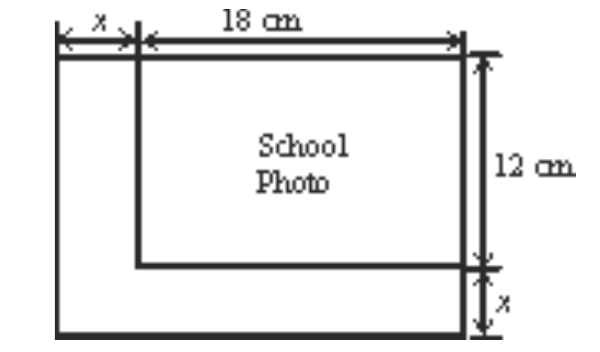
Show SolutionHide Solution
$x - \frac{1}{x} = 3 \implies x^2 - 1 = 3x \implies x^2 - 3x - 1 = 0$ (1 Mark)
$D = (-3)^2 - 4(1)(-1) = 9 + 4 = 13$ (1 Mark)
Roots are $\frac{3 + \sqrt{13}}{2}$, $\frac{3 - \sqrt{13}}{2}$ (1 Mark)
Now, $x + \frac{1}{x} = a \implies x^2 - ax + 1 = 0$ (1/2 Mark)
Since roots are real and equal, $D = 0$
$(-a)^2 - 4(1)(1) = 0 \implies a^2 - 4 = 0$ (1/2 Mark)
$a^2 = 4 \implies a = 2$ or $a = -2$ (1/2+1/2 Mark)