Polynomials — Class 10 Maths PYQs

Previous-year board questions (2023–2026) with marking-scheme solutions, grouped by topic and marks.

Try each question first, then press (or tap Show Solution) to reveal the answer. Press again for the next question.

Year:Marks:Level:

Polynomial, Degree, Value, Find k

1 Mark Questions
11 Mark · March 2023 · Standardopen ↗
If one zero of the polynomial $x^2 + 3x + k$ is $2$, then the value of $k$.
  • (a)$-10$
  • (b)$10$
  • (c)$5$
  • (d)$-5$
Show SolutionHide Solution
(A) $-10$
21 Mark · March 2024 · Standardopen ↗
What should be subtracted from the polynomial $x^2 - 16x + 30$, so that $15$ is the zero of the resulting polynomial ?
  • (a)$30$
  • (b)$14$
  • (c)$15$
  • (d)$16$
Show SolutionHide Solution
(C) $15$
31 Mark · March 2024 · Standardopen ↗
What should be added from the polynomial $x^2 - 5x + 4$, so that $3$ is the zero of the resulting polynomial ?
  • (a)$1$
  • (b)$2$
  • (c)$4$
  • (d)$5$
Show SolutionHide Solution
(B) $2$
41 Mark · March 2024 · Standardopen ↗
If a polynomial $p(x)$ is given by $p(x) = x^2 - 5x + 6$, then the value of $p(1) + p(4)$ is :
  • (a)$0$
  • (b)$4$
  • (c)$2$
  • (d)$-4$
Show SolutionHide Solution
(B) $4$
51 Mark · March 2024 · Standardopen ↗
Assertion (A): Degree of a zero polynomial is not defined.
Reason (R): Degree of a non-zero constant polynomial is $0$.
  • (a)Both Assertion (A) and Reason (R) are true and Reason (R) is the correct explanation of Assertion (A).
  • (b)Both Assertion (A) and Reason (R) are true, but Reason (R) is not the correct explanation of Assertion (A).
  • (c)Assertion (A) is true, but Reason (R) is false.
  • (d)Assertion (A) is false, but Reason (R) is true.
Show SolutionHide Solution
(B) Both Assertion (A) and Reason (R) are true, but Reason (R) is not the correct explanation of Assertion (A).
61 Mark · March 2025 · Standardopen ↗
If $-4$ is a zero of the polynomial $p(x) = x^2 - x - (2 + 2k)$, then the value of $k$ is:
  • (a)$3$
  • (b)$9$
  • (c)$6$
  • (d)$-9$
Show SolutionHide Solution
(B) $9$
71 Mark · March 2025 · Standardopen ↗
Which of the following statements is true for a polynomial $p(x)$ of degree $3$?
  • (a)$p(x)$ has at most two distinct zeroes.
  • (b)$p(x)$ has at least two distinct zeroes.
  • (c)$p(x)$ has exactly three distinct zeroes.
  • (d)$p(x)$ has at most three distinct zeroes.
Show SolutionHide Solution
(d) $p(x)$ has at most three distinct zeroes.
81 Mark · March 2026 · Standardopen ↗
Assertion (A): The polynomial $p(y) = y^2 + 4y+3$ has two zeroes.
Reason (R): A quadratic polynomial can have at most two zeroes.
(a) Both Assertion (A) and Reason (R) are true, and (R) is the correct explanation of (A).
(b) Both Assertion (A) and Reason (R) are true, but (R) is not the correct explanation of (A).
(c) (A) is true, but (R) is false.
(d) (A) is false, but (R) is true.
Show SolutionHide Solution
(b) Both, Assertion (A) and Reason (R) are true, but Reason (R) is not the correct explanation of the Assertion (A).
91 Mark · March 2026 · Standardopen ↗
Assertion (A) : The polynomial $p(y) = y^2 + 4y + 3$ has two zeroes.
Reason (R) : A quadratic polynomial can have at most two zeroes.
  • (a)Both, Assertion (A) and Reason (R) are true and Reason (R) is the correct explanation of the Assertion (A).
  • (b)Both, Assertion (A) and Reason (R) are true, but Reason (R) is not the correct explanation of the Assertion (A).
  • (c)Assertion (A) is true, but Reason (R) is false.
  • (d)Assertion (A) is false, but Reason (R) is true.
Show SolutionHide Solution
(b) Both, Assertion (A) and Reason (R) are true, but Reason (R) is not the correct explanation of the Assertion (A).
101 Mark · March 2025 · Basicopen ↗
One of the zeroes of the polynomial $p(x) = kx^2 - 9x + 3$ is $(-\frac{3}{2})$. The value of $k$ is :
  • (a)$\frac{22}{3}$
  • (b)$-\frac{14}{3}$
  • (c)$\frac{14}{3}$
  • (d)$-\frac{22}{3}$
Show SolutionHide Solution
(d) $-\frac{22}{3}$
2 Marks Questions
112 Marks · March 2025 · Standardopen ↗
If the sum of the zeroes of the polynomial $p(x) = (p + 1) x^2 + (2p + 3) x + (3p + 4)$ is $-1$, then find the value of 'p'.
Show SolutionHide Solution
Sum of zeroes $$\begin{aligned}& = -\frac{2p + 3}{p+1} = -1 \\ & p = -2\end{aligned}$$
122 Marks · March 2026 · Basicopen ↗
If one zero of the polynomial $p(x) = (k − 1)x^2 − (4k + 1)x + 10$ is $5$, find the value of $k$.
Show SolutionHide Solution
Since, $5$ is the zero of the given polynomial
$\therefore (k – 1) (5)^2 – (4k + 1) (5) + 10 = 0$ (1 Mark)
$\Rightarrow k = 4$ (1 Mark)
4 Marks Questions
134 Marks · March 2026 · Standardopen ↗
While playing badminton Ravi has set the barrier chain hung between two posts at the edge of the walkway of a street. It is hung in the shape of a parabola.
Based on the above information answer the following questions :
(a) Which type of the polynomial (linear, quadratic, cubic etc.) is graphically represented by a parabola ?
(b) If the polynomial represented by a parabola, intersects the $x$-axis at $-2$ and $3$ and $y$-axis at $-3$, then write the zeroes of the parabola.
(c) Find the expression for the above polynomial.
OR
(c) If the zeroes of the polynomial are $-5$ and $3$, find its expression.
Show SolutionHide Solution
(a) Quadratic (1 Mark)
(b) $-2$ and $3$ (1 Mark)
(c) $p(x) = k(x + 2)(x - 3)$ (1 Mark)
$p(x) = k(x^2 - x - 6)$
Using point $(0, -3)$, $-3 = k(0 - 0 - 6) \Rightarrow k = \frac{1}{2}$
$p(x) = \frac{1}{2}(x^2 - x - 6)$ (1 Mark)
OR
(c) $g(x) = (x + 5)(x - 3)$ (1 Mark)
$g(x) = x^2 + 2x - 15$ (1 Mark)

Graphical Presentation of Zero

1 Mark Questions
141 Mark · March 2023 · Standardopen ↗
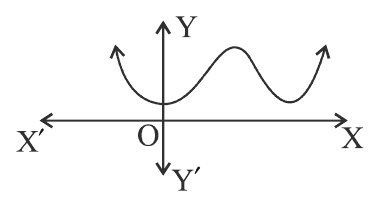
The graph of $y = p(x)$ is given, for a polynomial $p(x)$. The number of zeroes of $p(x)$ from the graph is
figure for this question
  • (a)3
  • (b)1
  • (c)2
  • (d)0
Show SolutionHide Solution
(B) 1
151 Mark · March 2023 · Standardopen ↗
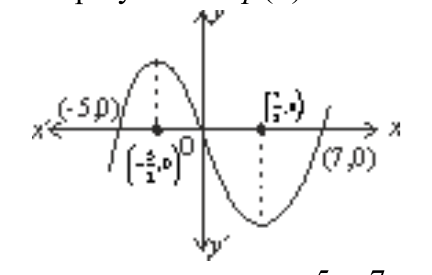
The graph of $y = p(x)$ is given in the adjoining figure. Zeroes of the polynomial $p(x)$ are
figure for this question
  • (a)$-5, 7$
  • (b)$-\frac{5}{2}, -\frac{7}{2}$
  • (c)$-5, 0, 7$
  • (d)$-5, \frac{7}{2}, 7$
Show SolutionHide Solution
(C) $-5, 0, 7$
161 Mark · March 2024 · Standardopen ↗
Assertion (A): If the graph of a polynomial intersects the x-axis at exactly two points, then the number of zeroes of that polynomial is $2$.
Reason (R): The number of zeroes of a polynomial is equal to the number of points where the graph of the polynomial intersects x-axis.
  • (a)Both Assertion (A) and Reason (R) are true. Reason (R) is the correct explanation of Assertion (A).
  • (b)Both Assertion (A) and Reason (R) are true. Reason (R) does not give correct explanation of (A).
  • (c)Assertion (A) is true but Reason (R) is not true.
  • (d)Assertion (A) is not true but Reason (R) is true.
Show SolutionHide Solution
(A) Both Assertion (A) and Reason (R) are true. Reason (R) is the correct explanation of Assertion (A)
171 Mark · March 2024 · Standardopen ↗
Assertion (A): If the graph of a polynomial touches $x$-axis at only one point, then the polynomial cannot be a quadratic polynomial.
Reason (R) : A polynomial of degree $n(n >1)$ can have at most $n$ zeroes.
Show SolutionHide Solution
(d) Assertion (A) is false but Reason (R) is true.
181 Mark · March 2024 · Standardopen ↗
The graph of a polynomial intersects the y-axis at one point and the x-axis at two points. The number of zeroes of this polynomial are :
  • (a)$1$
  • (b)$2$
  • (c)$3$
  • (d)$0$
Show SolutionHide Solution
(B) $2$
191 Mark · July 2025 · Standardopen ↗
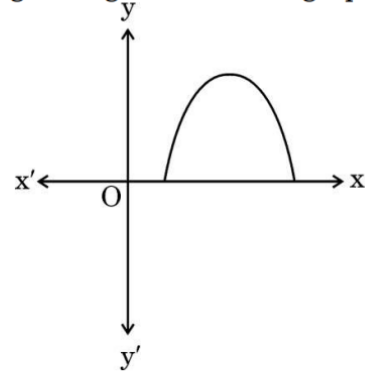
If the given figure shows the graph of polynomial $y = ax^2 + bx + c$, then :
figure for this question
  • (a)$a < 0$
  • (b)$b^2 < 4ac$
  • (c)$c > 0$
  • (d)a and b are of same sign
Show SolutionHide Solution
(A) $a < 0$
201 Mark · March 2025 · Standardopen ↗
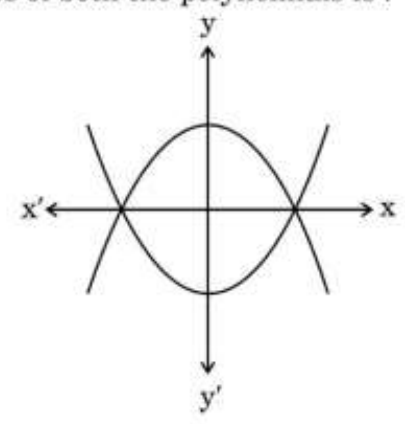
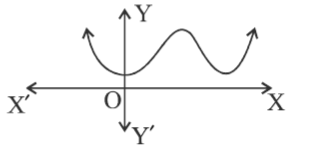
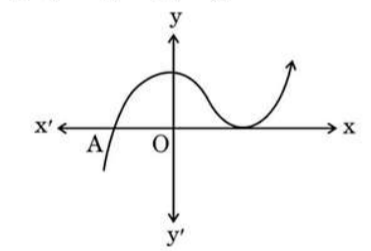
Two polynomials are shown in the graph below. The number of distinct zeroes of both the polynomials is:
figure for this question
  • (a)$3$
  • (b)$5$
  • (c)$2$
  • (d)$4$
Show SolutionHide Solution
(C) $2$
211 Mark · March 2026 · Standardopen ↗
The graph of $y = f(x)$ is given.
The number of zeroes of $f(x)$ is:
figure for this question
  • (a)$0$
  • (b)$1$
  • (c)$2$
  • (d)$4$
Show SolutionHide Solution
(a) $0$
221 Mark · March 2026 · Standardopen ↗
The graph of $y = f(x)$ is given.
The number of zeroes of $f(x)$ is :
figure for this question
  • (a)$0$
  • (b)$1$
  • (c)$2$
  • (d)$4$
Show SolutionHide Solution
(a) $0$ (1 Mark)
231 Mark · March 2026 · Standardopen ↗
The graph of $y = f(x)$ is given. The number of distinct zeroes of $y = f(x)$ is :
figure for this question
  • (a)$0$
  • (b)$1$
  • (c)$2$
  • (d)$3$
Show SolutionHide Solution
(C) $2$ (1 Mark)
241 Mark · March 2026 · Standardopen ↗
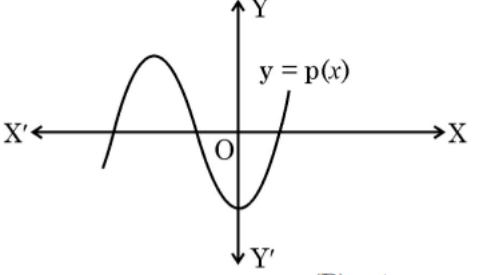
Observe the graph of polynomial $p(x)$. Number of zeroes of $p(x)$ is
figure for this question
  • (a)$5$
  • (b)$4$
  • (c)$6$
  • (d)$3$
Show SolutionHide Solution
(D) $3$
251 Mark · March 2026 · Standardopen ↗
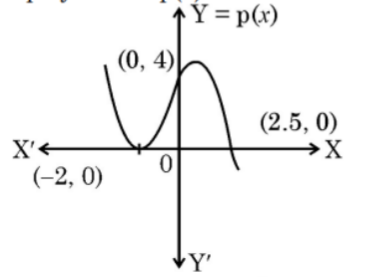
Observe the graph of polynomial $p(x)$. The zeroes of the polynomial are
figure for this question
  • (a)$-2, 0, 2.5$
  • (b)$-2, 2.5$
  • (c)$0,4$
  • (d)$-2,0$
Show SolutionHide Solution
(B) $-2, 2.5$
261 Mark · March 2025 · Basicopen ↗
The graph of the polynomial $ax^2 + bx + c$ is a downward parabola if
  • (a)$a > 0$
  • (b)$a < 0$
  • (c)$a = 0$
  • (d)$a > 1$
Show SolutionHide Solution
(B) $a < 0$

Find Zeroes

1 Mark Questions
271 Mark · 🔁 March 2023 & July 2023 · Standardopen ↗
The zeroes of the polynomial $3x^2 + 11x-4$ are:
  • (a)$\frac{1}{2}$, $-4$
  • (b)$\frac{1}{4}$, $-3$
  • (c)$\frac{1}{3}$, $-4$
  • (d)$\frac{1}{3}$, $4$
Show SolutionHide Solution
(c) $\frac{1}{3}$, $-4$
281 Mark · March 2023 · Standardopen ↗
The zeroes of the polynomial $p(x) = x^2 + 4x + 3$ are given by:
  • (a)$1,3$
  • (b)$-1,3$
  • (c)$1,-3$
  • (d)$-1,-3$
Show SolutionHide Solution
(d) $-1, -3$
291 Mark · March 2024 · Standardopen ↗
The zeroes of the quadratic polynomial $2x^2 - 3x - 9$ are:
  • (a)$3, -\frac{3}{2}$
  • (b)$-3, -\frac{3}{2}$
  • (c)$-3,\frac{2}{2}$
  • (d)$3,\frac{2}{2}$
Show SolutionHide Solution
(A) $3, -\frac{3}{2}$
301 Mark · July 2025 · Standardopen ↗
The zeroes of the quadratic polynomial $x^2+ 99x + 127$ are :
  • (a)both positive
  • (b)both negative
  • (c)one positive and one negative
  • (d)both equal
Show SolutionHide Solution
(B) both negative
311 Mark · March 2025 · Standardopen ↗
Zeroes of the polynomial $p(x) = x^2 -3\sqrt{2}x+4$ are:
  • (a)$2,\sqrt{2}$
  • (b)$2\sqrt{2},\sqrt{2}$
  • (c)$4\sqrt{2},-\sqrt{2}$
  • (d)$\sqrt{2},2$
Show SolutionHide Solution
(B) $2\sqrt{2}, \sqrt{2}$
321 Mark · March 2025 · Standardopen ↗
Zeroes of the polynomial $p(y) = 7y^2 - \frac{11}{3}y - \frac{2}{3}$ are:
  • (a)$\frac{2}{3}, -\frac{1}{7}$
  • (b)$-\frac{2}{7}, -\frac{1}{3}$
  • (c)$\frac{2}{1}, \frac{1}{7}$
  • (d)$\frac{2}{3}, -\frac{1}{7}$
Show SolutionHide Solution
(D) $\frac{2}{3}, -\frac{1}{7}$
331 Mark · March 2025 · Standardopen ↗
The value of $x$, for which the polynomials $9 - x^2$ and $6x + x^2 + 9$ vanish simultaneously, is
  • (a)$3$
  • (b)$2$
  • (c)$-2$
  • (d)$-3$
Show SolutionHide Solution
(D) $-3$
341 Mark · March 2026 · Standardopen ↗
How many zeroes does $p(x) = (x-2)(x+3)$ have?
  • (a)Zero
  • (b)One
  • (c)Two
  • (d)Three
Show SolutionHide Solution
(C) Two
351 Mark · March 2026 · Standardopen ↗
At which of the following points, the quadratic polynomial $p(x) = 3x + 18x^2 - 1$ intersects the positive $x$-axis ?
  • (a)$(\frac{1}{6}, 0)$
  • (b)$(-\frac{1}{3}, 0)$
  • (c)$(-\frac{1}{6}, 0)$
  • (d)$(\frac{1}{3}, 0)$
Show SolutionHide Solution
(D) $(\frac{1}{3}, 0)$
361 Mark · March 2026 · Standardopen ↗
The graph of a quadratic polynomial $f(x)$ passes through $(5,0)$, $(0, -1)$ and $(-2, 0)$. The two factors of the polynomial are
  • (a)$(x + 2), (x - 5)$
  • (b)$(x + 5), (x - 2)$
  • (c)$(x + 1), (x - 5)$
  • (d)$(x - 1), (x + 2)$
Show SolutionHide Solution
(A) $(x + 2), (x - 5)$
2 Marks Questions
372 Marks · March 2025 · Standardopen ↗
Find the zeroes of the polynomial $p(x) = x^2 + \frac{4}{3}x - \frac{4}{3}$.
Show SolutionHide Solution
$\frac{1}{3}(3x^2 + 4x - 4) = \frac{1}{3}(3x^2 + 6x - 2x - 4) = \frac{1}{3}(3x - 2)(x + 2)$.
Zeroes are $\frac{2}{3}, -2$.
382 Marks · March 2025 · Standardopen ↗
If $p$ and $q$ are zeroes of the polynomial $p(y) = 21y^2 - y - 2$, then find the value of $(1-p) . (1 - q)$.
Show SolutionHide Solution
$p+q=\frac{1}{21}$
$p.q=\frac{-2}{21}$
$(1-p)(1 - q) = 1 - (p + q) + pq$
$= 1-\frac{1}{21} - \frac{2}{21}$
$= \frac{18}{21}$ or $\frac{6}{7}$
392 Marks · March 2026 · Basicopen ↗
Find the zeroes of the polynomial $p(x) = 15x^2 – 19x + 6$.
Show SolutionHide Solution
For zeroes $15x^2 – 19x + 6= 0$ (1 Mark)
Zeroes are $\frac{3}{5}$ and $\frac{2}{3}$ (1 Mark)

Relationship of Zeros and Coefficients

1 Mark Questions
401 Mark · July 2023 · Standardopen ↗
If $\alpha$ and $\beta$ are the zeroes of the polynomial $p(x) = 2x^2- 7x + 3$, then the value of $\alpha^2 + \beta^2$ is :
  • (a)$10$
  • (b)$\frac{37}{4}$
  • (c)$\frac{23}{2}$
  • (d)$37$
Show SolutionHide Solution
(b) $\frac{37}{4}$
411 Mark · July 2023 · Standardopen ↗
If the sum of the zeroes of the quadratic polynomial $p(x) = kx^2+ 2x + 3k$ is equal to the product of its zeroes, then the value of $k$ is :
  • (a)$-\frac{2}{3}$
  • (b)$\frac{2}{3}$
  • (c)$\frac{3}{2}$
  • (d)$-\frac{3}{2}$
Show SolutionHide Solution
(a) $-\frac{2}{3}$
421 Mark · March 2023 · Standardopen ↗
If $\alpha, \beta$ are the zeroes of a polynomial $p(x) = x^2+x-1$, then $\frac{1}{\alpha} + \frac{1}{\beta}$ equals to
  • (a)1
  • (b)2
  • (c)-1
  • (d)$-\frac{1}{2}$
Show SolutionHide Solution
(A) 1
431 Mark · March 2023 · Standardopen ↗
If $\alpha, \beta$ are zeros of a polynomial $P(x) = 2x^2 -x-1$ then $\alpha^2 + \beta^2$ is equal to
  • (a)$-\frac{3}{4}$
  • (b)$\frac{5}{4}$
  • (c)$\frac{1}{4}$
  • (d)$\frac{3}{4}$
Show SolutionHide Solution
(B) $\frac{5}{4}$
441 Mark · March 2023 · Standardopen ↗
If $\alpha$ and $\beta$ are the zeroes of the quadratic polynomial $p(x) = x^2 - ax - b$, then the value of $\alpha^2 + \beta^2$ is :
  • (a)$a^2-2b$
  • (b)$a^2 + 2b$
  • (c)$b^2-2a$
  • (d)$b^2 + 2a$
Show SolutionHide Solution
(b) $a^2 + 2b$
451 Mark · March 2023 · Standardopen ↗
If one zero of the polynomial $x^2-3kx + 4k$ be twice the other, then the value of $k$ is:
  • (a)$-\frac{1}{2}$
  • (b)$2$
  • (c)$\frac{1}{2}$
  • (d)$-2$
Show SolutionHide Solution
(b) $2$
461 Mark · March 2023 · Standardopen ↗
If '$\alpha$' and '$\beta$' are the zeroes of the polynomial $ax^2 - 5x + c$ and $\alpha + \beta = \alpha\beta = 10$, then :
  • (a)$a = 5, c = -\frac{1}{2}$
  • (b)$a = 1, c = \frac{5}{2}$
  • (c)$a = \frac{5}{2}, c = 1$
  • (d)$a = \frac{1}{2}, c = 5$
Show SolutionHide Solution
(d) $a = \frac{1}{2}, c = 5$
471 Mark · March 2023 · Standardopen ↗
The sum of zeroes of the polynomial $\sqrt{2}x^2 - 17$ are given as :
  • (a)$\frac{17\sqrt{2}}{2}$
  • (b)$-\frac{17\sqrt{2}}{2}$
  • (c)$0$
  • (d)$1$
Show SolutionHide Solution
(c) $0$
481 Mark · March 2023 · Standardopen ↗
If $\alpha$, $\beta$ are zeroes of the polynomial $x^2-1$, then value of $(\alpha + \beta)$ is :
  • (a)$2$
  • (b)$1$
  • (c)$-1$
  • (d)$0$
Show SolutionHide Solution
(d) $0$
491 Mark · March 2023 · Standardopen ↗
If $\alpha$, $\beta$ are the zeroes of the polynomial $p(x) = 4x^2 – 3x – 7$, then $(\frac{1}{\alpha} + \frac{1}{\beta})$ is equal to :
  • (a)$\frac{7}{3}$
  • (b)$-\frac{7}{3}$
  • (c)$\frac{3}{7}$
  • (d)$-\frac{3}{7}$
Show SolutionHide Solution
(d) $-\frac{3}{7}$
501 Mark · July 2024 · Standardopen ↗
If $\alpha$ and $\beta$ are the zeroes of the polynomial $2x^2 + 5x + 1$, then the value of $\alpha + \beta + 3\alpha\beta$ is :
  • (a)$-4$
  • (b)$-\frac{3}{2}$
  • (c)$1$
  • (d)$-1$
Show SolutionHide Solution
(D) $-1$
511 Mark · March 2024 · Standardopen ↗
If the sum of zeroes of the polynomial $p(x) = 2x^2 - k\sqrt{2}x+1$ is $\sqrt{2}$, then value of $k$ is :
  • (a)$\sqrt{2}$
  • (b)$2$
  • (c)$2\sqrt{2}$
  • (d)$\frac{1}{2}$
Show SolutionHide Solution
(b) $2$
521 Mark · March 2024 · Standardopen ↗
The zeroes of a polynomial $x^2 + px + q$ are twice the zeroes of the polynomial $4x^2 - 5x - 6$. The value of $p$ is :
  • (a)$-\frac{5}{2}$
  • (b)$\frac{5}{2}$
  • (c)$-5$
  • (d)$10$
Show SolutionHide Solution
(a) $-\frac{5}{2}$
531 Mark · March 2024 · Standardopen ↗
If $\alpha, \beta$ are the zeroes of the polynomial $6x^2 - 5x - 4$, then $\frac{1}{\alpha} + \frac{1}{\beta}$ is equal to :
  • (a)$\frac{5}{4}$
  • (b)$-\frac{5}{4}$
  • (c)$\frac{4}{5}$
  • (d)$\frac{5}{24}$
Show SolutionHide Solution
(b) $-\frac{5}{4}$
541 Mark · March 2024 · Standardopen ↗
If $\alpha$ and $\beta$ are zeroes of the polynomial $5x^2 + 3x - 7$, the value of $\frac{1}{\alpha} + \frac{1}{\beta}$ is
  • (a)$\frac{3}{7}$
  • (b)$\frac{3}{5}$
  • (c)$\frac{3}{-7}$
  • (d)$\frac{5}{-7}$
Show SolutionHide Solution
(C) $\frac{3}{7}$
551 Mark · March 2024 · Standardopen ↗
If $\alpha$ and $\beta$ are zeroes of the polynomial $2x^2 - 9x + 5$, then value of $\alpha^2 + \beta^2$ is
  • (a)$\frac{1}{4}$
  • (b)$\frac{61}{4}$
  • (c)$1$
  • (d)$\frac{71}{4}$
Show SolutionHide Solution
(B) $\frac{61}{4}$
561 Mark · March 2024 · Standardopen ↗
If $\alpha$ and $\beta$ ($\alpha > \beta$) are the zeroes of the polynomial $-x^2 + 8x + 9$, then $(\alpha - \beta)$ is equal to
  • (a)-10
  • (b)10
  • (c)$\pm 10$
  • (d)8
Show SolutionHide Solution
(B) 10
571 Mark · March 2024 · Standardopen ↗
The ratio of the sum and product of the roots of the quadratic equation $5x^2-6x+21 = 0$ is :
  • (a)$5:21$
  • (b)$2:7$
  • (c)$21:5$
  • (d)$7:2$
Show SolutionHide Solution
(B) $2:7$
581 Mark · 🔁 March 2024 & March 2025 · Standardopen ↗
If $\alpha$ and $\beta$ are zeroes of the polynomial $p(x) = kx^2 - 30x + 45k$ and $\alpha + \beta = \alpha\beta$, then the value of 'k' is :
  • (a)$-\frac{2}{3}$
  • (b)$-\frac{3}{2}$
  • (c)$\frac{3}{2}$
  • (d)$\frac{2}{3}$
Show SolutionHide Solution
(D)$\frac{2}{3}$
591 Mark · July 2025 · Standardopen ↗
If one zero of the quadratic polynomial $4x^2+ 4x - m$ is $\frac{3}{2}$, then the other zero is :
  • (a)$\frac{2}{5}$
  • (b)$\frac{5}{2}$
  • (c)$-\frac{5}{2}$
  • (d)$-\frac{1}{2}$
Show SolutionHide Solution
(C)-$\frac{5}{2}$
601 Mark · March 2025 · Standardopen ↗
If $\alpha$ and $\beta$ are the zeroes of polynomial $3x^2 + 6x + k$ such that $\alpha + \beta + \alpha\beta = -\frac{2}{3}$, then the value of $k$ is:
  • (a)$-8$
  • (b)$8$
  • (c)$-4$
  • (d)$4$
Show SolutionHide Solution
(D) $4$
611 Mark · March 2025 · Standardopen ↗
The sum of the zeroes of the polynomial $p(x) = 5x-7x^2 + 3$ is:
  • (a)$-\frac{7}{5}$
  • (b)$\frac{7}{5}$
  • (c)$\frac{5}{7}$
  • (d)$-\frac{5}{7}$
Show SolutionHide Solution
(C) $\frac{5}{7}$
621 Mark · March 2025 · Standardopen ↗
If one zero of the polynomial $q(x) = (p^2 + 4)x^2 + 65x + 4p$ is reciprocal of the other, then the value of 'p' is :
  • (a)$-1$
  • (b)$1$
  • (c)$-2$
  • (d)$2$
Show SolutionHide Solution
(D) $2$
631 Mark · March 2025 · Standardopen ↗
If $\alpha$ and $\beta$ are the zeroes of the polynomial $p(x) = x^2-ax-b$, then the value of $(\alpha + \beta + \alpha\beta)$ is equal to :
  • (a)$a + b$
  • (b)$-a-b$
  • (c)$a-b$
  • (d)$-a+b$
Show SolutionHide Solution
(C) $a - b$
641 Mark · March 2025 · Standardopen ↗
If the zeroes of the polynomial $ax^2+bx+\frac{2a}{b}$ are reciprocal of each other, then the value of $b$ is
  • (a)2
  • (b)$\frac{1}{2}$
  • (c)-2
  • (d)$-\frac{1}{2}$
Show SolutionHide Solution
(A) 2
651 Mark · March 2025 · Standardopen ↗
If the square of the difference of the zeroes of the quadratic polynomial $y^2 + py + 36$ is equal to $81$, then the values of $p$ are
  • (a)$\pm 5$
  • (b)$\pm 15$
  • (c)$\pm 18$
  • (d)$\pm 12$
Show SolutionHide Solution
(B) $\pm 15$
661 Mark · March 2026 · Standardopen ↗
If $\alpha$ and $\beta$ are two zeroes of a polynomial $f(x) = px^2 - 2x + 3p$ and $\alpha + \beta = \alpha\beta$, then value of $p$ is:
  • (a)$\frac{2}{3}$
  • (b)$\frac{2}{3}$
  • (c)$\frac{1}{3}$
  • (d)$-\frac{1}{3}$
Show SolutionHide Solution
(B) $\frac{2}{3}$
671 Mark · March 2026 · Standardopen ↗
A polynomial $p(x)$, which has sum of its zeroes equal to their product, is :
  • (a)$3x^2 + 2x + 2$
  • (b)$3x^2-2x-3$
  • (c)$3x^2-2x + 2$
  • (d)$x^2 - 3x + 2$
Show SolutionHide Solution
(C) $3x^2 - 2x + 2$ (1 Mark)
681 Mark · March 2025 · Basicopen ↗
$\alpha, \beta$ are zeroes of the polynomial $2x^2 + 5x + 1$. The value of $(\frac{1}{\alpha} + \frac{1}{\beta})$ is :
  • (a)$-\frac{5}{4}$
  • (b)$5$
  • (c)$\frac{5}{4}$
  • (d)$-5$
Show SolutionHide Solution
(d) $-5$
691 Mark · March 2025 · Basicopen ↗
If $\alpha, \beta$ are zeroes of the polynomial $3x^2 + 14x - 5$, then the value of $3\left(\frac{\alpha + \beta}{\alpha\beta}\right)$ is :
  • (a)$\frac{14}{5}$
  • (b)$\frac{42}{5}$
  • (c)$-\frac{14}{5}$
  • (d)$-\frac{42}{5}$
Show SolutionHide Solution
(b) $\frac{42}{5}$
701 Mark · March 2025 · Basicopen ↗
If $\alpha$ and $\beta$ are zeroes of the polynomial $x^2 - x - 4$, then the value of $(\frac{1}{\alpha} + \frac{1}{\beta})$ is
  • (a)$-4$
  • (b)$-\frac{1}{4}$
  • (c)$\frac{1}{4}$
  • (d)$4$
Show SolutionHide Solution
(B) $-\frac{1}{4}$
711 Mark · March 2026 · Basicopen ↗
The value of $k$ for which sum of the zeroes of the polynomial $p(x) = 3x^2 - kx + 6$ is $2$, is
  • (a)$2$
  • (b)$-6$
  • (c)$-2$
  • (d)$6$
Show SolutionHide Solution
$6$
721 Mark · March 2026 · Basicopen ↗
If the zeroes of the polynomial $p(x) = 2x^2- 7x + 6$ are $\alpha$ and $\beta$, then the value of $\frac{1}{\alpha} + \frac{1}{\beta}$ is
  • (a)$\frac{7}{2}$
  • (b)$\frac{6}{7}$
  • (c)$-\frac{7}{6}$
  • (d)$\frac{7}{6}$
Show SolutionHide Solution
$\frac{7}{6}$
731 Mark · March 2026 · Basicopen ↗
If $\alpha$ and $\beta$ are two zeroes of the quadratic polynomial $p(x) = x^2 - 11x + 30$, then $\frac{1}{\alpha} + \frac{1}{\beta}$ is equal to:
  • (a)$\frac{30}{11}$
  • (b)$\frac{11}{30}$
  • (c)$\frac{11}{30}$
  • (d)$\frac{30}{11}$
Show SolutionHide Solution
(B) $\frac{11}{30}$
2 Marks Questions
742 Marks · July 2023 · Standardopen ↗
If $p$ and $q$ are the zeroes of the quadratic polynomial $f(x) = 6x^2 + x - 2$, then find the value of $\frac{1}{p} + \frac{1}{q} - pq$.
Show SolutionHide Solution
$p + q = -\frac{1}{6}$, $pq = -\frac{2}{6} = -\frac{1}{3}$
$\frac{1}{p} + \frac{1}{q} = \frac{p+q}{pq} = \frac{-\frac{1}{6}}{-\frac{1}{3}} = \frac{1}{2}$
$\frac{1}{p} + \frac{1}{q} - pq = \frac{1}{2} - (-\frac{1}{3}) = \frac{1}{2} + \frac{1}{3} = \frac{5}{6}$
752 Marks · March 2023 · Standardopen ↗
If one zero of the polynomial $p(x) = 6x^2 + 37x – (k – 2)$ is reciprocal of the other, then find the value of $k$.
Show SolutionHide Solution
$p(x) = 6x^2 + 37x - (k – 2)$
Let the zeroes be $\alpha, \frac{1}{\alpha}$
Product of zeroes = $\alpha . \frac{1}{\alpha} = \frac{-(k-2)}{6}$
$1 = \frac{-(k-2)}{6}$
$6 = -k + 2 \Rightarrow k = -4$
762 Marks · March 2024 · Standardopen ↗
If $\alpha, \beta$ are zeroes of the polynomial $p(x) = 5x^2 - 6x + 1$, then find the value of $\alpha + \beta + \alpha\beta$.
Show SolutionHide Solution
$\alpha + \beta = \frac{6}{5}$
$\alpha\beta = \frac{1}{5}$
$\alpha + \beta + \alpha\beta = \frac{6}{5} + \frac{1}{5} = \frac{7}{5}$
772 Marks · March 2024 · Standardopen ↗
If $\alpha$ and $\beta$ are zeroes of the quadratic polynomial $p(x) = x^2 - 5x + 4$, then find the value of $\frac{1}{\alpha} + \frac{1}{\beta} - 2\alpha\beta$.
Show SolutionHide Solution
$\alpha + \beta = 5$ (1/2 Mark)
$\alpha\beta = 4$ (1/2 Mark)
$\frac{1}{\alpha} + \frac{1}{\beta} - 2\alpha\beta = \frac{\alpha+\beta}{\alpha\beta} - 2\alpha\beta$ (1/2 Mark)
$= \frac{5}{4} - 2 \times 4 = \frac{5}{4} - 8 = \frac{5 - 32}{4} = -\frac{27}{4}$ (1/2 Mark)
782 Marks · March 2025 · Standardopen ↗
If the zeroes of the polynomial $x^2 + ax + b$ are in the ratio $3: 4$, then prove that $12a^2 = 49b$.
Show SolutionHide Solution
Let the zeroes are $3\alpha$ and $4\alpha$
$3\alpha + 4\alpha = -a$
$\Rightarrow 7\alpha = -a$ (1/2)
Also, $12\alpha^2 = b$ (1/2)
LHS = $12a^2 = 12 (-7\alpha)^2 = 49 \times 12(\alpha)^2 = 49b$ = RHS (1)
792 Marks · March 2025 · Standardopen ↗
If '$\alpha$' and '$\beta$' are the zeroes of the polynomial $p(y) = y^2 - 5y + 3$, then find the value of $\alpha^4\beta^3 + \alpha^3\beta^4$.
Show SolutionHide Solution
$\alpha + \beta = 5$
$\alpha\beta = 3$
$\alpha^4\beta^3 + \alpha^3\beta^4 = (\alpha\beta)^3(\alpha + \beta)$
$= 27 \times 5 = 135$
802 Marks · March 2025 · Standardopen ↗
If $\alpha$ and $\beta$ are zeroes of the polynomial $p(x) = x^2 - 2x - 1$, then find the value of $\frac{1}{2\alpha} + \frac{1}{2\beta} + 3\alpha\beta$.
Show SolutionHide Solution
$$\begin{aligned}& \alpha + \beta = 2 \\ & \alpha\beta = -1 \\ & \frac{1}{2\alpha} + \frac{1}{2\beta} + 3\alpha\beta = \frac{\alpha + \beta}{2\alpha\beta} + 3\alpha\beta \\ & = \frac{2}{2(-1)} + 3(-1) = -4\end{aligned}$$
812 Marks · March 2026 · Standardopen ↗
If $\alpha$, $\beta$ are the zeroes of the polynomial $p(x) = x^2-3x-1$, then find the value of $\frac{1}{\alpha} + \frac{1}{\beta}$.
Show SolutionHide Solution
Here, $\alpha + \beta = 3$, $\alpha\beta = -1$ (1 Mark)
$\frac{1}{\alpha} + \frac{1}{\beta} = \frac{\alpha+\beta}{\alpha\beta} = \frac{3}{-1}$ (1/2 Mark)
$= -3$ (1/2 Mark)
822 Marks · March 2026 · Standardopen ↗
Find the zeroes of the quadratic polynomial $x^2+7x+10$, and verify the relationship between the zeroes and its coefficients.
Show SolutionHide Solution
$x^2 + 7x + 10 = (x + 2)(x + 5)$ (1 Mark)
So, the zeroes of the polynomial are $-2$ and $-5$ (1/2 Mark)
Sum of zeroes $= -7 = \frac{-7}{1} = \frac{\text{coefficient of } x}{\text{coeffiecient of } x^2}$ (1/2 Mark)
Product of zeroes $= 10 = \frac{10}{1} = \frac{\text{constant term}}{\text{coefficient of } x^2}$ (1/2 Mark)
832 Marks · March 2026 · Standardopen ↗
If $\alpha, \beta$ are the zeroes of the quadratic polynomial $px^2 + qx + r$, then find the value of $\alpha^3\beta + \beta^3\alpha$.
Show SolutionHide Solution
$px^2 + qx + r$
$\alpha+\beta=-\frac{q}{p}$, $\alpha\beta = \frac{r}{p}$ (1 Mark)
$\alpha^3\beta + \beta^3\alpha$
$\quad = \alpha\beta (\alpha^2 + \beta^2)$ (1/2 Mark)
$\quad = \alpha\beta [(\alpha + \beta)^2 - 2\alpha\beta] = \frac{r}{p} [(-\frac{q}{p})^2 - 2 (\frac{r}{p})]$ (1/2 Mark)
$\quad = \frac{r}{p^3} (q^2 - 2pr)$ (1/2 Mark)
842 Marks · March 2026 · Standardopen ↗
$\alpha$ and $\beta$ are the zeroes of the polynomial $5x^2 – 16x - 10$. Find the value of $\frac{\alpha}{\beta} + \frac{\beta}{\alpha}$.
Show SolutionHide Solution
$\alpha + \beta = \frac{16}{5}$, $\alpha \beta = -2$ (1 Mark)
$\therefore \frac{\alpha}{\beta} + \frac{\beta}{\alpha} = \frac{(\alpha+ \beta)^2 – 2\alpha\beta}{\alpha\beta}$ (1/2 Mark)
= $\frac{(\frac{16}{5})^2 + 4}{-2}$ (1/2 Mark)
= $\frac{\frac{256}{25} + 4}{-2} = \frac{356}{25 \times -2} = -\frac{356}{50}$ or $-\frac{178}{25}$ (1/2 Mark)
852 Marks · March 2026 · Standardopen ↗
$\alpha, \beta$ are zeroes of the polynomial $p(x) = 3x^2 - 6x - 5$. Find the value of $\frac{1}{\alpha^2} + \frac{1}{\beta^2}$.
Show SolutionHide Solution
$\alpha + \beta = 2, \alpha \beta = -\frac{5}{3}$ (I) (1 Mark)
$\therefore \frac{1}{\alpha^2} + \frac{1}{\beta^2} = \frac{\alpha^2 + \beta^2}{\alpha^2\beta^2} = \frac{(\alpha+\beta)^2-2\alpha\beta}{(\alpha\beta)^2} = \frac{4 + \frac{10}{3}}{\frac{25}{9}}$ (II) ($\frac{1}{2}$ Mark)
$= \frac{66}{25}$ (III) ($\frac{1}{2}$ Mark)
862 Marks · March 2026 · Basicopen ↗
If one zero of the polynomial $x^2-5x-c$ is $(-1)$, find the value of $c$. Also, find the other zero.
Show SolutionHide Solution
As $-1$ is the zero, so $1 + 5 - c = 0$ gives $c = 6$ (1 Mark)
Sum of zeroes = $5$ (1/2 Mark)
Thus, other zero is $6$ (1/2 Mark)
872 Marks · March 2026 · Basicopen ↗
Verify the relation between the zeroes and the coefficients of the quadratic polynomial $4x^2 – 9$.
Show SolutionHide Solution
Zeroes of $4x^2 – 9$ are $\frac{3}{2}, -\frac{3}{2}$ (1 Mark)
Sum of zeroes = $\frac{3}{2} + (-\frac{3}{2}) = 0 = -\frac{\text{Coefficient of x}}{\text{Coefficient of x}^2}$ (1/2 Mark)
Product of zeroes = $\frac{3}{2} \times (-\frac{3}{2}) = -\frac{9}{4} = \frac{\text{Constant term}}{\text{Coefficient of x}^2}$ (1/2 Mark)
882 Marks · March 2026 · Basicopen ↗
Verify the relationship between the zeroes and the coefficients of the quadratic polynomial $25x^2 - 16$.
Show SolutionHide Solution
Zeroes of $25x^2 - 16$ are $\frac{4}{5}, -\frac{4}{5}$ (1 Mark)
Sum of zeroes $= \frac{4}{5} + (-\frac{4}{5}) = 0 = \frac{-0}{25} = \frac{\text{-Coefficient of } x}{\text{Coefficient of } x^2}$ (1/2 Mark)
Product of zeroes $= \frac{4}{5} \times -\frac{4}{5} = -\frac{16}{25} = \frac{\text{Constant term}}{\text{Coefficient of } x^2}$ (1/2 Mark)
892 Marks · March 2026 · Basicopen ↗
Verify the relationship between the zeroes and the coefficients of the quadratic polynomial $9x^2 - 25$.
Show SolutionHide Solution
Getting zeroes: $\frac{-5}{3}$ and $\frac{5}{3}$ (1/2+1/2 Mark)
Sum of zeroes = $\frac{-5}{3} + \frac{5}{3} = 0 = \frac{-0}{9} = \frac{-\text{Coefficient of } x}{\text{Coefficient of } x^2}$ (1/2 Mark)
Product of zeroes = $\frac{-5}{3} \times \frac{5}{3} = \frac{-25}{9} = \frac{\text{Constant term}}{\text{Coefficient of } x^2}$ (1/2 Mark)
902 Marks · March 2026 · Basicopen ↗
Verify the relationship between the zeroes and the coefficients of the polynomial $p(x) = 3x^2 – 5x$.
Show SolutionHide Solution
Zeroes are $0, \frac{5}{3}$ (1/2+1/2 Mark)
Sum of zeroes $= 0 + \frac{5}{3} = \frac{5}{3} = -\frac{\text{coefficient of x}}{\text{coefficient of x}^2}$ (1/2 Mark)
Product of zeroes$= 0 \times (\frac{5}{3}) = \frac{0}{3} = \frac{\text{constant term}}{\text{coefficient of x}^2}$ (1/2 Mark)
912 Marks · March 2026 · Basicopen ↗
Verify the relationship between the zeroes and the coefficients of the polynomial $2x^2 – 3x$.
Show SolutionHide Solution
Zeroes are $0$ and $\frac{3}{2}$ (1/2 + 1/2 Mark)
Sum of zeroes $= 0 + \frac{3}{2} = \frac{3}{2} = -\frac{\text{coefficient of } x}{\text{coefficient of } x^2}$ (1/2 Mark)
Product of zeroes $= 0 \times \frac{3}{2} = \frac{0}{2} = \frac{\text{constant term}}{\text{coefficient of } x^2}$ (1/2 Mark)
922 Marks · March 2026 · Basicopen ↗
Verify the relationship between the zeroes and the coefficients of the polynomial $5x^2 + 2x$.
Show SolutionHide Solution
Zeroes are $0, -\frac{2}{5}$ (1/2+1/2 Mark)
Sum of zeroes $= 0 - (\frac{2}{5}) = -\frac{2}{5} = -\frac{\text{Coefficient of } x}{\text{Coefficient of } x^2}$ (1/2 Mark)
Product of zeroes $= 0 \times (-\frac{2}{5}) = \frac{0}{5} = \frac{\text{Constant term}}{\text{Coefficient of } x^2}$ (1/2 Mark)
932 Marks · March 2026 · Basicopen ↗
If $\alpha$, $\beta$ are the zeroes of polynomial $p(x) = 6x^2-5x - 3$, then find the value of $\frac{1}{\alpha} + \frac{1}{\beta}$.
Show SolutionHide Solution
(a) $\alpha+\beta=\frac{5}{6}$, $\alpha\beta=-\frac{3}{6}$ (1 Mark)
$\frac{1}{\alpha} + \frac{1}{\beta} = \frac{\alpha + \beta}{\alpha\beta} = \frac{5/6}{-3/6} = -\frac{5}{3}$ (1 Mark)
942 Marks · March 2026 · Basicopen ↗
One zero of the polynomial $4x^2 - 12x + (2k + 1)$ is five times the other. Find the value of $k$.
Show SolutionHide Solution
Let zeroes of the polynomial be $\alpha$ and $5\alpha$
$\alpha + 5\alpha = \frac{12}{4} \Rightarrow \alpha = \frac{1}{2}$ (1/2 Mark)
$\alpha \times 5\alpha = \frac{2k + 1}{4}$ (1/2 Mark)
$\Rightarrow k = 2$ (1 Mark)
952 Marks · March 2026 · Basicopen ↗
If $\alpha$, $\beta$ are the zeroes of polynomial $p(x) = -9x^2 - 6x + 1$. Find the value of $\alpha^2 + \beta^2$.
Show SolutionHide Solution
$\alpha + \beta = -\frac{-6}{9}$, $\alpha\beta = -\frac{1}{9}$ (1)
$\alpha^2 + \beta^2 = (\alpha + \beta)^2 - 2\alpha\beta$
$= \frac{2}{3}$ (1)
962 Marks · March 2026 · Basicopen ↗
If $\alpha$, $\beta$ are zeroes of the polynomial $x^2 - 6x + 7$, then find the value of $4(\frac{1}{\alpha^2} + \frac{1}{\beta^2})$.
Show SolutionHide Solution
$\alpha + \beta = 6$ and $\alpha\beta = 7$ (1/2 Mark)
$4(\frac{1}{\alpha^2} + \frac{1}{\beta^2}) = 4(\frac{\alpha^2 + \beta^2}{\alpha^2\beta^2})$
$= 4(\frac{(\alpha + \beta)^2 - 2\alpha\beta}{\alpha^2\beta^2})$
$= 4(\frac{36-14}{49})$ (1/2 Mark)
$= 4(\frac{22}{49})$
$= \frac{88}{49}$
3 Marks Questions
973 Marks · March 2023 · Standardopen ↗
If $\alpha$ and $\beta$ are roots of the quadratic equation $x^2 - 7x + 10 = 0$, find the quadratic equation whose roots are $\alpha^2$ and $\beta^2$.
Show SolutionHide Solution
$x^2 - 7x + 10 = 0$
$\alpha + \beta = 7, \alpha\beta = 10$
$\alpha^2 + \beta^2 = (\alpha + \beta)^2 - 2\alpha\beta = 49 - 20 = 29$
$\alpha^2\beta^2 = (10)^2 = 100$
Quadratic Equation with roots $\alpha^2, \beta^2$ is
$\therefore x^2 - (\alpha^2 + \beta^2)x + \alpha^2\beta^2 = 0$
i.e. $x^2 - 29x + 100 = 0$
983 Marks · March 2023 · Standardopen ↗
If one root of the quadratic equation $x^2 + 12x - k = 0$ is thrice the other root, then find the value of $k$.
Show SolutionHide Solution
$x^2 + 12x - k = 0$
Let the roots be $\alpha, 3\alpha$
$\alpha + 3\alpha = -12 \Rightarrow \alpha =-3$
$\alpha.3\alpha=-k \Rightarrow 3\alpha^2 = -k$
$\Rightarrow k = -27$
993 Marks · July 2024 · Standardopen ↗
If $\alpha$ and $\beta$ are the zeroes of the polynomial $p(x) = x^2 – (k + 5)x + (5k + 1)$ such that, $\alpha + \beta = \frac{\alpha\beta}{3}$, then find the value of k.
Show SolutionHide Solution
Here, $\alpha + \beta = (k + 5)$ and $\alpha\beta = (5k + 1)$
Given, $\alpha + \beta = \frac{\alpha\beta}{3}$
$k+5 = \frac{5k+1}{3}$
$\Rightarrow k = 7$
1003 Marks · July 2024 · Standardopen ↗
If $\alpha, \beta$ are the zeroes of the polynomial $3x^2 - 13x - 10$, then find the value of $(3\alpha + 1) (3\beta + 1)$.
Show SolutionHide Solution
$\alpha, \beta$ are zeroes of $3x^2 - 13x - 10$
$\therefore \alpha + \beta = \frac{13}{3}$, $\alpha\beta = \frac{-10}{3}$
$(3\alpha + 1). (3\beta + 1) = 9\alpha\beta + 3(\alpha + \beta) + 1$
$= -30 + 13 + 1$
$= -16$
1013 Marks · 🔁 March 2024 & July 2024 · Standardopen ↗
If $\alpha$ and $\beta$ are the zeroes of the quadratic polynomial $f(x) = 6x^2 + 11x - 10$, find the value of $\frac{\alpha}{\beta} + \frac{\beta}{\alpha}$.
Show SolutionHide Solution
Here $\alpha+\beta = -\frac{11}{6}$ and $$\begin{aligned}& \alpha\beta = -\frac{10}{6} \\ & \frac{\alpha}{\beta} + \frac{\beta}{\alpha} = \frac{\alpha^2+\beta^2}{\alpha\beta} = \frac{(\alpha+\beta)^2-2\alpha\beta}{\alpha\beta} \\ & = \frac{(-\frac{11}{6})^2-2\times(-\frac{10}{6})}{-\frac{10}{6}} \\ & = \frac{\frac{121}{36}+\frac{20}{6}}{-\frac{10}{6}} = \frac{\frac{121+120}{36}}{-\frac{10}{6}} = \frac{241}{36} \times -\frac{6}{10} = -\frac{241}{60}\end{aligned}$$
1023 Marks · July 2024 · Standardopen ↗
Find the zeroes of the polynomial $2t^2 - 9t - 45$ and verify the relationship between the zeroes and the coefficients of the polynomial.
Show SolutionHide Solution
$2t^2 - 9t - 45 = 2t^2 - 15t + 6t - 45$
$= (2t - 15) (t + 3)$
$\therefore$ zeroes of the polynomial are $\frac{15}{2}$ and $-3$.
Sum of the zeroes = $\frac{15}{2} + (-3) = \frac{9}{2} = -\frac{\text{coefficient of } t}{\text{coefficient of } t^2}$
Product of the zeroes = $\frac{15}{2} \times (-3) = -\frac{45}{2} = \frac{\text{constant term}}{\text{coefficient of } t^2}$
1033 Marks · March 2024 · Standardopen ↗
Find the zeroes of the quadratic polynomial $x^2 - 15$ and verify the relationship between the zeroes and the coefficients of the polynomial.
Show SolutionHide Solution
Let $P(x) = x^2 - 15$
$= (x - \sqrt{15})(x + \sqrt{15})$
$\therefore$ Zeroes of $P(x)$ are $-\sqrt{15}$ and $\sqrt{15}$
Verification-
Sum of zeroes = $-\sqrt{15} + \sqrt{15} = \frac{0}{1} = \frac{- \text{coefficient of } x}{\text{coefficient of } x^2}$
Product of zeroes = $-\sqrt{15} \times \sqrt{15} = -15 = \frac{-15}{1} = \frac{\text{constant term}}{\text{coefficient of } x^2}$
1043 Marks · March 2024 · Standardopen ↗
Find the zeroes of the polynomial $4x^2 + 4x - 3$ and verify the relationship between zeroes and coefficients of the polynomial.
Show SolutionHide Solution
$$\begin{aligned}& P(x) = 4x^2 + 4x - 3 \\ & = (2x + 3) (2x - 1) \\ & \therefore \text{Zeroes of the polynomial are } -\frac{3}{2}, \frac{1}{2} \\ & \text{Sum of Zeroes } = -\frac{3}{2} + \frac{1}{2} = \frac{-3+1}{2} = \frac{-4}{4} = -1 = -\frac{(\text{coefficient of } x)}{(\text{coefficient of } x^2)} \\ & \text{Product of Zeroes } = -\frac{3}{2} \times \frac{1}{2} = -\frac{3}{4} = \frac{\text{constant term}}{(\text{coefficient of } x^2)}\end{aligned}$$
1053 Marks · March 2024 · Standardopen ↗
If $\alpha$ and $\beta$ are the zeroes of the polynomial $x^2 + x - 2$, then find the value of $\frac{\alpha}{\beta} + \frac{\beta}{\alpha}$.
Show SolutionHide Solution
Here $\alpha + \beta = - 1$ and $$\begin{aligned}& \alpha\beta = -2 \\ & \frac{\alpha}{\beta} + \frac{\beta}{\alpha} = \frac{\alpha^2 + \beta^2}{\alpha\beta} = \frac{(\alpha+\beta)^2-2\alpha\beta}{\alpha\beta} \\ & = \frac{(-1)^2-2(-2)}{-2} = \frac{1+4}{-2} = -\frac{5}{2}\end{aligned}$$
1063 Marks · March 2024 · Standardopen ↗
Find the zeroes of the polynomial $f(t) = t^2 + 4\sqrt{3}t - 15$ and verify the relationship between the zeroes and the coefficients of the polynomial.
Show SolutionHide Solution
$$\begin{aligned}& f(t) = t^2 + 4\sqrt{3}t - 15 \\ & = t^2 + 5\sqrt{3}t - \sqrt{3}t - 15 \\ & = (t - \sqrt{3}) (t + 5\sqrt{3})\ \therefore\end{aligned}$$ Zeroes of given polynomial are $$\begin{aligned}& -5\sqrt{3}, \sqrt{3} \\ & Sum of the zeroes =\end{aligned}$$(-5√3 + √3) = -4√3 = -coefficient of t/coefficient of t²
Product of the zeroes = $(-5\sqrt{3}) \times \sqrt{3}) = -15 = \frac{\text{constant term}}{\text{coefficient of t}^2}$
1073 Marks · July 2025 · Standardopen ↗
$\alpha, \beta$ are the zeroes of the quadratic polynomial $p(x) = x^2 - 4x + k$, such that $\alpha - \beta = 8$. Find the value of $k$.
Show SolutionHide Solution
$p(x) = x^2 - 4x + k$
Here, $\alpha + \beta = 4$
and $\alpha \beta = k$
$(\alpha - \beta)^2 = (\alpha + \beta)^2 - 4\alpha \beta$
$\Rightarrow (8)^2 = (4)^2 - 4k$
$\Rightarrow k = -12$
1083 Marks · July 2025 · Standardopen ↗
Zeroes of the quadratic polynomial $p(x) = (a^2 + 10)x^2 - 74x + 7a$ are reciprocal of each other and they are rational. Find the value of 'a'.
Show SolutionHide Solution
Since zeroes are reciprocal of each other.
$\frac{7a}{a^2+10} = 1$
$\Rightarrow a^2 - 7a + 10 = 0$
$\Rightarrow (a-2)(a-5) = 0$
$\Rightarrow a = 2, 5$
For $a = 5$, zeroes are rational.
1093 Marks · July 2025 · Standardopen ↗
If $\alpha, \beta$ are the zeroes of the polynomial $p(x) = x^2 - 2x - 3$, then find a polynomial where zeroes are $(2\alpha + 3\beta)$ and $(3\alpha + 2\beta)$.
Show SolutionHide Solution
$p(x) = x^2-2x-3$
Here $\alpha + \beta = 2$ and $\alpha\beta = - 3$
Let the required polynomial be $x^2 - Sx + P$
$S = (2\alpha + 3\beta) + (3\alpha + 2\beta) = 5(\alpha + \beta)$
$= 5 \times 2 = 10$
$P = (2\alpha + 3\beta) \times (3\alpha + 2\beta)$
$= 6 (\alpha^2 + \beta^2) + 13 \alpha\beta$
$= 6 [(\alpha + \beta)^2 - 2 \alpha\beta] + 13 \alpha\beta$
$= 6 (\alpha + \beta)^2 + \alpha\beta$
$= 6 (2)^2 + (-3)$
$= 21$
So, required polynomial is $x^2 - 10x + 21$
1103 Marks · March 2025 · Standardopen ↗
$\alpha$ and $\beta$ are zeroes of a quadratic polynomial $px^2+qx+1$. Form a quadratic polynomial whose zeroes are $\frac{2}{\alpha}$ and $\frac{2}{\beta}$.
Show SolutionHide Solution
$\alpha + \beta = -\frac{q}{p}, \alpha\beta = \frac{1}{p}$
Sum of zeroes of the required polynomial = $\frac{2}{\alpha} + \frac{2}{\beta} = 2\frac{(\beta+\alpha)}{\alpha\beta} = -2q$
Product of zeroes of the required polynomial = $\frac{2}{\alpha} \times \frac{2}{\beta} = \frac{4}{\alpha\beta} = 4p$
$\therefore$ required polynomial is $x^2 + 2qx + 4p$
1113 Marks · March 2025 · Standardopen ↗
$\alpha$ and $\beta$ are zeroes of a quadratic polynomial $x^2 - ax - b$. Obtain a quadratic polynomial whose zeroes are $3\alpha + 1$ and $3\beta + 1$.
Show SolutionHide Solution
$\alpha + \beta = a, \alpha\beta = -b$
Sum of zeroes of required polynomial
$= (3\alpha + 1) + (3\beta + 1) = 3(\alpha + \beta) + 2 = 3a + 2$
Product of zeroes of required polynomial
$= (3\alpha + 1)(3\beta + 1) = 9\alpha\beta + 3(\alpha + \beta) + 1 = -9b + 3a + 1$
$\therefore$ The required polynomial is $x^2 - (3a + 2)x + (3a - 9b + 1)$
1123 Marks · March 2025 · Standardopen ↗
If $\alpha$ and $\beta$ are the zeroes of the polynomial $ax^2 - x + c$. Obtain a polynomial whose zeroes are $\alpha - 3$ and $\beta - 3$.
Show SolutionHide Solution
$\alpha + \beta = \frac{1}{a}, \alpha\beta = \frac{c}{a}$.
Sum of zeroes of required polynomial = $\alpha + \beta - 6 = \frac{1}{a} - 6$ or $\frac{1-6a}{a}$.
Product of zeroes of required polynomial = $\alpha\beta - 3(\alpha + \beta) + 9 = \frac{c}{a} - \frac{3}{a} + 9$.
$\therefore$ required polynomial is $x^2 - (\frac{1-6a}{a})x + \frac{c-3+9a}{a}$ or $ax^2 - (1 - 6a)x + (c - 3 + 9a)$.
1133 Marks · March 2025 · Standardopen ↗
Obtain the zeroes of the polynomial $7x^2 + 18x - 9$. Hence, write a polynomial each of whose zeroes is twice the zeroes of given polynomial.
Show SolutionHide Solution
$7x^2 + 18x - 9 = (7x - 3)(x + 3)$
$\therefore$ Zeroes are $-3, \frac{3}{7}$
New zeroes are $-6, \frac{6}{7}$
Sum of new zeroes $= (-6) + \frac{6}{7} = -\frac{36}{7}$
Product of new zeroes $= (-6) \times \frac{6}{7} = -\frac{36}{7}$
$\therefore$ Required polynomial is $x^2 + \frac{36}{7}x - \frac{36}{7}$ or $7x^2 + 36x - 36$
1143 Marks · March 2025 · Standardopen ↗
Obtain the zeroes of the polynomial $p(x) = 2x^2 - 5x - 3$. Hence, obtain a polynomial each of whose zeroes is one less than each of the zero of $p(x)$.
Show SolutionHide Solution
$p(x) = 2x^2 - 5x - 3 = (x - 3)(2x + 1)$
$\therefore$ Zeroes are $3, -\frac{1}{2}$
New zeroes are $2, -\frac{3}{2}$
Sum of new zeroes $= 2 + (-\frac{3}{2}) = \frac{1}{2}$
Product of new zeroes $= 2 \times (-\frac{3}{2}) = -3$
$\therefore$ Required polynomial is $x^2 - \frac{1}{2}x - 3$ or $2x^2 - x - 6$
1153 Marks · March 2025 · Standardopen ↗
Find the zeroes of the polynomial $p(x) = 6x^2 - 5x - 1$. Hence, obtain a polynomial each of whose zeroes is three times the zeroes of $p(x)$.
Show SolutionHide Solution
$p(x) = 6x^2 - 5x - 1 = (x - 1)(6x + 1)$
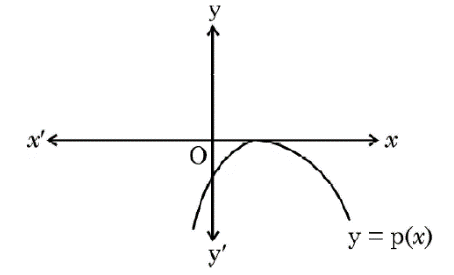
$\therefore$ Zeroes are $1, -\frac{1}{6}$
New zeroes are $3, -\frac{1}{2}$
Sum of new zeroes = $3 + (-\frac{1}{2}) = \frac{5}{2}$
Product of new zeroes = $3 \times (-\frac{1}{2}) = -\frac{3}{2}$
$\therefore$ Required polynomial is $x^2 - \frac{5}{2}x - \frac{3}{2}$ or $2x^2 - 5x - 3$
1163 Marks · March 2025 · Standardopen ↗
Find the zeroes of the polynomial $p(x) = 3x^2 - 4x - 4$. Hence, write a polynomial whose each of the zeroes is 2 more than zeroes of $p(x)$.
Show SolutionHide Solution
$p(x) = 3x^2 - 4x - 4$.
Zeroes are $-\frac{2}{3}$ and 2 (1 mark).
New zeroes are $\frac{4}{3}$ and 4 ($\frac{1}{2}$ mark).
Sum of new zeroes = $\frac{4}{3} + 4 = \frac{16}{3}$ ($\frac{1}{2}$ mark).
Product of new zeroes = $\frac{4}{3} \times 4 = \frac{16}{3}$ ($\frac{1}{2}$ mark).
Required polynomial is $x^2 - \frac{16x}{3} + \frac{16}{3}$ or $3x^2 - 16x + 16$ ($\frac{1}{2}$ mark).
1173 Marks · March 2025 · Standardopen ↗
Find the zeroes of the polynomial $q(x) = 8x^2 - 2x - 3$. Hence, find a polynomial whose zeroes are $2$ less than the zeroes of $q(x)$.
Show SolutionHide Solution
$p(x) = 8x^2 - 2x - 3$.
Zeroes are $-\frac{1}{2}$ and $\frac{3}{4}$.
New zeroes are $-\frac{5}{2}$ and $-\frac{5}{4}$.
Sum of new zeroes = $-\frac{5}{2} + (-\frac{5}{4}) = -\frac{15}{4}$.
Product of new zeroes = $(-\frac{5}{2}) \times (-\frac{5}{4}) = \frac{25}{8}$.
Required polynomial is $x^2 + \frac{15}{4}x + \frac{25}{8}$ or $8x^2 + 30x + 25$.
1183 Marks · March 2025 · Standardopen ↗
Find the zeroes of the polynomial $r(x) = 4x^2 + 3x - 1$. Hence, write a polynomial whose zeroes are reciprocal of the zeroes of polynomial $r(x)$.
Show SolutionHide Solution
$p(x) = 4x^2 + 3x - 1$. Zeroes are $\frac{1}{4}, -1$.
New zeroes $4, -1$.
Sum of new zeroes $= 4 + (-1) = 3$.
Product of zeroes $= 4 \times (-1) = -4$.
Required polynomial is $(x^2 - 3x - 4)$
1193 Marks · March 2026 · Standardopen ↗
Find the value of $p$, for which one zero of the quadratic polynomial $px^2-14x + 8$ is $6$ times the other.
Show SolutionHide Solution
Let the zeroes be $\alpha$ and $6\alpha$
Sum of zeroes $= \alpha + 6\alpha = \frac{14}{p}$ (1/2 Mark)
⇒ 7α = $\frac{14}{p}$ ⇒ α = $\frac{2}{p}$ (1/2 Mark)
Product of zeroes $= \alpha \times 6\alpha = $8/p (1/2 Mark)
⇒ 6(2/p)² = 8/p (1/2 Mark)
⇒ p = 3 (1 Mark)
1203 Marks · March 2025 · Basicopen ↗
Find the zeroes of the polynomial $p(x) = 3x^2 - 2x - 1$ and verify the relationship between the zeroes of $p(x)$ and the coefficients of $p(x)$.
Show SolutionHide Solution
$p(x) = 3x^2 - 2x - 1$
$= (3x + 1)(x - 1)$
Zeroes are $x = -\frac{1}{3}, 1$ [1 mark]
$\text{Sum of zeroes} = -\frac{1}{3} + 1 = \frac{2}{3} = \frac{-\text{coefficient of } x}{\text{coefficient of } x^2}$ [1 mark]
$\text{Product of zeroes} = -\frac{1}{3} \times 1 = \frac{-1}{3} = \frac{\text{constant term}}{\text{coefficient of } x^2}$ [1 mark]
1213 Marks · March 2025 · Basicopen ↗
Find the zeroes of the polynomial $p(x) = 2x^2 + 5x + 2$ and verify the relationship between zeroes of $p(x)$ and its coefficients.
Show SolutionHide Solution
$p(x) = 2x^2 + 5x + 2 = (2x + 1)(x + 2)$
Zeroes are $-\frac{1}{2}, -2$
Sum of zeroes $= -\frac{1}{2} + (-2) = -\frac{5}{2} = \frac{-\text{coefficient of } x}{\text{coefficient of } x^2}$
Product of zeroes $= -\frac{1}{2} \times (-2) = \frac{2}{2} = \frac{\text{constant term}}{\text{coefficient of } x^2}$
1223 Marks · March 2025 · Basicopen ↗
Find the zeroes of the polynomial $q(x) = 6x^2 - 5x - 1$ and verify the relationship between the zeroes of $q(x)$ and its coefficients.
Show SolutionHide Solution
$q(x) = 6x^2 - 5x - 1$
$(6x + 1) (x - 1) = 0$
Zeroes are $x = -\frac{1}{6}, 1$ [1 mark]
Sum of zeroes $= -\frac{1}{6} + 1 = \frac{5}{6} = \frac{- \text{Coefficient of } x}{\text{Coefficient of } x^2}$ [1 mark]
Product of zeroes $= -\frac{1}{6} \times 1 = -\frac{1}{6} = \frac{\text{Constant term}}{\text{Coefficient of } x^2}$ [1 mark]
1233 Marks · March 2025 · Basicopen ↗
Find the zeroes of the polynomial $9s^2 - 6s + 1$ and verify the relationship between the zeroes and the coefficients of the given polynomial.
Show SolutionHide Solution
$9s^2 - 6s + 1 = (3s - 1)(3s - 1)$.
Zeroes are $\frac{1}{3}$ and $\frac{1}{3}$.
Sum of zeroes $= \frac{1}{3} + \frac{1}{3} = \frac{2}{3} = \frac{-(-6)}{9} = \frac{-\text{Coefficient of } s}{\text{Coefficient of } s^2}$.
Product of zeroes $= \frac{1}{3} \times \frac{1}{3} = \frac{1}{9} = \frac{\text{Constant term}}{\text{Coefficient of } s^2}$. ($1 + 1 + 1$ marks)
1243 Marks · March 2025 · Basicopen ↗
Find the zeroes of the polynomial $4x^2 + 4x + 1$ and verify the relationship between the zeroes and the coefficients of the given polynomial.
Show SolutionHide Solution
$4x^2 + 4x + 1$
$(2x + 1)(2x + 1)$
Zeroes are $-\frac{1}{2}$ and $-\frac{1}{2}$ [$1$ mark]
Sum of zeroes $= -\frac{1}{2} + (-\frac{1}{2}) = -1 = \frac{-4}{4} = \frac{-\text{Coefficient of } x}{\text{Coefficient of } x^2}$ [$1$ mark]
Product of zeroes $= -\frac{1}{2} \times -\frac{1}{2} = \frac{1}{4} = \frac{\text{constant term}}{\text{Coefficient of } x^2}$ [$1$ mark]
1253 Marks · March 2025 · Basicopen ↗
Find the zeroes of the polynomial $25a^2 - 10a + 1$ and verify the relationship between the zeroes and coefficients of the given polynomial.
Show SolutionHide Solution
$25a^2 - 10a + 1 = (5a - 1) (5a - 1)$
Zeroes are $\frac{1}{5}$ and $\frac{1}{5}$
Sum of zeroes $= \frac{1}{5} + \frac{1}{5} = \frac{2}{5} = \frac{-(-10)}{25} = \frac{-\text{Coefficient of } a}{\text{Coefficient of } a^2}$
Product of zeroes $= \frac{1}{5} \times \frac{1}{5} = \frac{1}{25} = \frac{\text{Constant term}}{\text{Coefficient of } a^2}$
1263 Marks · March 2025 · Basicopen ↗
Find the zeroes of the polynomial $p(x) = 6x^2 + 13x - 5$ and verify the relationship between its zeroes and the coefficients.
Show SolutionHide Solution
$p(x) = 6x^2 + 13x - 5 = (3x - 1)(2x + 5)$
Zeroes of $p(x)$ are $\frac{1}{3}, -\frac{5}{2}$ [1 mark]
Sum of zeroes $= \frac{1}{3} - \frac{5}{2} = \frac{-13}{6} = \frac{-\text{coefficient of } x}{\text{coefficient of } x^2}$ [1 mark]
Product of zeroes $= \frac{1}{3} \times \frac{-5}{2} = \frac{-5}{6} = \frac{\text{constant term}}{\text{coefficient of } x^2}$ [1 mark]
1273 Marks · March 2025 · Basicopen ↗
Find the zeroes of the polynomial $p(x) = 4x^2 - 4x - 3$ and verify the relationship between zeroes and its coefficients.
Show SolutionHide Solution
$p(x) = 4x^2 - 4x - 3 = (2x + 1) (2x - 3)$
$\therefore$ zeroes of $p(x)$ are $-\frac{1}{2}$ and $\frac{3}{2}$ [$1$ mark]
Sum of zeroes $= -\frac{1}{2} + \frac{3}{2} = 1 = \frac{-(-4)}{4} = \frac{-\text{coefficient of } x}{\text{coefficient of } x^2}$ [$1$ mark]
Product of zeroes $= -\frac{1}{2} \times \frac{3}{2} = -\frac{3}{4} = \frac{\text{constant}}{\text{coefficient of } x^2}$ [$1$ mark]
1283 Marks · March 2025 · Basicopen ↗
Find the zeroes of the polynomial $p(x) = 9x^2 - 6x - 35$ and verify the relationship between zeroes and its coefficients.
Show SolutionHide Solution
$p(x) = 9x^2 - 6x - 35 = (3x - 7) (3x + 5)$
Zeroes of $p(x)$ are $\frac{7}{3}$ and $\frac{-5}{3}$
Sum of zeroes $= \frac{7}{3} - \frac{5}{3} = \frac{2}{3} = \frac{-(-6)}{9} = \frac{-\text{coefficient of } x}{\text{coefficient of } x^2}$
Product of zeroes $= \frac{7}{3} \times \frac{-5}{3} = \frac{-35}{9} = \frac{\text{constant term}}{\text{coefficient of } x^2}$
1293 Marks · March 2025 · Basicopen ↗
If $\alpha, \beta$ are zeroes of the polynomial $3x^2 - 8x + 4$, then form a quadratic polynomial in $x$ whose zeroes are $\frac{1}{\alpha}$ and $\frac{1}{\beta}$.
Show SolutionHide Solution
(a) $p(x) = 3x^2 - 8x + 4$
$\alpha + \beta = \frac{8}{3}, \alpha\beta = \frac{4}{3}$
$\therefore \frac{1}{\alpha} + \frac{1}{\beta} = \frac{\alpha + \beta}{\alpha\beta} = 2$ and $\frac{1}{\alpha\beta} = \frac{3}{4}$
$\therefore$ required polynomial is $x^2 - 2x + \frac{3}{4}$ or $k(4x^2 - 8x + 3)$, where $k$ is a non-zero real number.
1303 Marks · March 2025 · Basicopen ↗
Find zeroes of the polynomial $6x^2 - 7x - 3$ and verify the relationship between zeroes and its coefficients.
Show SolutionHide Solution
$p(x) = 6x^2 - 7x - 3 = (2x - 3)(3x + 1)$
Zeroes of $p(x)$ are $\frac{3}{2}$ and $-\frac{1}{3}$
Sum of zeroes $= \frac{3}{2} - \frac{1}{3} = \frac{7}{6} = -\frac{\text{coefficient of } x}{\text{coefficient of } x^2}$
Product of zeroes $= \frac{3}{2} \times \frac{-1}{3} = \frac{-3}{6} = \frac{\text{constant term}}{\text{coefficient of } x^2}$
1313 Marks · March 2025 · Basicopen ↗
If $\alpha, \beta$ are zeroes of the polynomial $8x^2 - 5x - 1$, then form a quadratic polynomial in $x$ whose zeroes are $\frac{2}{\alpha}$ and $\frac{2}{\beta}$.
Show SolutionHide Solution
$p(x) = 8x^2 - 5x - 1$
$\alpha + \beta = \frac{5}{8}, \alpha\beta = \frac{-1}{8}$ ($\frac{1}{2} + \frac{1}{2}$ marks)
$\therefore \text{sum of zeroes} = \frac{2}{\alpha} + \frac{2}{\beta} = -10$ ($\frac{1}{2}$ mark)
$\text{and product of zeroes} = \frac{2}{\alpha} \times \frac{2}{\beta} = -32$ ($\frac{1}{2}$ mark)
$\text{Required polynomial} = x^2 + 10x - 32$ (1 mark)
1323 Marks · March 2025 · Basicopen ↗
Find the zeroes of the polynomial $p(x) = 3x^2 + x - 10$ and verify the relationship between zeroes and its coefficients.
Show SolutionHide Solution
$p(x) = 3x^2 + x - 10 = (x + 2)(3x - 5)$
$\text{Zeroes of } p(x) \text{ are } -2 \text{ and } \frac{5}{3}$ (1 mark)
$\text{Sum of zeroes} = -2 + \frac{5}{3} = \frac{-1}{3} = -\frac{\text{coefficient of } x}{\text{coefficient of } x^2}$ (1 mark)
$\text{Product of zeroes} = -2 \times \frac{5}{3} = \frac{-10}{3} = \frac{\text{constant term}}{\text{coefficient of } x^2}$ (1 mark)
1333 Marks · March 2025 · Basicopen ↗
$\alpha, \beta$ are zeroes of the polynomial $3x^2 - 8x + k$. Find the value of $k$, if $\alpha^2 + \beta^2 = \frac{40}{9}$.
Show SolutionHide Solution
$p(x) = 3x^2 - 8x + k \Rightarrow \alpha + \beta = \frac{8}{3}, \alpha\beta = \frac{k}{3}$
$\alpha^2 + \beta^2 = \frac{40}{9} \Rightarrow (\frac{8}{3})^2 - \frac{2k}{3} = \frac{40}{9} \Rightarrow k = 4$
1343 Marks · March 2025 · Basicopen ↗
Find the zeroes of the polynomial $2x^2 + 7x + 5$ and verify the relationship between its zeroes and co-efficients.
Show SolutionHide Solution
$p(x) = 2x^2 + 7x + 5 = (x + 1)(2x + 5)$
Zeroes of $p(x)$ are $-1$ and $-\frac{5}{2}$
Sum of zeroes $= -1 - \frac{5}{2} = -\frac{7}{2} = -\frac{\text{coefficient of } x}{\text{coefficient of } x^2}$
Product of zeroes $= (-1)(-\frac{5}{2}) = \frac{5}{2} = \frac{\text{constant term}}{\text{coefficient of } x^2}$
1353 Marks · March 2026 · Basicopen ↗
Find the zeroes of the polynomial $p(x) = 3x^2 + 7x - 20$ and verify the relationship between its zeroes and the coefficients.
Show SolutionHide Solution
$p(x) = 3x^2 + 7x - 20 = 3x^2 + 12x - 5x - 20 = 3x(x+4) - 5(x+4) = (3x-5)(x+4)$ (1 Mark)
Zeroes are $-4, \frac{5}{3}$ (1 Mark)
Sum of the zeroes = $-4 + \frac{5}{3} = \frac{-12+5}{3} = -\frac{7}{3} = -\frac{\text{coefficient of } x}{\text{coefficient of } x^2}$ (1 Mark)
Product of zeroes = $-4 \times \frac{5}{3} = -\frac{20}{3} = \frac{\text{constant term}}{\text{coefficient of } x^2}$ (1 Mark)
1363 Marks · March 2026 · Basicopen ↗
Find the zeroes of the polynomial $p(x) = 4x^2 - 8x + 3$ and verify the relationship between its zeroes and co-efficients.
Show SolutionHide Solution
$p(x) = 4x^2 - 8x + 3$
Zeroes of $p(x)$ are $\frac{3}{2}, \frac{1}{2}$ (1 Mark)
Sum of zeroes = $\frac{3}{2} + \frac{1}{2} = 2 = -(\frac{-8}{4}) = -\frac{\text{coefficient of } x}{\text{coefficient of } x^2}$ (1 Mark)
Product of zeroes = $\frac{3}{2} \times \frac{1}{2} = \frac{3}{4} = \frac{\text{coefficient of } x^0}{\text{coefficient of } x^2}$ (1 Mark)

Making polynomials from zeroes

1 Mark Questions
1371 Mark · March 2023 · Standardopen ↗
Which of the following is a quadratic polynomial having zeroes $-\frac{2}{3}$ and $\frac{2}{3}$ ?
  • (a)$4x^2-9$
  • (b)$\frac{4}{9}(9x^2+4)$
  • (c)$x^2 + \frac{9}{4}$
  • (d)$5(9x^2-4)$
Show SolutionHide Solution
(D) $5 (9x^2 – 4)$
1381 Mark · March 2023 · Standardopen ↗
Which of the following is a quadratic polynomial with zeroes $\frac{5}{3}$ and 0?
  • (a)$3x (3x-5)$
  • (b)$3x (x - 5)$
  • (c)$x^2-\frac{5}{3}$
  • (d)$\frac{5}{3} x^2$
Show SolutionHide Solution
(A) $3x (3x - 5)$
1391 Mark · March 2023 · Standardopen ↗
The number of polynomials having zeroes $-3$ and $5$ is :
  • (a)only one
  • (b)Infinite
  • (c)exactly two
  • (d)at most two
Show SolutionHide Solution
(b) Infinite
1401 Mark · March 2023 · Standardopen ↗
The number of polynomials having zeroes $-1$ and $2$ is :
  • (a)exactly $2$
  • (b)only $1$
  • (c)at most $2$
  • (d)infinite
Show SolutionHide Solution
(d) infinite
1411 Mark · March 2023 · Standardopen ↗
The number of quadratic polynomials having zeroes $-5$ and $-3$ is
  • (a)1
  • (b)2
  • (c)3
  • (d)more than 3
Show SolutionHide Solution
(D)more than 3
1421 Mark · March 2024 · Standardopen ↗
A quadratic polynomial, one of whose zeroes is $2 + \sqrt{5}$ and the sum of whose zeroes is $4$, is:
  • (a)$x^2 + 4x-1$
  • (b)$x^2 - 4x - 1$
  • (c)$x^2 - 4x + 1$
  • (d)$x^2 + 4x + 1$
Show SolutionHide Solution
(B) $x^2 - 4x - 1$
1431 Mark · July 2025 · Standardopen ↗
A quadratic polynomial whose one zero is $3$ and the product of zeroes is $0$, is :
  • (a)$x^2-3$
  • (b)$x^2-9$
  • (c)$x^2 + 3x$
  • (d)$x^2 - 3x$
Show SolutionHide Solution
(D) $x^2 - 3x$
1441 Mark · March 2026 · Standardopen ↗
The sum and product of zeroes of a quadratic polynomial $p(x)$ are $-\frac{1}{3}$ and $2$ respectively. The polynomial $p(x)$ is :
  • (a)$3x^2 - x + 6$
  • (b)$x^2 + \frac{1}{3}x - 2$
  • (c)$3x^2 - x + 2$
  • (d)$-3x^2 - x - 6$
Show SolutionHide Solution
(D) $-3x^2 - x - 6$
1451 Mark · March 2026 · Standardopen ↗
If the zeroes of a polynomial $p(x)$ are $-3$ and $8$, then $p(x)$ equals
  • (a)$x^2+5x-4$
  • (b)$(x + 3)(-x+8)$
  • (c)$a(x^2+5x-24)$
  • (d)$x^2-24$
Show SolutionHide Solution
(B) $(x + 3)(-x + 8)$ (1 Mark)
1461 Mark · March 2026 · Standardopen ↗
If sum and product of zeroes of a polynomial are $(-3)$ and $(-2)$ respectively, then a polynomial is
  • (a)$x^2 - 3x - 2$
  • (b)$-x^2 - 3x + 2$
  • (c)$x^2 + 3x - 2$
  • (d)$x^2 + 3x + 2$
Show SolutionHide Solution
(B) $-x^2 - 3x + 2$
1471 Mark · March 2025 · Basicopen ↗
A quadratic polynomial having only zero $(-2)$ is
  • (a)$(x - 2)^2$
  • (b)$x^2 - 2$
  • (c)$x^2 + 2x$
  • (d)$(x + 2)^2$
Show SolutionHide Solution
(D) $(x + 2)^2$
1481 Mark · March 2025 · Basicopen ↗
A quadratic polynomial having zeroes $0$ and $-2$, is
  • (a)$x(x - 2)$
  • (b)$4x(x + 2)$
  • (c)$x^2 + 2$
  • (d)$2x^2 + 2x$
Show SolutionHide Solution
(B) $4x(x + 2)$
1491 Mark · March 2025 · Basicopen ↗
A quadratic polynomial, the sum and product of whose zeroes are $-1$ and $-2$ respectively, is
  • (a)$x^2 - x - 2$
  • (b)$2x^2 + x - 1$
  • (c)$x^2 + x - 2$
  • (d)$\frac{1}{2}x^2 + x - 4$
Show SolutionHide Solution
(C) $x^2 + x - 2$
2 Marks Questions
1502 Marks · March 2025 · Standardopen ↗
Find a quadratic polynomial whose zeroes are $2$ and $-\frac{7}{5}$
Show SolutionHide Solution
Sum of zeroes $= 2 + \left(-\frac{7}{5}\right) = \frac{3}{5}$ ($1/2$ mark)
Product of zeroes $= 2 \times \left(-\frac{7}{5}\right) = -\frac{14}{5}$ ($1/2$ mark)
$\therefore$ Required quadratic polynomial is $x^2 - \frac{3}{5}x - \frac{14}{5}$ or $5x^2 - 3x - 14$ ($1$ mark)
1512 Marks · March 2026 · Standardopen ↗
Find a quadratic polynomial whose zeroes are $(5-2\sqrt{3})$ and $(5+2\sqrt{3})$.
Show SolutionHide Solution
Let $\alpha$ and $\beta$ be the zeroes of the required polynomial.
$\alpha = 5 - 2\sqrt{3}, \beta = 5 + 2\sqrt{3}$
$\alpha + \beta = 10$ (I) (1/2 Mark)
$\alpha\beta = 13$ (II) (1/2 Mark)
$\therefore$ The quadratic polynomial is $x^2 - 10x + 13$ (III) (1 Mark)
1522 Marks · March 2026 · Standardopen ↗
Find the quadratic polynomial the sum of whose zeroes is $1$ and their product is $-12$. Hence find the zeroes of the polynomial.
Show SolutionHide Solution
Sum of zeroes = $1$, Product of zeroes = $-12$ ($\frac{1}{2}$ Mark)
Required polynomial = $(x^2 - x - 12)$ (1 Mark)
$= (x - 4)(x + 3)$ ($\frac{1}{2}$ Mark)
Equating to zero, $x = 4, -3$
$\therefore$ Zeroes are $4$ and $-3$ ($\frac{1}{2}$ Mark)
1532 Marks · March 2026 · Basicopen ↗
One zero of a quadratic polynomial is twice the other. If the sum of zeroes is (-6), find the polynomial.
Show SolutionHide Solution
Let the zeroes be $\alpha, 2\alpha$
$\alpha + 2\alpha = -6$ gives $\alpha = -2$ (1/2 Mark)
Polynomial is $x^2 + 6x + 8$ (1 Mark)
1542 Marks · March 2026 · Basicopen ↗
Form a quadratic polynomial whose zeroes are twice the zeroes of polynomial $p(x) = x^2 - 3x - 5$.
Show SolutionHide Solution
Let $\alpha$ and $\beta$ be zeroes of $p(x)$
then $\alpha + \beta = 3$ and $\alpha\beta = -5$ (1)
Zeroes of required polynomial are $2\alpha$ and $2\beta$
$2\alpha + 2\beta = 6$ and $4\alpha\beta = -20$ (½)
$\therefore$ Required polynomial is $x^2 - 6x - 20$ or $k(x^2 - 6x - 20)$ (½)
1552 Marks · March 2026 · Basicopen ↗
Form a quadratic polynomial whose sum and product of the zeroes are $\frac{1}{2}$ and $-\frac{1}{2}$ respectively. Hence, find the zeroes of the polynomial.
Show SolutionHide Solution
Required polynomial is $k(x^2 - \frac{1}{2}x - \frac{1}{2})$ or $18x^2 - 9x - 2$ (1 Mark)
Zeroes of the polynomial are $-\frac{1}{6}$ and $\frac{2}{3}$ (1 Mark)
3 Marks Questions
1563 Marks · March 2024 · Standardopen ↗
Find a quadratic polynomial whose sum of the zeroes is $8$ and difference of the zeroes is $2$.
Show SolutionHide Solution
Let the zeroes be $\alpha$ and $\beta$
$\therefore \alpha + \beta = 8$ and $\alpha - \beta = 2$
Solving above two equations, we get $\alpha = 5$ and $\beta = 3$
So, the quadratic polynomial is $x^2 - 8x + 15$
1573 Marks · March 2025 · Basicopen ↗
Find a quadratic polynomial whose sum and product of zeroes are $0$ and $- 9$, respectively. Also, find the zeroes of the polynomial so obtained.
Show SolutionHide Solution
Polynomial is $x^2 - 0 (x) + (- 9) = x^2 - 9$
For zeroes :
$x^2 - 9 = (x + 3) (x - 3)$
Zeroes are $- 3, 3$
1583 Marks · March 2025 · Basicopen ↗
Find a quadratic polynomial, sum and product of whose zeroes are 5 and $- 6$, respectively. Also, find the zeroes of the polynomial so obtained.
Show SolutionHide Solution
Required polynomial is $x^2 - 5x - 6$
For zeroes; $x^2 - 5x - 6 = (x - 6) (x + 1)$
Zeroes are $x = 6, - 1$
1593 Marks · March 2025 · Basicopen ↗
Determine a quadratic polynomial, sum and product of whose zeroes are $-10$ and $24$, respectively. Also, determine the zeroes of the polynomial so obtained.
Show SolutionHide Solution
Required polynomial is $x^2 + 10x + 24$
For zeroes: $x^2 + 10x + 24 = (x + 6) (x + 4)$
Zeroes are $-6, -4$
1603 Marks · March 2026 · Basicopen ↗
If $\alpha, \beta$ are zeroes of the polynomial $p(x) = 5x^2 - 7x - 3$, then form a quadratic polynomial whose zeroes are $\frac{2}{\alpha}$ and $\frac{2}{\beta}$.
Show SolutionHide Solution
$\alpha + \beta = -\frac{(-7)}{5} = \frac{7}{5}$, $\alpha\beta = \frac{-3}{5}$ (½ + ½ Mark)
Sum of zeroes of required polynomial = $\frac{2}{\alpha} + \frac{2}{\beta} = \frac{2(\alpha + \beta)}{\alpha\beta} = \frac{2(\frac{7}{5})}{-\frac{3}{5}} = -\frac{14}{3}$ (½ Mark)
Product of zeroes of the required polynomial = $\frac{2}{\alpha} \times \frac{2}{\beta} = \frac{4}{\alpha\beta} = \frac{4}{-\frac{3}{5}} = -\frac{20}{3}$ (½ Mark)
Required polynomial is $k(x^2 - (\text{sum of zeroes})x + \text{product of zeroes})$
$x^2 - (-\frac{14}{3})x + (-\frac{20}{3}) = x^2 + \frac{14}{3}x - \frac{20}{3}$ or $k(3x^2 + 14x - 20)$ where $k$ is any non-zero real number. (1 Mark)
1613 Marks · March 2026 · Basicopen ↗
Form a polynomial whose zeroes are $\alpha^2$ and $\beta^2$, where $\alpha$ and $\beta$ are zeroes of the polynomial $p(x) = x^2-3\sqrt{2}x+4$.
Show SolutionHide Solution
$\alpha+\beta= 3\sqrt{2}$, $\alpha\beta = 4$ (1/2+1/2 Mark)
α² + β² = (α + β)² - 2αβ = 10 (1 Mark)
α² β² = 4² = 16 (1/2 Mark)
Required polynomial is $x^2 - 10x + 16$ or $k(x^2 - 10x + 16)$ where $k$ is a non zero real number. (1/2 Mark)

Real life application

4 Marks Questions
1624 Marks · July 2023 · Standardopen ↗
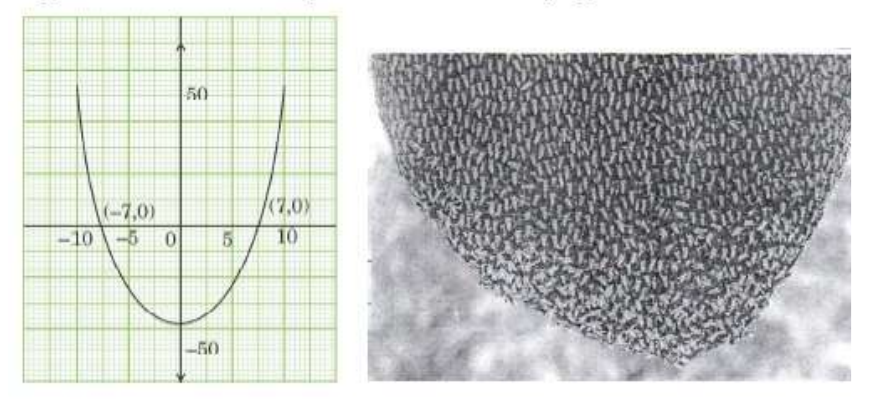
While playing in a garden, Samaira saw a honeycomb and asked her mother what is that. Her mother replied that it's a honeycomb made by honey bees to store honey. Also, she told her that the shape of the honeycomb formed is a mathematical structure. The mathematical representation of the honeycomb is shown in the graph.
Based on the above information, answer the following questions :
(i) How many zeroes are there for the polynomial represented by the graph given ?
(ii) Write the zeroes of the polynomial.
(iii) (a) If the zeroes of a polynomial $x^2 + (a + 1) x + b$ are $2$ and $-3$, then determine the values of $a$ and $b$.
OR
(iii) (b) If the square of difference of the zeroes of the polynomial $x^2 + px + 45$ is $144$, then find the value of $p$.
figure for this question
Show SolutionHide Solution
(i) Two
(ii) $7$ and $-7$
(iii) (a) $-(a + 1) = 2 + (-3) \Rightarrow a = 0$
$b = 2 \times (-3) \Rightarrow b = -6$
OR
(b) Let $\alpha$ and $\beta$ be the zeroes of given polynomial
Here, $\alpha + \beta = -p$ and $\alpha \beta = 45$
$(\alpha - \beta)^2 = 144$
$\Rightarrow (\alpha + \beta)^2 - 4\alpha\beta = 144$
$\Rightarrow (-p)^2 - 4 \times 45 = 144$
$\Rightarrow p = \pm 18$
1634 Marks · March 2024 · Standardopen ↗
A ball is thrown in the air so that $t$ seconds after it is thrown, its height $h$ metre above its starting point is given by the polynomial $h = 25t - 5t^2$.
Observe the graph of the polynomial and answer the following questions :
(i) Write zeroes of the given polynomial.
(ii) Find the maximum height achieved by ball.
(iii) (a) After throwing upward, how much time did the ball take to reach to the height of $30$ m?
OR
(iii) (b) Find the two different values of $t$ when the height of the ball was $20$ m.
figure for this question
Show SolutionHide Solution
(i) Zeroes of the polynomial are $0$ and $5$
(ii) Maximum height achieved by ball
$= 25 \times \frac{5}{2} - 5 \times (\frac{5}{2})^2$
$= \frac{125}{4}$ or $31.25$ m
(iii) (a) $-5t^2 + 25t = 30$
$\Rightarrow t^2 - 5t + 6 = 0$
$\Rightarrow (t-2)(t-3) = 0$
$t \ne 3$, $t = 2$
OR
(iii) (b) $-5t^2 + 25t = 20$
$\Rightarrow t^2 - 5t + 4 = 0$
$\Rightarrow (t - 4)(t - 1) = 0$
$\Rightarrow t = 4, 1$
1644 Marks · March 2026 · Standardopen ↗
During a theatre drama, a backdrop of building arches was used. The
nshape of the curve shown below can be represented by the polynomial
n$p(x) = -x^2 + 2x + 8$, where $x$ is the length (in feet) on stage level.
n(i) Determine the height of the arch.
n(ii) (a) Find zeroes of the polynomial $p(x)$. Which points on the
ngraph represent the zeroes?
nOR
n(ii) (b) Find the span of the arch on the stage floor.
n(iii) Write the coordinates of the point of intersection of the above curve
nwith the $y$-axis.
figure for this question
Show SolutionHide Solution
(i) $p (1) = - (1)^2 + 2 \times 1 + 8 = 9$ (1 Mark)
So, height of the arch is $9$ feet.
(ii) (a) $p(x) = -x^2 + 2x + 8$
$= - (x-4)(x + 2)$ (1 Mark)
$\therefore$ zeroes are $-2$ and $4$. (1/2 Mark)
Points $B$ and $A$ on the graph represent the zeroes. (1/2 Mark)
OR
(ii) (b) $p(x) = -x^2 + 2x + 8$
$= - (x - 4)(x + 2)$ (1/2 Mark)
$\therefore$ zeroes are $-2$ and $4$. (1/2 Mark)
Hence, Coordinates of point $A$ and $B$ are $(4, 0)$ and $(-2, 0)$ respectively.
Span of the arch on the stage floor, $AB = 4 + 2 = 6$ (1 Mark)
So, span of the arch on the stage floor is $6$ feet.
(iii) $p (0) = - (0)^2 + 2 \times 0 + 8 = 8$ (1/2 Mark)
$\therefore$ the given curve intersects $y$-axis at $(0, 8)$ (1/2 Mark)
1654 Marks · March 2026 · Standardopen ↗
This section (Q. 36 to 38) has 3 case study based questions of 4 marks each.
An arch of a railway bridge, built on Chenab riverbed, is shown in the above diagram. It is a parabolic arch connecting two hills at P and Q. If the parabolic curve is represented by the polynomial $p(x) = -0.0025x^2 - 0.025x + 136$.
Observe the diagram and based on above information, answer the following questions :
(i) Write the co-ordinates of point A.
(ii) Find the span of the arch.
(iii) (a) Write the zeroes of the polynomial using diagram and verify the relationship between sum of zeroes and polynomials.
OR
(iii) (b) Find the values of $p(x)$ at $x = 100$ and $x = -100$. Are they same?
figure for this question
Show SolutionHide Solution
(i) At $x = 0, p(x) = 136$
$\therefore$ Coordinates of point A = (0,136) (I) (1)
(ii) Span of the arch = $238.5 + 228.5 = 467$ units (I) (1)
(iii) (a) Zeroes of the polynomial are 228.5 and – 238.5 (I) (1)
Sum of zeroes = $-10 = \frac{-0.025}{-0.0025} = -\frac{\text{coefficient of x}}{\text{coefficient of x}^2}$ (II) (1)
OR
(iii) (b) $p(100) = 108.5$ (I) (1)
$p(-100) = 113.5$ (II) (1/2)
$\therefore p(100) \neq p(-100)$ (III) (1/2)
1664 Marks · March 2026 · Standardopen ↗
An arch of a railway bridge, built on Chenab riverbed, is shown in the above diagram. It is a parabolic arch connecting two hills at P and Q. If the parabolic curve is represented by the polynomial $p(x) = -0.0025x^2 - 0.025x + 136$.
Observe the diagram and based on above information, answer the following questions :
(i) Write the co-ordinates of point A.
(ii) Find the span of the arch.
(iii) (a) Write the zeroes of the polynomial using diagram and verify the relationship between sum of zeroes and polynomials.
OR
(iii) (b) Find the values of $p(x)$ at $x = 100$ and $x = -100$. Are they same?
figure for this question
Show SolutionHide Solution
(i) At $x = 0, p(x) = 136$
Coordinates of point A = $(0,136)$ (I Mark)
(ii) Span of the arch = $238.5 + 228.5 = 467$ units (I Mark)
(iii) (a) Zeroes of the polynomial are $228.5$ and $-238.5$ (I Mark)
Sum of zeroes = $-10 = \frac{-0.025}{-0.0025} = \frac{\text{coefficient of } x}{\text{coefficient of } x^2}$ (II Mark)
OR
(iii) (b) $p(100) = 108.5$ (I Mark)
$p(-100) = 113.5$ (II Mark)
$\therefore p(100) \neq p(-100)$ (III Mark)

General

1 Mark Questions
1671 Mark · March 2023 · Standardopen ↗
Assertion (A): The polynomial $p(x) = x^2 + 3x + 3$ has two real zeroes.
Reason (R): A quadratic polynomial can have at most two real zeroes.
Show SolutionHide Solution
(d) Assertion (A) is false, but Reason (R) is true.